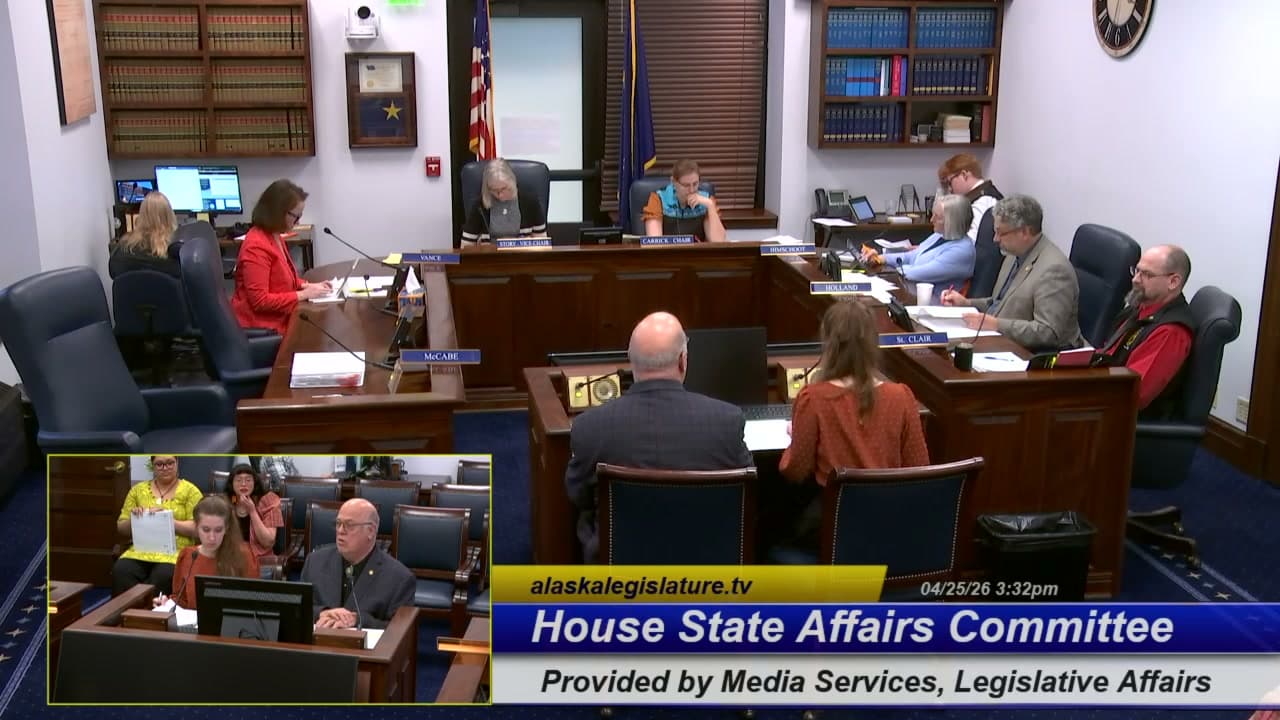
House panel hears bill requiring disclosure of out-of-state campaign funding
The House State Affairs Committee heard legislation Saturday that would require political groups funded mostly by out-of-state donors to clearly identify themselves in campaign communications.
House Bill 371 would mandate that independent expenditure groups receiving a majority of their money from non-residents disclose that funding source in advertisements and other political messages. The bill also would require such groups to maintain a physical Alaska address or appoint an in-state registered agent.
Representative Kevin McCabe, who introduced the measure, said the legislation addresses transparency gaps in Alaska's campaign finance system. Under current law, groups can spend unlimited amounts on political communications without revealing the geographic origin of their funding.
"This is not about limiting speech. It's about ensuring transparency so Alaskans can make informed decisions with full knowledge of who is trying to influence our elections," McCabe said.
The bill emerged from floor amendments McCabe proposed during the previous legislative session that drew broad support but were not adopted. Those amendments addressed what McCabe described as outdated statutes written in 1972, before the internet enabled small-dollar donations from across the country to flow into Alaska campaigns through platforms like Venmo and PayPal.
Alaska's campaign finance laws currently limit non-resident contributions to candidates: $20,000 for gubernatorial races, $5,000 for state senators, and $3,000 for state representatives. Groups and parties face a 10 percent cap on non-resident funding. But independent expenditure groups, which can spend unlimited amounts on communications that do not coordinate with candidates, face no such geographic restrictions.
Committee Chair Ashley Carrick noted that Alaska is viewed as inexpensive to influence compared to larger states. "Alaska, frankly, is seen as a cheap date by some of the outside influencers that are running independent expenditure groups, whether it be the NRA, it could be, you know, the environmentalists," Carrick said. "We live here, it's our state, and I think we need to be the major influencers."
The bill also would create new disclosure requirements for bundled contributions, when individuals pool donations through an intermediary to avoid appearing on public campaign finance reports. Under HB 371, candidates would have to report anyone who aggregates more than $10,000 in contributions during an election cycle.
McCabe said bundling allows donors to hide their identities while still exerting influence. "Maybe I wanted to give to your campaign, but I didn't want my name to be on the APOC list as contributing to your campaign. I could give it to somebody that was bundling together the contributions and then they would contribute it," he said.
Representative Mike Vance said the bill addresses concerns Alaskans expressed when they voted to adopt ranked choice voting in 2020, in part to eliminate dark money. "I have people tell me, I don't feel like it shifted as much as far as the transparency of who's influencing our elections on large scale," Vance said. "These IEs are these kind of ghost contributors that most Alaskans don't know who they are or what they do."
The legislation would update reporting timelines, including enhanced 24-hour disclosure requirements for large contributions and expenditures made close to an election. It also would prohibit the Alaska Public Offices Commission from changing reporting formats during an election cycle.
McCabe said several states have strengthened disclosure laws in recent years, including Texas, California, Arkansas, Nebraska, Louisiana, and Oklahoma. He said the bill was drafted in consultation with Legislative Legal Services to comply with federal court rulings on campaign finance, including the Citizens United decision.
Committee members raised questions about enforcement and whether the Alaska Public Offices Commission has adequate staff to implement the new requirements. McCabe acknowledged that APOC currently lacks resources to examine all campaign finance reports as statute requires, instead reviewing only those that generate complaints.
"I have talked to dozens of people about running for office in various different locations, and virtually to a person they have said, I don't want to deal with APOC, so I'm not going to run," McCabe said.
The committee did not take action on the bill Saturday. Carrick said she intends to schedule additional hearings before the end of the legislative session.
The bill defines an election cycle as the period from when a candidate files for office through the general election, addressing a loophole that allows donors to give maximum contributions on December 31 and again on January 1 under current annual limits.
HB 371 would take effect immediately upon passage and would not apply retroactively to contributions made before the effective date.
This article is based on a public meeting — Alaska Legislature: House State Affairs, 4/25/26, 3:15pm ().
AI-assisted. How we use AI Transcript byLucas Brown
Stay informed. Support what matters.
Free, permanent access to local news you can verify. Subscribe to support Alaska News and go ad-free.
Related Coverage
House panel hears bill to strengthen campaign finance disclosure
Alaska News · 5mo ago
Alaska House passes campaign contribution limits that could take effect during 2026 election
Alaska News · 4mo ago
Two former colleagues split over whether Ballot Measure 1 curbs big money or just reroutes it
Alaska News · 1mo ago
Alaska lawmakers hear testimony on four ballot initiatives
Alaska News · 5mo ago
Pro and Anti Ranked choice campaigns trade billionaire accusations at hearing
Alaska News · 2mo ago
Comments
Sign in to leave a comment.
No comments yet. Be the first to share your thoughts.