House panel hears bill to strengthen campaign finance disclosure
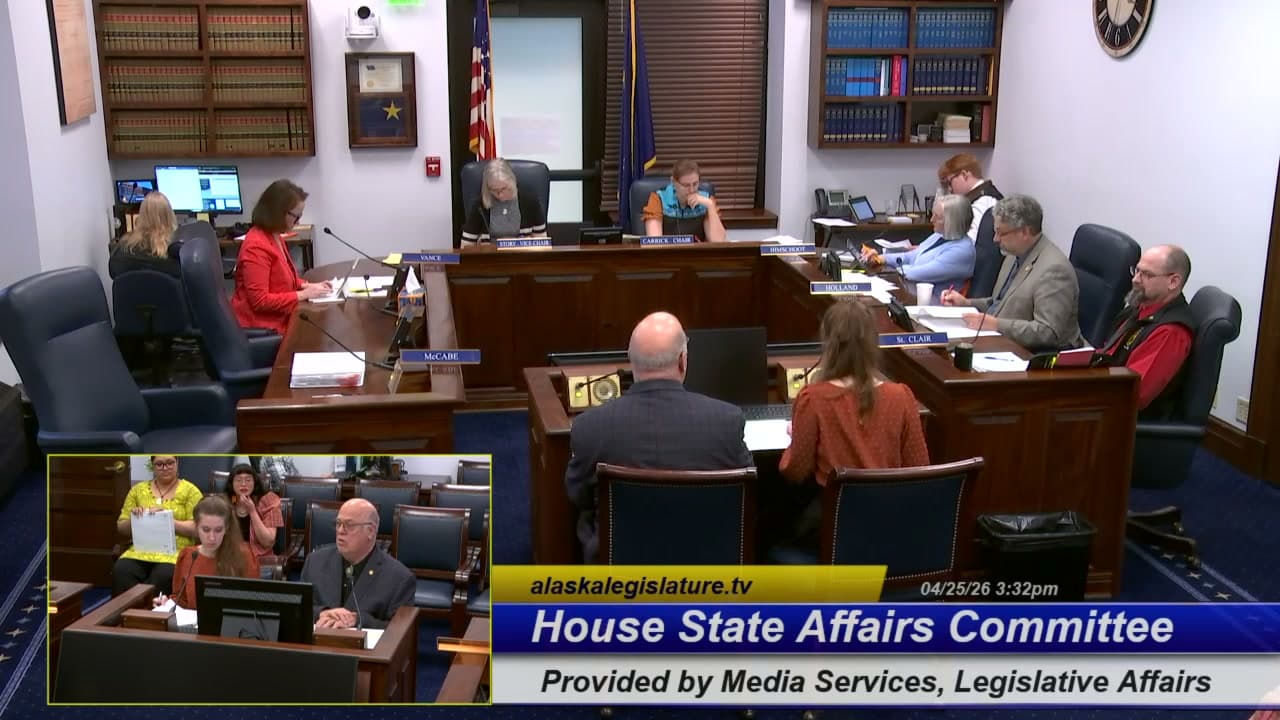
The Alaska House State Affairs Committee held an introductory hearing Saturday on legislation aimed at strengthening disclosure requirements for political contributions, particularly those from outside Alaska.
Representative Kevin McCabe presented House Bill 371, which would require groups making independent expenditures in Alaska elections to maintain a physical presence in the state and disclose when a majority of their funding comes from non-residents. The bill also addresses bundled contributions, where multiple small donations are aggregated and contributed under one name.
"House Bill 371 is about transparency and accountability in Alaska's elections. At its core, this bill ensures that Alaskans know who is funding the political messages they see, especially when that funding is coming from outside our state," McCabe said. "This is not about limiting speech. It is about ensuring transparency so Alaskans can make informed decisions with full knowledge of who is trying to influence our elections."
The legislation comes as the latest effort to update Alaska's campaign finance framework, which has evolved significantly since 1996 when the Legislature banned business and union contributions, capped individual contributions at $500, and restricted out-of-state funding for candidates and groups. The Ninth Circuit struck down those $500 individual contribution limits in 2021 as unconstitutional. The Legislature recently passed House Bill 16 to update campaign finance laws by requiring groups to maintain Alaska addresses, adjusting contribution limits, and enhancing Alaska Public Offices Commission reporting requirements.
While HB 16 addressed group registration and contribution limits, HB 371 goes further by requiring independent expenditure groups to disclose when most of their funding comes from non-residents and by mandating disclosure of bundled contributions exceeding $10,000. The new bill would also update rules for how candidates dispose of campaign assets after elections.
McCabe said HB 371 builds on amendments he offered during floor debate last year that drew broad interest but did not advance. Those amendments focused on updating Alaska's campaign finance laws to address modern fundraising methods including online donations, Venmo, and PayPal. "A good chunk of this law was written in 1972, which is about four years before I remember the first VIC-20 or Commodore 64 computer," McCabe said, noting that many current statutes predate the internet and digital payment systems.
McCabe pointed to persistent concerns about transparency despite existing disclosure requirements. "One of the reasons that ranked choice voting was adopted is it was dark money, of eliminating dark money. Well, we have that and we have had that in place because Alaskans wanted to have more campaign disclosure and we have had it for four years. But I have people tell me, I do not feel like it shifted as much as far as the transparency of who is influencing our elections on large scale," he said.
He described independent expenditure groups as "these kind of ghost contributors that most Alaskans do not know who they are or what they do," adding that the bill tries to address what "has slipped through the cracks and I think that is where a lot of the concern of Alaskans lies is where, where do all, where are all these other flyers and radio ads coming from that we have never heard of?"
The bill would require candidates to report individuals who aggregate more than $10,000 in bundled contributions during an election cycle. It would also mandate that groups or entities making independent expenditures register with the Alaska Public Offices Commission and provide either a physical Alaska address or designate an in-state registered agent.
Groups funded primarily by non-residents would be required to register as "majority non-resident funded entities" and include clear disclosures in their communications stating that most of their contributions came from outside Alaska. Chair Ashley Carrick expressed support for this provision. "We live here, it is our state, and I think we need to be the major influencers," Carrick said.
Committee members raised questions about several provisions, including how to define "reasonably known" when candidates report bundlers, and whether contribution limits should be based on calendar years or election cycles. Representative David Holland noted inconsistencies in the bill's timeframes. "Some you can do, you can double up on, some you cannot double up on," Holland said, referring to the possibility of making maximum contributions on December 31 and again on January 1 under a calendar-year system.
McCabe acknowledged the bill needs refinement. "This bill was put together from about eight different amendments, and there is, it is a first start, it is a first stab at it, and I am sure that it is going to take some amending to get it the way we want it," he said. He noted that many states have strengthened their disclosure laws, including Texas, California, Arkansas, Nebraska, Louisiana, and Oklahoma.
The legislation also updates rules for campaign asset disposition after elections, clarifying that candidates may retain one computer, one printer, bulk mailing permits, photographs, greeting cards, and campaign signs. The provision addresses recent Alaska Public Offices Commission guidance that candidates must declare reused campaign signs as in-kind donations, which McCabe said contradicts existing statute.
Representative Alyse Galvin noted that current law still operates on an election-year basis for contributions, not election cycles, and suggested the committee ensure any changes comply with existing nondiscrimination statutes.
Several committee members expressed support for the bill's goals while noting it would likely require additional work. Carrick acknowledged concerns about APOC reporting burdens. "I have talked to dozens of people about running for office in various different locations, and virtually to a person they have said, I do not want to deal with APOC, so I am not going to run. I do not want the reporting," Carrick said. She said she plans to bring the bill back for further discussion if time allows before the end of the session.
The House State Affairs Committee next meets Tuesday, April 28 at 3:15 p.m.
This article is based on a public meeting — Alaska Legislature: House State Affairs, 4/25/26, 3:15pm ().
AI-assisted. How we use AI Transcript byLucas Brown
Stay informed. Support what matters.
Free, permanent access to local news you can verify. Subscribe to support Alaska News and go ad-free.
Related Coverage
House panel hears bill requiring disclosure of out-of-state campaign funding
Alaska News · 5mo ago
Alaska House passes campaign contribution limits that could take effect during 2026 election
Alaska News · 4mo ago
Alaska lawmakers hear testimony on four ballot initiatives
Alaska News · 5mo ago
Two former colleagues split over whether Ballot Measure 1 curbs big money or just reroutes it
Alaska News · 1mo ago
House passes ethics reform to clarify complaints and strengthen oversight
Alaska News · 4mo ago
Comments
Sign in to leave a comment.
No comments yet. Be the first to share your thoughts.