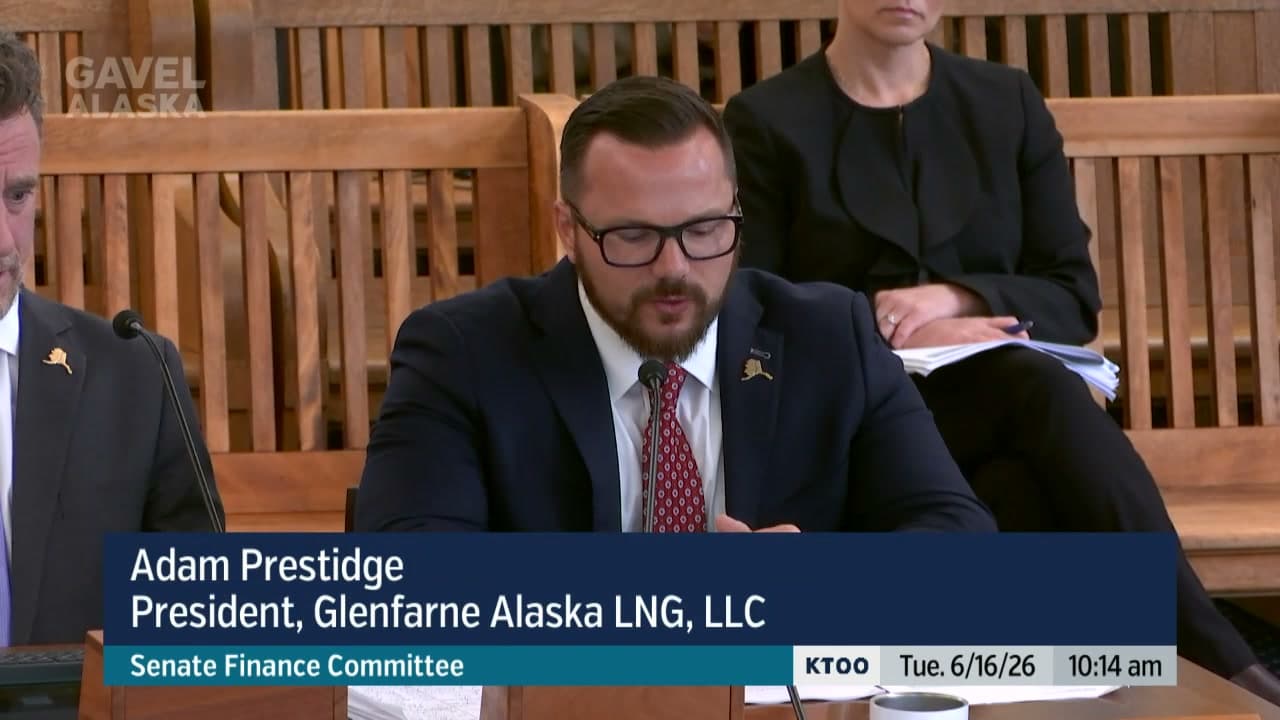
Frame from "Alaska Legislature: Senate Finance - June 16, 2026 9:00am" · Source
Glenfarne: 2060 tax sunset tied to 30-year loan lenders won't shorten
Lenders financing the Alaska LNG project will assume the worst-case tax scenario for the full loan term, making the 2060 property tax sunset in House Bill 381 essential to securing project debt, Glenfarne Alaska LNG President Adam Prestidge told the Alaska Senate Finance Committee on Tuesday.
The 2060 date is not arbitrary, Prestidge said. It reflects a few years of construction followed by 30 years of operations and 30 years of debt service payments, a timeline lenders will model in full when deciding whether to commit capital.
"If there's any possibility that after a period of time the tax rate would revert back to 20 mils, that's what lenders and investors would assume will happen because they'll take the most conservative view," Prestidge said. "And so that's the reason why the 2060 date is so important."
Prestidge directly disputed a claim attributed to consultant Gaffney Klein that a 10-year abatement would be sufficient.
"I have heard quite a few times that Gaffney Klein has made comments about a 10-year abatement in comparison, even going so far as to say that he thinks that Gaffney Klein's opinion is that the project only needs a 10-year abatement," Prestidge said. "That is factually not correct."
He said the Department of Revenue has a financial model that would support that position, and that a shorter abatement reverting to the current 20-mill rate would severely challenge the project's viability.
Competing Claims on Contract Terms and Tax Impact
Matt Kissinger, commercial director of the Alaska Gasline Development Corporation, pushed back on a separate claim made on the Alaska State House floor the previous week that the LNG industry was moving toward shorter contract terms. He said 95 percent of U.S. LNG sales agreements signed in 2025 were 20-year contracts, covering 40 million tons of LNG in total.
Senator Bert Stedman pressed for data the committee has not yet seen. He asked the Department of Revenue to isolate the marginal economic impact of the tax concession on the pipeline alone, separate from the conditioning plant and liquefaction facility.
"I have yet to see what is the economic impact of the projections of the concession," Stedman said. "Does it move the return 10 basis points? Does it move 50 basis points? Does it put you clear in the green light zone so it goes to FID — final investment decision — tomorrow?"
Stedman also noted that the Department of Revenue's cost assumptions have been roughly 50 percent off, limiting the usefulness of existing models. He asked Glenfarne to run its own analysis using updated capital projections and share the results with the committee.
AI-assisted, reviewed by editors. Spot an error?
Watch key moments from the source meeting. Click to expand.
Comments
Sign in to leave a comment.
No comments yet. Be the first to share your thoughts.