Photo by Cale Green
Dunleavy was at Trump's signing reopening 500,000 square miles of Western Pacific to commercial fishing
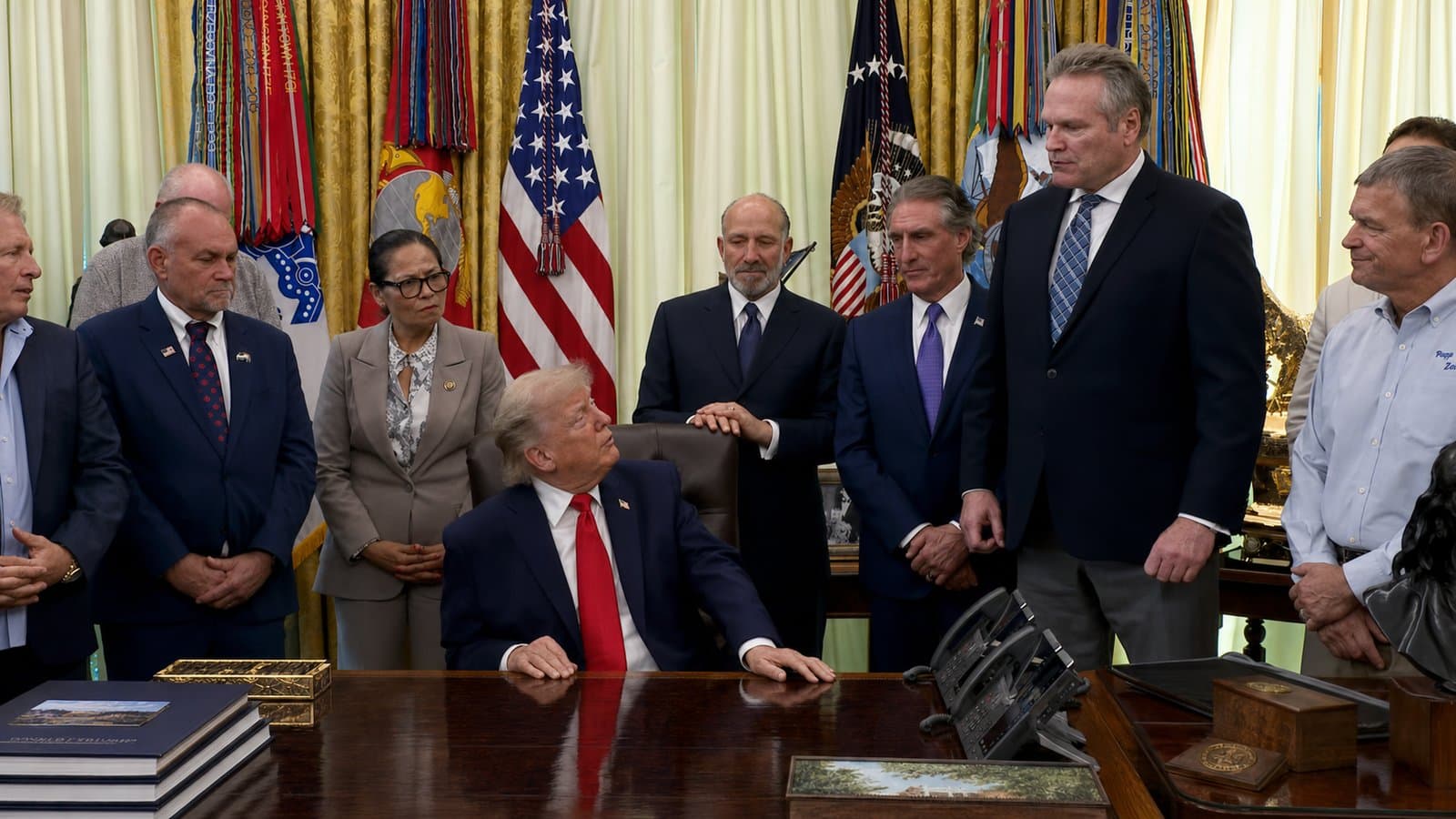
Alaska Governor Mike Dunleavy was at the White House Thursday as President Trump signed a proclamation reopening nearly 500,000 square miles of Western Pacific waters to commercial fishing — and for Alaska, which produces roughly 60 percent of U.S. seafood, the implications run well past the symbolism of a governor's attendance.
The proclamation reopens commercial fishing in waters around the Northwestern Hawaiian Islands (Papahānaumokuākea Marine National Monument), the Northern Mariana Islands area, and American Samoa — areas closed under marine national monuments established by President George W. Bush in 2006-2009 and dramatically expanded by President Obama through 2016. The closures were imposed under the Antiquities Act, the same federal statute used to designate many of Alaska's national monuments and protected areas. Conservation groups have already sued over a similar April 2025 Trump proclamation reopening parts of the Pacific Remote Islands Marine National Monument, arguing the president exceeded his Antiquities Act authority. How that lawsuit resolves will shape what future presidents can and cannot do to Alaska designations made under the same authority.
The species directly affected — bigeye tuna, swordfish, reef fish — are not Alaska fisheries, where the major harvests (salmon, halibut, king crab, pollock, cod) are managed by the separate North Pacific Fishery Management Council under the Magnuson-Stevens Act. But the policy signal matters. The administration is using executive proclamations to expand commercial access to federal waters, and Alaska — the dominant U.S. fishing state by volume — is the only state with a governor present at the signing.
"Alaska provides 60% of the country's seafood. We're the state with halibut, salmon, king crab, you name it, comes from Alaska," Dunleavy said. "Fishing in Alaska is one of the oldest industries in that entire state, employs thousands of individuals."
Trump framed the action as restoring U.S. territorial water access that had been closed to American fishermen while foreign fleets continued to operate in the same waters. Interior Secretary Doug Burgum noted that American Samoa, Guam, and the Northern Marianas are populated by American citizens whose own territorial waters had been closed to them. Commerce Secretary Howard Lutnick said the action would help reverse the U.S. shift from seafood exporter to importer.
Conservation groups had argued the Obama-era expansions were necessary to protect coral ecosystems, seabird nesting habitat, and recovering predator fish populations. The pending Antiquities Act litigation will turn on whether marine monuments established by one president can be substantially modified by a later president without congressional action — a question with direct relevance to the future legal status of Alaska's Antiquities Act designations.
This article is based on a public meeting of The White House — President Trump Signs a Proclamation, Jun. 11, 2026.
Made by our human newsroom with AI. How humans and AI work here · Grow with our newsroom Transcript byLucas Brown
Watch key moments from the source meeting. Click to expand.
Stay informed. Support what matters.
Free, permanent access to local news you can verify. Subscribe to support Cale Green and go ad-free.
Related Coverage
Trump fishing order targets Gulf, Atlantic data disputes and could reach Alaska
Alaska News · 1mo ago
Alaska opens all of Togiak to fishing with the sockeye count far below goal
Alaska News · 2mo ago
Trump's farm package, and what it actually means for Alaska
Alaska News · 4mo ago
An order would presume hunting is allowed on Alaska's federal land
Alaska News · 1mo ago
Murkowski flagged Alaska parallels at a Senate deep-sea mining hearing
Alaska News · 4mo ago
Comments
Sign in to leave a comment.
No comments yet. Be the first to share your thoughts.