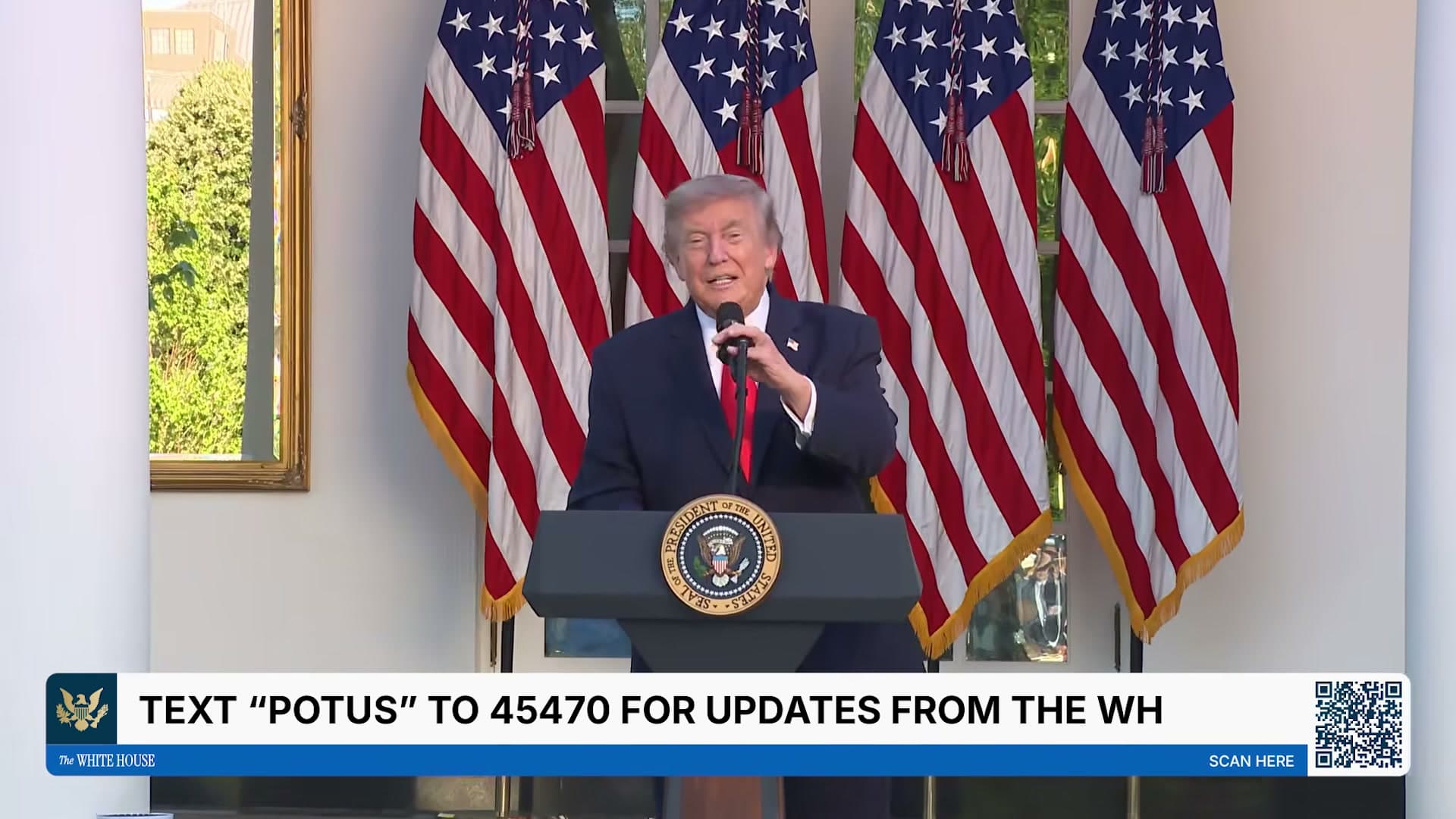
Frame from "White House: President Trump Participates in a Rose Garden Club Dinner with American Farmers" · Source
Trump's farm package, and what it actually means for Alaska
Alaska imports almost all of the food it buys — about 95% of it, by the Alaska Food Policy Council's count, roughly $2 billion a year sent out of state. That dependence is the backdrop for a pair of farm-policy moves President Trump made Thursday, and the reason they register in Alaska at all, far as the state sits from the heart of American agriculture.
At a White House dinner for farmers and ranchers, Trump signed an executive order directing federal agencies to speed agricultural innovation, and called on Congress to pass $11 billion in relief for specialty-crop and other producers he said were hurt by Biden-era rules. The two moves run on separate tracks: the order takes effect as agencies write the rules to carry it out; the $11 billion waits on a congressional vote that has not been scheduled.
The order, cast as a national-defense measure, directs the Agriculture Department to secure the domestic supply of two farm staples — elemental phosphorus, the backbone of fertilizer, and glyphosate-based herbicides. Inputs are a standing problem for Alaska growers: the state's soils need feeding, and almost everything a farm runs on arrives by barge, truck, or plane. A steadier domestic supply might help at the margins, though in Alaska the larger cost has always been the freight to haul it north.
The relief money is where Alaska's stake is most concrete. "Specialty crops" is a federal category that takes in fruits, vegetables, and horticulture — flowers included — which is to say it takes in Alaska's signature farm export. The state ships out almost nothing grown on its land except peonies, a cut-flower crop Alaska can deliver in a late-summer window when growers elsewhere are done for the year. Mat-Su Valley produce farms fall under the same heading. If the $11 billion clears Congress, Alaska's specialty growers would be eligible for a share — and Alaska's congressional delegation will be among those deciding whether it does.
Trump also touted trade developments at the dinner: he said Australia is admitting U.S. beef for the first time in more than 25 years, that China has committed to buy at least $17 billion in American farm goods, mostly soybeans, and that the agricultural trade deficit has fallen 42% this year. Those are Lower-48 commodities. Alaska raises little beef and no soybeans; its own food-export story runs through its docks, not its fields.
What makes any of this worth Alaska's attention is the direction the state is going. Alaska has one of the fastest-growing farm sectors in the country — the number of farms rose 54% between 2012 and 2022, by the latest Census of Agriculture, and the state ranks near the top for new and women farmers — much of it powered by a push to grow more food at home. Federal programs already prop up a good deal of that growth. Whether this week's actions help that effort or skip past it, they land on a farm economy Alaska is increasingly counting on.
This article is based on a public meeting of The White House — White House: President Trump Participates in a Rose Garden Club Dinner with American Farmers ().
Drafted with AI. Edited by Cale Green (1 revision). No full editor review is on record. Who is accountable. Transcript byLucas Brown
Watch key moments from the source meeting. Click to expand.
Stay informed. Support what matters.
Free, permanent access to local news you can verify. Subscribe to support Alaska News and go ad-free.
Related Coverage
Federal orders reach Alaska's beef labeling and processing gaps
Alaska News · 2w ago
Alaska's fishermen got left out of an $11 billion farm rescue
Alaska News · 2mo ago
New federal money for small meat processors could help Alaska lean less on imported food
Alaska News · 2mo ago
Alaska's best shot at a new federal fertilizer grant is an idle Nikiski plant — if it can get the gas
Alaska News · 2mo ago
An order would presume hunting is allowed on Alaska's federal land
Alaska News · 6d ago
Comments
Sign in to leave a comment.
No comments yet. Be the first to share your thoughts.