Board Cuts Area M June Salmon Fishing Time 30% to Protect Yukon-Bound Chum
The Alaska Board of Fisheries voted 4-3 Tuesday to reduce commercial fishing time during the June salmon season in Area M, replacing industry-led conservation triggers with department-controlled openings designed to protect chum and king salmon bound for Western Alaska rivers.
The decision marks a reversal from 2023, when the board voted down Proposal 136, a similar measure to reduce fishing time during the June Area M fishery. The new approach cuts fishing periods for drift gillnet vessels by 136 hours and purse seine vessels by 94 hours. That amounts to reductions of roughly 39 percent and 30 percent from the 2023-2025 management plan. The schedule also removes chum salmon harvest caps that previously allowed the commercial fleet to manage its own closures when catch thresholds were met.
Board Chair Märit Carlson-Van Dort, who introduced the substitute language, said the changes respond to years of testimony from Western Alaska communities facing subsistence closures. "We heard individuals ask from everything from a full closure to status quo of the adaptive management plan," she said. "I believe that this is a compromise on both ends."
Genetic studies show that 25 to 57 percent of Area M's June harvest consists of salmon bound for the Yukon and Kuskokwim rivers during peak migration periods. Those rivers have seen no commercial openings since 2020. Subsistence fishing has been severely restricted to protect collapsing chum and king salmon runs.
The substitute language maintains emergency order authority for the Alaska Department of Fish and Game to determine fishing periods, rather than locking in a fixed schedule. "Fishermen are still welcome and encouraged to participate in voluntary stand-downs when they see fit, communicate with each other and gather data, and engage in transparency with the public," Carlson-Van Dort said.
But department staff warned the new structure may increase chum harvest by removing fleet incentives for voluntary conservation. Area Management Biologist Matt Keys said the adaptive management plan adopted in 2023, which included chum caps, had been "effective in reducing Southeast chum salmon harvest in the June fishery" when combined with industry-led efforts.
"Prolonged or extensive closures that significantly reduce available fishing time can discourage the fleet from adopting proactive industry-led measures such as test fishing to assess chum salmon abundance or implementing voluntary closures in high abundance chum salmon areas," Keys said in staff comments.
Board Member Israel Payton said the caps gave the fleet a target to manage toward. "Without triggers, I think it's kind of ignorant to think that with the harvest capacity that exists out there could go and kill a lot of fish, even in a 2-hour opener," he said. "And if there's nothing saying you just caught too many chum, what keeps them from just catching chum?"
Board Member John Jensen agreed, predicting the adaptive management program would collapse without the cap structure. "I will tell you right now, my prediction is this, having been a fisherman and understanding how these things work, there is very little incentive for the adaptive management plan to go on," he said. "And that is a real unfortunate thing because I think there was a lot of benefit to that."
But Board Member McKenzie Chamberlain defended the department's ability to manage without caps, noting that emergency order authority allows closures when king salmon abundance is high, as happened in 2024. "There are so many factors that affect these fish that there's no one answer," he said. "We have to look at this as the totality of the circumstances."
Chamberlain also cited the board's statutory obligation under the Pacific Salmon Treaty and Alaska's subsistence priority law. "We as a board right now are regulating hunger," he said, referencing a subsistence presentation showing 40 percent food insecurity in the Yukon River village of Alakanuk.
Board Member Gerad Godfrey voted against the measure, saying he believed the adaptive management plan's collapse would result in higher chum harvest. "The net effect is far more chum get caught," he said. "And it was also my impression during this week the department was very impressed with the adaptive management plan."
The vote followed hours of public testimony from both Area M fishermen and Western Alaska subsistence users. The Orutsararmiut Native Council, which originally proposed a 10-day closure, endorsed the substitute language in a written comment. However, Western and Interior Alaska tribal organizations, including the Tanana Chiefs Conference and the Yukon River Inter-Tribal Fish Commission, stated the board failed to create meaningful migration windows for salmon bound for Western Alaska rivers. The Aleutians East Borough filed an ethics complaint with the state shortly after the board's decision.
The new management plan takes effect for the 2026 season. Fishing periods will begin June 6 for set gillnet gear and June 10 for purse seine and drift gillnet gear. The final period will close no later than June 28.
The board also voted 4-3 to allow non-retention of king salmon over 28 inches in Area M purse seine fisheries, and 5-2 to establish king salmon harvest triggers that would close statistical areas where more than 1,000 kings are caught in a single period.
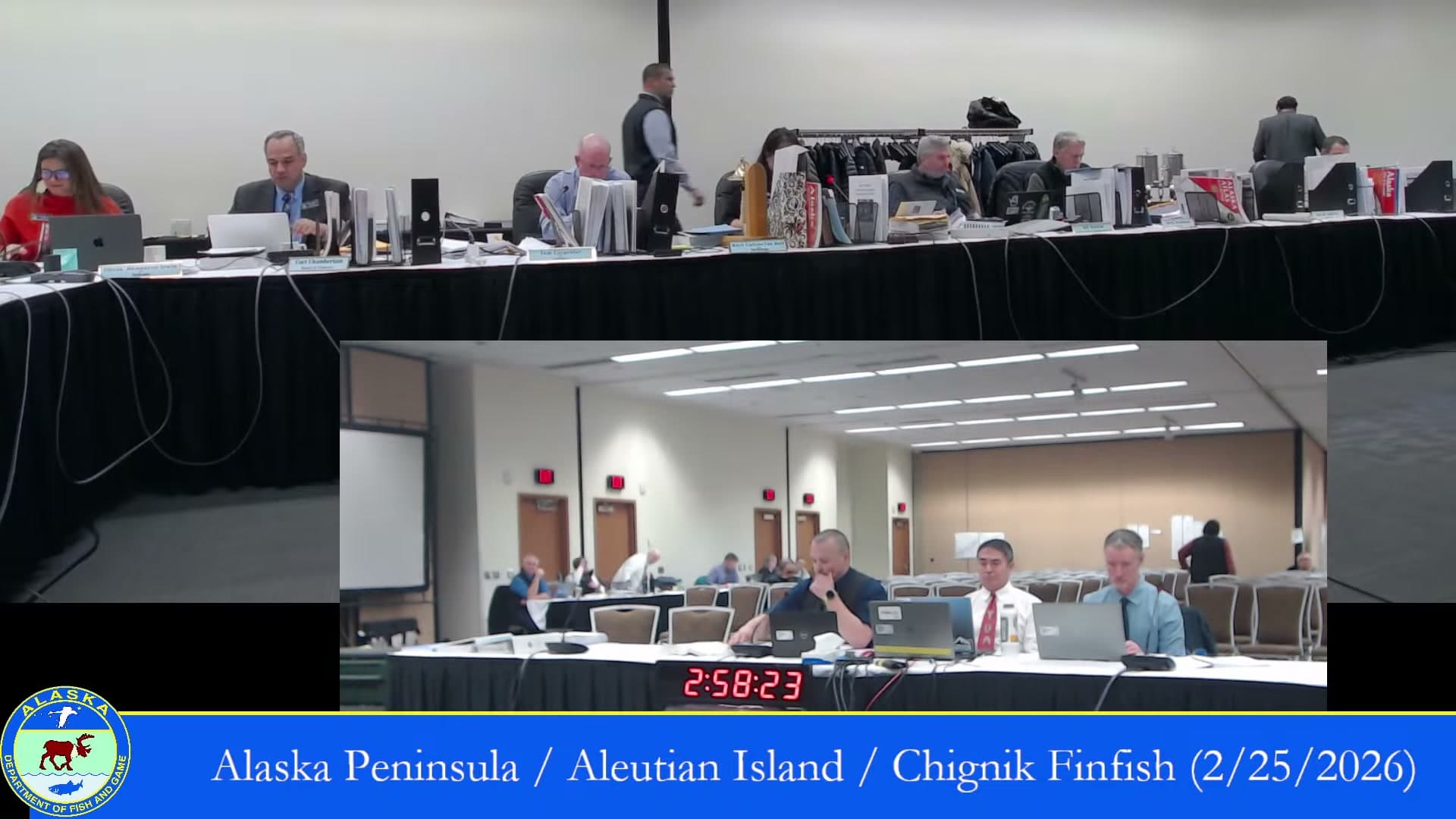
This article is based on a public meeting — Alaska Peninsula / Aleutian Island / Chignik Finfish (2/25/2026) ().
AI-assisted. How we use AI Transcript byLucas Brown
Stay informed. Support what matters.
Free, permanent access to local news you can verify. Subscribe to support Alaska News and go ad-free.
Related Coverage
Yukon salmon conservation rules are now locked into state regulation, not left to managers' discretion
Alaska News · 1mo ago
Board Restricts Fishing Gear to Protect Chinook in Chignik, Area M
Alaska News · 7mo ago
Board restricts Cook Inlet drift gillnet fishery to protect coho salmon
Alaska News · 6mo ago
Board Sets Fish Wheel Rules, Recovery Goals for Yukon Salmon
Alaska News · 4mo ago
Alaska closes Yukon subsistence salmon fishing through early June
Alaska News · 3mo ago
Comments
Sign in to leave a comment.
No comments yet. Be the first to share your thoughts.