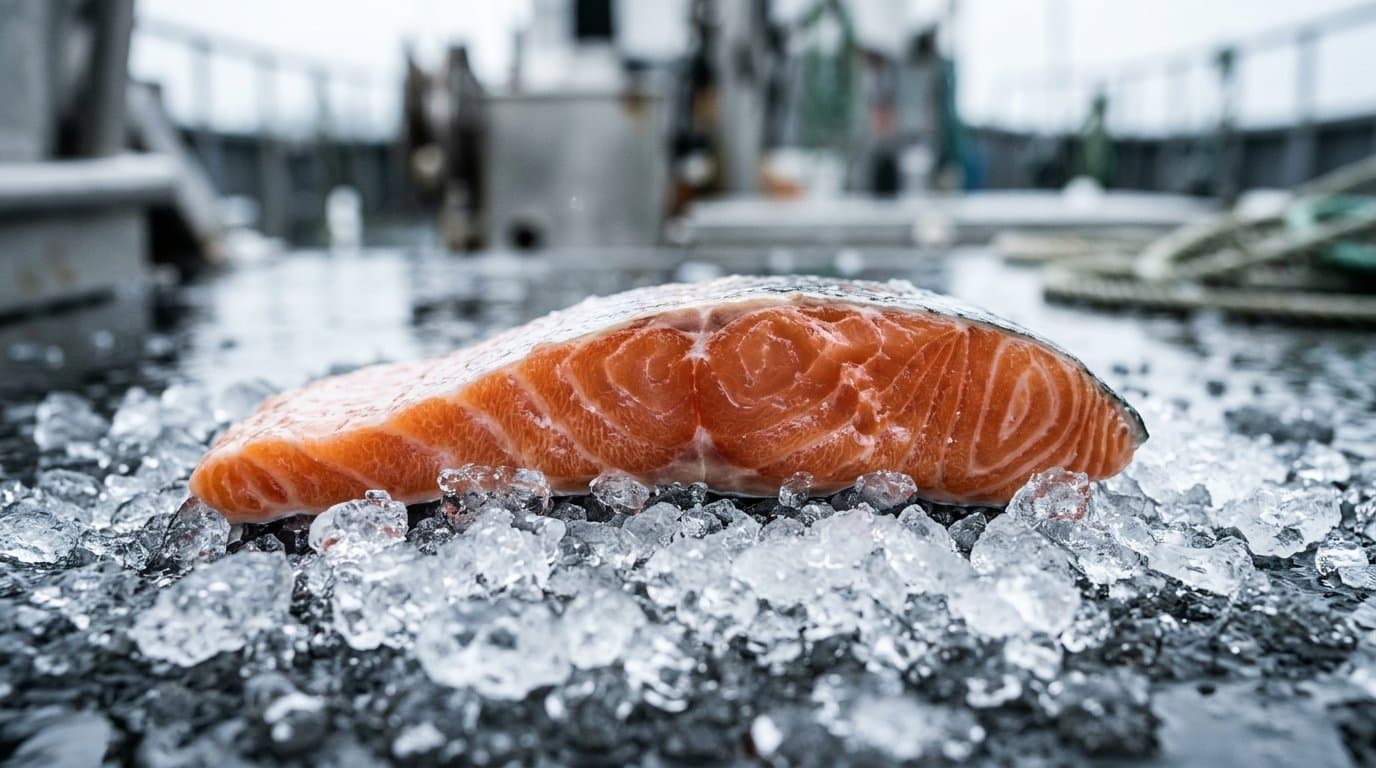
AI image
ASMI leaders to talk mariculture and market outlook at Seattle's Pacific Marine Expo
Alaska Seafood Marketing Institute staff will be at booth 1308 at Pacific Marine Expo in Seattle from Thursday through Saturday, Nov. 19-21, and two of the institute's leaders are scheduled to speak on the expo's Main Stage.
Executive Director Jeremy Woodrow joins a panel Thursday at 2 pm Pacific time, "Shellfish, Seaweed & the Working Waterfront: Where Alaska's Growing Mariculture Industry Fits in Seafood Economy." Technical Director John Burrows presents "Alaska Seafood Outlook: Market Data, Trends, and What's Shaping the Industry" Friday at 3 pm Pacific time. Each session is set for 45 minutes, according to the expo's education schedule.
The institute is also sponsoring the 2026 Alaska Symphony of Seafood on Friday, Nov. 20.
Woodrow laid out the industry's position on foreign competition and trade rules in June 2 written testimony to the U.S. Senate Subcommittee on Coast Guard, Maritime, and Fisheries. He argued that Russian fish, still moving through markets with looser restrictions than the U.S. ban, undercuts what Alaska harvesters and processors are paid. He called Russia Alaska's principal competitor for pollock, cod, salmon and king crab.
"Russian producers often benefit from lower production costs and less rigorous regulatory frameworks, allowing them to undercut Alaska seafood prices internationally," Woodrow said.
The testimony says the United States imposed a full ban on Russian seafood while the European Union, Japan and the United Kingdom adopted more limited measures; the UK applies a 35% tariff. Russian fish has still reached U.S. markets through third-country processing despite the federal ban.
Alaska seafood adds $5.2 billion a year to the state economy, about 7% of state GDP, and accounts for roughly two-thirds of U.S. commercial landings by volume, according to his testimony.
The EU was Alaska's top export market in 2024 at about $616 million, Japan took $571 million and China about $566 million, mostly as a reprocessing hub, while the U.S. market tops $2 billion, Woodrow said. He named the EU's CATCH system, a digital catch-tracking platform aimed at illegal fishing, as a non-tariff barrier.
"While the goal of the system is aligned with U.S. sustainability values, its implementation introduces extreme administrative and logistical challenges for exporters, particularly when requirements overlap with existing U.S. traceability systems," he said. Alaska seafood groups have called CATCH a trade barrier, and in July, NOAA secured exporters 18 more months before the new EU catch forms take effect.
Much of ASMI's overseas marketing runs on federal export-promotion money. ASMI board materials show the institute has relied on roughly $4.4 million to $4.6 million a year in USDA Market Access Program awards. A May 7 memo says a $6 million America First Trade Promotion Program award, announced in late April, will support ASMI's international work in its 2027 and 2028 fiscal years. The memo says the federal One Big Beautiful Bill effectively doubles Market Access Program funding starting in federal fiscal year 2027.
What did you make of this story? (no account needed)
Made by our human newsroom with AI. How humans and AI work here · Grow with our newsroom ·
Keep Alaska News free for everyone.
No paywall, ever. Members pay so everyone can read the meetings and records Alaska News covers.
Get Alaska News in your inbox
Create your free account and get the day’s top stories around 6 each morning, in a few minutes’ read.
Top stories, around 6 each morning.
Stories on what you follow, on Sundays.
Source: Alaska Seafood Marketing Institute.











Comments
Sign in to leave a comment.
No comments yet. Be the first to share your thoughts.