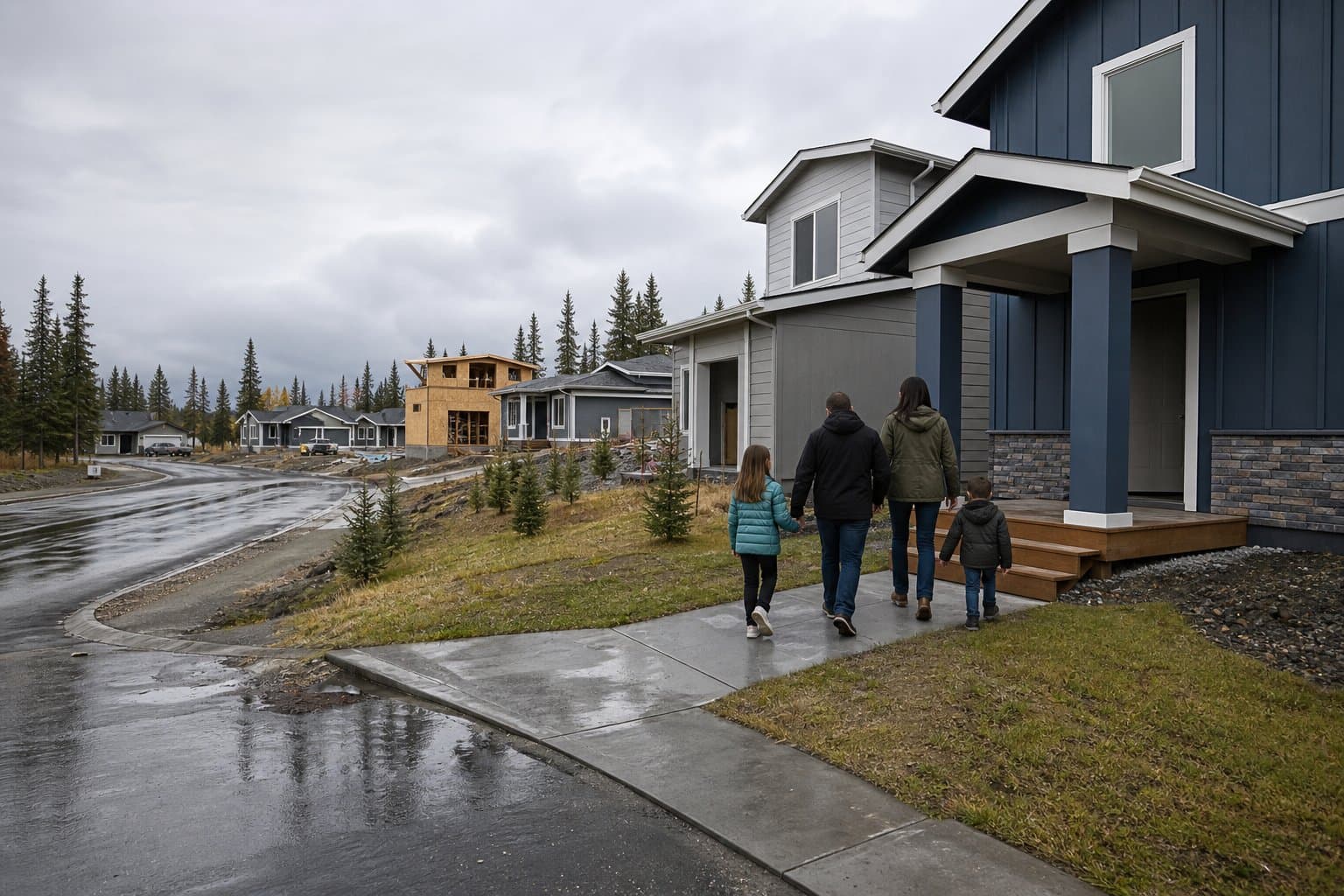
AI image
Anchorage mayor's revised starter-home tax break raises price ceiling to 120% of average home value
Anchorage's proposed tax break for first-time buyers of newly constructed homes would no longer vanish for homes priced just above the city's average value, under revised ordinance AO 2026-89(S), before the Assembly on Tuesday.
The substitute raises the qualifying sale price ceiling to 120% of the most recent annual average assessed value of a single-family home in Anchorage, put at $496,746 for 2026, or about $596,000. The exemption still covers only value up to that average. Anything above is taxable, and a home above 120% does not qualify. The earlier version capped sales at the average. A memorandum by Nolan Klouda of the mayor's office says the change eliminates the "cliff," under which a new home becomes "ineligible if its cost increases by a small amount above the average assessed value." The administration recommends approval.
Core eligibility is unchanged. Qualifying new construction, owner-occupied as a primary residence and bought by a first-time homebuyer, would be exempt from municipal and school district property taxes for 10 consecutive years. Short-term rentals are excluded. Applications close at 5 p.m. on Aug. 31, 2031. The substitute also leaves AMC 12.110.030A.2.b, the provisional-approval section, still requiring a price at or below the average, even as 12.110.015B.1.c allows 120%.
LaFrance introduced the measure June 23 under her 10,000 Homes in Ten Years strategy, saying it encourages "starter" homes and expands homeownership access. She cited a 40% rise in home prices from 2020 to 2025. Administration worksession materials put average new construction near $750,000. Testimony filed for the Aug. 4 meeting opposed the ordinance, arguing it subsidizes builders and shifts the tax burden onto existing property owners.
A municipal economic-effects analysis projects the break will be revenue-neutral, with negligible effect on mill rates. The analysis says the Property Appraisal Division can administer it within existing resources.
Two provisions are new. Service areas with elected boards may opt out by resolution within 60 days of the effective date. A deteriorated commercial property's exemption could transfer when part or all of it is sold to an owner occupant.
Assembly housing materials scheduled the public hearing for the Sept. 15 regular meeting.
Source: Anchorage Assembly ().
AI-assisted. No editor review is on record for this article. Who is accountable.
Stay informed. Support what matters.
Free, permanent access to local news you can verify. Subscribe to support Walter AlaskaNews and go ad-free.
Related Coverage
Anchorage Assembly weighs 10-year tax break for first-time homebuyers of new starter homes
Alaska News · 1mo ago
Anchorage's proposed tax break caps at $497,000. New homes average $750,000.
Alaska News · 1mo ago
Anchorage Assembly weighs 10-year tax break for condos above shops and offices
Alaska News · 1mo ago
Two Anchorage housing votes on June 23: a tax break and new fees on the same new homes
Alaska News · 2mo ago
Anchorage proposes tax break for mixed-use buildings with owner-occupied units
Alaska News · 1mo ago
Comments
Sign in to leave a comment.
No comments yet. Be the first to share your thoughts.