
AI Generated Image
Analysis: Outside groups spent $5.2 million on Alaska's long-shot candidates
About 10,500 ballots in Alaska's U.S. House race ranked only Eric Hafner, a Democrat serving a federal prison sentence. That is more than Republican Rep. Nick Begich's 7,385-vote margin over nonpartisan Bill Hill in the state's Nov. 18 ranked-choice count.
That doesn't mean Hill would have won without Hafner. Those voters ranked neither finalist, so the records can't show which one they would have preferred.

Since that count, some people online have speculated about how the race might have gone without Hafner, or argued that it was rigged; earlier this year, Republicans complained about Daniel J. Sullivan Jr. of Petersburg, a Senate candidate with nearly the same name as Republican Sen. Dan Sullivan, and called him a sham.
Both candidates were certified for the ballot. A judge put Sullivan Jr. back on after the state removed him, much as a judge let Hafner stay on the ballot in 2024 after Democrats sued to keep him off. But the records can't show what either candidate intended, and patterns in the ballots can't prove what voters meant. They show how people voted, not why.
Long shots, candidates who won less than 8% of the primary vote, have moved onto the general ballot in every election since Alaska adopted top-four primaries and ranked-choice general elections in 2020.
What changed this year was the money. Outside groups spent about $3.4 million for or against the four long shots on this year's congressional general ballot, compared with less than $7,000 for the long shots on the 2022 and 2024 ballots combined, according to FEC reports filed through Nov. 20.
They spent another $1.7 million on long shots who didn't get past the primary. Most of the $5.2 million came from groups that also spent against Sullivan or Begich, and a smaller share from a group that also spent against Democrat Mary Peltola, who unseated Sullivan.
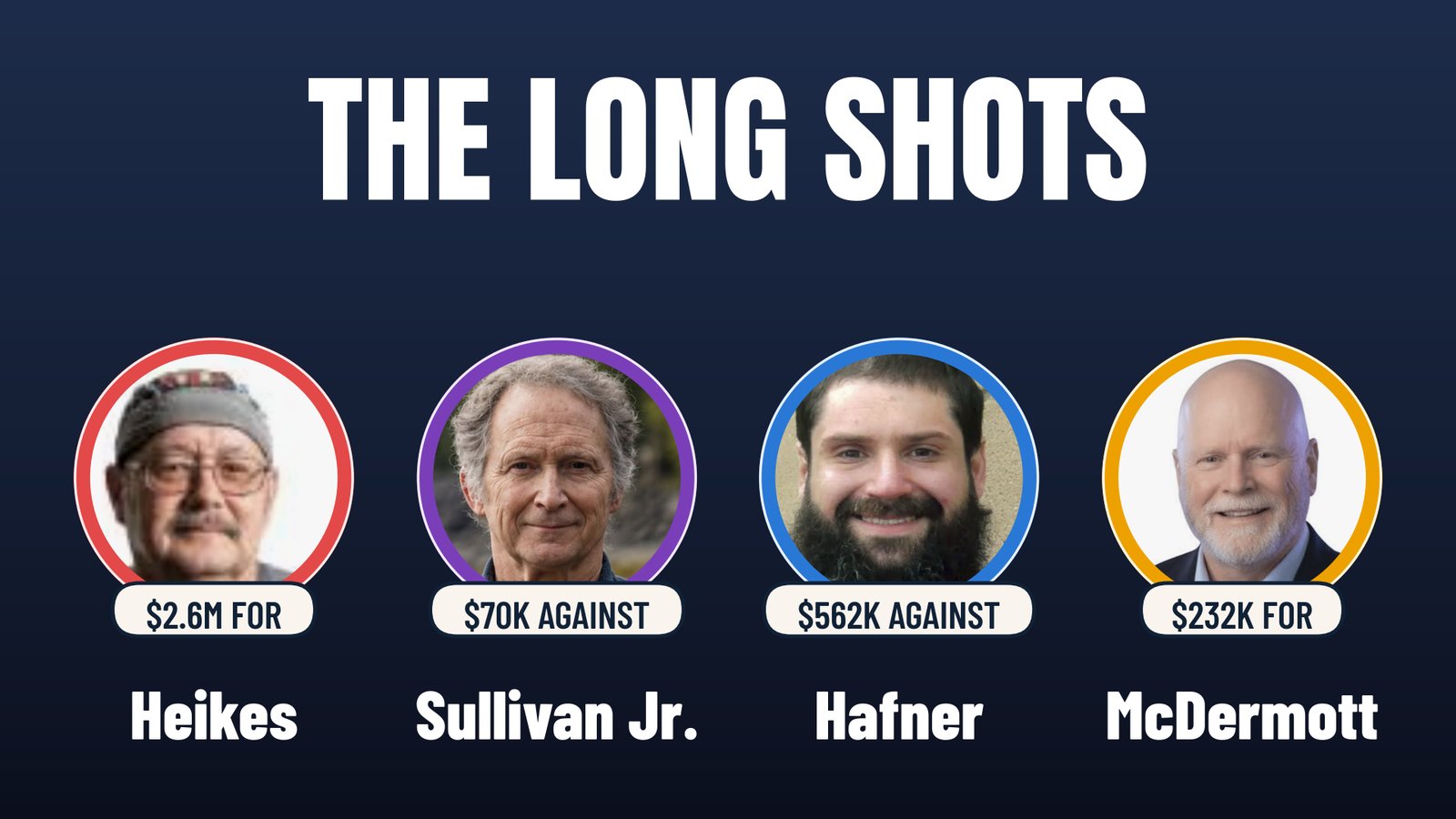
This is a full breakdown, based on the Division of Elections' primary results, its Nov. 18 count and ballot-level records, court records and Federal Election Commission filings.
The results are unofficial until the state certifies them, which it plans to do Nov. 25. Alaska News' counts from the ballot records follow the state's ranked-choice rules: write-in votes that weren't assigned to a candidate are set aside, and a ballot stops counting after two skipped rankings in a row.
What the long shots' ballots show
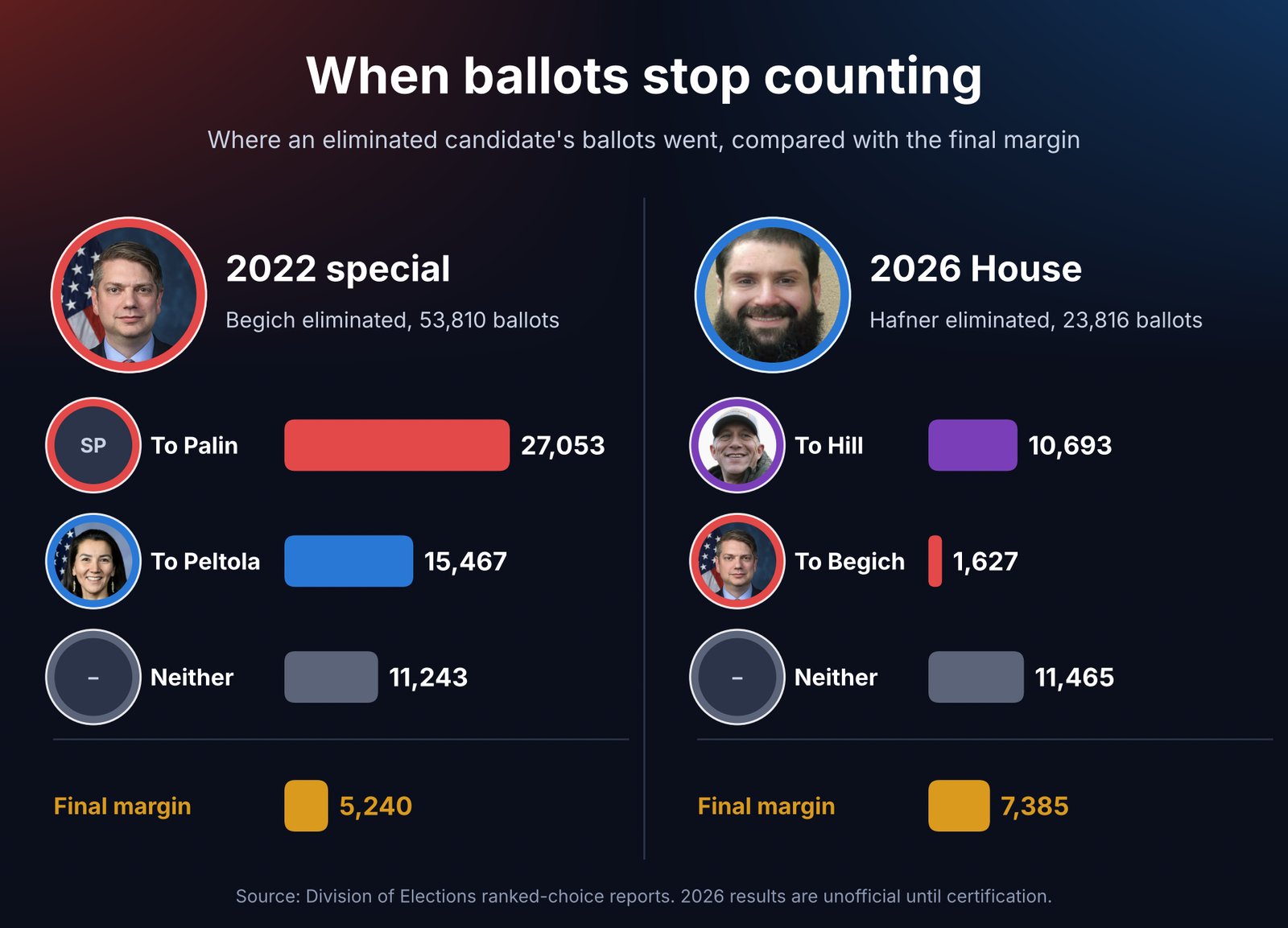
When the state eliminated Hafner in the second round, 23,816 ballots were counting for him. Of those, 10,693 ranked Hill next and 1,627 ranked Begich. The other 11,465 ranked neither and stopped counting, and 10,579 of those ranked no one but Hafner.
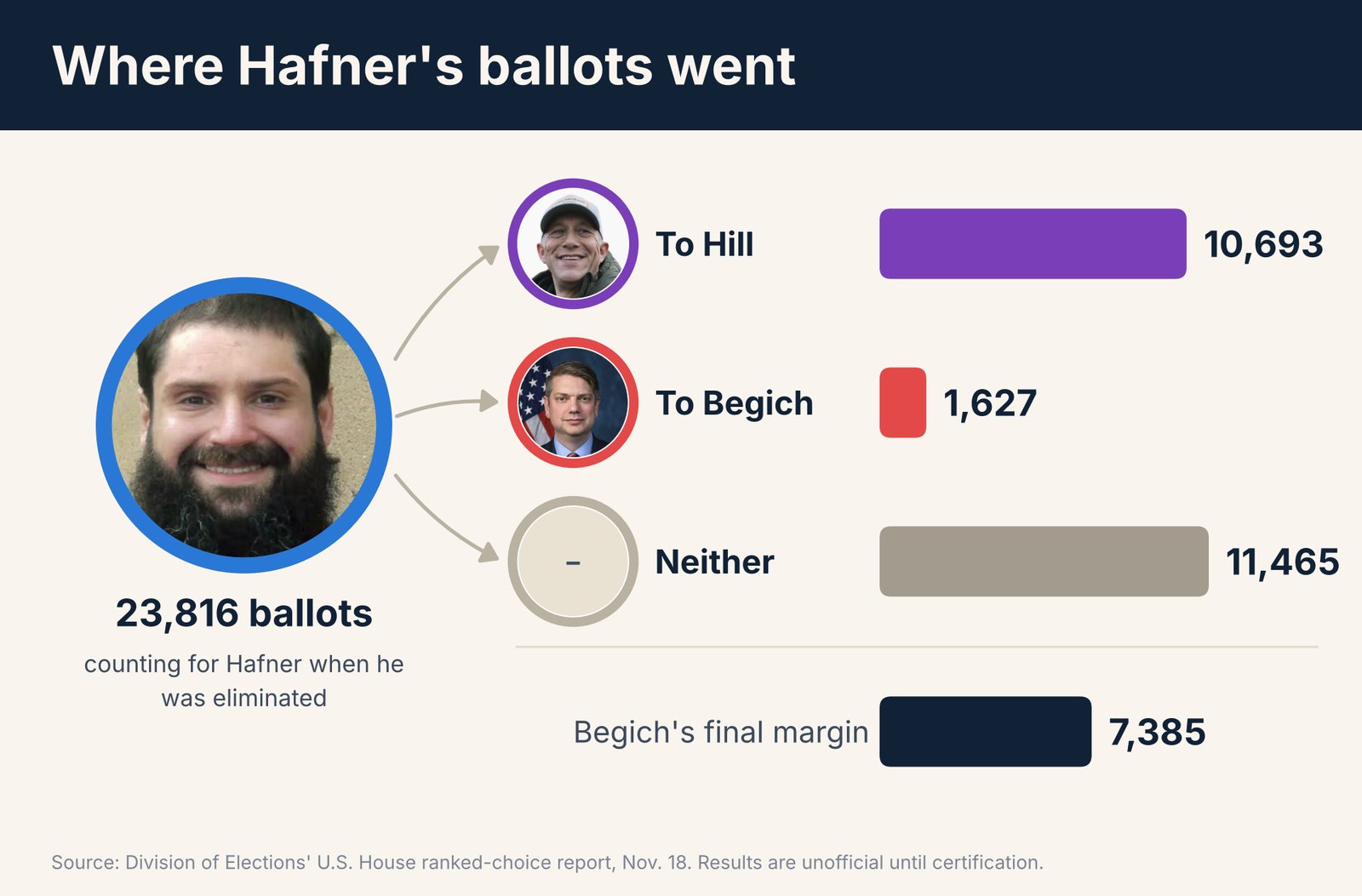
Those ballots mostly backed Democrats in the other races. On 94% of the ballots that stopped with Hafner, the voter picked Peltola for the U.S. Senate, and on 90%, Democrat Jonathan Kreiss-Tomkins for governor.
Under state law, a ballot counts only for candidates the voter ranked. A ballot that ranks no one left in the race stops counting; it can't be assigned to anyone else.
Those voters didn't rank Hill or Begich, and the ballots don't say why. People pick candidates for all kinds of reasons. Some of those voters may have known who Hafner was and wanted him and no one else. Some may have marked the only Democrat in the race without knowing much about him, including that he is in prison. Others may have meant it as a protest or had reasons of their own.
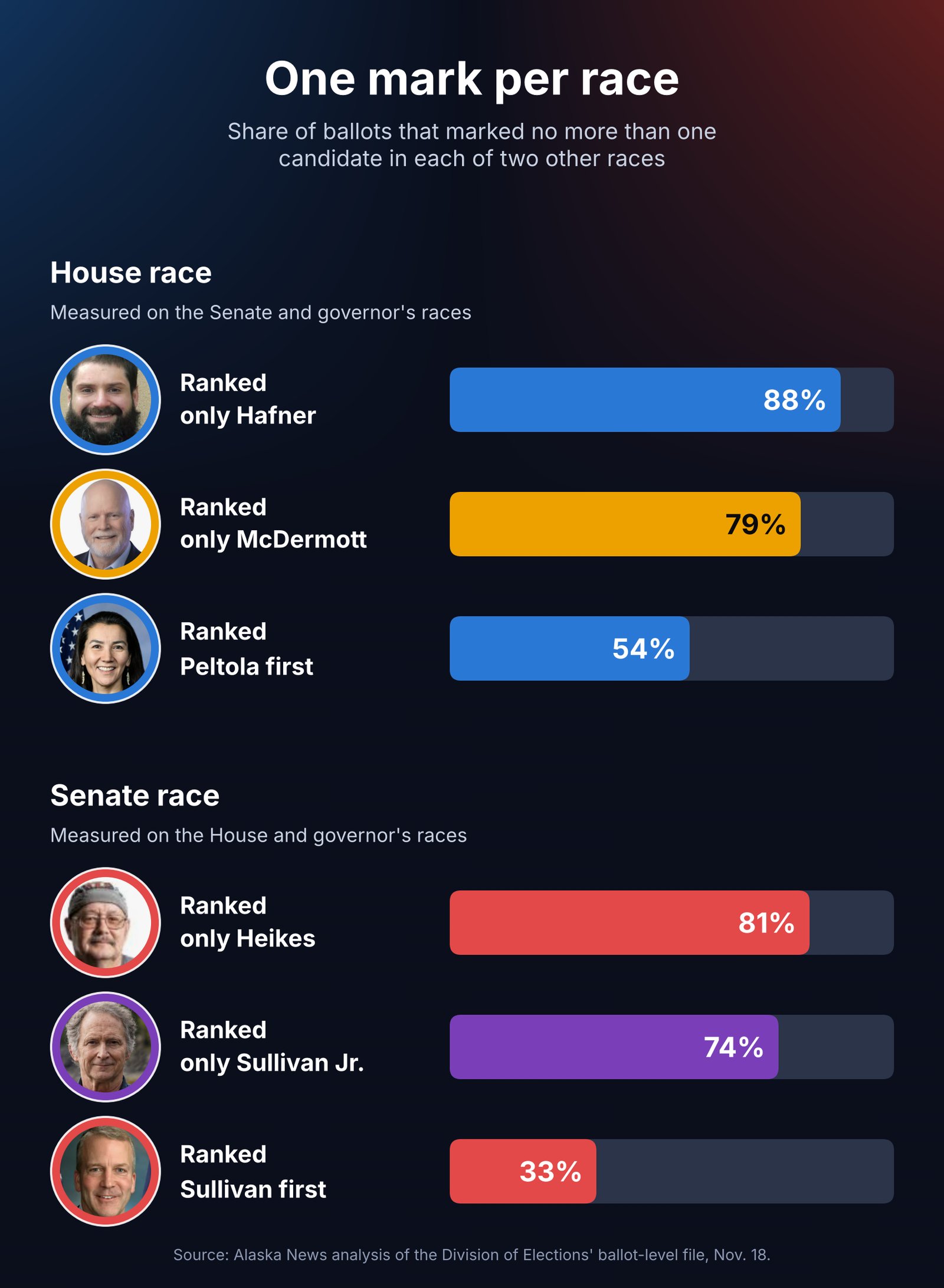
The ballots can't answer that, but they show a pattern. Of the ballots that ranked only Hafner, 88% also marked no more than one candidate for Senate and one for governor, nearly always Peltola and Kreiss-Tomkins. Among all ballots that ranked Peltola first, 54% did.
Gerald Heikes was the Republican long shot in the Senate race.
Sullivan and his Republican allies called Sullivan Jr. a sham candidate working with Democrats to help Peltola, which he and Democrats denied. No outside group reported spending to support Sullivan Jr.
Heikes had $2.6 million in outside support, all of it from groups that also spent against Sullivan. One of them, Alaska Values PAC, ran an ad in which a narrator tells voters, "Rank one name, leave the rest blank: Only rank Heikes," as reported by CNN.
The ballots show the same one-mark pattern for both Senate long shots.
Of the 2,378 ballots that ranked only Heikes, 81% marked no more than one candidate for the House and one for governor, and so did 74% of the roughly 1,800 that ranked only Sullivan Jr.; among all ballots that ranked the senator first, 33% did.
Both groups leaned Republican in the other races: 72% of the Heikes-only ballots and 61% of the Sullivan Jr.-only ballots backed one of the three Republican tickets for governor.
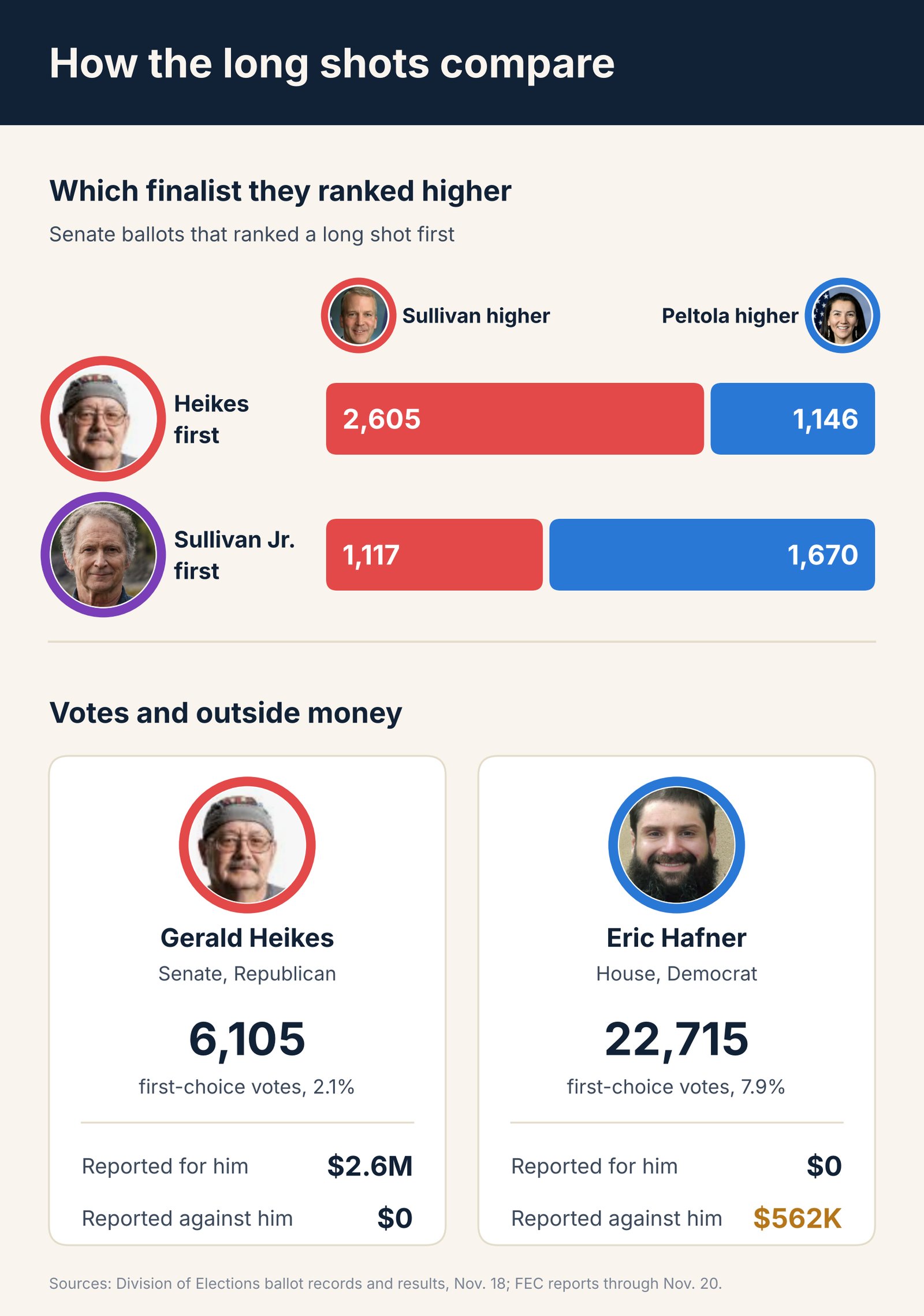
Voters who ranked more candidates split differently. Ballots that ranked Heikes first put Sullivan ahead of Peltola 2,605 times and Peltola ahead 1,146 times. Sullivan Jr.'s other 3,100 ballots leaned the other way, putting Peltola ahead of the senator 1,670 times and the senator ahead 1,117 times.
Heikes won 6,105 first-choice votes, or 2.1%, with $2.6 million behind him. Hafner won 22,715, or 7.9%, with no reported support and more than $500,000 spent against him by a group backing Hill.
Someone also sent at least two unsigned texts urging Democrats to vote for him, and no one has reported paying for them. Hafner was the only Democrat in the House race; Heikes shared the Republican label with Sullivan.

Neither Senate long shot changed the result. Peltola won 144,486 first-choice votes, more than every other Senate candidate and write-in combined, so she would have had a majority even if every voter who picked another candidate first had ranked Sullivan second.
The fourth candidate, Libertarian Jim McDermott, didn't tip the race either way. His 7,649 ballots split almost evenly when he was eliminated first: 2,112 to Hill, 2,061 to Begich and 942 to Hafner. Another 2,521 ranked no one else, and 13 were overvoted.
How the long shots got on the ballot
Alaska's primary sends the top four finishers in each race to the general election. If one withdraws at least 64 days before the general, state law says the Division director fills the spot with the candidate who received "the fifth most votes in the primary."
This year's withdrawal deadline was 5 pm Aug. 31, according to the Division's candidate list.
In the Aug. 18 primary, Hafner made the House top four on his own. He finished fourth with 6,175 votes, or 3.8%, behind Begich, Hill and Democrat Matt Schultz. McDermott finished eighth, with 1,951 votes, or 1.2%.
He moved onto the general ballot after Schultz and the three candidates who finished between Hafner and McDermott left the race: Democrat John B. Williams, Republican Clay Strickland and Democrat Yaquelin Reynoso.
That left Hafner as the only Democrat in the race. He lists a mailing address in South Dakota, and a federal court order puts his release date in 2036.
The Senate race followed the same path. Sullivan Jr. finished third in the primary with 4,107 votes, or 2.5%.
In June, the Alaska Republican Party asked the Division to disqualify him, arguing that his declaration of candidacy listed him as a Republican while his voter registration said undeclared.
The Division agreed. Director Carol Beecher ruled June 15 that he had asked to appear on the ballot as "Dan Sullivan," a name he had never used, and filed "with the purpose of confusing or misleading the electorate," and she removed him.
Eleven days later, a Superior Court judge reversed her. The judge found the "good-faith" requirement she applied doesn't appear in the U.S. Constitution, state law or the Division's regulations. He appeared on the ballot as Daniel J. Sullivan Jr., undeclared.
Democrat David Leslie finished fourth in the Senate primary, 109 votes ahead of Heikes, and then left the race. Heikes, who finished fifth with 1,741 votes, or 1%, took his place.
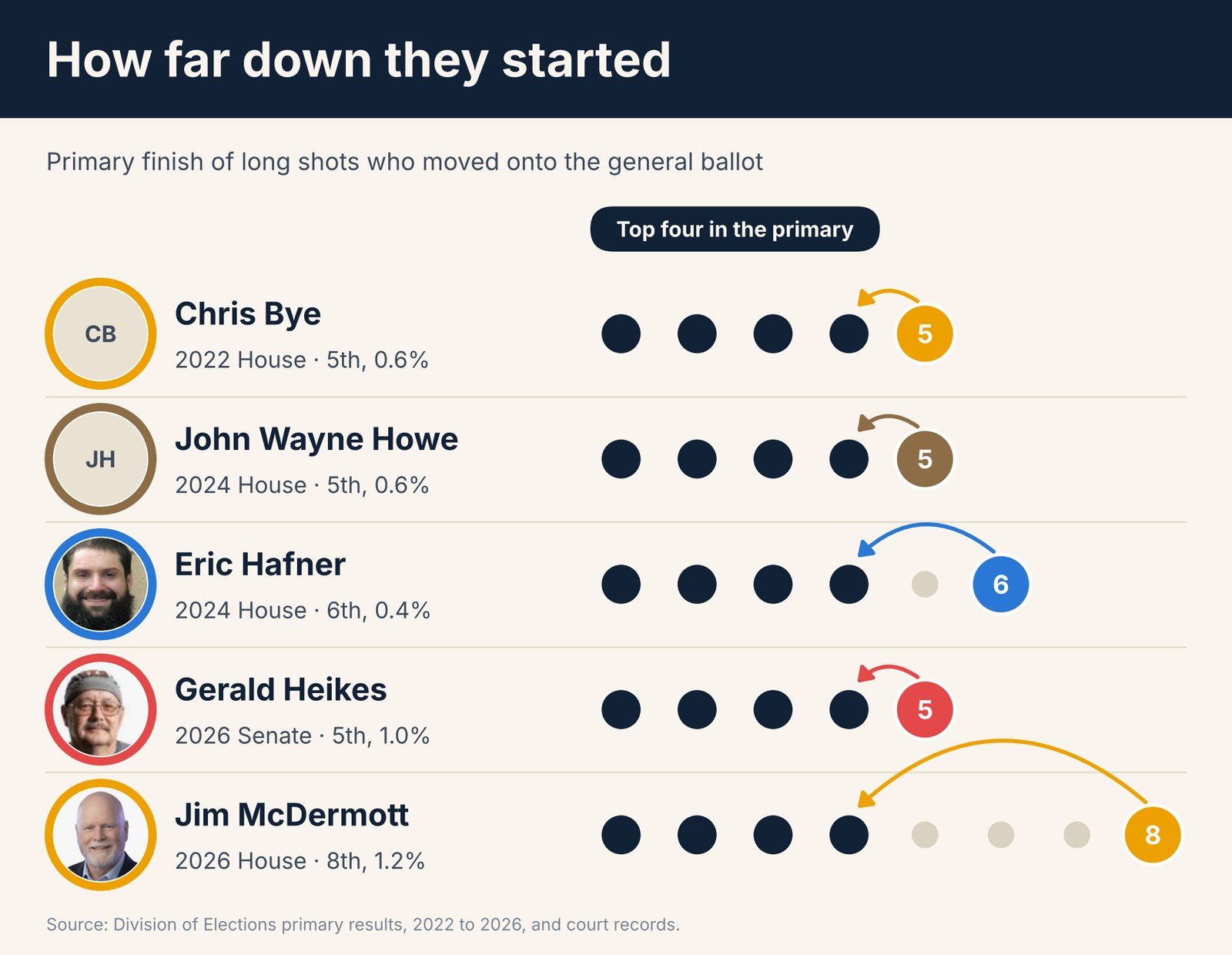
Withdrawals have reshaped the congressional ballot in every election under the system:
2022 House: Republican Tara Sweeney finished fourth and withdrew, according to the Division's candidate list. Libertarian Chris Bye, fifth with 0.6%, took her spot.
2024 House: Lt. Gov. Nancy Dahlstrom, a Republican, finished third and withdrew Aug. 27, and Republican Matthew Salisbury, fourth, withdrew Aug. 30, according to court records. John Wayne Howe of the Alaskan Independence Party, fifth, and Hafner, sixth with 0.4%, moved up.
2024 lawsuit: The Alaska Democratic Party sued to keep Hafner off the ballot, arguing the law allows only the fifth-place finisher to move up. Superior Court Judge Ian Wheeles disagreed. "It is more reasonable to presume that the same procedure ... would continue to apply to subsequent withdrawals; that is, to replace a second candidate who withdrew from the top four with the sixth-place finisher in the primary election, and so on," he wrote in his Sept. 2024 order. The Alaska Supreme Court affirmed in July 2025. That reading is how an eighth-place finisher reached this year's ballot.
2022 special House election: It had only three candidates. Al Gross finished third in the special primary and withdrew 56 days before the election. That was too late for a replacement under the 64-day rule, and the Alaska Supreme Court agreed in June 2022.
The money
None of the minor congressional candidates reported raising much money of their own. Outside groups can spend unlimited amounts for or against candidates as long as they don't coordinate with campaigns and report the spending to the FEC.
This year they spent about $5.2 million for or against minor congressional candidates, according to FEC records, much of it before the Aug. 18 primary.
Groups that also reported spending against Sullivan or Begich spent about $3.6 million supporting Heikes, McDermott, Republican Clay Strickland and Senate candidate Earl "Skip" Southworth. A group that also spent against Peltola spent about $680,000 supporting two long shots in the Senate primary.
That's new. In 2022 and 2024, the records show $1,809 spent supporting Bye and $4,942 opposing Democrat Pat Chesbro in the 2022 Senate race, and nothing for or against the other long shots on those general ballots.
Those figures don't include primary spending on long shots who never reached the general.
In the 2024 House primary, a group called Vote Alaska Before Party reported $308,152 against Heikes, then a House candidate, and the same amount against Republican Nancy Dahlstrom.
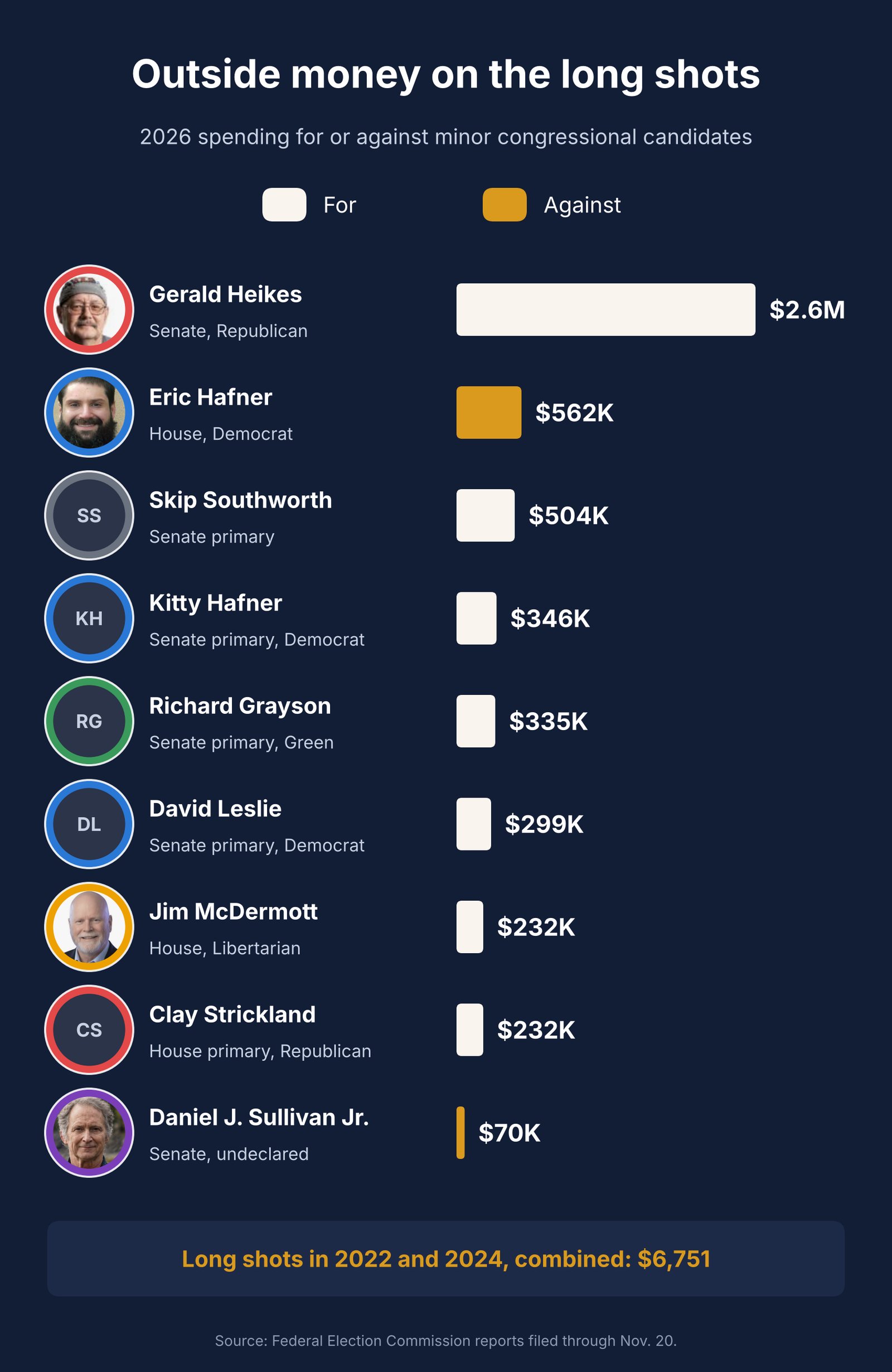
In the Senate race:
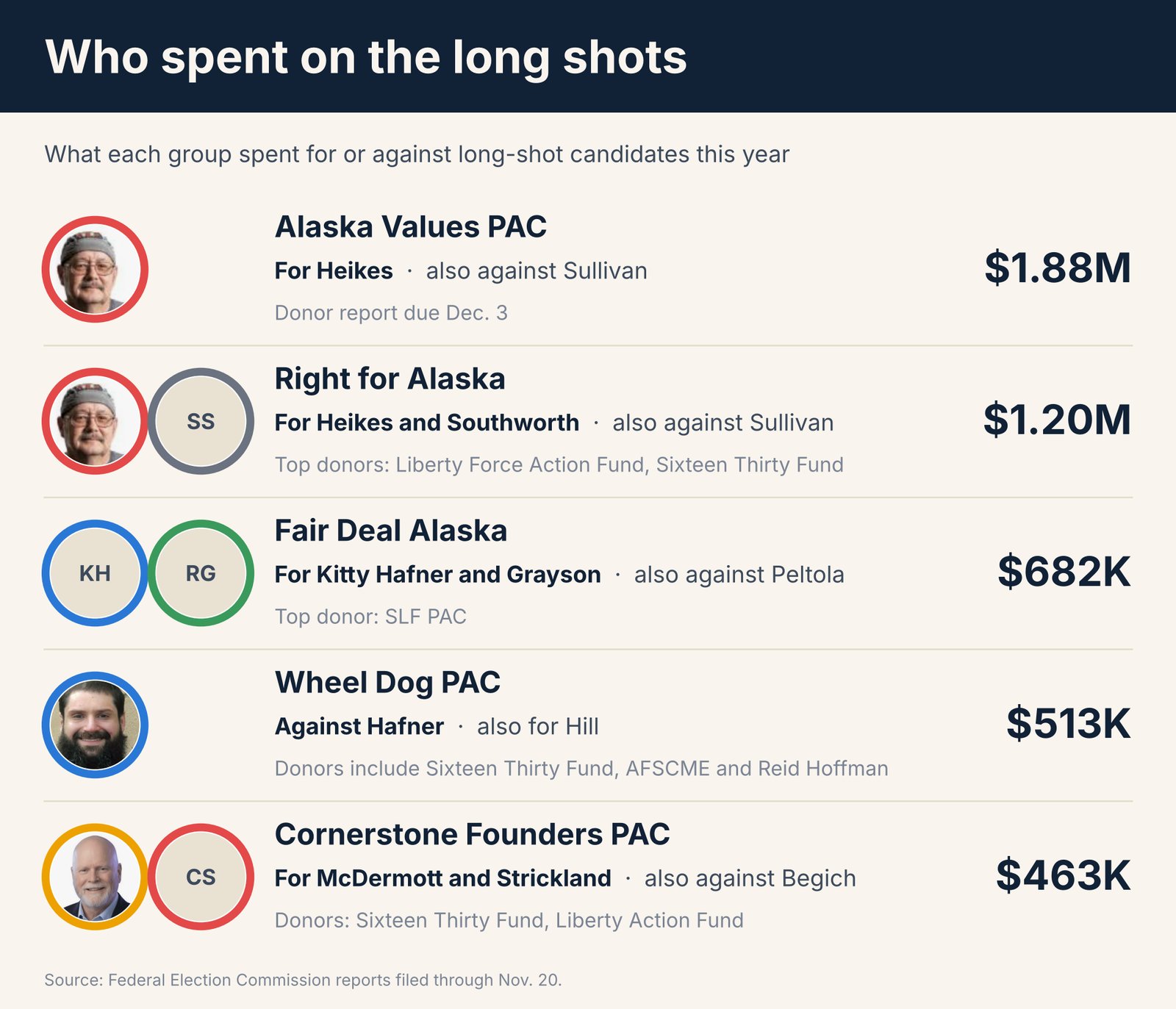
Right for Alaska spent $700,145 supporting Heikes and $503,776 supporting Southworth before the primary, and $1.15 million opposing Sullivan over the cycle. Its largest donors were Liberty Force Action Fund, at $1.29 million, and the Sixteen Thirty Fund, at $990,000, according to its FEC reports. Southworth, who listed his affiliation as the Registered Alaskan Party, won 803 primary votes.
American Democracy Project spent $299,312 supporting Leslie before the primary. Elsewhere this year, it spent to support Democratic House candidates such as Rep. Tom Suozzi of New York and to oppose Republicans such as Rep. Mike Lawler. Leslie finished fourth, then left the race, and Heikes moved up.
Alaska Values PAC registered with the FEC on Sept. 2, after Heikes had moved onto the general ballot. From Oct. 15 to 29, it spent $1.88 million supporting him, and it reported the same $1.88 million as spending against Sullivan. As of Nov. 20, it hadn't reported where its money came from.
Fair Deal Alaska, a super PAC formed July 28, spent in the Senate primary on the other side:
$346,395 supporting Democrat Carol "Kitty" Hafner.
$335,348 supporting Green Party candidate Richard Grayson.
$153,750 opposing Peltola.
Where Fair Deal's money came from: $650,000 of its $850,000 came from SLF PAC, according to its FEC reports. That's the same super PAC that spent $17.6 million against Peltola in the general. Kitty Hafner finished sixth in the primary, with 1,009 votes, and Grayson got 432.
Sullivan Jr.: No outside group reported spending to support him. Working America, which also spent for Peltola, spent $69,765 opposing him, and WorkMoney spent $536.
In the House race:
Cornerstone Founders PAC spent $463,000 in the week before the primary supporting McDermott and Strickland, $231,500 for each. It also spent $125,000 opposing Begich. Its donors were the Sixteen Thirty Fund, at $350,000, and Liberty Action Fund, at $251,000. Strickland finished sixth and left the race; McDermott moved up.
Wheel Dog PAC spent $5.7 million supporting Hill. It also spent $512,759 opposing Hafner, starting with digital ads the week before the primary. Its ads called him a "fake Dem" and a "Republican plant," according to Meta's Ad Library. Its donors include the Sixteen Thirty Fund, the public employee union AFSCME and investor Reid Hoffman.
CFFE PAC, another group that backed Hill, spent $49,173 against Hafner.
No group reported spending to support Eric Hafner, but that doesn't mean no one did. Alaska News found at least two unsigned texts urging Democrats to vote for him that no group has reported paying for.
One went out the week before the August primary, as reported by the Anchorage Daily News, and the other on Oct. 28. Those are only the texts Alaska News knew about; there could have been others.
FEC reports show spending as the groups themselves describe it, for or against the candidates they name.
A small buy in the final weeks may not have to be reported until a later filing, and groups' post-election reports hadn't been filed as of Nov. 20.
Does ranked choice stop spoilers?
A spoiler, in the everyday sense, is a candidate who can't win but draws enough votes from a similar candidate to change who does, as Ralph Nader was accused of doing to Al Gore in 2000.
Ranked choice is meant to fix that: if your first choice is eliminated, your ballot moves to your next choice.
That works only for voters who rank a next choice. A ballot that ranks only one candidate stops counting once that candidate is eliminated, much like a vote for a third-party candidate under the old system.
Researchers call that ballot exhaustion, and it's common. In four early ranked-choice elections in California and Washington, political scientists Craig Burnett and Vladimir Kogan found that about 10% to 27% of ballots stopped counting before the final round and that none of the four winners got a majority of all ballots cast, according to their 2015 study in the journal Electoral Studies.
Mathematicians Adam Graham-Squire and David McCune found the same shortfall in more than half of the 182 American ranked-choice races they studied from 2004 to 2022 that went past the first round.
Their overall finding was that ranked choice's weaknesses "are rarely observed in real-world elections," with exhausted ballots the main exception.
Twice in Alaska's five ranked-choice congressional races, more ballots stopped with an eliminated candidate than the winner's final margin.
In the 2022 special House election, 11,243 ballots for Republican Nick Begich ranked neither Republican Sarah Palin nor Peltola, and Peltola beat Palin by 5,240.
This year, 11,465 Hafner ballots ranked neither Begich nor Hill, and Begich beat Hill by 7,385. The ballots can't show how those voters would have ranked if they had kept going.
Mathematicians use a stricter test for a spoiler: take a losing candidate off every ballot, count again and see whether the winner changes.
By that test, Alaska has had one. In the 2022 special election, Begich would have beaten Palin 101,217 to 63,618 and Peltola 87,859 to 79,451 if each pair were counted one-on-one, Alaska News' rerun of the state's ballot records shows.
But he had the fewest first choices, so he was eliminated first. With Palin taken off every ballot, Begich wins by 7,725.
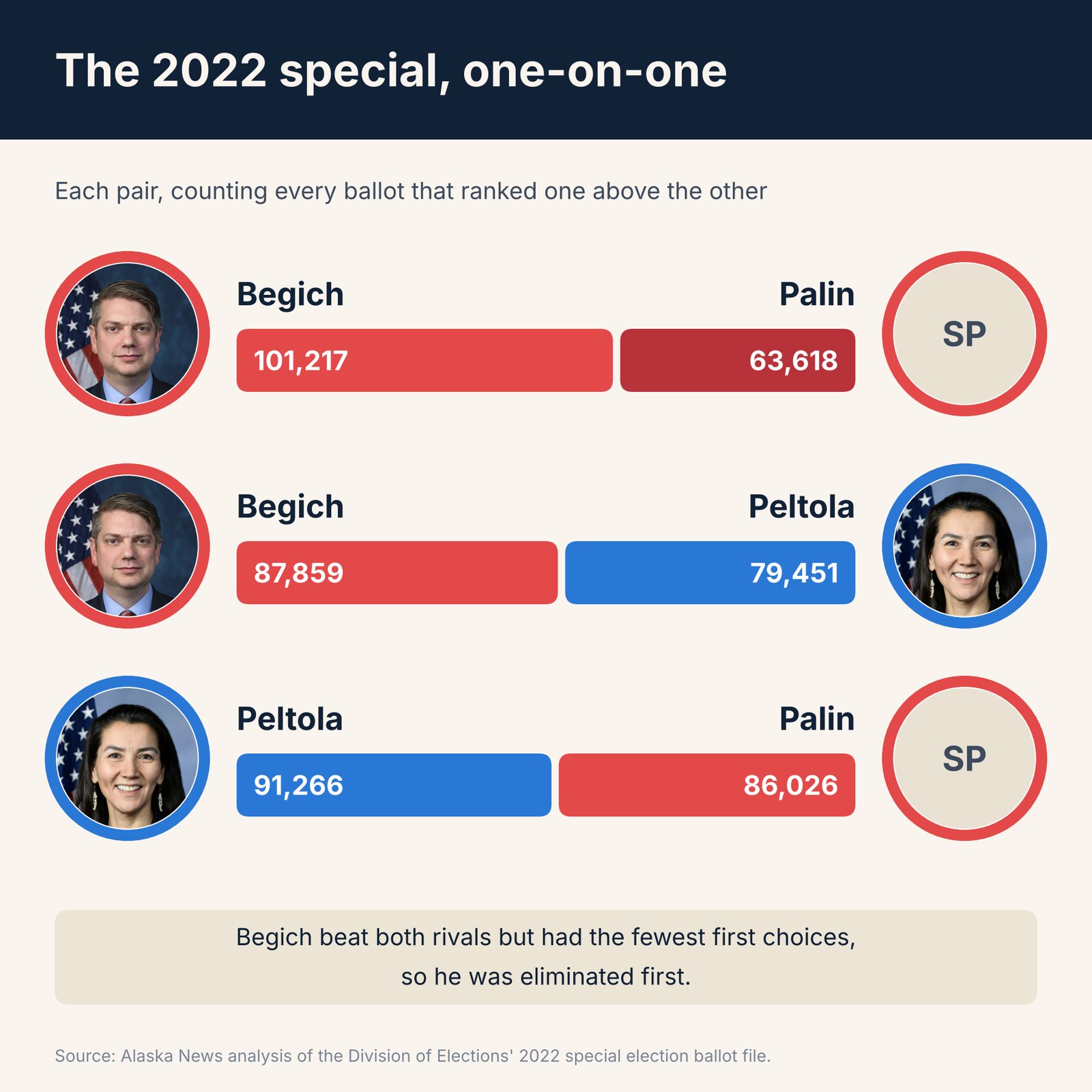
Graham-Squire and McCune counted three spoilers in their 182 races, including that one.
Law professors Nathan Atkinson, Edward Foley and Scott Ganz wrote that Alaska's first election under instant runoff voting, the form of ranked choice Alaska uses, "signaled that the method may fail to elect the candidate most preferred by a majority of the state's voters."
FairVote, a national group that promotes ranked choice voting, disputes calling Palin a spoiler. "Palin did not 'spoil' the race for Begich, because she did not split the Republican vote," it wrote, noting that many Begich voters ranked Peltola second.
It says ranked choice "helps prevent" the spoiler effect. A 2023 study by McCune and mathematician Jennifer Wilson in the journal Public Choice concluded that "ranked-choice voting is superior to plurality with respect to the spoiler effect."
The special election stands out in Alaska's records. In the 36 other Alaska races with three or more candidates that have gone to ranked-choice rounds, including 14 this year, the winner was also the candidate who would have beaten every rival one-on-one, and taking any losing candidate off the ballot wouldn't have changed the result, Alaska News' analysis shows.
Exhaustion is also why telling voters to rank only one candidate can be a strategy. A ballot that ranks only a long shot stops counting when the long shot is out, so it can't help the finalist that voter might have picked next.
Which side that helps depends on the race. Among Hafner ballots that went on to a finalist, Hill led Begich more than 6 to 1. If the ballots that stopped with Hafner had split the same way, Hill would have gained more than Begich; the records can't show that they would have.
Among Heikes-first ballots that ranked Sullivan or Peltola, Sullivan came first more than 2 to 1. If the Heikes-only ballots had followed that pattern, stopping with Heikes would have cost Sullivan more, had the Senate race gone to rounds.
In the governor's race, three Republican tickets split the first round vote.
The texts promoting Hafner that Alaska News found didn't mention rankings. The Oct. 28 text said, "Don't throw your vote away: Vote Democrat, Vote Hafner."
Winning with less than half of all ballots
Ranked choice also changes what a majority means. A winner needs more than half of the ballots still counting in the final round, not half of all ballots cast. Exhausted ballots drop out along the way, as about 14,000 did in this year's House race.
Measured against everyone who voted in the race, not just the ballots still counting at the end, Alaska's ranked-choice congressional winners have landed on both sides of half:
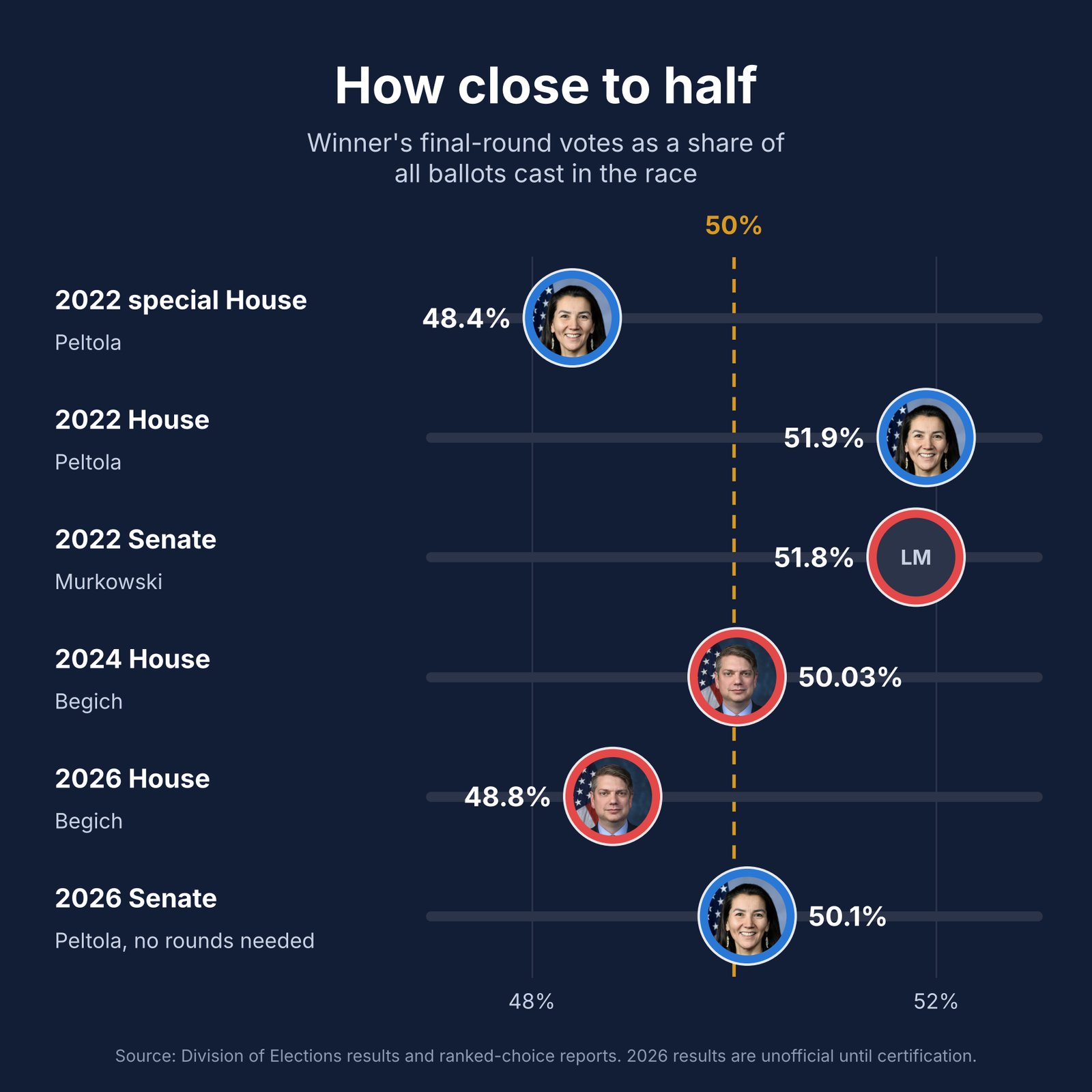
2022 special House election: Peltola won with 48.4%. It had three candidates after Al Gross withdrew.
2022 general: Peltola won the House race with 51.9%, and Republican Sen. Lisa Murkowski won the Senate race with 51.8%.
2024 House: Begich won with 50.03%, about 110 ballots over half.
2026 House: Begich won with 48.8%.
2026 Senate: Peltola won a majority of first choices, so no rounds were needed.
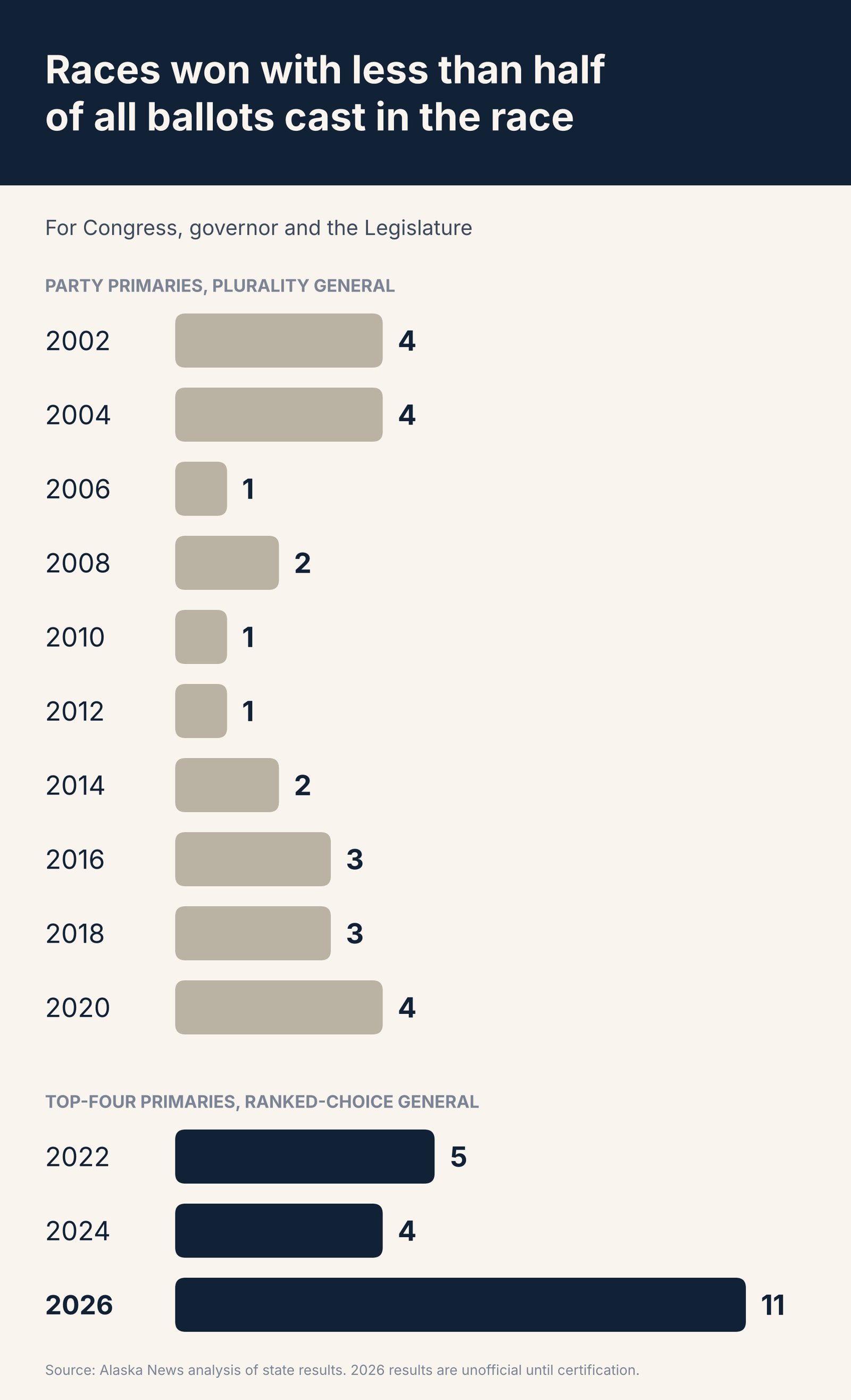
Counting every race for Congress, governor and the Legislature, the winner's final total was less than half of the ballots cast in the race 5 times in 2022, 4 times in 2024 and 11 times this year, according to the state's ranked-choice reports.
From 2002 through 2020, under party primaries and plurality general elections, it happened in 25 of 543 races, and never more than four times in one election.
Part of the difference is the size of the field: up to four candidates now advance from the primary, where party primaries used to send one candidate per party.
Comparing only races with three or more candidates on the ballot, the winner fell short of half in 21 of 77 from 2002 through 2020, 5 of 25 in 2022, 4 of 14 in 2024 and 11 of 21 this year.
Those numbers can't show how the same races would have gone under the old rules. The older counts leave out party primaries, where a nominee could win with less than half the vote.
Turnout is another unknown. This year's 290,323 ballots were the most in any Alaska midterm.
The records can't show whether the voters whose ballots stopped counting would have voted at all under the old system; if they had stayed home, the winners' shares would have been higher.
Both sides of this year's ballot measure on ranked choice made claims about majorities and uncounted ballots in the state's official election pamphlet.

Opponents of Ballot Measure 2, which would have repealed ranked choice and open primaries, wrote that ranked choice "ensures that the winning candidate must earn the support of a majority of the voters," in a statement signed by Senate Majority Leader Cathy Giessel, Nicole Borromeo of the ANCSA Regional Association and Joelle Hall of the Alaska AFL-CIO.
That majority is counted among the ballots still counting in the final round. Begich's 140,346 votes were 51.4% of those this year, but 48.8% of all the ballots cast in the House race.
Supporters of repeal, in a statement signed by former Lieutenant Govs. Mead Treadwell, Craig Campbell and Loren Leman, wrote that "thousands of ballots don't count every year." Exhausted ballots do count for the candidates their voters ranked, until those candidates are eliminated.
Voters kept the system. Ballot Measure 2 failed with 53.81% voting "No."
Legal and on the record
Withdrawing before the deadline is allowed, and the courts have upheld the rule for who replaces a withdrawn candidate.
Outside groups may spend unlimited amounts for or against candidates as long as they don't coordinate with a campaign, and they must report the spending to the FEC, which is how these totals are known.
The public records don't show why any candidate left the race or whether anyone coordinated.
Both major parties have tried to keep a long shot off the ballot through official channels, and both lost.
Democrats went to court over Hafner in 2024, and the Alaska Supreme Court ruled against them.
This year, Republicans persuaded the Division to remove Sullivan Jr., and a judge put him back on.
What did you make of this story? (no account needed)
Made by our human newsroom with AI. How humans and AI work here · Grow with our newsroom ·
Keep Alaska News free for everyone.
No paywall, ever. Members pay so everyone can read the meetings and records Alaska News covers.
Get Alaska News in your inbox
Create your free account and get the day’s top stories around 6 each morning, in a few minutes’ read.
Top stories, around 6 each morning.
Stories on what you follow, on Sundays.
Source: Analysis: About 10,600 Alaska House ballots ranked Hafner and no one else.














Comments
Sign in to leave a comment.
No comments yet. Be the first to share your thoughts.