AI image
Alaska school tests show early gains and a one-in-five participation gap
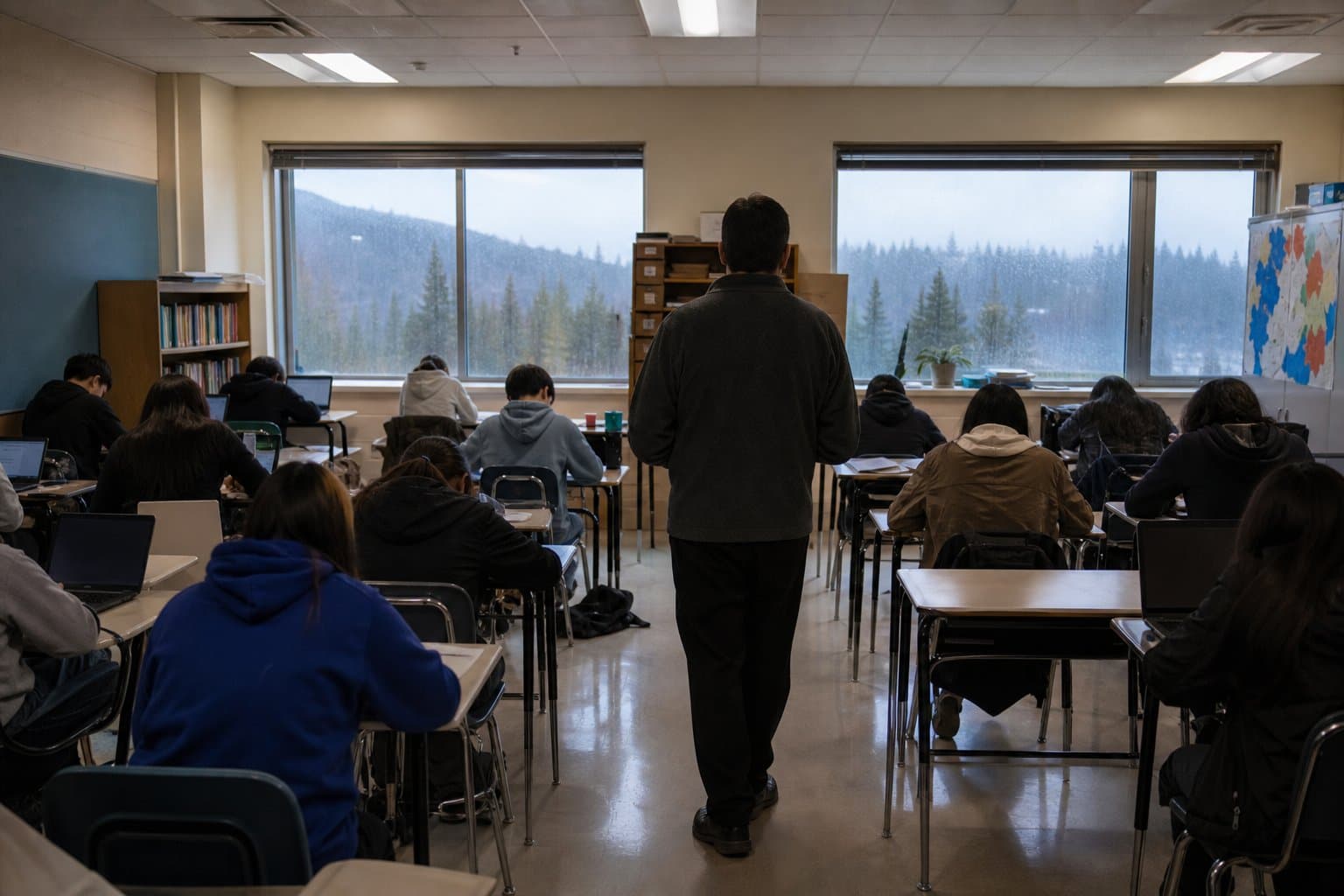
Alaska's latest school test release tells two stories. The first is the one the state led with: younger students are making progress. The second sits deeper in the tables: roughly one in five students in the tested grades produced no score.
The Department of Education and Early Development's two-page brief describes "upward momentum," particularly in grades 3 through 5, while calling achievement in the higher grades relatively flat. The full results support that distinction. Early-grade scores generally moved upward, but statewide proficiency remained at about one-third of students in both reading and math, virtually unchanged from last year. Ninth-grade math proficiency has remained between 17 and 18 percent for three years.
Those percentages describe the students who took the tests. The statewide tables show reading participation fell below 80 percent. Of 66,807 enrolled students, 13,622 had no valid reading score. Math participation was nearly identical. Science participation was lower still, and about one-third of 10th-graders had no valid science score.
The participation gap was not confined to a few tiny districts. Twenty-six of the 50 districts with published reading rates fell below the federal 95 percent target. Together, those districts enrolled nearly nine in 10 students covered by the published district figures. Alaska's four largest districts all missed the target, ranging from about 93 percent participation in Anchorage to 78 percent in Mat-Su.
At the bottom of the list were Nenana City, Galena City and Yukon-Koyukuk, each below 18 percent. All three operate statewide correspondence programs. The pattern extends beyond them: each of the 13 lowest-participation districts hosts at least one program in the department's correspondence directory.
That overlap strongly suggests correspondence testing accounts for a substantial part of Alaska's participation gap. It does not prove that every missing score belongs to a correspondence student. The district tables combine correspondence and neighborhood schools, so they cannot divide the statewide shortfall cleanly between the two.
An April Senate Education Committee hearing helps explain why the gap exists. Sen. Loki Tobin said about 14 percent of correspondence students were opting out. Education Commissioner Deena Bishop described a broader logistical problem. Secure electronic testing requires approved devices and places where students can be proctored, arrangements that became harder as testing moved away from paper and pandemic-era disruptions broke up earlier testing sites. Bishop said the department was exploring at-home proctoring and had sought funding to help correspondence programs create places to test.
Missing the federal target also affects how schools are judged. Alaska does not simply count every untested student as failing. Under its accountability rules, the state recalculates a school's achievement rate against 95 percent of the full-year students eligible to test. Schools that miss the target for two consecutive years must prepare an improvement plan. Academic growth, which carries more weight than achievement in a school's index, is not subject to that adjustment.
The state's brief is not wrong to highlight early-grade gains. But without participation, readers can mistake results for the students who tested as a description of the whole system. Alaska's spring scores show modest progress in some grades, stubborn weakness in others and a participation gap large enough to shape how confidently either result can be read.
Source: Alaska says its test scores are rising in grades 3 to 5. The tables underneath say 13,622 students had no score, and ninth grade math is at 17.9 percent ().
Drafted with AI. Edited by Cale Green (3 revisions). Reviewed by Cale Green. Who is accountable.
Stay informed. Support what matters.
Free, permanent access to local news you can verify. Subscribe to support Walter AlaskaNews and go ad-free.
Related Coverage
Alaska's youngest students are improving in math and reading. Older grades aren't.
Alaska News · 2w ago
Alaska says 4,264 fewer K-3 students ended the year reading at the lowest level
Alaska News · 3w ago
Alaska passed a federal check that keeps its school funding system intact
Alaska News · 3mo ago
Task Force Hears Federal Assessment Rules, NAEP Context, and AKSTAR Demo
Alaska News · 5mo ago
Migratory students lose ground moving between Alaska districts; the state's new alert is an email
Alaska News · 3d ago
Comments
Sign in to leave a comment.
No comments yet. Be the first to share your thoughts.