Alaska Universities Report 73% Jump in Teacher Pipeline Enrollment
The University of Alaska reported Wednesday that student participation in its Ed Rising teacher pipeline program grew 73 percent from last year, offering hope for addressing Alaska's chronic teacher shortage of 324 vacancies.
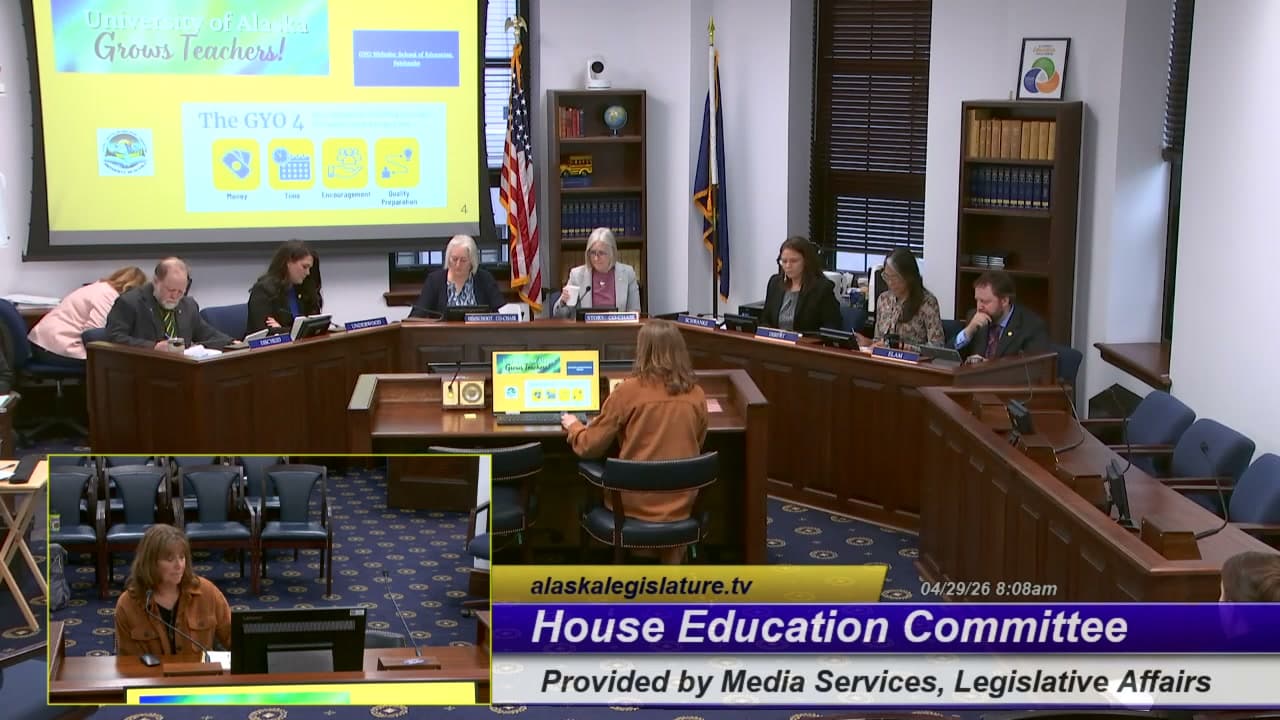
Dr. Bridget Weiss, the university's liaison to the Alaska College of Education Consortium, told the House Education Committee that enrollment in teacher education programs increased across all three UA campuses for fall 2026 compared to fall 2025. The university is preparing to award more than $1 million in scholarships to 109 teacher candidates, with 43 receiving full funding plus living stipends.
"We had from a year ago to this year 73% growth in student participation. That is incredible," Weiss said. "There's room for lots more growth."
The enrollment surge follows years of regulatory streamlining by state education officials. Since 2017, the State Board of Education has approved 31 regulation changes to certification. The changes include expanded alternative certification routes, new certificate and endorsement types, aligned teacher assessments and reciprocity, and streamlined certification processes. Kelly Manning, deputy director of innovation and education excellence at the Department of Education and Early Development, said the changes were designed to strengthen the workforce while making it easier for educators to access certification and providing more opportunities for districts to bring on different types of educators.
Manning also reported that the state's online certification system, which fully launched in June 2024 after stopping paper applications, has reduced processing times to four to six weeks after initially experiencing a backlog. "We piloted with a small number of applications in 2023, fully launching and stopping paper applications in June of 2024," Manning said. "At that time, because we had a backlog of paper applications that we needed to get into the new system, because there was, you know, as there are with new online systems, some glitches and things, our processing times got pretty long, and I know you heard about that, but we now have gotten down to the standard processing time of about four to six weeks."
Commissioner Deena Bishop told lawmakers that a working group of about six superintendents is identifying additional regulatory adjustments. The group is reviewing finalization requirements, Praxis testing, the availability of portfolio options as an alternative to test scores, and clarifying language around major and minor requirements that complicate reciprocity from other states.
The Ed Rising program, which focuses on recruiting high school students into teaching careers, has expanded into rural communities across Alaska. Weiss said many participants are excited about becoming educators, though not all will ultimately choose teaching as a career.
"All of them through this program will definitely be contributing members to our state in some fashion or form," she said.
The university is awarding scholarship letters next week to teacher education students in their third or fourth year, or those pursuing graduate initial licensure programs. Forty-three students will receive complete funding covering all tuition and fees, plus a $5,000 per semester living stipend during their student teaching internship.
"We'll award just over $1 million," Weiss said.
The university has also launched registered apprenticeship programs in preschool, elementary, secondary, and special education to support place-based teacher development. Weiss said Alaska is keeping pace with or ahead of other states in implementing these federally endorsed programs.
"Registered apprenticeship programming is new across our country, the university did not miss a beat collaborating with DEED and other agencies in the state to develop and launch registered apprenticeships for educators," Weiss said. "Alaska is right there. We're either ahead of most presentations we heard or participation, or right next to them."
The apprenticeship programs allow people already anchored in their communities to become certified teachers while remaining in place. Weiss said this builds trust and long-term retention. The university is preparing to expand into educational leadership with a registered apprenticeship program in that area.
Rep. Jamie Story, co-chair of the House Education Committee, asked about adequate funding as a retention tool. Weiss responded that timely and adequate funding is essential.
"When superintendents, our school board members, our educators are spending months every year, lots of time advocating here with all of you, lots of time stewing, trying to run budgets where they don't have the numbers to run a budget when it's due next week," Weiss said. "That is the base."
Weiss said the university has produced initial licensure graduates in declining numbers over the past five years, though current enrollment trends point upward. She attributed the lag to the lingering effects of COVID-19 on student enrollment and the time required to complete teacher preparation programs.
The university is also piloting a dual enrollment course for Ed Rising students using Alaska-based curriculum, replacing the national Ed Rising curriculum. The course will launch this fall.
Weiss said all elementary teacher candidates now graduate with Alaska Reads Act certification, reducing the burden on school districts to certify new hires. The university also operates a statewide mentor project supporting over 150 teachers, pairing recently retired teachers with new or new-to-Alaska educators.
The Alaska College of Education Consortium represents the schools of education at UA Anchorage, UA Fairbanks, and UA Southeast. Weiss said the consortium has fostered collaboration among the three campuses to address the teacher shortage from multiple angles.
"We are pulling out all the stops," Weiss said. "We are looking at it from all directions."
This article is based on a public meeting — Alaska Legislature: House Education - April 29, 2026 8:00am ().
AI-assisted. How we use AI Transcript byLucas Brown
Stay informed. Support what matters.
Free, permanent access to local news you can verify. Subscribe to support Alaska News and go ad-free.
Related Coverage
Alaska's educator apprenticeship program wins permanent federal approval
Alaska News · 2mo ago
Senate Finance considers $1M teacher loan repayment pilot program
Alaska News · 4mo ago
Senate Education Committee advances teacher loan repayment pilot program
Alaska News · 5mo ago
Alaska Special Education Crisis: 200 Teaching Positions Unfilled Statewide
Alaska News · 6mo ago
UAA trains rural school workers to become teachers without leaving home
Alaska News · 1mo ago
Comments
Sign in to leave a comment.
No comments yet. Be the first to share your thoughts.