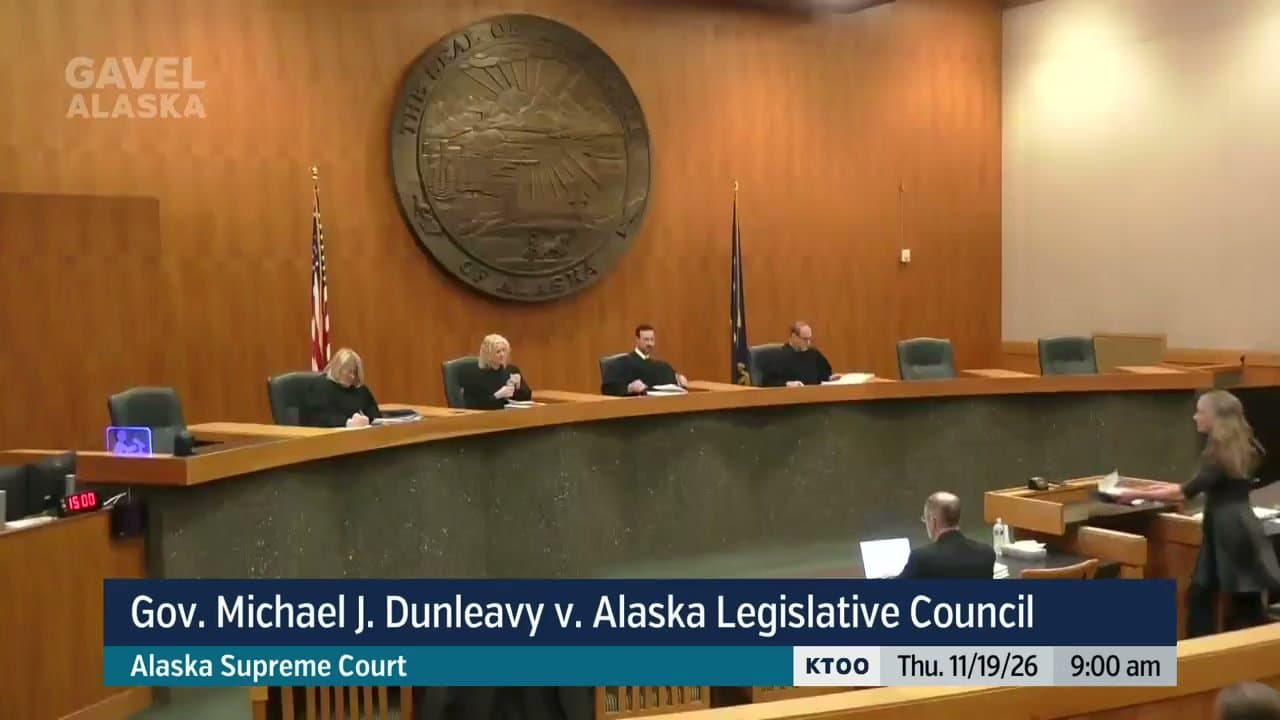
Frame from "Alaska Supreme Court oral argument: Dunleavy v. Alaska Legislative Council (S-19708)" · Photo source
Alaska Supreme Court weighs Dunleavy agriculture order sent during a special session
The Alaska Supreme Court heard arguments Thursday on whether Gov. Mike Dunleavy could create a state Department of Agriculture by sending lawmakers an order during a special session.
The ruling will decide whether a governor can put a plan to reorganize state government before lawmakers in a special session, where they have at most 30 days to reject it, instead of a regular session, where the constitution gives them 60.
Agriculture is now a division inside the Department of Natural Resources.
Dunleavy first tried to make it a department at the start of the 2025 regular session, with Executive Order 136. Lawmakers rejected that order in a 32-28 joint vote on March 19, 2025, according to the House Journal.
The Governor then called a special session for August and issued a similar order, Executive Order 137, the day before it opened.
Lawmakers refused to accept it, citing constitutional concerns, and their Legislative Council sued. A Juneau Superior Court judge sided with the Legislature on Dec. 31, 2025, a day before the order would have taken effect. Dunleavy appealed, and agriculture has stayed a division in the meantime.
The case turns on one sentence of the Alaska Constitution. It gives lawmakers "sixty days of a regular session, or a full session if of shorter duration" to reject a governor's reorganization order.
The two sides disagree on whether "a full session" includes a special session.
"A special session is a session. The court does not add missing words to the Constitution," said Laura Fox, the governor's attorney.
Lawmakers can vote down an order in a special session for any reason, she said, including wanting more time. "If they want more time, they can just vote no."
Kevin Cuddy, arguing for the Legislative Council, said the case asks whether the governor "can force the Legislature to consider certain executive orders during a truncated 30-day special session."
No governor had tried it before, he said, and EO 137 would "jam or shoehorn 40 changes of Alaska statutory law into a special session that is constitutionally limited to just 30 days."
Lawmakers took 58 or 59 days to work through the earlier order, Cuddy said, and the delegates who wrote the constitution never mentioned special sessions.
"That silence matters," he said.
The justices pushed back on both. Justice Dario Borghesan told Cuddy he was "starting with a lot of inside baseball," drafting history voters likely never saw.
Justice Jude Pate asked him, if the provision is clear on its own, "What's left to clarify?"
But Borghesan also told Fox, "It is hard to ignore, though, the consistent use of the term regular in the draft provisions up until the end." And Justice Jennifer Henderson asked whether Fox's argument minimized "the importance of full consideration by the legislature of what the governor is advancing."
The Legislative Council has authorized up to $185,000 for its outside lawyers.
Borghesan said the court will "take the matter under advisement and issue a decision at a later date." Chief Justice Susan Carney did not attend; Borghesan said her participation, if needed, will be decided later.
Dunleavy is term-limited and leaves office in December. The court gave no timeline for its decision.
What did you make of this story? (no account needed)
Made by our human newsroom with AI. Reviewed by Cale Green. How humans and AI work here · Grow with our newsroom · Transcript byWalter AlaskaNews
Keep Alaska News free for everyone.
No paywall, ever. Members pay so everyone can read the meetings and records Alaska News covers.
Get Alaska News in your inbox
Create your free account and get the day’s top stories around 6 each morning, in a few minutes’ read.
Top stories, around 6 each morning.
Stories on what you follow, on Sundays.
This article is based on a public meeting of Alaska Court System — Alaska Supreme Court oral argument: Dunleavy v. Alaska Legislative Council (S-19708) ().
Watch key moments from the source meeting. Click to expand.











Comments
Sign in to leave a comment.
No comments yet. Be the first to share your thoughts.