Alaska Supreme Court oral argument: Dunleavy v. Alaska Legislative Council (S-19708)
Alaska News • • 43 min
Articles from this transcript
Alaska Supreme Court weighs Dunleavy agriculture order sent during a special session
The Alaska Supreme Court heard Dunleavy's case for creating an agriculture department through a special session. Justices pushed both sides and didn't rule.

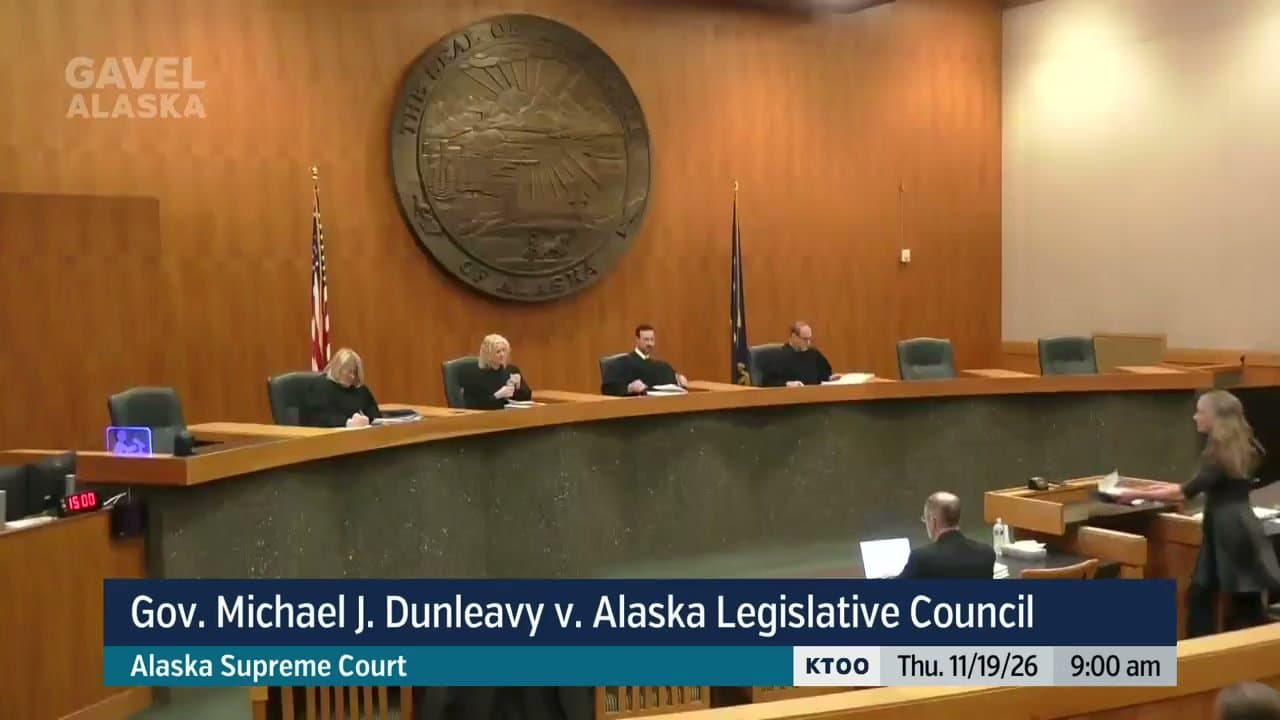
The Honorable Justices of the Supreme Court of the State of Alaska. Please have a seat.
The Supreme Court is now in session. Good morning. We're hearing the matter of Governor Michael J. Dunleavy versus Alaska Legislative Council. I believe Ms. Fox is arguing for the appellants, and you're going to take 15 minutes and reserve 5 for rebuttal. Mr. Cuddy will be arguing for the appellees.
Whenever you're ready, Ms.
Fox. May it please the Court, my name is Laura Fox, and I represent the Governor in this appeal. A special session is a session. The court does not add missing words to the Constitution, and you'd need to add missing words in order to limit the Governor's executive reorganization power under Article III, Section 23 to only regular sessions of the legislature. There's no reason to add those missing limiting words.
Just applying the plain text, which is not limited to regular sessions, best furthers the provision's purpose, because excluding special sessions is arbitrary and unnecessary. The legislature can vote against a governor's reorganization plan just as well during a special session as during a regular session, and it can vote no for any reason, including just because it wants more time. Nothing in the largely silent drafting history outweighs this provision's plain text and purpose. So with that, I'll start by discussing the provision's text, and then its history, and then its purpose. So the court always starts with the constitutional text.
And that includes not just this one disputed sentence, but also the entire constitutional text, which must be read harmoniously. So the disputed sentence says, "The Legislature shall have 60 days of a regular session, or a full session if of shorter duration, to disapprove these executive orders." And the question here is, what is a full session? Well, the Constitution defines two types of sessions, regular and special. And both are sessions. Special session is a perfectly valid legislative session for all legislative purposes.
It's not some sort of second-class legislative session. The only limits the Constitution places on special sessions are the ones that are in Article II, Section 9, which is the provision defining special sessions. So, Ms. Fox, um, you've argued in your brief that to, um, to limit this this authority, the Governor's authority to regular sessions, you know, the Legislative Council's interpretation really requires implicitly adding the word regular to the clause or full session. So it's like a full regular session. They respond to that argument by pointing out later in the provision it refers to joint session.
No audio detected at 2:20
And so their argument is that actually your interpretation requires implicitly adding the terms but not joint session, but not— right. Can you respond to that argument? Right, so joint sessions are not a third type of session because the Constitution never uses joint session as a noun. It never says a joint session or the joint session. It only ever uses the adverbial phrase "in joint session" to refer to something that the legislature does during a regular or special session when they meet together.
And you can tell that even from this very provision, Article III, Section 23, because it says that the disapproval vote has to happen in joint session. So even if we were just looking at regular sessions, under this provision, in joint session has to be something that happens during a regular session, not a third type of session. So there's only two types of sessions defined in the Constitution. They both have their own provision of Article II. It's a regular session or it's a special session.
So I understand the logic of that. It makes sense. Is pretty nuanced read of the language. And if our primary focus, as you've argued, is what do the voters think when they voted on this, are they going to pick up on that nuance? Well, the voters—.
Oh, sorry. I'm just— I guess my question is, does that understand the logic of your argument? Does that make it ambiguous enough that it would be appropriate even within sort of the the argument about the role of legislative history in constitutional interpretation, even within accepting your arguments about that, does that joint session piece create enough ambiguity that it would be appropriate to lean on that? No, nothing. I mean, if you look at the constitutional text as a whole, if a voter is reading through that constitutional text, they're not going to come away with thinking that there's a third type of session called a joint session.
There's, as I said, in Article II, there's a provision saying special sessions, there's a provision saying regular sessions. Those are the only two types of sessions defined in the Constitution. And so if you look at the constitutional text as a whole, like I said, not just this one provision, but the entire text, you would come away thinking there are two types of sessions. There's a regular session, there's a special session. And when the Constitution refers to just a session, it's covering both.
And there's examples of that in the reply brief too. So on page 10 of the reply brief, the Constitution doesn't say regular or special session. Article 2, Section 6 says legislators attending, quote, legislative sessions are not subject to arrest. It doesn't say regular or special legislative sessions. There's some other examples of that too.
The Constitution doesn't use that redundant extra phrasing, regular or special. It uses the word session to cover both. And it knows how to specify just regular or just special by using those adjectives when it wants to. It also— there's also another way in Article 10, Section 12, the provision about local boundaries. It uses the definite article "the" to point back to a regular session that was previously mentioned.
No audio detected at 5:40
So Article 3, Section 23 does not do either of those things. It doesn't say a full regular session. And it doesn't say "the full session" to point back to the previously mentioned session. So without those missing words, no grammatical principle imports the regular from the first part of the sentence into the second part of the sentence. You need to add those missing words if you want to limit the provision to only regular sessions.
And so what the council mostly points to is the history. But the history doesn't justify departing from the text here. We don't even have— sometimes when you have legislative history or constitutional history, you have the delegates, one delegate saying, "I think the language means this," or something like that, where the provision is being substantively discussed. But we don't have anything like that here. There's no substantive discussion of that at all.
There's nobody saying, "Oh, well, of course we have to limit this to regular sessions because XYZ." We have nothing like that. So like in the Warren v. Boucher case, the court was also looking at some constitutional history. It said, eh, some delegates said this, some delegates said that. But in the end, the history did not, quote, reveal an agreed-upon meaning or a consciously adopted definition of what the critical language should mean. Same thing's true here.
The delegates didn't even talk about this. So like in that case, the court should rule based on the constitutional text and its purpose. Rather than trying to read historical tea leaves that just aren't there. Would you please address the Style Committee's authority to change substance? Because it seems like— I mean, if you just read it straight across, it seems like maybe the Style Committee, the Style and Drafting Committee, did make a change in substance to what had been previously provided.
Is that— how would you respond to that? Well, I'd say a few things. So one thing, the governor is not asking the court to infer anything from that sparse drafting history. It's the counsel that's asking the court to infer something. And I'm asking you to respond to that.
And right. The court has never said that the proper way to interpret the Constitution is just to undo the changes of the Style and Drafting Committee on the theory that none of those changes could possibly touch on substance, and that we should just look at the prior drafts instead. And there's at least 4 reasons why in this particular situation, the Style and Drafting Committee restrictions are particularly not helpful. So first, the Convention gave unanimous consent to these changes, which is the technical step necessary, and that's explained at footnote 93 of the reply brief— or the opening brief, sorry. Second, the committee consulted with the substantive committee, which it said when it reported that it had cleared the changes with the substantive committee and that this is what the substantive committee wanted.
Third, at the same time as this change to this very provision, The committee also made another indisputably substantive change that's not being disputed here by giving the governor the power to set an effective date. And fourth, the committee chair in this situation did not explicitly disclaim having made any substantive changes at all, which is something that committee chair did in other situations, like when they were making the changes to Article II, which is discussed in the Glover case. So, so again, The governor's not asking the court to infer something from the drafting history. The governor is just saying the drafting history is not providing anything here that would override the plain text. It's not particularly helpful here.
The court should focus on what the final text that the voters ratified and the provision's purpose. It is hard to ignore, though, the consistent use of the term regular in the draft provisions up until the end. So, you know, if we are looking at that, and we're looking at that the evolution of the language, it seems like your position is the best way to understand that is that the Style and Drafting Committee did make substantive changes, and there's no strong indication that no one wanted that. Well, again, we're not asking the court to infer anything from the drafting history. We're asking the court to look at the final text, because the starting point is the final text.
No audio detected at 9:40
No audio detected at 9:50
It's backwards and upside down to decide we're going to start with the prior drafts and try to figure out why they were changed, and if we can't figure out why they were changed, we're just going to go back to them. Unless we think there's some ambiguity. Well, to the extent that the court finds— I don't think that there's any ambiguity in the text, but even if the court remained a little bit uncertain about the text, the best thing that we have here to resolve the ambiguity here is the purpose of the statute. We don't have anything in this history that tells us that these delegates really thought it was important to limit it to regular sessions, or that, you know, they thought it would be bad if it extended to special sessions. So we don't have any substantive discussion at all.
No audio detected at 10:20
So to the extent that we need something to resolve some lingering uncertainty, even though, again, I said the plain text is clear, we don't have those words, but if you need something to resolve an uncertainty, the purpose of the provision, Creek, is the best thing to look to. Doesn't this also skip over what's happening concurrently on Article 2 at the same time? In Article 2, they are talking about whether they should adopt a temporal limit to regular sessions. They are talking about special sessions and the purpose of those. And my understanding is those provisions were approved out of committee like 3 or 5 days before the final version of what we are talking about here in Article 3.
Certainly they were looking at all of these things together, and actually the closest thing that we have to any sort of on-point delegate comment in the history of this provision is referring to that Article II situation, and it supports the governor's view of the drafters' animating concerns. So that's when we have Delegate Rivers saying, "Hey, we need to add a time limit to this provision," because, quote, "the fact came out that," quote, "we have a continuous session." They said actually the regular session is not even going to have a definite endpoint. So we need to put a time limit on this, otherwise the governor is going to have to wait too long, potentially forever. It's going to be an indefinite time period. I think you can see that evolution of the temporal limits throughout the versions.
No audio detected at 11:40
It began with the next regular session, which could be a long time because concurrently they are talking about regular sessions maybe only happening biennially. So that could be 4 years. And so I think what's kind of absent here is that everyone says, oh, Article II powers, Article III powers, but these things are happening concurrently. So, and it— and Two Rivers was active in Article II discussions as well. So can you shed some light of what the understanding of— I mean, if the language, if the evolution of the language was always saying regular session and they're talking about a regular session, should we— I think someone even said Should it be 30 days?
Should it be 60 days? That makes sense when you look at the final language because they were contemplating maybe a regular session could be shorter than 60 days. Well, I mean, there isn't— there isn't any discussion where they're saying should it be 60 days? Should it be 30 days? They are in the Article 2, in the article.
Oh, for the Article 2? Yeah. Yeah. One, I mean—. And it's the same people.
I mean, they don't like compartmentalize their knowledge when they go in and talk about—. Exactly. But I mean, to the extent that we have anything about this provision, It's expressing a concern that the governor shouldn't have to wait too long. And the point of this provision is to give the governor this useful power to reorganize the executive branch, subject to an opportunity for the legislature to say no. And so Delegate Rivers' one on-point comment here is saying, well, the governor shouldn't have to wait forever for that legislative opportunity to say no.
No audio detected at 13:20
We need to put a time limit on that. And so then they put a time limit in that. That's not a concern about we need to make sure that the legislature has a long time, a long runway for, you know, potentially as long as it wants to say no. It's a concern that the, you know, this, you know, the point of this is to give the governor this power subject to this opportunity for legislative veto. And so the important thing is that, you know, there is the legislature can say no, but if the legislature doesn't say no, then the governor's plan can go forward.
So can I ask you an unfair question? Well, I'm going to. Let's just assume for argument that the legislature and the governor have good counterarguments all the way down through our entire constitutional evaluation rubric, and we have to come out and decide what makes sense for reason and policy. What is your best policy argument that we should adopt the governor's reading? And yes, I will ask Mr. Cuddy the same unfair question, but he gets lead time.
No audio detected at 14:20
There's just no reason that the exercise of this useful constitutional power that they were trying to give the governor should have to wait around for a regular legislative session, because the whole point of having special sessions is that sometimes either the governor or the legislature doesn't want to wait for the regular session to roll around, and the Constitution provides for special sessions because of that. And there's just— a special session is a perfectly valid legislative session for all legislative purposes, including you know, passing legislation or doing a veto resolution. And so to the extent that the point is to allow the governor to do this unless the legislature says no, a special session is a perfectly valid opportunity for the legislature to say no if it wants to, and including just because it wants more time. And he can call a special session unlike regular sessions, which is the legislature. I mean, either— again, the reason we have special sessions is because either the governor or the legislature might want to have a session at another time of year and they don't want to wait for the regular one to roll around.
No audio detected at 14:50
And the governor can't force the legislature to do anything he wants at the session. He can call the session, but, and the legislature can just say, "No, we're not going to do what you want." But it's just, it's a perfectly valid legislative purpose session for all purposes other than as limited by the provision defining special sessions. A perfectly good opportunity to say no for any reason. And so I don't want to use up all my rebuttal time.
Thank you. Thank you. Mr. Cuddy.
No audio detected at 16:20
Good morning. May it please the Court, Kevin Cuddy on behalf of the Alaska Legislative Council for the Alaska State Legislature. This case is about the proper interpretation of Article III, Section 23 of the Alaska Constitution, and in particular it asks whether the Governor can force the Legislature to consider certain executive orders during a truncated 30-day special session for a possible legislative veto, as opposed to the 60-day window that is contemplated by Section 23. The Court has an established framework for deciding these types of issues. When there— the constitutional question is not squarely addressed by precedent, the Court's first step or starting point of the analysis is the plain text of the constitutional provision as clarified by its drafting history.
No audio detected at 16:40
No audio detected at 16:50
The Court also, of course, looks to the purpose of the provision, and I'll be addressing all of those today. We agree with the Governor that this issue is not squarely addressed by precedent. And the reason for that, we submit, is because no Governor in the history of the State has ever attempted to do this, to try to jam or shoehorn 40 changes of Alaska statutory law into a special session that is constitutionally limited to just 30 days. And we submit that it is unprecedented because it's clearly at odds with Section 23. I'm first going to put the language of the provision into context by addressing the clarifying drafting history.
Then discuss the plain language, and then finally talk about the, how the legislature's interpretation best aligns with the purpose of Section 23. You heard my friend talk about how the drafting history here is quite sparse, and so I'd like to walk through that a little bit with you this morning. The first 3 drafts of the language that would ultimately become Section 23 all contain substantively the same language. It says that executive orders requiring the force of law shall become effective at the close of the next regular session of the legislature, unless there is a legislative veto. So it contemplates full regular session for that exercise.
That changes with what we've called the Rivers Amendment, for the chair of the Committee on the Executive Branch, Delegate Victor Rivers, who explains at page 3322 of the Constitutional Convention minutes, now we are going to add in there the words, unless disapproved by the legislature in 60 days or the adjournment of the legislature if it takes place sooner, but we haven't got the exact wording ready yet. That's, that's the quote from him. So in plain English, he's saying it's either going to be up to 60 days, or if it adjourns earlier, it'll be that, that shorter window. No reference to any different session or any special session. That then gets memorialized at excerpt page 24, where they say that the executive order becomes effective after 60 days of a regular session of the legislature having elapsed, uh, have elapsed following their, their issuance, or at the close of the next regular session, whichever is sooner, unless of course there's this legislative veto.
No audio detected at 18:50
So it references regular sessions twice. Chairman Rivers explained that this was a quote-unquote minor substantive change at page 3322, and the reason for the change my friend was describing is to put a cap of 60 days because the Framers had now decided to go with this continuous regular session. And so there was not going to be a fixed end date, and you needed to have some sort of finality there to provide. That then gets turned to the Committee on Style and Drafting the following day where they offered what they called suggestions for redraft of substantive amendments. And Ed Pay— Excerpt page 166, the chair of the Committee on Style and Drafting explains that we have cleared our proposed language with the chairman of the Committee on the Executive, Mr. Victor Rivers, and we understand that our language expresses the substance which was desired by the committee when it brought in the amendments.
There are 4 takeaways, I would submit, from this drafting history. The first is that you have consistency across the drafts. It is always explicitly contemplated that the legislature would have time during the regular session for a legislative veto. Second, the Rivers Amendment, which sort of sets off this changed view, was deemed to be a minor amendment that addressed how Section 23 would work during a continuous regular session. It has nothing to do with special sessions.
Uh, third, the Committee on Style and Drafting was simply trying to express the substance of what Chairman Rivers and his committee had previously explained to the delegates. That is, the executive order should become effective unless disapproved by the legislature within 60 days, which refers to the regular session, or the adjournment of the legislature if it takes place sooner.
As the court noted, this committee is not authorized to change the sense or purpose of any proposal referred to it, and that is why, as a general rule, changes in meaning should not be derived from the edits of the Style and Drafting Committee, as found in the Glover case. Fourth and final takeaway here is there is simply no mention of special sessions. Nowhere. It's not in the drafts. It's not in the committee reports.
Not even mentioned once in all of the debates. That silence matters. This simply was not a consideration. I guess the difficulty with the way you've laid out this analysis is you're starting with a lot of inside baseball. You're starting with a lot of legislative history— we'll call it legislative history— that probably the voters wouldn't have been aware of.
The voters are confronted with the text when they go into the booth to decide, or, you know, they get the pamphlet, you know. So I'm not saying that like this is unhelpful or we need to know this, but why do we start there? Like, why should we start by what the draft looked like at the beginning when that's not what the voters saw and that's not what they voted on, right? They probably didn't even know. Of course.
No audio detected at 22:10
And they never know, right? They're not present at the convention. But this court has always, for decades, in the Boucher case that my friend cited, Starr v. Haglund from the 1960s, coming through to the Forrer case in 2020, Dunleavy v. Alaska Legislative Council in 2021, we have always looked to the draft of the statute. Does there have to be ambiguity? Or maybe a different way of posing the question.
No audio detected at 22:30
Is if there weren't ambiguity, would it be appropriate for us to elevate the inferences that we drew from the constitutional proceeding history over what the plain text of the provision seemed to say? So I've never seen it articulated quite that way, to say that you're elevating anything over anything else. Instead, I think the proper way to look at this is that this is what the court has said. This is a clarifying exercise. We're trying to better understand what was intended here.
What did the framers mean? What were the problems they were trying to solve in establishing that process? So we have two different tracks here. You have the framers' intent and what the people would have ultimately understood. But the court has always considered both, and they're both essential to a proper understanding of what the meaning is.
Counselor Teddi, the constitutional provision is— itself, without reference to the drafting history, is clear and unambiguous. What's left to clarify?
If there's nothing left to clarify, then there is nothing left to clarify. We would submit that that is—. So are you arguing that the constitutional provision is ambiguous?
Frankly, no, Your Honor. We think that the provision is clear on its face, and I'm about to talk through the—. And even— I know that this is not your argument, but divorcing it from the drafting history, the language itself is clear and unambiguous? We submit that the language is certainly clear enough on its face. That readers of the provision would have reached the same conclusion as every Attorney General who looked at this prior to 2025, and even this Court, in assessing that the legislature should have 60 days.
No audio detected at 24:10
And it would be unreasonable for anyone to read that— it would be unreasonable for anyone to read the provision and assume that it could apply to a special session? I'm not going to say it would be abjectly unreasonable to interpret it in a particular way. But I think that the point of the exercise— and I'm about to talk through the plain meaning analysis here— uh, the point of the court's exercise today is not to figure out what is a possible interpretation, to try to assess whether if you squint just hard enough, can you, can you see a way that the word session could mean special session or joint session as opposed to regular session? The question is, what, what is it? What is the right understanding?
No audio detected at 24:30
What is the correct assessment? And we look to all the tools that the court has traditionally used for decades, for the entirety of the Court's jurisprudence in evaluating these provisions. And that includes assessing the drafting history, the framers' intent, but also looking to the plain language, as I'll talk about here in a moment. Well, isn't plain language the driver? I mean, I think to Justice Payt's point, if there's no ambiguity, why don't we just stop there?
That's what it means. What it says, what it means. It is always the plain language as clarified by the drafting history. The court considers them to be part of the same exercise, which they are. Does that undermine— I guess that does that undermine— so this is different than legislative history, and I feel sometimes our cases have cross-pollinated the two types of analyses.
No audio detected at 25:40
In legislative history, when we're interpreting legislation, the same people that are voting on the text are the people who have been part of the debates and have been part of the the negotiations and seeing the, you know, the bill files and such. And so all that is informing their judgment of the language. I'm not sure that can be said for constitutional history. So I just— and I know your argument is that there's— the language is not clear and maybe it's clear in your favor. But, you know, just as I would say more as a a question of like methodology.
No audio detected at 26:10
If the language was clear in one way, could— clearly supported one interpretation over another, could we then go interpret it in a different way because of legislative history? Right. So I'm going to borrow my friend's example from the opening brief, which is to say, if the text had said green and the drafting history had said blue. Could you interpret it that way? I would struggle to find a way to make that happen.
No audio detected at 26:50
That is not this case. The question is simply, what did the framers mean? What did the people understand? What does a reasonable person looking at this understand when they're looking at a provision that says that we're talking about 60 days? So those are 3 different things, though.
Like, what did the framers mean? What did the person voting on it mean? And what does a reasonable person looking at it now understand, right? Aren't those three different questions? Not in this case, Your Honor, no.
They overlap, and they are intertwined, because we submit that the provision is frankly not ambiguous. It's not so unclear. But we always look to the framers' understanding to understand what are the issues they're even dealing with? What are the problems we're trying to face? And that, again, is consistent across the court's jurisprudence for half a century now.
I understand that the voters would not have access to all of this information under the provision. Mr. Petty, I know that you want to address plain language. I do. So I'm not going to take long with this question, but it seems like some of the concerns that you've just been addressing tie into purpose and how the, I guess, opposing interpretations of the language either would best support the purpose.
And so I wonder, as you're moving into plain language, given the limited time, if you can also address that argument related to purpose. I will.
And perhaps at the— your invitation, Your Honor, I'll go ahead and talk about purpose now, and hope that I'm able to address all of those questions. The debate during the drafting process really focused on the legislature's ability to exercise a legislative veto as a check on the governor's power when this reorganization required what they called the force of law, which is to say new laws were going to be created or deleted or amended in some way. And all of this debate was being done with the backdrop of these early drafts that we just talked about where the legislature would have a full regular session to exercise that authority. So Delegate Rivers— this is— Pages 2227 and 2228 of the committee minutes, he explains the two different purposes. On the one hand, you do have to provide an opportunity for the governor to recommend changes to support organizational efficiency.
No audio detected at 28:30
No audio detected at 28:40
This is his or her branch, and he or she should be allowed to make some of those changes. However, if and when those changes require the force of law, that we're going to be basically invading the legislature's sphere of influence, then it would require the, quote unquote, "concurrence" of the legislature in the case of any such major change. So what he said is that it does give him the power to alter existing organizational structures that have been set up by law, but only after the legislature has failed to say, "No, we won't let you do that." So we have these two elements of making sure that the governor is able to make certain changes, And the governor can make any change that he wants as long as he's not changing the law, right? That, that's the only time when this force of law element comes in. But when he starts to, to step over that line and require lawmaking, uh, changes to the provisions, that's when the legislature has not just the right but the constitutional duty to step in and make its views heard.
And what we saw with the treatment of the nearly identical executive order that the governor submitted, 136, at the beginning of that regular session, is that it takes time. If you're, if you're going to take this job seriously, as the legislature does, you have to get constituent input. You're scheduling hearings, you're having debates. I think it was either 58 or 59 days for them to do that work with respect to Executive Order 136. That is the 60-day window that the legislature contemplates with, with Section 23.
And to have that circumvented by jamming everything into a special session where other important issues are also on the docket really turns the interpretation on the head and undermines that purpose, all in favor of allowing the Governor to make changes that affect the laws as quickly as possible. That is not what the framers intended or what they described. The language allows for a shorter session. It does. So they're contemplating it could be done in a shorter amount of time than 16.
No audio detected at 31:00
—Exactly, Your Honor, and it does so at the legislature's discretion. If the legislature determines that it can complete all the work it needs to do in 29 days, or 5 days, or 2 days, so be it. That is their choice. No, the language says "or a full session of shorter duration," which means the language of the provision contemplates it could be done in less than 60 days. I'm agreeing with you, Your Honor.
No audio detected at 31:30
The point is that it is the legislature's choice. It is not the governor's call to say you should only have 10 days to consider the session. I thought that we have a legislative limit on the amount of the session and then there's a constitutional amendment to create, I think, 120-day limit. But at the time that this was being drafted, wasn't it contemplated that the legislature could say like we're going to have a 45-day session and put that in statute? Or am I misunderstanding how that works?
No audio detected at 31:50
No audio detected at 32:00
I think that you are, Your Honor. The point being that you have a continuous session as they were working through it. The legislature, under uniform rule, I think it's 51 or 52, they make the call as to when they have completed all the work they need to do. So it could be a shorter session than 60 days if that's what they decided to do. But as a practical matter, we know that since the 1970s, that's just never been the case.
No audio detected at 32:20
No audio detected at 32:30
But this 120-day limit obviously wasn't in place at the time that Section 23 was being—. But they were contemplating having shorter sessions of 30 days when they were discussing Article II. Yes. It was a possibility. When we get to the Rivers Amendment, as Your Honor had noted, that was gone, right?
The 60-day limit was out, and we were into a continuous session. So was it possible that they were going to be able to complete all their work before 60 days? Yes. But by the time that we're into Section 23 and its actual adoption, we've got the continuous session. And so it's going to be up to the legislature to decide how much time do they need in order to do this work.
So I hope that I've addressed the purpose. I do want to circle back to the plain language in the time that I have. Left here.
The— if I can find my place. The language at issue is fairly straightforward in providing that we'll have— the legislature shall have 60 days of a regular session or a full session if of shorter duration to disapprove these executive orders. The parties agree that this phrase, of shorter duration, necessarily refers back to the beginning of the sentence. It's the only way that it makes any sense at all. Of shorter duration than what?
Well, of shorter duration than 60 days of a regular session. The Governor would like to slice and dice this phrase so that the term "a full session" is somehow completely independent and has no relationship to that first part of the sentence. We submit that the more reasonable and thoughtful Assessment of that and how the voters would have understood it is that the same, the same referential phrase would apply to both parts, so that the entirety of, or a full session if of shorter duration, would apply by using the beginning part of that sentence. It's a dependent phrase. It doesn't contain its own independent subject and verb.
It relies on the remainder of the sentence context for its meaning, and it's only there that you, you're able to draw some understanding of what was intended. The Governor's reply brief explains its grammatical argument in saying that this is a noun phrase that contains a nested dependent modifying clause introduced by a subordinating conjunction, and that the independent clause encompasses multiple direct objects that are connected by a coordinating injunction— conjunction, excuse me. To the Court's point, I think that that might be a level of complexity that the typical voter may not have quite followed. The exercise here, again, is not so much can we squint hard enough and find some way that session could be interpreted in this way. It is instead to use a reasonable and practical interpretation of the provision in accordance with common sense.
No audio detected at 35:20
We submit that voters reading that provision would likely interpret it to mean that the language at issue was referring back to the 60 days for regular session at the beginning of the sentence. The core question for the Court in, in its assessment of this language question is whether it's more likely, more reasonable, and more consonant with common sense that the Framers were describing a shorter than 60-day regular session which is something that was being actively debated and is completely consistent with Chairman Rivers's plain English proposal to the delegates, or, for the Governor, that the framers suddenly changed course, with no debate, no notice, no analysis, no discussion, and added special sessions into Section 23 through a stylistic edit by the Committee on Style and Drafting that, by its own charter, lacked the authority to make any such change. That's the question for the court, stripped away of all the other details.
I see my time is running. The court should affirm the legislature's interpretation, we submit, is the more reasonable, practical, and consistent with the purpose of Section 23 and its plain meaning. It's clarified by the drafting history. Thank you. Thank you, Mr. Pepper.
On this clock, we have 5 minutes left.
Hi. So I want to make just a few points. First, the default is the plain text. So without looking at anything else, the default is the plain text, which is broad and not narrow. And you have to squint at it to find the limits that the counsel is arguing for, not to see the broadness that the governors are arguing for.
No audio detected at 37:20
There's no dependent phrase. I invite the court to diagram the sentence. They have no grammatical rule to support their limiting construction. So they say, well, as clarified by the drafting history. That doesn't mean as overridden by the drafting history.
And none of the cases that they cite do that. And the couple cases where the court said as clarified by— the Forer case about state debt and the Dunleavy v. Council case about appointments. In both of those cases, the court looked at the plain text and then looked at some substantive discussion in the history to just confirm its textual reading. In neither case was the court looking at that drafting history to override the plain text. And in those cases, the history included substantive discussion of the provision, not just looking at old drafts.
Looking at the old drafts is backwards, starting with the old drafts rather than starting with the final text. As Justice Borgeson suggested, the final text is even more important when we're talking about the Constitution, which was ratified by the voters. They weren't looking at these prior drafts. And so, no, the court should not elevate the history over the plain text, which is written broadly. Not narrowly, but that's what the Superior Court did here, explicitly elevating the history over the text.
What you need is you need convincing history if you want to override the text. You don't need convincing history to just adhere to the text, which again is written broadly. And that kind of convincing history would at least have to involve substantive discussion if the court was ever going to consider overriding the final text that the voters ratified. As far as policy, the council suggests, well, you know, this executive order modified, you know, 90 statutes or whatever it was. It was very complicated.
If it's too complicated, the legislature can just vote no. If they want more time, they can just vote no. If they need to have control over the amount of time that they have, they can just vote no. They can do that just as well during a special session as during a regular session. The point is they need to have this opportunity to vote no, which they have under either party's interpretation.
They also suggested here, "Well, the governor had previously introduced an executive order just like this," and, well, in that case, if, you know, they are annoyed that the governor's introduced the same thing and they already know that they want to vote no, they can just vote no right away and go home right away. They don't even have to spend 30 days. So, There's no reason why that can't happen during a special session just as well as during a regular session for any reason that the legislature wants to vote no. And that's what the—. Does that argument, though, minimize the importance of full consideration by the legislature of what the governor is advancing?
It seems to imply that there's this kind of tit-for-tat or quick reaction by a large group of legislators. So it feels like some minimization there of the legislature's role. Well, the point of this provision is to allow the governor's plan to go forward unless the legislature says no. And they have that opportunity. I mean, that opportunity is important.
They can say no. They just have to be in session to do that, in a session, which can be a special session, because a special session is a perfectly valid legislative session. They can pass full legis— very complicated entire legislation during a special session. The Constitution allows for that. So yes, their veto opportunity is very important, but they have that opportunity under either interpretation.
They're the ones that have the last word. And, you know, for whatever reason they want to vote no, whether, you know, whether it's just because they want more time, whether it's because they want more substantive input, they want to have more constituent consideration, whether it's because they just oppose this entire idea, whatever reason it is that they want to vote no, they have that control under either party's interpretation. The important thing is that just that in order to take legislative action of whatever kind, they need to be in session. And they have that control in there in session where they can take legislative action under either party's interpretation. So, um, in conclusion, the governor respectfully requests that the court reverse the Superior Court's decision, hold that a full session can be a special session, and hold that EO 137 took effect on January 1st, 2026.
Thank you to both counsel, uh, for your briefing and arguments today. Um, we will take the matter under advisement and issue a decision at a later date. I should have noted at the outset, uh, what you obviously noticed, which is that Chief Justice Carney is not here today. Her participation, if needed, will be decided at a later date. She will have the opportunity to review the arguments and brief it.
No audio detected at 42:30
So with that, we will stand in recess until our next argument at 10:00.
No audio detected at 42:50
No audio detected at 43:00
No audio detected at 43:10