Alaska LNG tax bill advances as working draft, disputes unresolved
A dispute over whether the alternative volumetric tax can be applied to required local contributions was one of the main unresolved disagreements aired at the Alaska Legislature's conference committee on HB 381, which adopted a new working draft Thursday before taking a few days off for the Fourth of July weekend.
HB 381 sets the tax framework for the Alaska LNG project, an integrated system that includes an approximately 800-mile pipeline and an LNG export terminal in Nikiski on the Kenai Peninsula. The bill's alternative volumetric tax is expected to apply to property associated with the project, replacing certain state and municipal property taxes on project infrastructure. The conference committee was formally appointed June 28 to resolve House-Senate differences during the Third Special Session.
The bill affects multiple constituencies differently. Interior stakeholders see the project as a path to more affordable gas and want the tax framework to support in-state delivery. The Kenai Peninsula Borough and other local governments near Nikiski want stable revenues and warn that tax relief should not erode service funding. Glenfarne, the project developer, has argued that some tax provisions hurt project viability, while Alaska Native organizations have raised concerns about subsistence resources and corridor impacts.
The working draft includes several substantive changes from the Senate floor version. Staff explained that the draft removes Senate floor language that would have sunset the required local contribution for the alternative volumetric tax five years after the final investment decision on Phase 2, noting that modeling indicated that sunset would have effectively prevented any required local contribution from being paid on the AVT. The draft also adds new reporting requirements, including a provision that non-confidential filings with FERC, the U.S. Department of Energy, and the Committee on Foreign Investment in the United States must be included in biannual reports and the public dashboard, and a new notice requirement triggered when an entity in a legal relationship with the corporation enters into a transaction requiring a CFIUS declaration.
Rep. Justin Ruffridge argued that removing a Senate floor amendment allows the alternative volumetric tax to apply to required local contributions, a result neither chamber originally intended. "In effect, by taking out Section 3, you are saying that the Senate version did not allow AVT to be required to apply to required local contribution, and the House version did not require AVT to apply to local contribution, but now you're saying by the removal of Section 3 that AVT can apply to require local contribution, thereby making a substantive change in this conference committee," Ruffridge said. Legislative Legal Services confirmed the changes were within the committee's powers under the uniform rules. Ruffridge ultimately removed his objection, and the working draft was adopted without further objection.
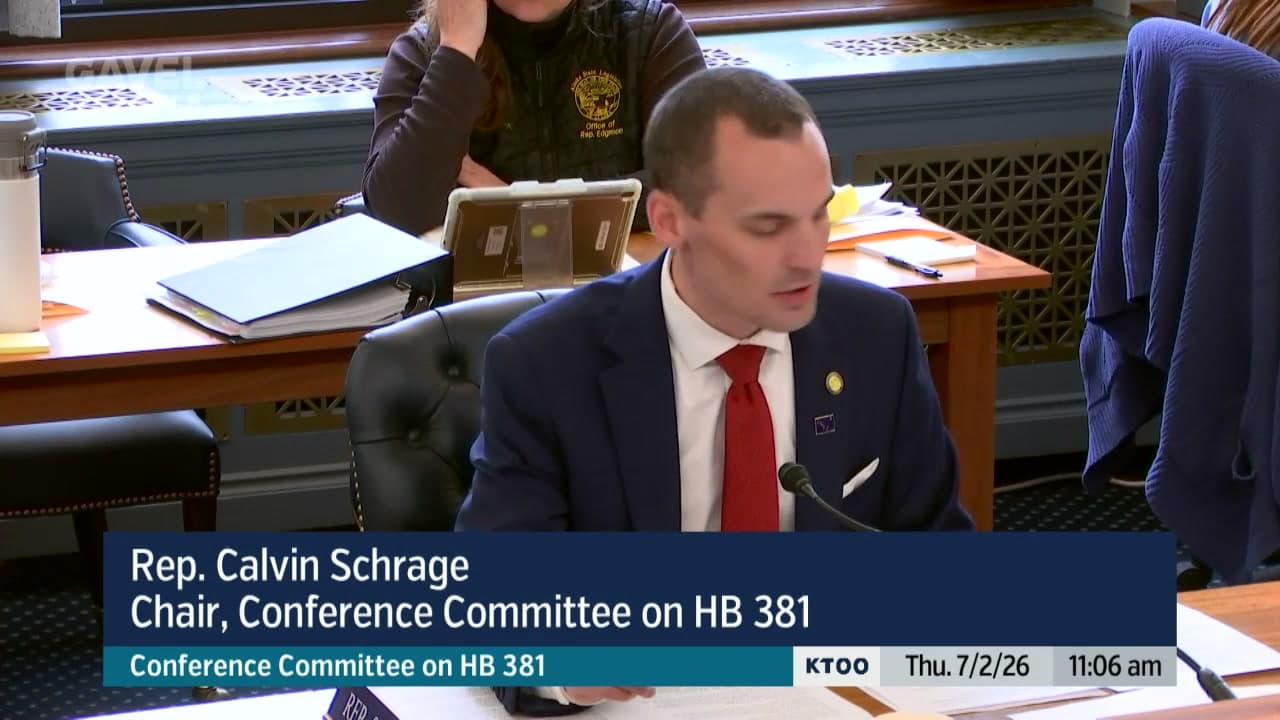
Chair Calvin Schrage and Speaker Bryce Edgmon noted that the draft largely reflected work with AGDC, the administration, and legislative legal to find common ground and improve project viability.
Sen. Bert Stedman cautioned against cutting the tax rate too deeply, noting the bill addresses treatment plant through tidewater property taxes and does not change the severance tax, corporate income tax, or royalty rates. "If you take the tax rate to zero, it still doesn't get this project over the line financially," he said. "So there's more work to be done by the developer to get this project economic." Stedman has also noted that Alaska's oil and gas property tax rate, set at 20 mills in 1974, is roughly ten times higher than comparable LNG jurisdictions, making some relief necessary to attract investment.
Schrage said the draft will be refined when the committee reconvenes after the recess. "This is not the final product and it will be refined further," he said.
This article is based on a public meeting — Alaska Legislature: Conference Committee On HB 381, 7/2/26, 10:30am ().
Made by our human newsroom with AI. How humans and AI work here · Grow with our newsroom Transcript byLucas Brown
Watch key moments from the source meeting. Click to expand.
Stay informed. Support what matters.
Free, permanent access to local news you can verify. Subscribe to support Walter AlaskaNews and go ad-free.
Related Coverage
Where Alaska's gas-line tax deal stands, and what's still stuck
Alaska News · 3mo ago
Alaska's gas-line tax bill stalls in committee
Alaska News · 3mo ago
Alaska LNG tax bill advances to floor on split conference committee votes
Alaska News · 2mo ago
Conference draft keeps oil-and-gas pass-through tax, delays it to 2029
Alaska News · 2mo ago
Alaska LNG Tax Bill Walks Tightrope Between Project Viability and Local Needs
Alaska News · 5mo ago
Comments
Sign in to leave a comment.
No comments yet. Be the first to share your thoughts.