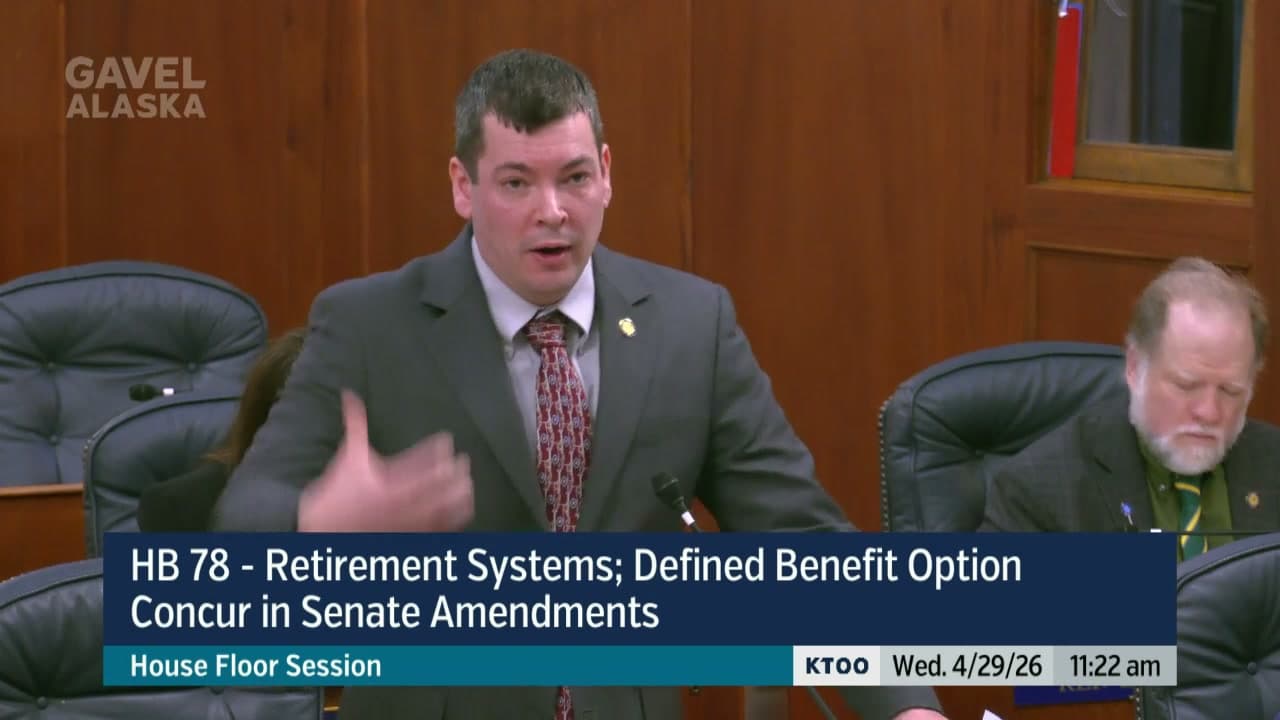
Alaska House Revives Defined Benefit Pensions in Narrow 21-19 Vote
The Alaska House of Representatives voted Tuesday to restore defined benefit pensions for public employees, ending a two-decade experiment with defined contribution-only retirement that lawmakers said fueled massive workforce turnover.
The House concurred 21-19 with Senate changes to House Bill 78, which creates a new pension tier for state and municipal workers hired after the effective date. The Senate amendments made the plan more fiscally conservative but added complexity that some members said raised unanswered questions.
The bill now heads to the governor without an effective date clause, which failed 21-19. That means the measure takes effect 90 days after the governor signs it, rather than the delayed January 2027 start the Senate had proposed.
The Senate increased the employer contribution rate for municipalities from 22 percent to 22.5 percent and removed the 12 percent cap on employee contributions. The changes also gave municipalities a six-month window to opt out of the new pension system, a provision that drew sharp criticism from members who said it would create inequities between communities.
"The Senate made this bill structurally more conservative and stronger," the bill's sponsor said. The uncapped employee contribution means workers would pay whatever share is needed to keep the plan funded at 90 percent or higher, though actuaries said that scenario is unlikely.
Opponents warned the state is repeating the mistakes that led to a $7 billion unfunded liability in the early 2000s. "We started out on our existing plan that was closed in 2006 with $15 billion total liabilities," one representative said. "That amount of money today, that liability on the closed plan is over $25 billion."
The debate stretched more than two hours as members wrestled with the fiscal implications and procedural mechanics. Several representatives said they lacked time to consult with school districts and municipalities about the opt-out provision, which locks communities into their choice permanently.
"This plan, as it comes back, costs $467 million over the next 10 years and more," one member said, questioning whether projected savings would offset the additional budget costs.
Supporters said the current system has failed Alaska. The state has the highest teacher turnover rate in the nation at 30 percent, and 72 percent of departing state troopers leave for states offering pensions. Vacancy-driven overtime costs the state $140 million annually.
"I am sick and tired of listening to people in public safety talk about the number of folks that went through academy with them that are gone in four years, five years, because they have been poached by communities out of our state who offer a pension system," one representative said.
The Senate amendments included a freeze provision for employees who move between employers with different retirement systems. If a worker moves from a municipality offering the defined benefit plan to one that opted out, their pension accrual freezes and they begin accruing defined contribution benefits instead. Several members questioned whether this constitutes a benefit diminishment prohibited by the state constitution.
The bill keeps the existing defined contribution plan alive. Employees can choose between the two systems, and those who select the defined benefit option can switch to defined contribution before they vest at five years. The conversion uses an actuarial formula that some members said penalizes workers who change their minds.
Municipalities will have from January 1 through June 30, 2027, to decide whether to participate. Employees then have another six months to elect their retirement option. For municipalities that opt in, the employer contribution rises to 22.5 percent. Those that opt out stay at 22 percent and offer only defined contribution plans.
The bill also addresses non-occupational disability benefits, which the current system lacks. Under the new plan, employees who suffer cancer, stroke, or heart attack off the job would retain healthcare coverage and higher income replacement than the current 40 percent.
The Alaska Railroad Corporation operates a legacy defined benefit pension with 1,150 members that is 96 percent funded, supporters noted, demonstrating that pensions can remain solvent with proper management. The new plan includes multiple safeguards the railroad system lacks, including shared risk between employers and employees.
Critics said the changes shift risk onto employees through uncapped contributions and onto municipalities through higher rates, while the state still bears constitutional obligations it cannot reduce. "Once we make this decision, we cannot change it," one member said. "Something is going to give."
The vote fell largely along caucus lines, with the bipartisan majority supporting concurrence and most minority members opposing. The measure now awaits action from the governor's office.
This article is based on a public meeting — Alaska Legislature: House Floor Session, 4/29/26, 10:30am ().
AI-assisted. How we use AI Transcript byLucas Brown
Stay informed. Support what matters.
Free, permanent access to local news you can verify. Subscribe to support Alaska News and go ad-free.
Related Coverage
Alaska Senate passes bill restoring defined benefit pensions for public workers
Alaska News · 5mo ago
Alaska Legislature fails to override veto of pension bill
Alaska News · 4mo ago
Senate Finance advances pension bill with municipal opt-in provision
Alaska News · 5mo ago
Senate advances pension bill without updated actuarial analysis
Alaska News · 5mo ago
Dunleavy vetoes public pension bill, leaving override as long shot
Alaska News · 4mo ago
Comments
Sign in to leave a comment.
No comments yet. Be the first to share your thoughts.