Alaska Legislature fails to override veto of pension bill
The Alaska Legislature failed Tuesday to override the governor's veto of a bill that would have restored a defined benefit pension option for public employees and teachers.
The override attempt fell seven votes short of the required two-thirds majority. The joint session voted 33-27 in favor of overriding the veto, but 40 votes were needed to succeed.
House Bill 78 would have given employees in the Public Employees Retirement System and the Teachers Retirement System a choice between a defined benefit pension and the current defined contribution retirement plan. The joint session was called under Article 2, Section 16 of the Alaska Constitution for the sole purpose of considering the veto.
Supporters said the bill was necessary to address Alaska's workforce crisis. They cited high turnover rates among teachers and state troopers.
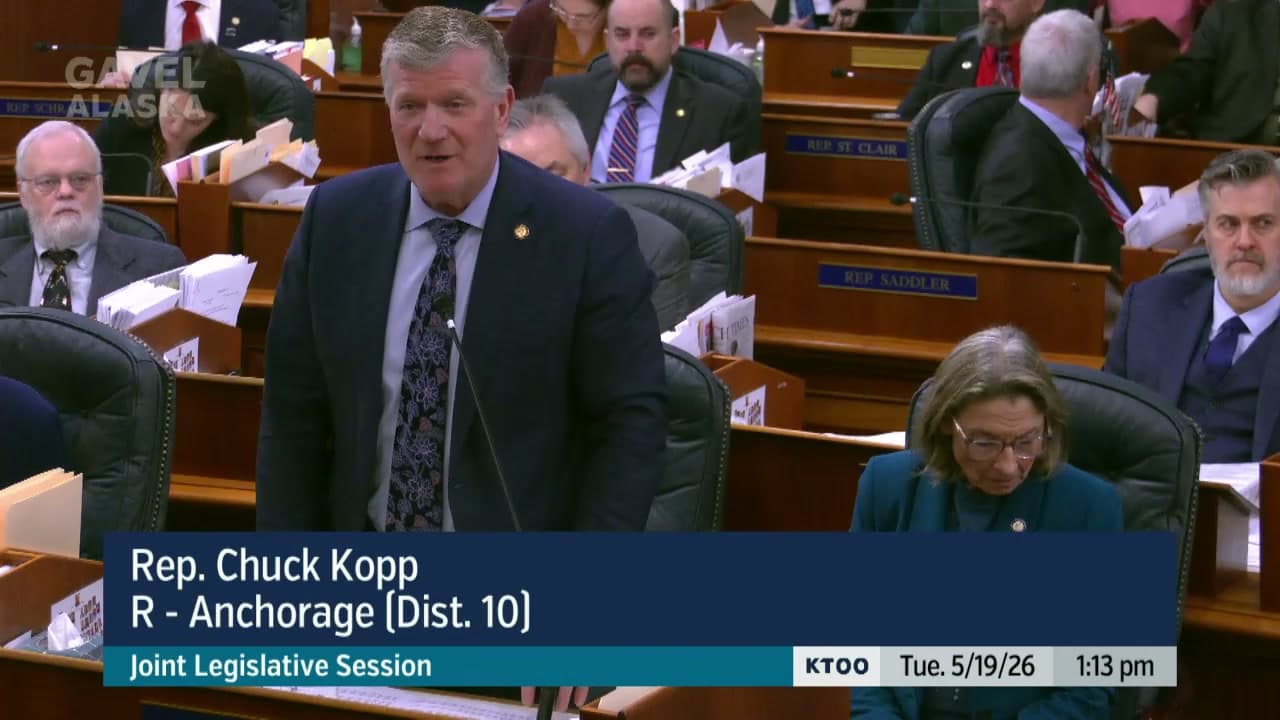
Rep. Chuck Kopp of Anchorage said teacher turnover in Alaska stands at 29 percent, the highest in the nation. He said the Department of Public Safety has 80 vacancies in sworn positions. Rookie troopers who complete the Public Safety Academy at a cost of over $200,000 often leave after 18 months for states that offer pensions. More than 70 percent of police officers who leave Alaska go to states that offer pensions, he said.
"House Bill 78 is not a retirement bill, Mr. President," Kopp said. "It is a workforce bill, and it is a resource development bill."
Sen. Bill Wielechowski of Anchorage said Alaska has the worst retirement system in the nation because it is the only state where public employees receive neither Social Security nor a pension.
"We have the worst retirement system in the nation. The absolute worst," Wielechowski said. "Why are we the worst? Because we are the only state in the entire country where our public employees get no Social Security and get no pension."
Opponents raised concerns about potential costs to the state. Sen. Bert Stedman of Sitka said the bill would shift costs from municipalities to the state. In fiscal year 2030, the shift would amount to approximately $22 million. Non-state employers' contributions toward the unfunded liability would decrease from $173 million to $151 million under the bill, with the state covering the difference.
Stedman disputed claims that Alaska has a poor retirement system. He said Alaska ranks around 10th or 11th in the country for retirement benefits.
"We have one of the richest retirement systems in the country, not the worst," Stedman said. "Probably around 10th or 11th in the entire country."
Rep. Will Stapp of Fairbanks said the bill would cost more than the current system because it offers better benefits. He said the state would bear the additional costs if the plan required increased employer contributions.
"Better benefits cost more money, Mr. President," Stapp said. "And this bill is probably a better benefit than the current 401 for a lot of employees, but just know the reason it is is because it is going to cost more money."
The bill included risk-sharing provisions designed to prevent unfunded liabilities. If the plan fell below 90 percent funded, employee and employer contributions would increase.
The House voted 21-19 in favor of the override. The Senate voted 12-8 in favor. The combined total of 33 votes fell short of the 40 needed.
"By a vote of 33 yeas and 27 nays, the joint legislative session has failed to override the governor's veto on House Bill 78," Senate President Gary Stevens said.
The failure of the override means Alaska will continue operating under its current defined contribution retirement system for public employees and teachers. The state established the system in 2006 when it closed its previous defined benefit pension plan to new employees.
This article is based on a public meeting — MISC-20260519-1300.
AI-assisted. How we use AI Transcript byLucas Brown
Stay informed. Support what matters.
Free, permanent access to local news you can verify. Subscribe to support Walter AlaskaNews and go ad-free.
Related Coverage
Dunleavy vetoes public pension bill, leaving override as long shot
Alaska News · 4mo ago
Alaska Senate passes bill restoring defined benefit pensions for public workers
Alaska News · 5mo ago
Alaska House Revives Defined Benefit Pensions in Narrow 21-19 Vote
Alaska News · 5mo ago
Alaska Legislature Falls Two Votes Short of Overriding Elections Bill Veto
Alaska News · 5mo ago
Senate advances pension bill without updated actuarial analysis
Alaska News · 5mo ago
Comments
Sign in to leave a comment.
No comments yet. Be the first to share your thoughts.