Alaska House panel hears bill to hold contractors liable for unpaid wages
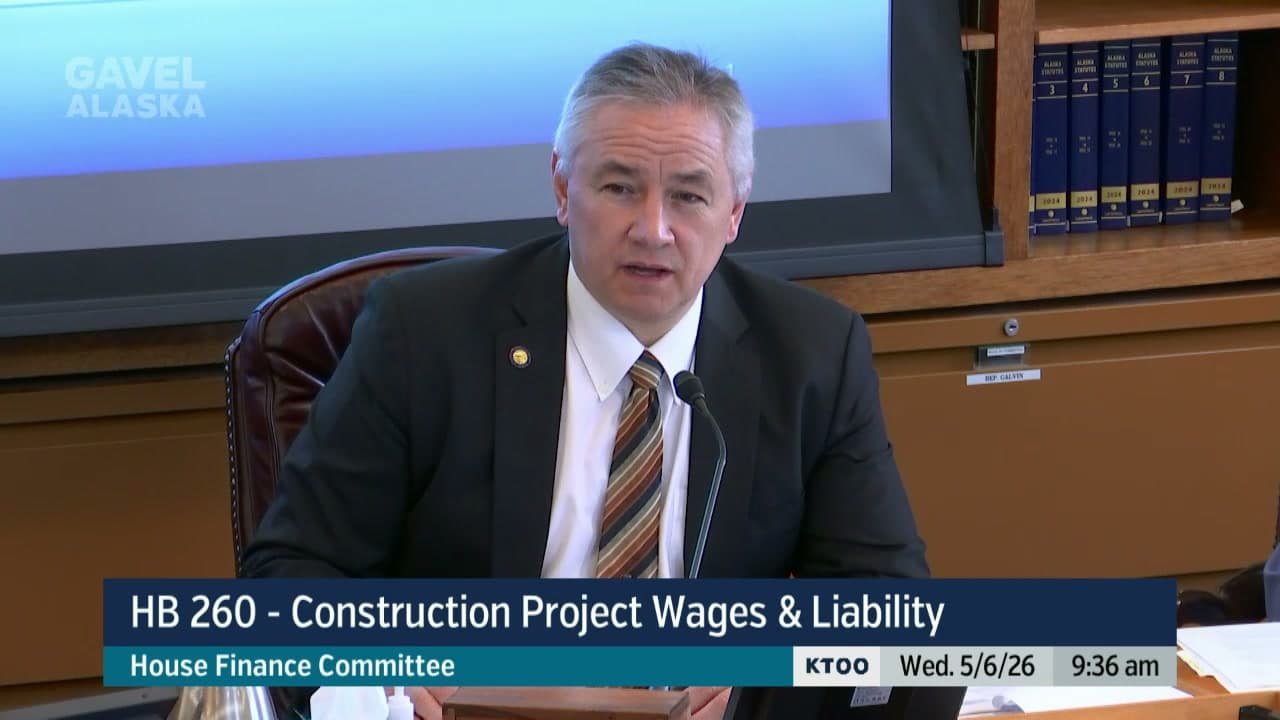
The Alaska House Finance Committee heard testimony Wednesday on legislation that would make project owners and general contractors responsible for unpaid wages when subcontractors fail to pay their workers.
House Bill 260 would establish joint and several liability up and down the construction chain, requiring project owners and general contractors to pay employees if subcontractors do not.
Representative Andy Josephson, the bill's sponsor, said the measure addresses a pattern of out-of-state subcontractors dissolving or disappearing without paying employees. Workers currently have no recourse when subcontractors vanish, he said.
Josephson said the bill reflects a shift in strategy by industry backers who want less reliance on understaffed state enforcement. The industry is saying state government enforcement is not working because the Department of Labor lacks staff, he said.
The bill creates what Josephson called a self-policing mechanism. General contractors and project owners would share payroll information with subcontractors and become jointly liable for employee wages. General contractors could then recover money from subcontractors who fail to pay.
The bill would require subcontractors to certify they have not been sanctioned in the past five years for failing to pay employees, Josephson said. Before anyone can sue, the bill provides a 21-day window to exchange information and resolve issues.
Boris Griesley, policy director at the Western States Regional Council of Carpenters, testified that similar laws in other states have produced clear results: cheated workers get paid faster, a culture of compliance develops, and states recover lost revenue.
Griesley said contractors who steal wages can underbid honest contractors by as much as 30 percent or more, creating incentive to continue when enforcement is weak. He said real-world data from Denver, the District of Columbia, and parts of California show that accountability works. The bill aims to protect both workers and responsible contractors from being undercut by firms that fail to pay workers lawfully.
Alaska recovered over $3 million in stolen wages since 2012, according to legislative documents. A 2023 Century Foundation report estimated 14.6 percent of Alaska construction workers are misclassified or paid off the books, depriving them of $4.7 million in unpaid overtime wages. Alaska News previously reported that in April 2025, witnesses including union leaders and contractors urged the Alaska House Judiciary Committee to strengthen enforcement tools to combat wage theft and misclassification in construction.
The bill also addresses certificate of fitness requirements for electricians and plumbers. Current law requires criminal prosecution for violations, with a $500 fine. The bill would move the penalty to an administrative fine of $1,000 without requiring criminal court, Josephson said.
Alden Zellhuber, business manager for Plumbers and Pipefitters Local 262, testified that the current system is ineffective. As a former state plumbing inspector in Southeast Alaska, he said he could only issue cease and desist orders that had no teeth.
Zellhuber said workers without certificates of fitness often produce code violations. A certificate requires a four-year, 8,000-hour program, biannual licensing, and continuing education every two years.
Zellhuber testified that under the bill's structure, modeled after existing contractor licensing enforcement, inspectors could issue the $1,000 administrative fine on the spot.
The bill exempts public agencies from project owner liability. Griesley testified that on federal projects, liability up the chain exists but stops at the general contractor. In Oregon, public agencies are also exempted from up the chain liability. In some states, liability stops at the general contractor and does not include project owners at all.
The committee took no action Wednesday.
This article is based on a public meeting — HFIN-260506-0900 ().
AI-assisted. How we use AI Transcript byLucas Brown
Stay informed. Support what matters.
Free, permanent access to local news you can verify. Subscribe to support Alaska News and go ad-free.
Related Coverage
Alaska bill would penalize state for late payments to contractors
Alaska News · 4mo ago
Alaska House Panel Advances Bill to Speed Up State Contract Payments
Alaska News · 5mo ago
House Finance weighs bill to standardize state payment timelines
Alaska News · 6mo ago
Alaska House committee reviews $759K in agency requests to fix payment delays
Alaska News · 5mo ago
House Panel Considers Bills to Ease Alaska's Liquor Liability Insurance Crisis
Alaska News · 6mo ago
Comments
Sign in to leave a comment.
No comments yet. Be the first to share your thoughts.