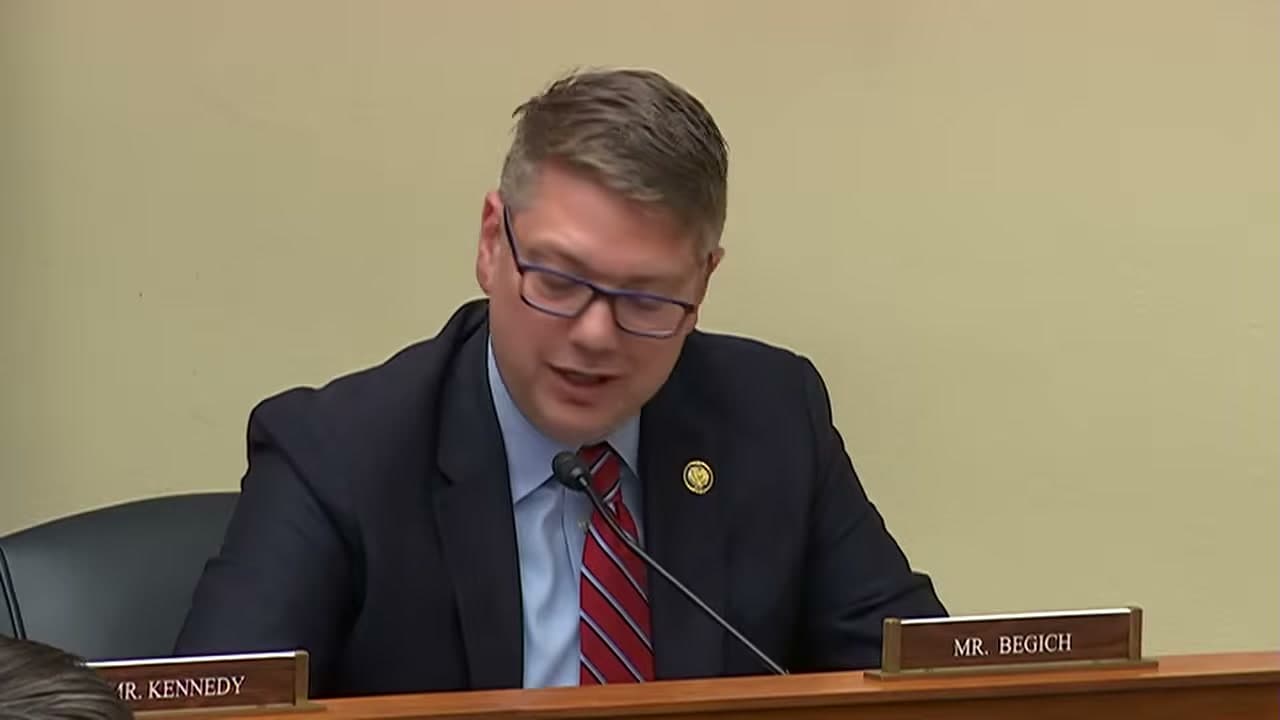
Frame from "House Science, Space, and Technology (Begich): Full Committee Markup" · Photo source
Alaska has the most earthquakes. The program that watches them expired in 2023.
The federal program that coordinates earthquake monitoring, building codes, and warning systems has been running on expired authorization for three years. A House committee voted Tuesday to renew it — housekeeping in most of the country, closer to infrastructure here.
No state shakes like this one. Alaska sees a magnitude 7.0 in most years and a magnitude 8.0 roughly every 13, and it holds the record for the largest earthquake ever measured in North America, the 9.2 that tore up Southcentral in 1964. "Alaska is the most earthquake-prone state in the country," Rep. Nick Begich said during the markup.
The reauthorization would lock in at least $30 million a year through 2030 for the national seismic monitoring network. For the first time, it also gives tribal governments a seat in the program's advisory structure, which carries weight in a state with 229 federally recognized tribes.
The committee advanced a second bill that could matter more in rural Alaska than anywhere else. The GeoPOWER Act would fund geothermal demonstration projects in hard-to-drill rock, up to $150 million a year through 2031, with priority for projects on or near Indian land. Begich pointed to Unalaska and Akutan, both sitting beside active volcanoes, where a working project could displace the diesel that villages now barge and fly in. "Less diesel dependence, less supply chain vulnerability, and less energy poverty," he said.
One member objected that the Energy Department already holds demonstration authority and that the funding is more than seven times the old program's level. Both bills head to the full House, with no floor date set.
This article is based on a public meeting of House Science, Space, and Technology (Begich) — House Science, Space, and Technology (Begich): Full Committee Markup ().
Made by our human newsroom with AI. How humans and AI work here · Grow with our newsroom Transcript byLucas Brown
Watch key moments from the source meeting. Click to expand.
Stay informed. Support what matters.
Free, permanent access to local news you can verify. Subscribe to support Melinda Communities.News and go ad-free.
Related Coverage
The program mapping Alaska's unknown ground expires this year
Alaska News · 3mo ago
Senate committee advances five-year renewal of federal program mapping Alaska's geology
Alaska News · 2w ago
Alaska shakes the most and gets the least warning
Alaska News · 3mo ago
The program mapping Alaska's subsurface runs out at the end of the year
Alaska News · 1mo ago
Anchorage Assembly to consider study of building rules in high-hazard earthquake zones
Alaska News · 5d ago
Comments
Sign in to leave a comment.
No comments yet. Be the first to share your thoughts.