Sealaska Heritage Institute: Temporality of Haa Shuká A Scalar Perspective on Climate Change Lingít Knowledge & Alaskan Identity
Alaska News • • 62 min
Articles from this transcript
Tlingit scholar says Southeast climate adaptation should rest on Tlingit knowledge
A Tlingit scholar argued in Juneau that Southeast should face climate change mainly at a local and regional scale, grounded in Tlingit knowledge.

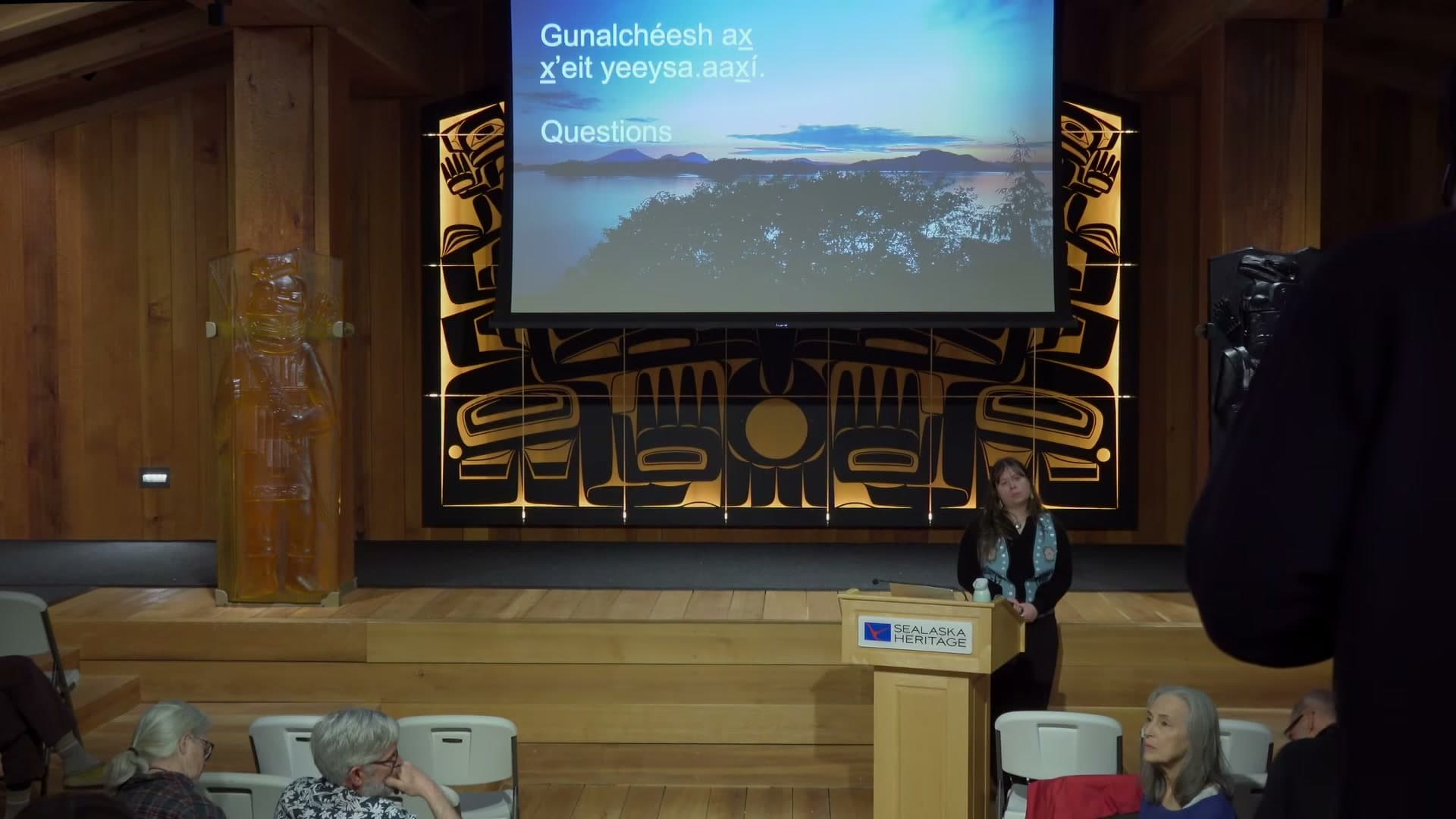
Good afternoon, everyone. My name is Dylan Patterson, and I'm the Culture and History Director here at Sealaska Heritage Institute. We'd like to welcome you to SHI's 2026 Native American Heritage Month lecture series. We also ask that you silence your cell phones and refrain from bringing food or drink into this space. This afternoon, it is my pleasure to introduce Ndáal Tsiil Ndiil Micsibina Allen.
Dr. Allen is an Assistant Professor of Indigenous Studies at University of Alaska Fairbanks. She is . She is also an enrolled tribal citizen of Sitka Tribe of Alaska and Central Council of Tlingit and Hydah Indian Tribes of Alaska.
Juneau received her PhD in anthropology from the University of Chicago. Her work centers on Tlingit oral history and climate change. She considers how traditional knowledge is being taken up in current responses to the changing environment, especially in nonprofit and tribal government spaces. Her work is invested in Indigenous methodologies and community-based research. Dr. Allen's lecture today is titled The Temporality of Hash Kaash, a Scalar Perspective on Climate Change, Tlingit Knowledge, and Alaskan Identity.
The talk will focus on Tlingit adaptation throughout time, especially in response to climate change. And discuss the Raven Cycle as a foundation of cultural knowledge and values while examining Alaska's social construction as a site of climate change in the American consciousness. With that, please join me in welcoming Dr. Ellen Itzigak.
Thank you so much, Dylan, for that introduction. Hello everyone, thank you so much for being here today. And before I begin, I would I would also like to say gunalchéesh to SHI and to Rosita Worl for inviting me here today to present for you, and also to all the staff who helped arrange this event. So gunalchéesh. So you heard a little bit about me, but I'm just going to give my Tlingit introduction and give a little bit more background just as kind of context for this talk.
So, anax Juneau xad duasaag, Dzánti K'ihéeni. Sabiina Allen. So I am Gonahtkaydi. My K'ihéeni is Ondak Juneau. My English name is Sabiina Allen.
I am from Ishkahit and a child of the Kogwantan Clan, and I am from Sitka. I was born in Sitka, grew up between there and the East Coast, and then about 3, a little over 3 years ago, I was able to move back, uh, to conduct my graduate work and have been able to stay, which is amazing. So even though I'm at UAF, um, I'm based on my traditional territory, um, and I feel very blessed and lucky for that to be the case. Um, my grandparents were the late Bob and Betty Allen, and my father is Rob Allen. Um, and as Dylan mentioned, uh, my PhD is in anthropology, but I also have background in Indigenous studies from my undergraduate work.
Um, And I also wanted to mention that I am an EPSCoR faculty at UAF, which is a National Science Foundation grant focused on research development in the state.
So, before I begin, I'm going to give you a little bit more context for my work, just so that you have an idea of what I'll be discussing today. Um, so broadly, my research interests are focused on climate change and Tlingit knowledge. So thinking about historical approaches to change in the region, especially coming from our histories of adaptation and migration. Often these are precedented by natural disasters like floods, glacial advance, volcanoes that then drove people to move and adapt to those changing circumstances. And now this approach to the environment and relationships to land are often drawn upon in order to consider climate adaptation and mitigation today.
And my fieldwork took place mostly in Shipikada, but there are some regionally focused projects which you'll also hear about. And so there were other communities throughout Xinget Ani that came into play in this work.
And I'll go over my research questions for you as well. So first, what is the relationship between current and historical Tlingit adaptation? How is Tlingit knowledge utilized in climate research and projects focused on, on adaptation and mitigation? And how do settlers factor into these dynamics, specifically with regard to erasure, cooption, or forced hybridity of indigeneity? And then my central argument, this is pulled directly from my dissertation.
I argue that due to the long history of Tlingit presence and adaptation in our homelands, we hold relevant knowledge of our changing region and also a unique cultural approach towards change that has served us well in a shifting environment for thousands of years. Even in the face of settler colonialism and climate change, our way of life has endured and adapted. Indeed, I argue that this cultural continuum requires specific attention in order to center a place-based approach climate adaptation and mitigation efforts, which is key to addressing pertinent Tlingit environmental concerns. So essentially, there are two key components to this. The first is that we as Tlingit people are best suited to understand and adapt to changes on our homelands, which we have been doing for over 10,000 years.
And the second is that approaches to climate change adaptation and mitigation should be regionally and locally focused, and specifically with an attention to clicket knowledge. I'm gonna talk a little bit about my methods. So, I first wanna acknowledge the fact that research in general, and especially anthropology as a discipline, have had very negative impacts in the past on Indigenous communities. And this has taken a lot of different forms, knowledge extraction and theft, imbalanced power relations, and stereotypes are just a few examples. And with that in mind, you know, as an Indigenous scholar studying anthropology, I really wanted to draw from my Indigenous studies background and think about centering those Indigenous perspectives and worldviews and theoretical grounding in my work.
So that is kind of the starting place for this. More practically speaking, what did I do? Interviews with community members and especially employees at various tribal governments, local nonprofits, and to a certain extent, Alaska Native corporations in the region. And then also what is called participant observation, which is essentially going to events, meetings, community gatherings, and attending them as a participant, but also kind of with an attention to these research questions. And then finally, as you've already heard a little bit about, there was a focus on professional spaces in this work.
And that was because I was interested in how Indigenous values and knowledge have been taken up in these spaces. And these, in a lot of cases, are the places where a lot of that discussion of climate adaptation and mitigation are taking place. And so it was relevant to consider this in that perspective. The next thing that I wanna discuss is what I call Tlingit theory. And so theory, broadly speaking, is how we talk about what we know.
And how we consider the big picture. In academia, this often comes from Western philosophy. Within Tlingit culture, one place this comes from is our histories. And this was something that I focused on in my work. Some of these histories are owned by specific clans, and these require proper citations and permissions in order to share.
And these stories are something that have influenced me in the way I've been thinking about my work. So you heard me talk about various migrations, those are often coming from these clan histories. But they are also something that I wanted to avoid in the actual written work that I was doing. So, in the dissertation, I do address these, but I do not go through them in great detail or specificity. And that is because not all knowledge should be shared widely, and I didn't want that knowledge to be taken up in ways that the community did not consent to.
So, people taking these things up, And not providing those proper citations, not asking proper permission, whatever that may be. I knew that I wouldn't have control over that. And so I decided to not include that information. So instead, I focused on some of our oldest stories that do not belong to any one clan. And this also means that those histories are related to Tlingit people and land more generally.
And so I argue that they serve as a basis for this general sense of Tlingit cultural theory. And so specifically, I drew largely from what is called the Raven Cycle. And if you're not familiar, the Raven Cycle tells of the trickster Raven and kind of his early life. And it's a series of stories that are interconnected and can be told either together or separately. It starts with Raven's uncle, who did not want him to be born.
And tried very hard to prevent this from occurring. When Raven eventually was born, he made multiple attempts on his life and eventually caused this massive flood into the region. Raven has to flee. He saves his mother and then flees himself. And then from there, he is kind of adapting to this changed landscape that he encounters and also kind of shaping it for his own uses.
So I argue that the Raven cycle specifically illustrates the need for two elements, which are adaptation and then also repetition. So again, Raven reacting to this changed environment and adapting to it, adapting it to his own needs, and then also him needing to oftentimes try things multiple times in order for them to work out before he can find success. And this is a theme that we'll see in other Tlingit histories as well. It appears in Clan histories, and it is a very common theme, this need to continually try things and not, you know, needing to kind of figure them out in action is what I would say. And essentially, I argue that this grounding in these ideas and the way that we react to the world is ancestral knowledge that has been utilized for generations and that people continue to take up today.
And this relates directly to concepts of haashonka, and this is often translated as our ancestors and can also mean our descendants. And this essentially means that we need to take those ancestral considerations and bring them both into the present and then also into that forward-looking approach. And so this kind of explains that the need for that ancestral orientation. As well.
I also want to go over a few terms just so that we're all on the same page about how I am using them in my work. So the first is scale, and the important thing to note about scale is that it is culturally and contextually contingent. So this graphic that you see on the screen is a very common scale that we might see, for example, in the discipline of geography. So you have local, regional, national, global. And that's also used in, you know, journalism, politics.
You've probably encountered something similar to this. And so that's one form of scale that again exists within this kind of Euro-American context. And oftentimes climate change science, especially that that is focused on these systems changes, is very focused on that global scale, or what is often called the planetary. And the interest in the planetary comes from this desire to understand change as an entire system and the way that all of these events and changes are existing kind of with the whole planet as context. However, this makes things very difficult for us to conceptualize as people.
So it's hard to kind of zoom out and be able to actually understand that planetary system. Scale. And when it comes to Indigenous knowledge, it's also not necessarily the scale at which that knowledge exists. A lot of Indigenous knowledge is very place-based and rooted in specific context. And so my work pushes back against this planetary scale when it comes to discussions of climate change, because this is also something that we experience in our everyday lives and on a very, um, you know, kind of collective community level and also on an individual level.
So I focus much more on the regional and local scale. However, these Euro-American scales are not the only scales that exist within my research. We can also understand various Tlingit scales. So something like the goan could be a geographic scale. Woidee, clan, house is a different way to understand scale.
And then something I've already mentioned a little, temporality is another important scale. So, the understanding of ancestors as going very far back, this 10,000+ years, um, and what some scholars have called deep time. And then also that forward-looking approach that's not just your immediate descendants or grandchildren but is much further into the future. And there's an orientation to decision-making, um, that takes into account both of those things, that ancestral knowledge and then how it's going to impact those future generations. The next term that I want to go over is settler colonialism, and settler colonialism is a form of colonialism focused not only on extraction of resources, but also on replacing the indigenous population.
It operates along many vectors of everyday life, and it's also an ongoing project. So this isn't something that happened in the past and is over. This is something that we live continuously, um, to this day. And I have this quote here from Native Hawaiian scholar Maile Arvin, which I'll read for you. She writes, its power usually operates simultaneously through economy, the turning of land and natural resources into profit, law, the imposition of the legal political apparatus of a settler nation state rather than an indigenous form of governance, and ideology, culturally and morally defined ways of being and knowing resulting from European post-Enlightenment thought, and desire for a cohesive cultural ideology.
So we can see these different factors like economy, governance, and these sociopolitical factors where upon or prior to contact, these would have been fully Indigenous forms that existed here in Southeast Alaska. Upon contact, there have been active attempts to erase these Indigenous forms and to replace them with settler. And in a lot of cases, this has been very successful. We can still see those Indigenous forms in a lot of places, which we'll talk about a little bit. And then in some cases, we see sort of hybridized forms that have emerged as well.
But essentially, that replacement is the important key part. I'm now going to move into some of the chapters of the dissertation, and we're going to go about this thematically. So first, we're going to talk a little bit more about adaptation and the Raven cycle, and then we'll talk about Alaska Alaska, kind of internally and externally, and how that relates to the, the way people here in Southeast Alaska discuss climate change. And then we'll move into 3 case studies which represent 3 chapters in my dissertation, and these include cruise ship tourism and appropriation of indigeneity, research in Southeast Alaska related to the environment, and then futurity. Juneau.
Dzánti K'ihéeni.
So first, a little bit more on adaptation. So I talked a little bit about the Raven Cycle, and what I really want to emphasize is the way that the Raven Cycle shows us in a lot of ways how to live, and not necessarily meaning that we want to copy Raven or copy the exact things that are going on, but rather the knowledge that is contained in it, whether that be from interactions that we're observing or simply traditional knowledge that is recorded in these stories. And this is directly related to the Tlingit concept of hakusdi'i, which is often translated as our way of life, but can also mean our culture. And this refers not just to what we do, but how we do things. And within hakusdi'i, we continue to take up the lessons from our ancestors and apply them today.
For example, in how we adapt to settler colonialism. And you can trace the line from adaptation as an important theme in the Raven Cycle to adaptation in the face of settler colonialism, or now in relation to climate change. And we can take this information and enact those practices in everyday life, which is what Tŋanana Athabascan scholar Diane Millian calls theory runway, or the idea that we make theory as we go about life and is in places that are often not recognized by academia. She writes, "Theory theorizing is, as I have argued in other places, a verb in action. I think that theorizing is something that we do plainly every day in any moment where we make a proposition about what is happening and why." So I similarly argue that Tlingit people enact theorizing every day, directly bringing in those forms of ancestral knowledge.
For example, in telling raven stories and other histories at public events. Like at conferences, and bringing those lessons into work that's being done on issues like sustainability, economy, and governance. And these are places where we can see settler colonialism has tried to enact that erasure. However, those Indigenous forms of life continue today through this enacting of honkusti'i: Theory from Life, and we can see an insistence on these Indigenous forms in practice as they are lived and enacted.
Next, I'm going to move on to this construction of Alaska in the public consciousness. So we're zooming out a little bit from Southeast Alaska. We're thinking about the larger problem space within which this work exists. And I was really interested in how Alaska was being socially constructed and how this continues to impact discussions of climate change and images associated associated with it today. And Alaska has always quite literally loomed large in the public consciousness.
At the time that it was purchased from Russia, and I put that in quotes, it was really, Russia had no right to sell the land that they allegedly sold, but at this time there were a number of people who were pro this sale, who thought that this would positively contribute to the nation-state of the US, and then there were people who were very against. This sale. And so a number of political cartoons emerged at this time, and a lot of them circulated, which displayed Alaska as an Arctic wasteland that was overrun with walruses and polar bears. And there were also some that include very racist depictions of Alaska Native people, which I've chosen, chosen not to include. And you can kind of see this on the one I have included in the zoomed-in part.
You can see these kind of ice towers, and then there are some bears, walruses, and just generally this sense of kind of an icy wasteland.
Juneau, and this solidified early associations with Alaska and ice, polar bears, etc. And this did change a little bit in subsequent years, especially as tourism in Southeast Alaska began to take off, and this occurred during the Gilded Age, so the late 1800s. There was much more emphasis on the beauty of the region, and many scholars argue that this influx of tourists also led to the infrastructure that kind of defined the next moment in Alaskan history that we also often reflect on, which is the Gold Rush. And the legacy of the Gold Rush has very much shaped perceptions of Alaska as a harsh wilderness. There were a lot of writings that were coming out of this, a lot of letters, diaries, books, and people were very— many people were very be with their experiences here in Alaska during the Gold Rush.
And this legacy of the kind of last frontier narrative, a sense of toughness, has really stuck around. And we can see this in a quote from James Michener's book Alaska, where he writes, Alaska would always call forth the best in a small handful of daring men and women. But those who did not relish the contest or who refused to obey the harsh rules which governed it would find the bitterly cold land repellent and would flee it if they could retreat before it killed them. Juneau. So again, you have this sense of toughness that has emerged, and this came along as well with the idea that Alaska was simply so vast and so wild that it was kind of an untouchable wilderness.
And this relates directly to the way that nature and wilderness have been constructed in Euro-American society. And for a long time, nature and wilderness had a very negative connotation. So with a lot of fear and uncertainty. And this began to shift also in the 1800s with the Industrial Revolution. As more land was being developed, people were moving into cities, and there were a lot of fears about how that was going to impact people sort of socially and culturally.
And so people began to set— develop a sense of wilderness as something to be preserved. You see the rise of the early conservation movement coming out of this. And in this, again, Alaska was seen as being so large and vast and sort of unimaginable in its scale that it was simply thought to be untouchable within this and sort of one of the last truly wild places. And scholars argue that this began to shift with the 1989 Exxon Valdez oil spill, which made people, especially people outside of Alaska, begin to see that Alaska was actually not so invulnerable as they had thought. And I argue, also picking up on a lot of scholarship that discusses the Arctic and Alaska in relation to images of climate change, that from the oil spill onwards, we start to see as well these images associated with climate change being associated with Alaska.
So again, melting sea ice, glaciers, starving polar bears, these come to stand in for how we can actually imagine and envision climate change because sometimes it can be difficult to perceive. And then Alaska itself more broadly has come to kind of stand in for climate change in a lot of the public perceptions and consciousness. But how does this impact us here in Alaska? So something that I observed during my fieldwork was the way that people will talk about climate change and environment in Juneau in the everyday. And people in Southeast Alaska often take note of the changing landscape.
No audio detected at 24:00
This is something that people are very aware of in their everyday life. Perhaps they enact, you know, harvesting. Perhaps they do various sports on the land, whatever that may be. People are very aware of the landscape and really like to talk about it and like to talk about changes that they're observing. And this is not just Indigenous people.
This is all residents. Of Southeast Alaska who have these types of conversations. So if there's something strange happening with bear behavior, if the salmon streams are running low, or the, uh, harvest doesn't look like it's going to be good, if berries are at all off in their timing, everyone is going to be talking about it. And I was really interested in the way that this concept, which I call climate talk, is related to Indigenous knowledge. And it overlaps with Indigenous knowledge, but they're not exactly the same thing.
And we can understand this through different types of scale in the way that that knowledge is constructed. So climate talk is often drawing from more recent observations and direct lived experience, whereas Tlingit knowledge, Indigenous knowledge, are really drawing from this ancestral knowledge. And so ancestral knowledge is distinct, again, in the way that it is constructed. So you have this very long temporal relationship that is being observed and recorded in that knowledge. And then you also have many generations who are contributing to that knowledge.
And so even though these things are related, in a lot of cases Indigenous knowledge can inform climate talk, they are distinct, and that distinction is important to note and kind of remember. And this will come back in some of the other discussions that we'll have. So with that, I'm going to move into the 3 case studies. So as I said earlier, these are cruise ship tourism, Western scientific research in Southeast Alaska focused on the environment, and then climate futurity. So first we're going to talk about cruise ship tourism.
And cruise ship tourism is often a very contentious issue in Southeast Alaska. It has brought a lot of economic opportunity for people. However, there are a lot concerns about quality of life, and especially about the environmental impacts, including air and water quality, especially. So, one of the things I was interested in, in this chapter was the different temporal investments that people have to this industry. So, you have tourists who may be concerned with the duration of their trip.
Perhaps they're concerned with sustainability efforts put forth by these large cruise ship companies, they often have sustainability pages. Maybe they're not interested in that. But either way, this relationship with the land is very short-lived, and it's going to be probably about planning and then during their trip. And of course, that's a generalization, but largely speaking, that is the case. For non-Tlingit residents, this is a much longer-term investment.
It may be, you know, their own lifespan, the lifespan of their children, and this relationship may be several generations. But it is not as long as Tlingit relationality. For Tlingit people, this is a matter of past and future generations, 10,000+ years. And this, within that time span, is also an industry which we have had a great number of interactions historically. And so, for example, during that period I mentioned with the Gilded Age tourists who were coming here, they have a lot of interest in what are called curios.
So various forms of Native art that people were collecting. This has been kind of a, a form of economic investment for Tlingit people for a long time, and that continues to this day. So there are various tribes who are engaged in tourism, Alaska Native corporations, and then of course artists who also often rely on this industry. And so because of these complex relationships, I'm really interested in the way that indigeneity was coming into these conversations. Especially into anti-tourism conversations from non-Indigenous people who were evoking this Indigenous identity in the arguments that they were making.
And within this, there are two components that I want to highlight. And the first is crisis thinking. And this essentially is just the way that people will treat the yearly arrival of tourists and the general perception of large cruise ships in the region. As a crisis in and of itself. And crisis thinking is very common with regards to climate change as well.
Western thinking likes to emphasize this idea of presentism and this assumption that the situation is unprecedented. And this assumption of unprecedented crisis has been much critiqued, especially by Indigenous scholars. It ignores other ongoing forms of harm, such as settler colonialism, and also serves as a paralyzing form of engagement that often aids in reinforcing, uh, current existing power structures rather than kind of calling to action. And Indigenous worldviews often offer alternatives to this based on historical experiences with various forms of catastrophe, including the fact that a lot of Indigenous people will call settler colonialism a form of ongoing apocalypse, for example. And then also these long-term temporal relationships and future-oriented thinking that I've been mentioning, which is a form of temporality that really refuses this focus on presentism.
And in the case of tourism in Sitka, a crisis narrative also has directly contributed to another claim wherein non-Indigenous residents will make claims to their rootedness and as a claim to authority within these conversations. And this has included non-Plinkett people making claims to Indigenous knowledge or to the longevity of— or excuse me, to Indigenous knowledge and then to local knowledge, but without attending to these long histories on the land. And these claims often also perpetuate the idea of local knowledge as a into Indigenous knowledge. And while local knowledge has its own value, sort of similar to climate talk, it's not backed by the generations of inhabitants and ancestors which form the basis of Tlingit knowledge. And these claims to local knowledge also create a new way for settler colonialism to be perpetuated, specifically by undermining Tlingit political identity in the region.
And Tlingit political identity is tied to sovereign tribal authority and the ability to determine citizenship, which by definition excludes non-Indigenous residents. Tribal citizenship is important within issues like environmental justice because it provides specific political authority, including to negotiate with the US federal government. So even if non-Tlingit and non-Indigenous people can absolutely love Southeast Alaska, it's important to pay attention to how this long-term scale of residents impacts things and how Tlingit political authority is important, especially in the face of these ongoing environmental concerns. Next, we're going to talk about research in Southeast Alaska. And a lot of this work is based on a project that is a collaboration between the Sika Sound Science Center and Sika Tribe of Alaska.
And it is called the Communication and Reciprocal Exchange, or CARE, Initiative. And this initiative includes trainings for scientists on how to better interact with Indigenous communities. So people who are coming in from outside of the region, from other universities, and may not know cultural protocols or how to kind of best present themselves in these situations. And this is necessary partially because research has such a contentious history in Indigenous communities, and oftentimes in these relationships, authority is placed in the hands of Western with science, and power imbalances emerge from this, um, wherein Indigenous knowledge is often treated as lesser. And there is work that certainly attempts to address this, but because these issues are so systematic, it can be very difficult to kind of root them out in that work.
And this includes, again, issues like data extraction and especially assumed access to knowledge and lack of understanding of cultural protocols about how knowledge is properly used in community.
And one of the reasons why this is an issue is because research is often desired by tribal governments and by communities. It's something that can be very useful. Climate change has led, of course, to accelerated forms of change. And so it's important to keep track of these things, especially as some traditional knowledge has become less reliable in the in the face of these rapid changes. And having a record of baselines and changes as they occur can be really helpful, especially for tribes in these kind of environmental justice movements.
And there are, like I said, various forms of research that attempt to address some of these issues. And so one of them is called co-production, which seeks to bring Indigenous knowledge into Western scientific frameworks. And the idea is that the community and the scientists are co-producing that work. And one of the things that I was really interested in, in relation to co-production, was how even though there is that desire for this equal relationship, there are still ways in which that is undermined in practice. And one of those ways is through the assessment of how well that work is actually doing its job.
So rather than turning to the communities in a lot of cases and asking them, um, you know, how is this working? What does this look like? Those external, um, kind of powers are still at work. And so you have external entities like funders, universities, etc., that are coming in and assessing that work and saying how well it is being done rather than this kind of stemming from community.
And this specifically strips tribes of agency and of sovereign authority within this process because they're unable to have that ability to determine that relationship for themselves. And there are certainly alternative— alternatives to this way of doing things. And one of the ways that I talk about is instead of Indigenous knowledge being brought into these Western systems, thinking about Western science and how that can be a tool in communities and how that can be directly utilized in community work in a way that almost appropriates it back for Indigenous peoples. And so this is kind of another form of adaptation where we're looking at these tools, acknowledging that they can be useful, especially in the face of climate change, and then taking them on for ourselves. And so one really great example of this is the Southeast Alaska Tribal Ocean Research Lab at Sikkok Tribe of Alaska, and specifically the work that they do for shellfish testing to make sure that that is safe to eat.
And so essentially, traditional knowledge gives us very specific instructions about when, where, and how to harvest shellfish, but a lot of Oftentimes that has become less reliable because of these climate change-induced shifts. And so this is a way to allow that harvest and that important community relationship to continue, even in the face of these ongoing changes. So, again, this kind of appropriation of that tool that continues to place self-determination agency in the hands of the tribe. Now, we're going to shift to the last case study, which is focused on this transformative scenario planning process that occurred a few years ago here in Southeast Alaska. And I'm going to explain a little bit about what this process was, what it looked like.
Then we're going to talk a little bit about the history of scenario planning. And then we'll kind of shift back to the implications for the Southeast Alaska example. So, essentially, this process was a collective effort to generate this document, which is called Possible Futures for Southeast Alaska. And it is 4 fictional scenarios that were created that are meant to be plausible and challenging and really push people to think outside of the box. So, thinking beyond what we might imagine, like, initially imagined as how the future could look in order to better assist with strategic planning.
And this process brought together about 30+ people from around the region in Southeast Alaska. I was one of those people. It took place from January through April of 2024. So there were two in-person multi-day workshops. One was in January in Saxman, One was here in Juneau in March, and then it culminated at the Sustainable Southeast Partnership Spring Retreat, which was in April of 2024 in Sitka.
And there was— between those different meetings, there were— there was also kind of asynchronous and virtual work that was being done again to kind of collectively create these documents.
And because climate change is so essential in this region, a lot of them had to do with kind of climate futures and different ways that this could go depending on various factors, both externally to the region and then also internally.
So with that in mind, I'm going to talk a little bit about this broader methodology and where it actually came from. So scenario planning, which is distinct from transformative scenario planning, and we'll hear why, Um, actually emerged from work done by the oil company Royal Dutch Shell. So in the 1960s, futures thinking was very popular, especially the idea of multiple futures rather than one singular future. So the idea that this needed to be kind of considered, imagined, calculated, and an innovator in this field was Herman Kahn. He wrote about nuclear war and fallout, among other things, and Shell sent one of their employees, Pierre Wacht, to learn this methodology from John.
And from there, Wack developed the Shell scenario planning process. And the kind of claim to fame for this process is that it predicted the 1973 oil crisis. So essentially, they had these different scenarios, and one of them included something akin to the oil crisis. And as a result of this, Shell was able to better react to that crisis when it struck. And so they kind of came out on top as a result of this.
And so this really solidified the legacy of these Shell scenarios, and they continue to use this process to this day. So they go through it every however many years. In the 1990s, Shell employee Adam Kahane used this process in discussions of ending apartheid in South Africa. South Africa, and he created an off branch of this methodology, which he called transformative scenario planning. And it was designed to bring people together from very different backgrounds and perspectives and to create plausible and challenging scenarios to help with strategic planning.
So in the face of this kind of any two apartheid, so these scenarios were called the Mont Fleur scenarios.
And. After that, he went on to form Rios Partners, and Rios Partners also facilitated the scenario process here in Southeast Alaska. So they do this process kind of globally. And what I really want to emphasize here is the way that these scenarios are rooted in specific knowledge systems that come from the oil industry and from nuclear futures. And so even if these transformative scenarios are not about the future of the oil industry or about corporate futures, they still draw from knowledge systems and contexts that are highly antithetical to Indigenous lifeways, land claims, and values.
And this is something that has been much critiqued, especially by media studies scholars. So I'm going to read this quote by media studies scholar Cara Keely, where she's discussing some of the implications of the Shell scenarios. So she writes, a future in which Royal Dutch Shell would continue to exist as such forecloses upon a future in which those groups of living beings we currently can identify as Black people and/or Indigenous peoples have the resources to enjoy a sustainable and joyful existence on this planet. So essentially, Shell relies on extraction from the lands and labor of Black and/or Indigenous peoples And simultaneously, these people are those put most at risk by Shell's operations. And the implications of these knowledge systems are especially important to note when we're specifically thinking about climate futures, when one of the largest blocks to climate action has been large oil companies.
So with this in mind, we're going to pivot back to the possible futures for Southeast Alaska scenario planning process and think about how Cliket futures did not necessarily fit within these scenarios. So throughout this process, I was asking myself, whose future are we imagining? And in the process of writing the scenarios as a group, it was initially very difficult to define where Native people were fitting into these scenarios. And this was partially because there were a lot of people involved who were non-Indigenous, and a lot of them did not have knowledge of how tribal governments function, how Alaska Native corporations function. And so it was very easy for them to kind of forget this and move on from it when thinking about these futures and how they would function and how everything would fit together.
And Tlingit participants within this and other Indigenous participants worked very hard to be included in all of the scenarios. But nevertheless, one scenario actually proposed a future wherein there would be no pligation. People in the region by the end date of the scenarios, which was 2050. And this was very quickly deemed not plausible and was not included in the final scenarios. And this was partially because of the long-term Tlingit presence in the region.
And essentially, this was established partially through attention to Tlingit temporality. So this concept of haax'u kaal, past and future. Our presence in the past allows us to project our presence into the future. So as a result of this, Tlingit temporality was represented, at least in some form, in the scenarios. However, our forms of futurity also exceeds the boundaries of this scenario planning process, and I ultimately argue that the deep relationships with place and with our ancestors and descendants precedes and will outlast to the forms of futurity of the settler colonial state and of oil and corporate futurity.
And so on a similar note of futurity, my conclusion focused on the theme, the future is Indigenous. And my usage of this was coming out of a Tlingit and Haida youth summit that took place several years ago. And this was the theme for the summit, the future is Indigenous. And what I really like about it is the way that it emphasizes continued presence on our lands, and also the way that our way of life is intertwined with our homelands. And as they continue to change and adapt, so will we.
And this is a continuation of what we as Tlingit people have always done. And I just want to end with a brief description of some of the future plans for the research you heard about today. So I am currently working on a book proposal, which will include a lot of the things you've heard about today. And then I will also be continuing this research in various forms, and I'm going to be thinking about this question of incommensurability. So essentially, incommensurability is when things do not fit together, they don't talk to one another, they are not compatible.
And I'm very curious about the ways that incommensurability comes into play when we're thinking about different knowledge systems. So knowledge systems like Euro-American, Western science especially, and Indigenous knowledge. And there's a lot of interest in bringing these things together, and that has been very fruitful and very helpful in community in a lot of cases. But is there a point at which these are no longer compatible? What does that point look like?
And how does climate change expose these moments? So those are some of the questions I'm asking that I'll be considering going forward. And with that, good night.
I think we have a couple minutes for question and answer. Anybody have questions for Dr. Allen?
Okay, I'll set a question.
Okay, yeah. Okay, okay, okay. Thank you for your presentation. There's so much information that you gave us. Right now, my head is spinning.
When we talk about culture and we talk about community, we still haven't gotten over colonization.
I would like to see, when you talk about communities and quams, when you start using the word Tlingit, our name, Clans own the land. Clans are the ones that make the decision. But the most important part of all of this is, and I've said it before with my good friend Dan Brown, that uncles will never raise nephews and aunties will never raise Nieces, because we have a point of arrogance in our culture. It's not because we can't, it's because what you've been talking about on the screen all this time is who has the money, and that's what makes the world go around. Who has the money?
Who has to say It's the person that has the money. I would like to see more interaction with clans and call it what it is and call clan ownership intellectual property rights. I've also sat on the Repatriation Committee back in 1990, and I was the youngest. When I sat there and Uncle Matthew Fred and Harold Martin and my grandmother and Lena Farkas, quite a bit of them.
This is a really touchy subject when we start talking about ownership of that oo. We never at that time, because I was the youngest, I said I'll quit and put an elder ahead of me. They said, no, we want you here because you're going to outlive us, but I want you to remember what was said today. What they said today is we never wanted the clearinghouse. We wanted the stuff to go back to the clans, to make sure it goes back to the clans.
When we start talking about what goes back to the clans and we talk about our corporation and whatever, Sealaska— and I'm trying to down talk, you guys are doing a good job or else I wouldn't be here. But the whole point of the fact is that clans don't own the land anymore. Sealaska owns the land. Clans don't have any say on their land. Sealaska has the say.
What more can we do besides changing the colonization of our verbiage to make the younger generation stand strong enough to tell their story, to tell who they are?
Your introduction today was really nice. But the most important thing is we don't introduce ourselves. Somebody has to introduce you. But there's so much that people look at it as nitpicking, but it's called protocol. I learned from Willis Peters, my grandpa, Poom Yes, Kaaw Wantan from the Gauhit.
I've learned from my great-grandfather, Don Wakish, from the Gwich'in.
And they said, you know, always hold your head up and be proud.
The most important thing is this is your land. So corporation, Juneau community, all communities. There has to be some type of coalition between all of us if we are going to survive.
For the people that sit there, and I saw what you said about non-Natives, we haven't a problem with non-Natives that are telling our stories. We have a problem that they're getting paid for it when natives of Tlingit or Haida should tell their own stories because of their birth, their birth rights. I think a lot of these things that we're talking about, this protocol and sharing of knowledge and whatever, is very important. But it seems to be a soundboard for everybody, you know. Everybody says, okay, we did a good job, we're talking about it, boom, let's bring it up.
We bring it up and boom, we're gone.
Why? Because there's no money in there. Money pays for time. So any type of trickle-down of meetings like this where people can come and talk of what little knowledge we have.
Like I said before, take that tree over there, that spruce tree. I only know a needle of that spruce tree, of what's passed down, and I'm just imitating.
Just how much information, knowledge, that our grandchildren's children will have to buy in the future.
I'm saying we buy, because if you don't pass this down and we don't protect Tlingit Hwaa'nee, just looking at corporations now, they're telling us what to do. Or ANSCA. ANSCA should is a specialty. We shouldn't have to go through all of this permits and whatever. We should be able to stand.
When we use the word sovereignty, sovereignty means you stand on your own. You make your own money. It's not given to you by the United States government.
We, the Xhunka people, And I'll tell you what, when I was growing up, there was hardly anybody on Sealaska that had a degree. But look at where we are today. That's so amazing. But I want to thank you very much for your presentation, and I really appreciate it. But you opened too many doors.
Thank you. Yeah, thank you for your comments. And I think what you were saying about the clan and everything, I— one of the other next steps, which is something I think really needs to be rooted in community and not so much for, you know, the larger academic discourse, is what you were saying about that clan knowledge and how can we continue to bring that to the younger generations and ensure that, you know, they understand those protocols and that, you know, we can carry that forward. So that's something else I've been thinking about is how this work applies in community directly in those land relationships. So, koonas atxii for that.
Quick question.
You mentioned tourism, climate change, climate change, and are the smaller communities' ability to adapt to the changes that are happening. What is your solution? Because what I'm seeing is less and less. How do we control that? I know the world spins around money, but when it comes right down to our adapting to survive in today's climate change is, what do you think needs to happen?
Yeah, thank you for that. I mean, I think in terms of the cruise industry specifically, I think one of the problems that we've seen here in Southeast Alaska is that, like you said, because of money, because they have so much power, that industry has really been able to come in and divide communities. And pit us against each other in a lot of cases. And so, you know, there is this kind of unequal distribution where there's no real like bargaining power from the communities. And so in that regard, I think that, you know, something that would be really helpful would be a collective approach, you know, from different communities being able to come together and kind of set those boundaries, set standards for what that interaction should look like.
And then in a broader sense, I think honestly, just continuing to have these conversations kind of in a similar vein, like what do people want regionally? And then also scaling down to that individual community in terms of, you know, their climate change response. So we thinking about adaptation, are we thinking about mitigation? What do those look like in different communities? And really trying to, I think this is already happening, but really trying to continue to have those conversations between communities and on a regional level so that we can have an approach that is bringing people together instead of kind of siloing us into our individual communities.
Thank you very much for your presentation, but also thank you for helping us continue this journey to sort of indigenize our young people's thinking. Yes, the impacts of the Western culture colonization on our cultures, on our thinking, on our worldview is forever part of us, but We know that more recent times we are on this path to sort of reclaim, you know, our place and the credibility, the integrity of everything that Indigenous Tlingit people have. When we think about our art as, you know, as an example, we're seeing this revitalization of art that was nearly lost. And the science and the knowledge that's required behind it. And as we see it in public places, what our communities are learning is that just because the Tlingit people, the Native people, are having art in public places, are having educational materials in our classrooms, we are not taking away anything from anyone.
In fact, we are adding to it. We're adding to that authenticity, to that local, regional knowledge and authenticity of where we live, where we have lived for 10,000 years. It is an ongoing learning process. So I just want to share a recent revelation with the Council of Traditional Scholars, and we were talking about, you know, it is beautiful how we're seeing these art classes now being taught online, being taught in our communities outside of Southeast Alaska and Washington and Oregon. And a number of these scholars who are also artists, they had growing concerns with the way— and while it's still a beautiful thing, what they were concerned about was that our artists were not feeding that very important connection to Indigenous knowledge, to traditional science, in the part that takes place in harvesting.
If you're harvesting furs, spruce roots, cedar bark, there is so much knowledge that's required to ensure that, you know, we're not taking too much, that it's going to grow back. Uh, so all of these things, um, are really important. Again, it shows that we can have, um, traditional knowledge, indigenous science that runs parallel with, uh, Western science, and they can complement each other. But we want to show our young kids that, you know, we need to— as you talked about, just that constantly remember what our ancestors brought for us. So, goodish jeez.
Yeah, absolutely. And I think something that's so important within that is that it's such a holistic way of looking at things, you know. So like you said, it's like you can learn how to weave, for example, but if you don't know how to harvest cedar, that's a whole really important important component that you're not getting. And so I think what's really interesting about Indigenous knowledge systems as opposed to these Western systems is the way that Indigenous knowledge is so focused on that holistic approach where that whole component needs to come into it and to think about, um, you know, all those relationships that are built across, you know, that entire process. And so yeah, thank you for bringing that I think that's really important to bring forward.
All right, with that, I think we're at the top of the hour. We need to close it out, so I just want to close with saying, T'niishaa'zhaan, honest T'niishaa'zhaan, and love Juneau for hanging out and sharing the great windows of water with us.