Anchorage Assembly: AssemblyRegular: Live
Alaska News • • 400 min
Articles from this transcript
Assembly shelves salary commission pick after questions over his firm's city contract
Anchorage's mayor picked a consultant for the panel that sets officials' pay. Then his firm's $86,899 city contract came up, and the Assembly shelved the pick.

Anchorage Assembly delays Missing Middle housing vote again, this time to Dec. 1
The Anchorage Assembly scheduled its Missing Middle housing vote for a Friday at noon, then unscheduled it. It's now Dec. 1, the second delay in four weeks.
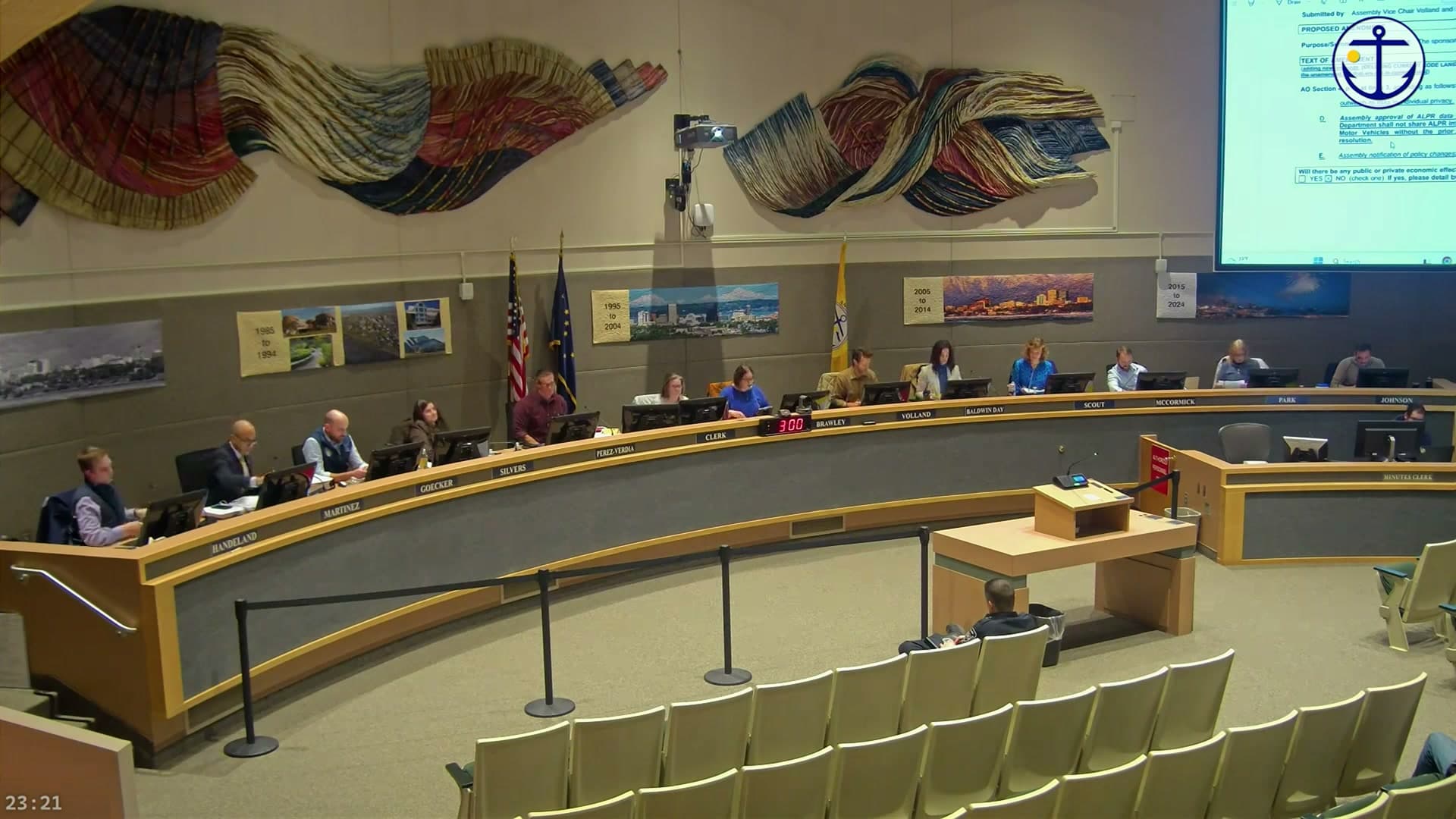
Anchorage passes surveillance rules, rejects new limits on plate reader searches
The Assembly wrote police plate reader and crime center rules into code 11-1, but left the 14-day data limit in police policy and rejected new search limits.
Alcohol tax advocates ask Anchorage to put more into prevention and treatment
Groups behind Anchorage's alcohol tax say it put nothing into substance misuse treatment in 2025 or 2026, with none planned for 2027. They want a change.
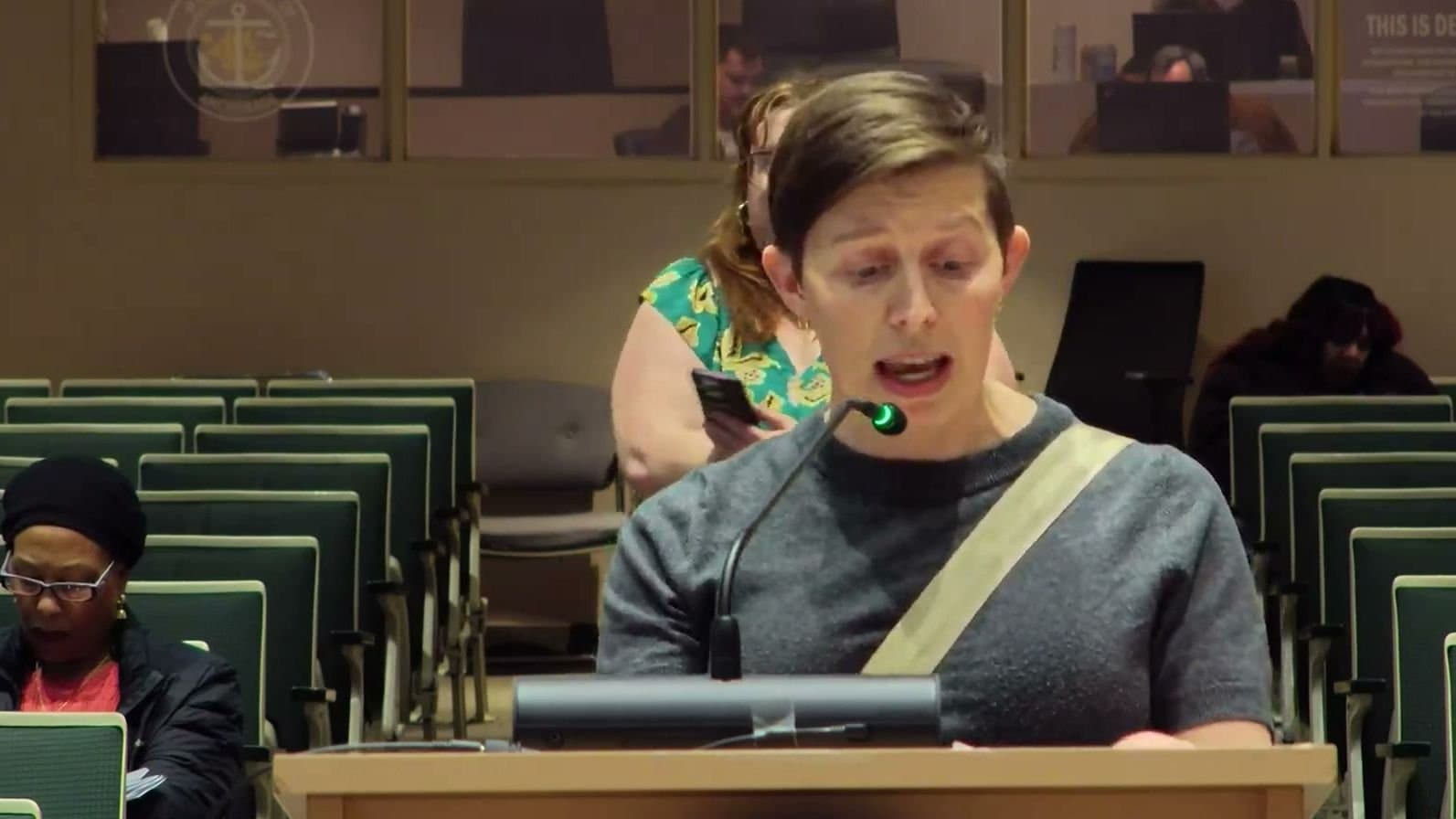
Good evening, everyone. We'll get started in a couple more minutes.
No audio detected at 9:07
No audio detected at 11:07
Okay everyone, let's go ahead and call this meeting to order. Today is Wednesday, November 4th. This is the regular assembly meeting here in chambers, here on a Wednesday instead of a Tuesday. So, Madam Clerk, will you please call the roll?
Member Handeland? Present. Member Martinez? Present. Member Girdcker is, uh, will be here by 7 and excused at this point, I understand?
Yes. Member Silvers? Here. Member Perez-Verdia? Here.
Chair Brawley? Here. Vice—. Sorry, Vice Chair Volland? Happy to be here.
Member Baldwin Day? Present. Member Scout? Present. Member McCormick?
Here. Member Park? Present. Member Johnson? Here.
And Student Representative Ali? Here. Chair Brawley, you have a quorum.
Thank you. Next, I will ask Mr. Doehl to lead us in the pledge this evening.
Thank you. Vice Chair Vohland, would you please read the land acknowledgment?
Yes. A land acknowledgment is a formal statement recognizing the indigenous people of a place. It is a public gesture of appreciation for the past and present indigenous stewardship of the lands that we now occupy. It is an actionable statement that marks our collective movement towards decolonization and equity. The Anchorage Assembly would like to acknowledge that we gather today on the traditional lands of the Dena'ina Athabascans.
For thousands of years, the Dena'ina have been and continue to be the stewards of this land. It is with gratitude and respect that we recognize the contributions, innovations, and contemporary perspectives of the Upper Cook Inlet Dena'ina. Thank you. Next on our agenda, we have minutes of previous meetings. We do not have any of those, uh, this evening.
So next we'll move on to the mayor's report. Uh, Madam Mayor, please proceed. Thank you, Chair Brawley, and good evening, everyone. Welcome, students. I hope you all had a fun Halloween weekend.
There were so many wonderful events going on in our community, and I was fortunate to attend a few of them and see many familiar faces along the way. Yesterday, as we all know, was Election Day. As we wait for the final results, I want to thank everyone who participated in our civic process. I also want to thank the election workers across the state, but especially those working early voting at City Hall. Your work made our elections safe secure and accessible to so many Alaskans.
Next Wednesday is Veterans Day. Anchorage is truly a military community, and both our municipality and our state are home to thousands of active duty service members, veterans, and military families. I am deeply grateful to all who have served and sacrificed for our nation, and especially to those veterans who choose to make Anchorage their home. And we have a number of them who work here at the municipality. We are also excited to welcome more service members and their families next year as Joint Base Elmendorf-Richardson continues to grow.
Thank you also to Chair Brawley and Member Baldwin Day for organizing the Fiscal Future Summit and helping facilitate an important community conversation about our budget and the long-term fiscal future of our municipality. This year we faced a $15 million budget gap. We were able to close that gap through a combination of one-time funding, targeted adjustments, and by cutting positions that we could eliminate because we had rebuilt municipal services. However, big challenges remain ahead as we prepare for future budget discussions and consider potential cuts in the years to come. It is critical that residents understand the fiscal realities we face and have a meaningful voice in shaping the path forward.
These conversations aren't always easy, but they're necessary, and they are the most— they are most productive when we approach them together as a community. Tonight we'll hear public testimony on the proposed municipal budget for next year. We've heard public comments about the downtown foot patrol, and I would like to provide some clarification. Funding for the foot patrol does not appear as a separate line item in the proposed budget. It was not a line item in the 2026 budget, so if you look for it in the budget, you will not see it.
The program was launched this spring to improve public safety downtown, enhance the experience for visitors and residents, and strengthen relationships between our officers and the community. We've heard clearly that many people would like to see the program continue, and we share that enthusiasm. This year, the patrol was supported with funding from the bed tax as a tourism improvement program and staffed by officers on a voluntary overtime detail. The absence of a specific line item in the budget should not be interpreted as a decision to end the program. It's my intent to continue the downtown foot patrols, and we're looking at other ways we can provide this service moving forward.
However, we need to ensure the police department has adequate staffing. We also need to continue working with the assembly and our partners to increase staffing at APD in general and to strengthen retention efforts so the department can accommodate public safety needs like this across our neighborhoods. That's also why the conversation we'll have later tonight about public safety technology is so important. Technology is not a substitute for our officers, but it can help officers work more effectively, improve safety for officers and the public, and allow us to make the most of the resources we have. So I urge support of the S version of AO 2026 -108, an approach that both enables modern policing tools and provides strong safeguards for privacy and accountability.
Thank you, and I look forward to a productive evening tonight—. Meeting this evening—. Tonight. Thank you. Thank you, Mayor LaFrance.
Next, we'll move on to the chair report. I'll add a few comments and some preview for how we'll be doing our business tonight. First, echoing the follow-up on elections. So reminder to everyone, our big state and federal election was yesterday. So you can take your phone off mute and stop blocking unknown callers.
I know it was a little overwhelming this year in your mailboxes too. Anyway, but seriously, state and federal elections every 2 years are always a big deal because they determine who is in power for our country and our state. This cycle has certainly been no exception. But we know that, that there's still a ways to go. So there are still absentee ballots coming in several days before we have definitive results, and the State Division of Elections will tabulate ranked choice votes in 2 weeks on Wednesday, November 18th, and will certify the election, per their information on the website, on Monday, November 23rd.
So if you want more information about that, check out the State Division of Elections website. But I know we all look forward to seeing those final results so we can move ahead into 2027 with new state leadership, whatever that looks like. And keep working on the municipality's legislative priorities with those folks at the state and federal level. Next, about the— oh, and I'll say also thank you again to everybody who voted and participated in this election, and I'll echo the mayor's thanks to the election workers, especially those who are at City Hall for early voting, but across the state doing the hard work of keeping our elections secure. Next up, last Friday we held our summit on the municipalities fiscal future.
We had over 120 attendees. It was a really informative and collaborative day, a lot of excited and interested folks leaving even after talking about our budget for several hours. So I think that was a good sign. The mayor and department representatives provided background on how they are dealing with our fiscal challenges, and we had a broad swath of community members engaged in honest and thoughtful conversations, not just with elected officials but with each other. If you were unable to attend, the public survey is still up through this week, through Friday, November 6th.
If you'd like to provide, provide input. You can find that survey as well as materials and recordings from the summit in the news section of the Assembly's website, muni.org/assembly. This event was an important milestone, but it's really just one step in a bigger process to make big decisions as a whole, as a whole community about what we need and what we're willing to pay for. So stay tuned for more opportunities to engage over the winter and into 2027. And if also, if you want a fun interactive game to play with friends and family over the cozy holiday season, check out Your Muni, Your Budget.
There's a physical packet you can pick up from the Legislative Services Office at City Hall if you want a print copy, or you can download those materials online. And we were able to provide a number of them to folks who participated on Friday. Speaking of the budget, tonight is the second public hearing on the 2027 budget. That's items 14A through 14H on the agenda. We will be prioritizing those items this evening after dinner.
These public hearings offer the opportunity to comment on our operating budget, which is funding for public services and programs, our capital budget, which is money to invest in infrastructure like streets, sidewalks, and vehicles, plus also the operating and capital budgets for our enterprise agencies and utilities, things like the port, our solid waste services, and our Community Development Authority, ACDA. So thank you to everyone who has come here tonight to testify on the budget and to those who have already testified or sent comments by email. As decision makers, we really value community input that we receive on the budget. We will also continue our budget public hearings to the November 17th meeting, uh, after which we will be closing the hearings at that meeting and debating amendments and then approving the FY27 budget. Uh, that is the schedule that we follow every year.
Speaking of amendments, uh, one more reminder to members: please get your budget amendments to our budget analysts as soon as possible. Uh, I know we're, we're in the middle of a meeting tonight, but try to do it by tonight or tomorrow morning at the latest. Uh, these are, uh, necessary for discussion at our November 6th Friday, November 6th work session. Remember that these amendments are discussion drafts and there's a little bit more time and there's always more work to refine them before we actually debate on the 17th. So if as much as you can get your goals and ideas on paper and Miss Rocher will help you work through it and then we'll find the how to get those things done.
And then a reminder to the public, our government budgets are complicated, but you don't need to be an expert to provide your input and priorities. The assembly has a lot of information and resources to help guide you through the process. They can be found on our budget and taxes page, which you can find at muni.org/assembly. And speaking of our website, uh, one very brief note on the website. We launched a redesign of the Muni website on last Thursday, uh, October 29th.
It's intended to be simpler, easier to use on multiple devices, and help point people quickly to where they want to go. But as with any change, we're still ironing out some wrinkles as pages transition. Search indexes are getting updated with new links and there's bugs to fix. So please be patient if you have been trying to find something or have run into those— the dreaded 404 not found pages. Please be patient and also note if you are having issues or you have feedback, you can scroll to the bottom of the homepage, the muni.org homepage, and click the submit website feedback under contact us.
And then that's a place if you need to flag something that's missing or just have suggestions for how to make it better. So, uh, keep looking for improvements there. Uh, so turning then to tonight's agenda, as you can see, we have another packed agenda tonight, and I anticipate we'll have similarly busy agendas for the 4 remaining regular meetings this year through December 15th. As you'll hear shortly, I am changing the public hearing dates on a few items, uh, that have been introduced to spread out the workload and then also to provide some more certainty on when we can get to those items so that we don't have to keep postponing things that are published and then we don't get to, uh, part of the goal. So leadership will also this evening ask members to change the order of the day.
We'll speak to that a bit later, but at a very high level, we will be proposing to prioritize our budget public hearings, so those would be first after the consent agenda and dinner break. And then there's a few other things that are either time sensitive or are things that we understand sponsors intend to postpone, so we'll get those out of the way first. Then we do anticipate continuing and hopefully finishing amendments and debate on AO 2026, the Surveillance Technology Ordinance, ordinance. And then I also understand that the sponsors of AO-2026-85, MHOP, or the Missing Middle Housing Opportunity Overlay, intend to— intend to postpone debate on that ordinance to a special meeting which has been scheduled for Friday, November 13th, noon to 3 PM, which will also be held here in Assembly Chambers in Midtown here. So we may send a couple of small items to that special meeting as well, depending on the timing for tonight.
But the main item for that meeting will be debating on AO 2026-85. I'll also note some other items are likely to be postponed to future meetings depending on how far we get and how members are looking at them. So that would either be to our December— sorry, November 17th or December 1st meeting or possibly further out. So with all of that, I'll do my best to move us through tonight's agenda so that we can conclude at the most reasonable hour possible. So just a few reminders.
Again, this is a business meeting. We're here to do the work of the municipality. Please help create a climate of respect in the chambers. Please refrain from personal attacks, speaking out of turn, shouting, clapping, and pacing. Please keep any signs to 8.5 and 11 inches by size.
Please keep the aisles clear except if you're lined up to testify. Please don't approach the dais directly. But if you have something you'd like to share with members, you can hand it to the clerk at the lower dais for distribution. And then I'll ask also, if, if someone calls a point of order, whether it's during testimony or during debate, Please everyone stop speaking so that I may rule on the point of order so our record is clear. And if rules are not followed, I may interrupt speakers to call for compliance.
If compliance with the rules doesn't occur, then I may pause the meeting. If there's an actual disruption, I will give a warning. And if the disruption persists or happens again, the person will be asked to leave. And then I'll give our usual reminders about public testimony later. So I believe that concludes the chair report.
So next we will move on to committee and liaison reports. I'll start this evening with Mr. Johnson.
No report, Chair.
Okay, next, Ms. Park.
Legislative committee will meet Friday at 1 PM at 155 6th Avenue.
Okay, Mr. McCormick.
Nothing to report, thank you.
Ms. Scout.
Um, nothing to report. Thanks. Miss Baldwin Day. Thank you, Chair. I'd like to add my gratitude to yours for all the folks who came out to the Fiscal Future Summit last Friday, but especially to the Legislative Services staff and the folks who showed up to make that event a success.
So thank you to those who participated, to those who help us behind the scenes to make it happen, and also to those of you who will continue to participate in our budget conversations both this year and going forward. The Audit Committee met on Wednesday, October the 21st. We heard a report from the Anchorage Health Department on the administration of the Community Development Block Grant, which is federal funding that we receive on an annual basis. Uh, the Health Department folks absolutely get the award for the most comprehensive audit progress report to date. So thank you to the Health Department for their work and for the progress they are making on the items that were identified as places for improvement in our audit, which is of course the goal of the Audit Committee is to surface the ways that we can be more efficient and more effective in our administration of local government.
Finally, the Housing, Community, and Economic Development Committee meets tomorrow morning at 9:00 a.m. That meeting will happen at the Permit Center over off of Elmore. We have a variety of interesting new business that is on our agenda. We have a presentation from, I believe, Keegan Randall on the cross-country skiing, cross-country skiing efforts here locally and how that is impacting our economy. We have a, a couple of ordinances that pertain to changes in zoning, and the mixed-use tax incentive proposal that was brought forward and then postponed— action postponed— will be on the agenda as well for some additional conversation. Also, third-party plan review reporting will be back on the agenda.
So if you are interested in any of those things, please join us tomorrow morning at 9:00 AM. Thank you. Thanks. Next, Vice Chair Voland. Thank you, Madam Chair.
The Budget and Finance Committee scheduled for November 19th, that meeting has been canceled. However, as the chair referenced in her report, the, um, on Friday, November 6th at 10 AM, we will be having our customary work session on proposed assembly member amendments to the budget, and then we will take the budget up at our regular meeting on November 17th. Thank you, Madam Chair. Thank you. And I'll roll briefly back to, um, Ms.
Scout for another committee report. Thank you. Um, the Energy Enterprise and Utilities Oversight Committee of the Whole meets Thursday, November 12th at 10:00 AM at City Hall Conference Room 155, and we will, um, be getting some updates on Eklutna projects, so both the ordinance we passed, or resolution that we passed last meeting, and then also hearing updates about the public meetings and stakeholder meeting we've had this past month. Um, also hoping to get updates about the stormwater utility and also hoping to start talking with my colleagues about how we can work together with utilities the state legislature, and across the municipality on planning for energy resilience as we face an energy cliff in south-central Alaska and across the state. So, um, hope that all will attend.
Thank you. Thanks. Next, Mr. Perez-Verdia. Thank you, Jharrett. No updates tonight.
Oh, Miss Silvers. Thank you. No updates tonight. Mr. Martinez. Thank you, Chair.
Just a couple of additional items to tomorrow's Housing and Community Economic Development Committee. It's also available online, so it's 9 AM, but you don't have to be there in person to participate and to observe the meeting. Uh, at our new assembly— our new municipality website, you can find the links. Additionally, just to make the connections, the committee often does business across time, and so Kicken Randall is not a random presentation. It is part of the discussion that we've had around year-round tourism, winter tourism, and this year particularly the Arctic— the Ski Association is going to have some tremendously important national-level ski activities here in our community.
And Ferrande came to our last meeting, or two meetings ago, and gave a presentation on the importance of Ferrande's economic activities Anchorage as well. And so we're trying to connect some of these threads to our place in terms of tourism and to other opportunities for economic activity year-round, and then that subsequently means making sure we have a city that functions year-round. So snow removal then becomes more important to keep economic activity alive as well. So I just wanted to thread that needle. And additionally, Chair, the National Association of community organizations— or county organizations, rather— met.
And our recent discussion at the Community and Economic Workforce Development Committee, we are discussing that the 120th Congress is beginning to develop a second road to housing bill. And considering the potential changes in DC leadership, this is an exciting opportunity to get all hands on deck around advancing more housing and initiatives with the legislative package. Thank you, Chair. Thank you. Next, Mr. Handeland.
Nothing to report.
Okay. That concludes our committee and liaison reports. So next, we'll turn to our addendum to the agenda. Before we do that, I will read some laid-in— laid-on-the-table items into the record.
Currently, we have only supplemental items, so I'll go ahead and read those and no further action will be needed at this time. The first one is going to be an unnumbered AIM 2026. Administration and Municipal Clerk's Answers to Assembly Questions. That's item 10F4 under informational reports. And then, uh, the rest of these are supplemental to, uh, public hearing items.
So the first one is, uh, 14A2, so it's unnumbered AIM 2026 supplemental for 14A 2026-123, uh, our operating budget. It is informational response to AR 2026-211, FTE information for non-recruited positions that have been vacant for 12 consecutive months. Within MOA General Government. The next one is for item 14J3, so that is AO 2026-129, an ordinance of the Anchorage Municipal Assembly, uh, amending Code Section 28.30.030 to require candidates for municipal public office submit a nominating petition with their declaration of candidacy. That is unnumbered AIM 2026.
And then for 14K, there are two items. Both of them are unnumbered AIMs. The first one is Anchorage School Board letter opposing 2026-130 regarding an ordinance of the Anchorage Assembly submitting to qualified voters of the Municipality of Anchorage a proposition amending the charter to provide for the election of school board members by district. And then the second item for that same ordinance is an information memorandum unnumbered for the same item. From myself.
So, uh, that concludes those laid on the table items. Again, no further action is needed. Uh, if anything else shows up, we will deal with it at that time. Uh, so with that, uh, those items incorporated, then I will ask for a motion to incorporate the addendum to the agenda and laid on the table items.
Motion to approve.
Second.
Motion by Ms. Park, uh, to incorporate the addendum and laid on the table items. Second by Mr. Bolland. Uh, any further discussion on this item.
Any objections to incorporating the addendum?
Okay, seeing and hearing none, then we will consider that unanimously incorporated. And then of course we will get shortly to our consent agenda items when we can pull individual items, including those that were just— at least the one that was included on the late on the table items. So next item, we will move on to our appearance requests. We have 3 of them this evening. So first I will invite up, and I'll do them again in order, on the page.
So first I'm going to invite up Mr. Jim Renkert and the Alaska Speed Skating Club. So anyone who's here for that, please come forward.
Okay, and then if you want to turn on the microphone there, state your name And you'll have 3 minutes. Go ahead.
Thank you. Hi. Thank you for this opportunity.
My name is Jim Renkert. I'm with the group Anchorage Skates. With me this evening is Peter Hoisler and Chuck Gilbert with the Alaska Speed Skating Club. We wanted to bring some of the skaters here this evening, but they have practice this evening, so they could not join you. I'd actually like you to indulge me just for a second here.
I want to put on another hat. I want to put on my Friends of Nikesite Summit hat and thank all Assembly members and the mayor who were able to do a Nike Site Summit tour this summer, and I hope we can get the rest of you up there next summer. So yeah, just a thank you. So this is our annual presentation to the mayor and the assembly for ice maintenance at the Cuddy Family Midtown Park skating oval. We have here— this is the 16th year we've done this, and we have a check.
For the mayor and Parks and Rec Department for $10,000.
So if the mayor and Shannon Gamble, our park director, are here— so, um, could you do a photo op here? Oh, and we also have our, um, our annual ice pins. So I think we have— we may be short a few. We're short a few. But we have some pins.
Yes. Yeah. Thank you. We sell these pins to raise the money to help maintain the ice. So—.
And I'll suggest maybe if you want to conclude your remarks, and then we could do photos afterwards because your time is running. So I want to make sure that you— if there's anything else you'd like to share.
Oh, you got it. Got it.
And that's all. Oh, and please come to the solstice party on November— I'm sorry, December 18th that Parks and Rec is putting on. That's a great event. And we're also real excited that a master plan will be getting underway for the park here soon. We are going to continue to work on building a chalet for the park.
So thank you. Thank you. And before you walk away, we have one member in the queue, Mr. Martinez. I wanted to say thank you, but I wanted to confirm, just so for the record, Chuck, that's not a speed skating injury that you—. Okay, right on.
Thank you. Uh, thank you all for being here. Thank you for the, the gift to the municipality and for the continued life that you bring to our community. Thank you.
Okay, thank you very much.
Okay, and I'll just note for public's interest, only certain individuals can actually accept funds on behalf of the municipality, so that's why we offer the mayor or the CFO, or there's a couple other folks who can touch those checks. That's not everybody that can do that, so, um, just for as a note because we get those once in a while. Okay, next we'll move on to our second appearance request, so I will invoke invite up Ms. Sharon Jackson. Please come forward.
And as you're coming up, I'll note we did receive materials, and then I'll note the microphone is already on. So state your name, part of town, you'll have 3 minutes. Hi, I'm Sharon Jackson, also known as Me Too Times Four, the old fat black lady. Being willfully blind, covering one's eyes to facts, it doesn't work. There's no poor people, there's no drug problem in Anchorage, there's no homeless.
See, it doesn't work. People are being gang stalked in Anchorage. And what does an honest, law-abiding citizen have to do to be heard? Well, being educated should help. Check.
Gathering witnesses, including mental health experts, check. Gathering boxes of evidence, check. And then going to the authorities, check. Oh wait, nuh-uh, she's a Me Too times 4. Her story is awful and scary.
Let's be willfully blind and dismiss her claims. Let's call her crazy. Wow, that makes me feel more comfortable. Phew, I'm a good person, really I am. Yeah, feel good, but the system doesn't work.
Facts are facts. They don't change because it's uncomfortable, inconvenient, or scary. Sometimes it takes the truth time to be heard. Millions were killed in death camps before the truth was there for all to see. If a power-hungry hate group is not acknowledged, first it's those people who are attacked, but next time it could be you and yours.
Look at Nazi Germany. Ignoring the truth tellers can be costly and very devastating. It doesn't work. The truth is a truth. The status of being willfully blind is simply dangerous.
We can all be better people. Open your eyes, listen, be a stronger and wiser person who can find solutions to obvious problems. If we ignore the truth, solutions will not be found. We need you. You're important.
Your jobs are so important. United we stand, we will win over the diabolical. Together we are strong, divided we shall fall.
Let's make it work for all of us. Hear the truth, it has been told. Well, last time I was here at the last assembly meeting, October 20th, at approximately 11:10, I found 4 security guards standing by my car. I said to myself, I'm not going to be intimidated. The guards walked towards me in the darkness of the night.
Luckily, I knew one of the security guards. I want footage of that incident, and I want footage of the state trooper that followed me into a dead end. I lead with love. Your time is expired. And I am here to inform, educate, and not to blame, because we all can be willfully blind.
Thank you for listening to my narrative.
Thank you. Okay, next person, please come. Forward. So, uh, last person we have for appearance request tonight is, uh, Miss Teresa Obermeyer.
So please come forward.
And I'll note that, uh, members have also received your materials. The microphone is not on, so— oh, it is on. So, uh, please go ahead and you'll have 3 minutes.
Good evening, ladies and gentlemen. Good evening, Mayor and assembly.
I truly commend you when I come over here and see what's going on. I know how much time you put into this and how difficult it is. I have a— an appearance request to talk about elect Alaska Attorney General. I had one on voting no on the judges, but I don't even know what they were, whether or not they were retained. But I wanted all of you to understand the Missouri court plan and how it does not apply to Alaska judges.
You can look, I sent you an email about it, but you probably get like 200 or 300 emails a day. So I'm not, I'm not sure you were able to read all that, but I'm thinking of having an advisory vote. Of the municipality at the April 6th election. And I don't know how this might go, and I truly need a little help from my friends, because I do think it's something that if, if necessary, I think we'd have to get 7,220 signatures. That is something I'm considering.
But I also think there's a possibility that the assembly itself can decide to put this on the ballot. If you'll forgive me, ladies and gentlemen, it really is time for this. I look at all these darling kids and our wonderful community in our state, and we have to do better. Your pages 3 and 4 here, I could read, but I only have like a minute and a half. It's about a draft of a whereas, and I'm not sure if I even have the right way I'm doing this.
Whereas Senate Joint Resolution 21 was on, on February 24th, 2020, proposing amendments to the Constitution of the State of Alaska regarding the Office of Attorney General. You see, ladies and gentlemen, the only way we can change our Alaska Constitution is by a two-thirds vote of each of the houses of the state legislature. Now, to me, that is just almost insurmountable. That's why I'm saying we have 40% of the population of Alaska, and we might be able to give them advice, and they might run with it and decide to have a two-thirds vote. Just to mention, when our Constitution was written, it has— we have got a 329% increase in our population.
No audio detected at 46:37
We live in such a different community. Than when these constitutional delegate— delegates created our constitutional— Constitution. I think it is so good if we talk about this and make things better for these darling kids, all of us, and the future of our great state of Alaska. Thank you so much, Ms. Crowley, and Assembly, for hearing me. I appreciate it.
Any questions? I hope you'll look at 3 and 4 especially. Thank you. Any questions for Ms. Obermeyer? Uh, Ms. Baldwin Day.
Yeah, thank you, Ms. Obermeyer, and, um, and thank you for— it's rare that someone comes with a draft resolution already written, so thank you. I don't know whether I even worded it correctly. Um, it's, it's impressive. Um, I'm wondering— I haven't had a chance to read this, but I'm wondering if you know how many other states in the U.S. have an elected attorney general versus appointed? 43 States.
40 States have elected attorneys, have an elected attorney general. Yes. Thank you. And that is one of the issues here on the one of the— it's right here. It's the, the fourth one down, whereas currently Alaska has no elected attorney who by designation must be required to be a member of the Alaska Bar Association.
It gives you the statistics. So thank you for asking questions. Any other questions? Thank you. Thank you.
I don't see any at this time, so thank you. Thank you so kindly.
Okay, that takes us through our appearance requests. So next we will go to the consent agenda. Um, so as a reminder, the consent agenda is typically routine items such as bid awards, new business information and reports, as well as things like resolutions. So under Assembly Rules of Procedure, these are not items for public hearing. And as a reminder, members may pull any of these items for separate discussion before the consent agenda is approved.
So I will go down the list tonight, um, uh, for items to pull. Uh, so start with Mr. Handeland.
I've got, uh, 10A4 and 10D10.
Okay, uh, we've got 10A4, 10D10. Uh, next, Mr. Martinez.
Thank you, Chair. 10A3.
Okay, 10A3.
Next, Miss Silvers.
Nothing to pull, thank you.
Okay, next, Mr. Perez-Verdia.
No items, thank you.
Okay, next, Mr. Boland.
No items, thank you.
Next, Miss Baldwin Day. 10 Delta 18, thank you.
Okay, 10D18. Next, Miss Scout.
I'll pull 10F1 and 10G8.
Okay, I have 10F1 and 10G8. Uh, one question on 10G8: is it to change the public hearing, or do you have another intention?
Oh, is the public hearing set? Um, if you would like to direct a different date for public hearing, we can do that. Uh, you can just tell me.
Okay, got it. Sorry, I missed that.
No, no, I'll remove that. Just 10F1.
Okay, thank you. Okay, um, yeah, and then if you would like to have the date changed, I have a few that I will change, so just let me know. Okay, next, um, Mr. McCormick.
Uh, 10 Bravo 3. Okay, 10B3.
And next, Ms. Park.
No items, Chair, thank you.
Okay, and Mr. Johnson.
10A2.
Okay, 10 Alpha 2.
One second.
Okay, Mr. Voland. Madam Chair, in addition, I would like to pull Item 10A-1. Okay, thank you.
Okay, so I will read the list back. Uh, so we've got 10A1, Mr. Bolland, 10A2, Mr. Johnson, 10A3, Mr. Martinez, 10A4, Mr. Handeland, 10B3, Mr. McCormick, 10D10, Mr. Handeland, 10D18, uh, Miss Erin Baldwin Day, and 10F1, Miss Scout. Um, any additional items that we missed?
Okay, and then, um, before we move on, I will also direct the, uh, chair— or sorry, the, the clerk to change the following public hearings. Um, so that would be for items 10G1, 4, 5, and 11, to set the public hearing for those for December 15th. And then for items 10G14, 15, and 17, to set the public hearing for those to January 13th, 2027. And I'll ask one more time, Miss Scout. I did not change, uh, 10G8, so is there a different date?
Okay, thank you. Yeah, I'll repeat that one more time, so, uh, and the clerk can, uh, will be documenting this as well. So the items 10G1, 4, 5, and 11 will be set for December 15th, and then items 10G14, 15, and 17 will be set for January 13, 2027. Our first meeting of the year.
Oh, one second. We are double-checking the date of the meeting, but the intent is the first meeting in January. Okay, okay, I misspoke. I was thinking of this year. So, uh, sorry.
So it's, uh, January 12th, 2027, our first regular meeting of the year. Okay. Any additional items to pull? Just one more check.
Okay, any additional items? Don't hear any. Any objection to adoption of the consent agenda minus the pulled items?
Okay, then I am, uh, seeking a motion to approve the consent agenda. Um, Madam Chair, move to approve the consent agenda minus the pulled items, and specifically in reference to number 10D6, that would be the A version as part of my motion.
Okay, there's a motion to approve the consent agenda minus the pulled items. Also, I think I misspoke earlier when I was asking if there's any objections, so I was skipping ahead a step. So motion by Mr. Bohlen. Is there a second for that?
Second.
Okay, second by Ms. Park. Any further discussion on this? Any objection to adopting the consent agenda minus these pulled items? Okay, seeing and hearing none, then those items have been— the consent agenda minus the pulled items have been unanimously accepted. So if you were here for any of those items and they were not pulled, then you can consider those completed and approved or accepted.
So then we'll move through our individual items. So first, we will start with our recognition resolutions and item 10A.1. So that is Resolution AR-2026-311, a resolution of the Anchorage Municipal Assembly recognizing Anchorage Water and Wastewater Utility for 2025 National Association of Clean Water Agencies Peak Performance Awards. This item was pulled by Mr. Voland.
Thank you, Madam Chair.
Move to approve. Second.
Motion by Mr. Vollen to approve, second by Miss Baldwin Day. Any further discussion on this item?
Okay, any objection to adoption of this resolution?
Okay, seeing and hearing none, then this item has been adopted. And I believe Mr. Vollen will be reading, and then Miss Scout is presenting, so please proceed. Yes, thank you, Madam Chair. A resolution of the Anchorage Municipal Assembly recognizing Anchorage Water and Wastewater Utility for 2025 National Association of Clean Water Agencies Peak Performance Awards. Whereas Anchorage Water and Wastewater Utilities' 3 wastewater treatment facilities were recognized for excellent environmental treatment services during 2025 and awarded National Association of Clean Water Agencies Peak Performance Awards for outstanding compliance with their National Pollutant Discharge Elimination System.
And Alaska Pollutant Discharge Elimination System permits. And whereas, the Asplund Wastewater Treatment Facility serves the Anchorage Bowl and received a Silver Award in 2025 for having less than 5 violations with its NPDES permit. And whereas, the Eagle River Wastewater Treatment Facility serves Anchorage's northern communities and received a Platinum Award in 2025 for 5 consecutive years of 100% compliance with no NPDES permit violations during that period. And whereas the Girdwood Wastewater Treatment Facility serves the Girdwood area and received a Silver Award in 2025 for having less than 5 violations with its APDES permit; and whereas these outstanding levels of service are only possible with a professional staff at each facility dedicated to operational excellence, for which the AWU Board of Directors has unanimously congratulated their efforts; and whereas the utility continues to invest to protect the health and welfare of the public and the environment by providing responsible water and wastewater services today and long into the future. Now, therefore, the Anchorage Assembly resolves that Anchorage Water and Wastewater Utility is recognized for receiving these prestigious NACWA Peak Performance Awards for excellence in the delivery of wastewater treatment services to the citizens of the Municipality of Anchorage.
No audio detected at 55:37
Anchorage and for advancing a new standard of excellence.
Thank you. And I see we have Director Persinger here and some folks from AWU if you'd like to provide some comments. Thank you. David Persinger, General Manager, Anchorage Water and Wastewater Utility. And we really appreciate this recognition and it truly is because of the tremendous professional staff that we have that are out there 365 days a year, 24/7, making sure that we're able to provide safe and reliable water and wastewater services to the community.
And it also includes the support from the Anchorage Assembly as well as Mayor LaFrance and her administration, because none of this would be possible without your support. So we really appreciate it. And thank you.
All right. Thank you very much.
Okay, next we have, um, a couple of timely resolutions for November. So we will be moving to item 10A2, that is AR-2026-318, a resolution of the Anchorage Municipal Assembly recognizing November 11th, 2026 as Veterans Day, celebrating all US veterans and honoring Alaskan veterans for their service to our country. This item was pulled by Mr. Johnson.
Move to approve. Second.
Motion by Mr. Johnson to approve, second by Mr. Bolland. Is there any further discussion on this one? I also note that we— there's a couple of these resolutions that we do annually, and not all members have opted into these individually. So also ask, is there any members who object to being added to this?
Okay, okay, then please direct that we will add. And I believe I'll also ask the mayor if you would like to be added as as well. Okay, uh, so yeah, please, uh, clerk, add all my— oh wait, oh, okay, okay, sorry, I was looking at the top. Anyway, we'll make sure everybody's on that one. Uh, so, uh, is there any objection to adoption of this resolution?
Okay, seeing and hearing none, this resolution has been adopted. Um, I believe we have Mr. Johnson reading and Mr. McCormick presenting, so please proceed. And I'll also ask if anybody who is a veteran or if you happen to be active service, please feel free to step forward if you would like to. I'm looking at one of our attorneys who may be as busy at work. Okay, he's saluting, but he's at work right now.
So I also recognize we have our Community and Economic Development Director, Mr. Doehl, who is also a veteran. So please proceed, Mr. Johnson. Whereas Armistice Day began in 1918 as a day to reflect upon the heroism of those who died in our country's service and later became known as Veterans Day to honor all veterans in all wars. And whereas today the U.S. continues to celebrate November 11th as Veterans Day to honor persons in military service and their families for their willingness to serve and sacrifice for the common good, and whereas Alaska's military history includes the Alaska Nike Hercules anti-aircraft missile systems during the Cold War, the Aleutian Islands campaign, and the Aleutian Tigers, and the Alaska Territorial Guard during World War II, and with today's service members actively involved in monitoring and protecting the northwest of the U.S. And whereas Alaska is one of the military's most desirable duty stations, with many new recruits choosing to serve here as their first duty station. And whereas an estimated 1 in 10 Alaska residents has served in the armed forces, and Anchorage is home to J-Bear, the largest U.S. military installation in Alaska, which is home to 32,000 service members, their families, and civilian personnel.
No audio detected at 59:37
And whereas, in Anchorage, there is a ceremony on J-Bear on November 11th, or celebrate by visiting the Anchorage Veterans Museum. And now, therefore, the Anchorage Assembly recognizes November 11, 2026, as Veterans Day and celebrates and honors all U.S. military veterans for their service to our community state, and nation. Passed and approved by the Anchorage Assembly this 4th day of November, 2026.
Thank you. Mr. Dole. Good evening. Bob Dole, Colonel retired. Thank you, Maureen, for reading that resolution.
Alaska has the most veterans per capita, and they're gathered mostly or concentrated around Anchorage. That's a testament to the support of this community and the support of this body. On behalf of Anchorage veterans, I thank you for your support and your ongoing support and have one ask as we go forward towards Veterans Day. This, as written, Veterans Day recognizes veterans. Veterans and service members do not serve alone, so don't forget those family members.
They serve with them. In many ways, I think their duty is tougher. But thank you for your support. Thank you. And I—.
Thank you. I see a couple members in the queue. Mr. Handeland, if this was left over—.
That it was left over to be added to the resolution.
Sorry.
Sorry. And Mr. Volland. Um, yeah, thank you, Chair Brawley. Um, and thank you, Bob, for being here to accept this. Um, I just thought, uh, maybe— I think we've done this in the past— if there were other veterans in the room who would want to stand.
I'd also love to recognize your service. So anyone who has served in the military, if you could please stand.
Thank you very much. Thank you very much, all of you, for your service. Thank you, Madam Chair. Thank you. No further folks in the queue.
Thank you, everyone. So moving on to our next recognition resolution on a similar theme. So AR 2026-319, a resolution of the Anchorage Municipal Assembly recognizing November as Purple Heart Month and remembering and honoring all of the military personnel wounded or killed in combat with hostile forces. This item was pulled by Mr. Martinez.
Move to approve.
Second. Second.
Okay, motion to approve by Mr. Martinez, second by Mr. Boland. Any further discussion on this item? And I guess I'll ask also— I'm scanning the names— does anybody object to be adding to this, added to this, if you're not there already?
Okay, then we will direct to make sure— I see the mayor's on there, so we'll add all members. Any objection to adoption of this resolution?
Okay, seeing and hearing none, this resolution has been unanimously adopted. So I believe we have Mr. Martinez reading and then Mr. Perez-Verdia presenting. So anybody who is here for the Purple Heart resolution, please come forward. A resolution of the Anchorage Municipal Assembly recognizing November as Purple Heart Month and remembering and honoring all of the military personnel wounded or killed in combat with hostile forces. Whereas established in 1782 by George Washington, the Purple Heart is a combat decoration originally known as the Badge of Military Merit awarded to enlisted members and is the nation's oldest military medal.
It was lost for 150 years and was reestablished into the modern Purple Heart in 1932 by U.S. Army Chief of Staff Douglas MacArthur. And whereas in 1998 it was effectively limited to members of the Armed Forces of the United States who served after April 5th, 1917 that could be awarded the Purple Heart for being wounded, killed, or who may die from wounds received in combat. And whereas Purple Heart Day is August 7th, when the nation acknowledges and remembers the sacrifices made by the brave wounded members of our military. On November 5th, 2019, the assembly passed AR 2019-386, which designated the Municipality of Anchorage as a Purple Heart City and November as Purple Heart Month to recognize and honor all of the Purple Heart recipients within the Municipality of Anchorage, and whereas Although the exact number of Purple Heart recipients in the Municipality of Anchorage is unknown, the military— the members of the Military Order of the Purple Heart Local Chapter Number 593 are all Purple Heart recipient veterans, volunteer— veteran volunteers who work to identify and provide aid to all Purple Heart recipients and their families within the Municipality of Anchorage. And whereas there are many organizations, services, and recognitions for the Anchorage Purple Heart recipients, including the Military Order of the Purple Heart Chapter 593, free parking at EasyPark garages, Purple Heart license plates that are free of charge, paws for Purple Hearts, and the tribute highway of the Alaska Highway from Fairbanks to the Canadian border as a part of the National Purple Heart Trail.
Now therefore, the Anchorage Assembly recognizes November as Purple Heart Month and honors all of the Purple Heart recipients within the Municipality of Anchorage. Passed and approved on this 4th 4th day of November 2026. Thank you.
Yeah, microphone's on, so please feel free to make some remarks. I'm Dan Collins. I'm the current commander of the Anchorage chapter, also known as 593. I think we have the longest resolution. But anyway, to the mayor, uh, Mayor and her staff and the chair and assembly on behalf of the Purple Heart that I represent and those I know of but who aren't in my chapter.
We really appreciate your consistent and constant support and all the things you've done for the Purple Heart members. So thank you very much.
All right, thank you very much. Then we'll move on to our next and last recognition resolution this evening. So AR-2026—326, a resolution of the Anchorage Municipal Assembly recognizing Betty Davis East, West, and Chugiak High School students as cross-country running champions. So I know we have a large number of folks here today, so if you want to come up and start gathering on the podium. But in the meantime, is there a mo— sorry, this item was pulled by Mr. Handeland.
Move to approve. Second.
Okay, motion by Mr. Handeland, second by Miss Baldwin Day to approve. Is there any objection to, uh, or any discussion on this resolution?
Just would love to be added.
Oh yeah, I see a couple folks in the queue. Is this to also, um, also to add names?
Yes.
Okay.
Yes, please.
Does anybody object to being added to this resolution? Okay, okay, uh, then we'll add all members, uh, to this resolution. So, uh, so we are gonna— oh yeah, uh, Mr. Ali.
Uh, yes, I would like to, uh, read this piece of legislation out.
Okay, yes, I think that would be a great opportunity. Um, so we have— we'll have our student representative read that shortly. So, uh, I believe— one second.
Okay, so, uh, we— before we move on to the next step, uh, is there any objection to adoption of this resolution? Okay, seeing and hearing none, then this resolution has been unanimously adopted. Um, I believe originally we were going to have Mr. Handeland read, um, and so, uh, we will have Mr. Ali read the resolution, and then I'll be presenting this one, uh, and if Mr. Handeland wants to come down as well. Yeah, I'll also note this, uh, this does affect, uh, folks in 3 different districts, so anybody who would like to come down, please, uh, feel free. And we'll ask Mr. Ellie to read, so please proceed.
Whereas the accomplishments and dedication of Betty Davis East High School Thunderbirds, West High School Eagles, and the Chugiak High School Mustangs cross-country running students, along with their coaches' dedication and leadership, has led them to a victorious year And whereas Betty Davis East High School senior Kaden Staples finished in a time of 15 minutes 34 seconds, earning his third consecutive Division I state cross-country title. Whereas West High School won the boys cross-country title with 3 runners in the top 10 and 7 in the total, winning the boys team championship: Atlan Frederick, Arlo Jesperson, Finn Dudley, William William McCahan, Elias Williams, Kenny Mullins, Axel Stone, and JT Gurney. Frederick finished in second place along with the team overcoming Jesperson's late-season injury and coming together for the championship with just one senior and two freshmen competing. They also won the team GPA award winners with a 4.0. And whereas Chugiak High School Division I cross-country ranks won its sixth consecutive state title with freshman Claire Shahar finishing in 2nd place, Madison Kukuk 6th place, Riley Ruggles 15th place, and Lucia Sandoval 18th place, resulting in 4 runners crossing the finish line in the top 20.
And whereas the teams' hard work, resilience, and knowledge that coming together, working together, and learning from each other is what really matters. Now therefore, the Anchorage Municipal Assembly recognizes the Betty Davis East East High Thunderbirds, West High School Eagles, and the Chugach State Park Mustang cross-country running students as cross-country running champions. Passed and approved by the Anchorage Assembly.
No audio detected at 1:10:37
Okay, thank you. Yeah, this is why the chair doesn't usually do this, but, um, so I'm going to ask, um, and I know it'll take a little bit of time, but we have a lot of folks here today, so I'll say thank you for being here. We've got folks from 3 different schools represented. I think this may not be the entire team, so I want to say shout out to the entire teams, uh, even if you couldn't be here tonight. And then I'm going to ask each of the students to come up and just say your name, what school you're with and then if the coaches would like to make any brief remarks, we'll take a little time to do that.
So please proceed.
Hello, I'm Katahdin Staples.
Thank you so much.
I'm from Betty Davis East.
Yeah, and feel free to just come on up as you're ready.
Hi, I'm Alan Frederick, and I'm from West Anchorage High School, and I know Rakeek.
Hi, I'm William McMahon, and I'm also from West.
Hi, I'm Arlo Jesperson and I'm also from West.
Hi, I'm JT Gurney and I'm from West.
Hi, I'm Finn Dudley and I'm from West.
Hi, I'm Kenny Mullins and I'm from West.
I'm Elias Williams and I'm from West.
Hi, I'm Axel Stone. I'm from West.
I'm Olivia Sandoval. I'm from Chugiak State Park.
I'm Lucia Sandoval and I'm from Chugiak State Park.
Hi, I'm Clare Shehay and I'm from Chugiak State Park.
Okay, then if I could also ask the coaches, the adults, to come up. You do not have to say a lot of words, but you are welcome to. You can just also say your name.
I'm Joey Caterniccio, and I'm head coach at West. I've been coaching in the district for 25 years, and, uh, having this whole group of athletes, student athletes, is kind of our future.
And it's great for them to see what you guys do and great for you guys to recognize them. I am so proud of not just West but East and Chugiak, and just having been in this, uh, role leading youth and they then become hopefully in your seats soon. So thank you.
Hello, I'm Christina Schertle from East, and I've been coaching at East for about 14 years now for cross country and track. And thank you for recognizing all of these fabulous athletes. And they're not just fabulous athletes, they're also fabulous students. So hi, I'm Brian Krichowski from Chugiak State Park. I've been coaching there for about 10 years now.
Thanks for recognizing these athletes in our small community of Anchorage. As a coach, you get to know how hard these guys work, not just from your own team, but from the rest of the teams. And these guys have put in a lot of time and effort, and they really deserve to be recognized. So thank you.
Okay, well, thanks everybody for being here, and I see we have one person in the queue, Miss Baldwin Day. Yeah, thank you all so much for being here. Um, as a former member of the Betty Davis East Anchorage High School cross-country team, um, I am particularly proud of, uh, of Katahdin's accomplishment— 3 consecutive state cross-country championships. I don't think anyone's done that since Keith and Randall in the late '90s, early 2000s. So, um, that's a pretty boss accomplishment.
Well done. And then also to the coaches, I think from this vantage point I now understand just how much time and energy and effort, the hours that you pour into your athletes. And so thank you for the way that you are investing in the future of Anchorage. That does not go unnoticed or unappreciated, and I just want to be sure that you all receive the recognition you deserve for the ways that you have shaped these young people's lives. My cross-country coach and my track coaches had incredible influence on my life, and so I know, I know that you are passing on that same legacy to your athletes as well.
So thank you for what you do.
All right, thanks everyone. Thanks for being here.
And I'll note that we had some presentation copies and then also a nice copies one for each of the students, so I will just trust that the coaches will distribute them as, as needed. Thank you. Uh, okay, that takes us through our recognition resolutions. Let's move on to the next item, that is AR 2026-328, a resolution of the Anchorage Assembly establishing an ad hoc assembly committee on Anchorage Police Department policies and implementation to provide legislative public policy guidance, collaboration, and partnership with APD and the Department of Law in the development and implementation of policies on use of force, de-escalation, and Police Technology. This item was pulled by Mr. McCormick.
Move to approve. Second.
Okay, motion to approve by Mr. McCormick, second by Mr. Volland. Mr. McCormick.
I'd just like to hear the sponsor speak to it.
Okay, um, the sponsor is Mr. Perez-Verdia. Thank you for the opportunity. Um, this is an effort to, um, to work with the police department as they implement a whole series of new policies, both from the report that we received, the use of force report. And depending on what happens tonight in terms of some of the technology policy. So it's an opportunity for us to work for the next year on collaboratively learning about how those policies are being implemented and providing the kind of oversight that this body should be doing.
And so I look forward to this passing. I look forward to other assembly members joining this effort. And working with the department over the next year for this. And then there will be reports coming back to the body, both to the Public Safety Committee and to the full body quarterly to give a sense of what the work is and what's been done. And look forward to also sending out a fair amount of information to the public to keep them informed as this work can continue.
So happy to answer any questions, but that's, that's what this is. Okay, next I have Ms. Scout in the queue.
Thank you. Um, I specifically have questions around the word development in the title of this resolution. What kind of policies do you think this task force can or should be developing?
Is that to me? Yeah, I believe that's to the sponsor. Yeah, the, the primary role of this committee is not in developing new policies. It is, it is working on existing policies and with the implementation of those. However, I think through that process, there may be things that we learn along the way that would need to come back to the assembly for something that would change.
So I think the development piece is there simply because we want to learn as we go through this process. And if there is a change or if there's an update that needs to happen, then I think this committee can be part of, of developing collaboratively what that change or what that new policy might be and bringing it back to the assembly for adoption, or working with the department on developing a policy that would be an operational policy. So I think depending whether it's something in code or something that's more at the department level, there may be an opportunity to make changes or develop something new through what we have learned. Okay. Thank you.
And I have a second question for the sponsor, if that is okay, while I have the floor. Yeah. Please proceed. How is this different or related to the task force to reimagine the Public Safety Advisory Commission? Thanks for that question.
So just to refresh folks' memory, we did have before the body an effort to develop an advisory group that was primarily the, the community to, to do two things: to provide the similar kind of collaborative input to the police department and to the assembly as policies are being implemented and developed. It also was an effort to, to increase the amount of engagement that happened between the administration and and the public around the work that they're doing. So I think what this does is it allows us to bring forward the policy oversight piece of that, the policy alignment piece, and still communicate with the public on that. It does not necessarily involve the public more than them being aware of it and participating. So they can come to the committee meetings.
There will be opportunities for them to speak. Week, and there will be opportunities for us to share information with them. So it's a— I think it's an opportunity for us to— because the other piece didn't pass, it's a way for us, I think, to continue to do that work in a different form. Thank you. Okay, next, Mr. Bolland.
Thank you, Madam Chair. I think I want to tag along to Member Scout's line of questioning and sort of the— I guess the work product that is envisioned here. And as I'm reading this, the, the goal here is to inform policy, and I think I'd like to hear from the sponsor a little bit on— is that just internal policy, uh, for APD, or is that assembly policy? Because the word policy can be used in more than one context, and so if you could maybe just unpack that a little bit for Sure, and I think there—. Again, I think this is going to be a process where we're going to learn a lot along the way.
But what I would say initially is both. I think it's an opportunity for us because we're having discussions now, both from the technology perspective and the use of force, on policies that are being implemented within the department and our role in terms of understanding those and seeing what those look like once they're put in place. So I would say that, that, that's an opportunity for, for the body and for the public to learn about how those are going and what's being, being done and what those look like in real life. And for us to receive data about them. Are they working?
Are they having the impact that we want them to have? And so I think it's an opportunity for us to have a higher level of communication around it and understanding around those policies. But I think to answer your direct question, my, my thought is both. I think that this is, this is a place where we would we would talk about and think about both policies that were put in place by the Assembly and policies that are currently or developed by the department and understanding how those are being implemented and what those look like in action. Okay, thank you for that, that answer.
Um, I intend to support this. I think it's a worthwhile effort, and from my perspective, I don't think any one piece of legislation needs to be the end of a conversation. I think we have items that we may take up later this evening that I actually think are the start of a conversation, not the end of the conversation.
I guess two things that— maybe two concerns that I would voice on this effort. One would be, so in Section 2, it resolves that the committee shall provide legislative policy oversight of the development and implementation of Anchorage Police Department policy, working in partnership with APD and the Department of Law.
What I don't think I see here is who else, who else gets the seat at the table, you know, whether that's subject matter experts in this type of technology or if that's members of the community who have strong opinions on this subject.
And so I guess that is one area where I hope that this committee, this special committee, maybe will think carefully about. I think it's— some of this, I think, can't just be informed by the preferences of the police department. Be frank. There's also other voices that need to help shape some of this, and there's a lot, I think, of learning that we can do as this technology evolves, and it is evolving very quickly. And I think there's people who can teach us about where the technology is headed.
So that's one thing. The other thing is just the time and capacity of the assembly. Again, I think that this is a worthwhile effort, but I do share a little bit of of the concern of, you know, the Public Safety Commission, that reimagining effort. I know that members, including the sponsor of this item, put a lot of work into that and spent a lot of time on it. But the work product there, at least in my estimation, didn't really seem to make anyone all that happy.
You know, it seemed like folks on both sides of that debate were, you know, just not pleased with what was the final package that was presented. And I think we saw, you know, on this dais not move forward for that reason. So, you know, let's take another crack at it. I think it's always good to have these sort of longer-term conversations with input from the departments, with input from the community, with input from subject matter experts.
But I, I, I hope it, it, uh, it results in something meaningful, and I'm willing to take a leap of faith that it will and support this tonight. Thank you, Madam Chair. Okay, next I have myself in the queue. Member Raleigh. Thank you.
Um, just a brief question to, uh, the sponsor. I think this was a little bit alluded to, but just wanted it to be clear on the record. So, um, Mr. Perez-Verdia, from your perspective Does this committee and then what this is proposing in this work, is it instead of what the item that we're going to be debating later this evening, or is it in addition?
In addition to. That's, that's the intention, is that, is that this, this committee would, whatever the actions are taken by the assembly, that this would be part of the implementation of those. Okay, thank you. And that was all for me. Ms.
Scout. Thank you. I am curious, was this discussed in a prior committee meeting or work session before landing on tonight's agenda?
It was brought up— oh, sorry, the question is to me? Yeah, it was brought up in two previous rules committees, and the process of developing it was done in coordination with, of course, the Department of Law and, and the, the Anchorage Police Department, but it has not been discussed in terms of the substance of it until tonight. Okay, thank you. Were any past members, particularly from the public, of the task force to reimagine the Public Safety Advisory Commission consulted in the development of this policy? Yeah, the— we—.
I think after the, the item that we're referring to did not move forward, both Chair Brawley and I met with a number of, of, of community members that were quite involved in that and had a conversation with them about some of the ideas of next steps. And so there was a meeting with, I think, 4 or 5 community members that were sort of leaders in that effort. And, and at least my impression was they were, they were happy about this next step and felt like that it was a good direction. Okay. And if I can also respond to that.
So I was also in that meeting. I'm not listed as a sponsor here, but I have reviewed this as well. And I want to just clarify for everyone because the task force has come up. The task force, as it was designed by Resolution, was really— it had assembly members, but it had many other representatives in a more community I guess, community process. What's proposed here is an ad hoc committee.
So rather than creating a standing committee like our Public Safety Committee and committees of the assembly, I think we have the ability to add members to them, but typically they are considered a committee where it's only assembly members. So I just want to be clear when we talk about this task force and we talk about a committee, those words have, have distinctions. And what's proposed is really essentially a subcommittee of the assembly. Assembly, if that makes sense. Thank you.
I have one more question. Just curious about the timeliness of this proposal and whether we can't review it in substance in an assembly committee before being asked to vote tonight.
That is for the sponsor. Mr. Persifridia. It is the will of the body. So I think the will of the body, whether they want— whether the body wants to act on it tonight or postpone it. I think those are all options.
I would say that, that I have, I have had conversations prior to the development of this with a number of, of, of assembly members post the last action. But yeah, it's the will of the body. If, if you want to postpone it and have more discussion about it, happy to do that. But I think there is a, a need to move forward on this. I think, uh, the public and, and the, uh, the assembly need to be engaged in these conversations.
And so I would prefer that we voted on it tonight, um, and I can answer any questions tonight. But if that's the will of the body to postpone it, I'm willing to do that too. Thank you. And I'll just, uh, just briefly for timing, so our, uh, the Public Safety Committee for this month would have been today. It was canceled, I think, part because of this meeting.
And then our December— so that, that next meeting would not happen until after our December 1st meeting. So I would suggest that if the intent is to send it to committee, it would need to be December 15th. And then the alternative would be a special committee meeting, which the chairs would— they would be the ones to decide if that would happen in the timing. Or alternatively, we could find time for a work session. But I will note, as everybody knows, our time is short.
So So just to note, those are some options.
Okay. Next, Ms. Baldwin Day.
Yeah. Thank you. I was one of the folks that visited with Member Perez-Verdia about this particular proposal. I think it is worth noting that by definition, Assembly committees are an opportunity for the public to weigh in. Every committee meeting ends with an opportunity for the public to speak to whatever they would like for 3 minutes.
And so I think there is a very clear vehicle for other folks to, to show up, to be engaged, to state their piece as this ad hoc committee as proposed unfolds. It was really, it was really clear to me through the Public Safety Advisory Committee or Commission public hearing process that the, the public deeply interested in a window into APD operations, policy development, how are all of these different studies that have been, that have been commissioned and then reported out being applied. And it also became clear through a variety of mechanisms that the Assembly really is the existing body that can and should be providing oversight of APD operations unless and until some other body is, is constituted. And so I, I think this is a really natural next step. It—.
No audio detected at 1:31:07
This to me does not feel like it is a replacement for the Public Safety Advisory Commission. It feels like it is the next thing we ought to be doing if in fact we are going to take questions about policing technology and use of force and privacy matters seriously. So I will be in full support of the development of an ad hoc committee, and I urge my colleagues to do the same. Thank you. Okay.
Next, Mr. McCormick. I guess at this point, I am— it does seem a bit duplicate— duplicative to me that we have the Public Safety Committee, and now we are looking to add another ad hoc committee. We just did a lot of work to simplify, streamline our structures and our committee meetings. Meetings and what committees that we have, and now we're looking at adding another and kind of reverting back to the large committee continual meeting model. The Public Safety Committee is open to the public.
I mean, if we're going to create committees for all these little things, then what is the point of having the Public Safety Committee? It seems like we have the venue for that. We can engage the public there. We can call upon the chief, the the police department to answer questions there. We can discuss policy.
We have this forum to come up with regulations.
At this juncture, I'm open to hearing more, but I would like to postpone to have that deeper conversation in said committee meeting. So I will move to postpone until the meeting of December 15th. Okay, there's a motion to postpone this item to the meeting of December 15th by Mr. McCormick. Is there a second? Second.
Second by, um, Ms. Scout. Do you want to speak to it further, Mr. McCormick?
No, thank you.
Okay, uh, the next— I'll go through the queue.
Uh, do you want to speak on postponement, Ms. Silvers, or the main item? Uh, sure, I can speak on postponement. Um, I, I don't I don't actually support postponement because I don't think we need to have a discussion to have a discussion. So what we are asking here is to have a discussion where we go more into depth on some of these issues and make sure that we are all operating from a basis of facts.
No audio detected at 1:33:37
Of course, to get the most out of this committee, people will have to go to it. And to learn the facts, people will have to go to it. But I just really don't think we need to have a discussion about having a discussion. So I will be a no on postponement, and I will be a yes on the formation of the committee because I sincerely support this. Thank you.
Next, Mr. Voland on postponement. Yeah, I can make it to postponement. So I think, you know, we heard a sort of duplication of committees described or a thread there of we've been trying to streamline some of our committees. For instance, we let the Urban Design Commission sunset. I think a committee or a subcommittee of the Assembly, ad hoc committee of Assembly, is a little bit different in that it's not as intensive in terms of staffing and some of the other resources.
No audio detected at 1:34:37
We do have precedent for it. We had a subcommittee, ad hoc committee, when we worked on the sales tax proposal.
So I guess for those reasons, I'm mostly agnostic on the motion to postpone. I think that we can— my hope is that we can sort of walk and chew gum at the same time. Um, I guess one thing I, I do want to put out there is whether we take action on this tonight or at a future meeting, um, that I hope the members who unders— who, who are bringing this forward or supporting it tonight understand that The work of this committee does not preclude other members who may not be part of this committee or attend said meetings from bringing their own legislation forward on these topics. So just want to state that for the record, and I'll turn it back to the chair. Thank you.
No audio detected at 1:35:37
Thanks. Next, Erin Baldwin Day on postponement.
Thank you. I just want to point out that the Public Safety Committee meeting agendas have been bursting at the seams for quite some time, and the level of conversation and dialogue that I think is being envisioned by this resolution goes beyond what the Public Safety Committee has the capacity to absorb. So to me, it makes sense to carve out space for a subcommittee that is specifically tied to policing because public safety encompasses more than just policing, and I think there— we need to make room for all of the conversations that pertain to public safety without trying to squeeze in an entire new thread of what would essentially become an old business item on the agenda month after month after month. So I think postponement is— I'm unclear as to the purpose. Of postponement when we know our committees are stacked.
We know this conversation needs to happen, and I don't— I have not heard yet from any members that there's content in this resolution that is objectionable or that requires additional time to consider. So I will be a no on postponement and a yes on the underlying item. Thank you. Next, Mr. Martinez on postponement. Yes, thank you, Chair.
I'll be a no on postponing. I think Member Silver's quip was remarkably accurate. A conversation to have a conversation doesn't seem like it's a useful worth of time. But to the mover of the motion to postpone, I did have a follow-up question similar to the line of questioning that they offered to Mr. Perez-Verdia, which is essentially to the item AO108, that is— that was referenced as part of, uh, the Public Safety Committee, or the Public Safety Committee rather was referenced as a body that could otherwise have seen this particular item work through the committee. And I just wonder, how many Public Safety Committee meetings did AO-108, uh, 2026-108 go through?
I think that is a question to any of the sponsors. To the mover of the motion. Sorry, Mr. McCormick.
I will answer. We had 2 work sessions on this policy alone. I think totaling 3 to 4 hours of focused discussion on just that one policy. Will see. Thank you.
And for the record, a work session is different than the committee, which I think speaks to the point that there are specialized opportunities to dig in a little deeper perhaps that would the— what this committee would offer. I think that speaks to it. And additionally, I think a work session speaks to a particular legislative item that has a terminal timeline, like we will pass this because there's an outcome. I think Member Perez-Verdia is envisioning something a little different, and so a work session wouldn't capture it. It would be in this particular mechanism, and so I think he's thought that through, and it makes pretty good sense.
And I don't— and I think that also speaks to why it's not duplicative in this particular instance. I do encourage members to not postpone this tonight, primarily because I think we set up expectations when we delay things that are matter of fact to move forward. This conversation is essentially— or this potential item here is a continuation of work that has been happening in a particular space that gives a little more unique discretion to specific questions. And I think that that is exactly appropriate for the body to consider. And my condolences to the member for volunteering this amount of work, because I know that this is a tremendous amount of work that they're waving their hand to say that they would be willing to take on.
And not only amount of work, but the, the substance of of this work is pretty heavy. So I encourage colleagues to not postpone, get moving on this now, and let the work continue. Thank you. Okay, next, Mr. Perez-Verdia on postponement. Yeah, I just, I would really prefer my colleagues either vote this up or down, or, and not postpone.
I don't think we're going to learn anything in a postponement. I don't think there's any information you're going to gather that's not on the paper and in front of you. So I would really encourage my colleagues to not move to postpone, but just vote on this tonight and let's have a decision and let's move forward with the rest of the meeting. Okay, next, Ms. Scout, on postponement.
Thank you. Yeah, I'd like to speak to my reason for seconding the move to postpone, particularly I will note that this item was on the addendum, and so we really didn't get much time to review it. I actually do have concerns with both sections 2 and sections 4, and if given more lead time, would have liked to talk with my colleagues, especially in a committee meeting, about some of the language and the choices that were made in those sections. Directions. I also— I also am curious if the Public Safety Committee meeting agendas are so full, why today's canceled meeting was not rescheduled to keep us on a monthly cadence, and/or if there is a plan to reschedule.
No audio detected at 1:41:37
I understand that there is timeliness to this proposal. I really support and feel grateful for this proposal coming before us and plan to support it whenever it makes sense, but do just have some concerns around the process here and the ability to weigh in and work collaboratively on something before it gets to the full meeting. So curious, um, yeah, about if there are plans to reschedule the committee meeting, um, given the quantity of items you have to cover. Okay, on that question, um, so we have our chair of the Public Safety Committee, so I'll ask Silvers if you'd like to respond in terms of the committee schedule. And that's okay if you don't.
No, I hadn't planned on scheduling one sooner.
She doesn't plan on scheduling another committee. Okay. Well, it sounds like there's not support for postponing this, so I will withdraw the motion if I can do that or let Member McCormick do that. I do support this policy, just sharing my frustration at the lack of ability to review it before it lands on the addendum.
Thank you. Okay, Member McCormick, would you like to—. Yeah, such a busy schedule, couldn't reschedule it. I'll withdraw my motion.
Okay, we are back on the main item. Mr. Bolland. Thank you. I want to, I guess, maybe just repeat the concern that I mentioned earlier because the more that I'm looking through this, you know, I really do see lacking— it just, it reads as if we're going to be getting all the information from APD and the Department of Law, which I think they of course can give us very valuable input, or this committee very valuable input, and, you know, explain from their vantage point, um, you know, their perspective, which matters should be internal policy, which matters should be in code, So at each meeting, the committee shall review one or more policies, including what the policy requires, how it operates in practice, related data, and real-world examples presented by APD personnel who perform the work.
No audio detected at 1:44:07
It just— how is this committee going to evaluate a different perspective, or sort of what, what could happen with this technology, um, should it be misused, and how we prevent that. I mean, I just— how do we— how will this committee avoid just taking dictation from APD and the Department of Law? I guess it's just a major concern because I don't see something written in this. And I think if there was, you know, sounds like we're not going to be postponing, and that's fine, but like, that's where I would be headed if I were to get some feedback into this document, is what other types of inputs is this committee going to have? Because otherwise, I think it may not be balanced, and I—.
And I—. That's a real concern of mine. So I don't know if that—. I'm happy to speak to it. I also see that the municipal attorney's in the queue.
I—. For me, it's pretty obvious. I mean, we our job is to represent the public, right? Our job is to talk to the public, to reach out to them, to have conversations with them, to answer emails and to interact with them. So I, I feel like that, that that's a natural part of this, that we would be as, as members of this committee not just listening to APD but researching, talking to folks, engaging with folks, right?
Um, and I, I think your, your point's well, well taken. It— there's nothing restricting us inviting others to present at this committee. There's no restriction of bringing in outside agencies that may have interactions around these policies, or— so I think the goal here is to understand the implementation of these policies, and are they working or are they not, and the challenges associated with that, and to communicate about that. So I think your point's well taken, that it doesn't need to be and it shouldn't be an echo chamber of just Assembly members and APD. I think there's a real opportunity here to have a broader conversation about how these are doing.
And so I take that, and I take it very, very seriously that I think part of our role as assembly members is to do that extra work and to bring those perspectives into this conversation. So I just felt like that was an obvious role that we have, and I would expect that, that we'd be a part of this, this committee as well. It does not limit us, and I, I would assume that we would want to bring other ideas and perspectives and organizations and those kinds of things into the, into the conversation. So, and I also see Ms. Gardner in the queue, so I'll see if you want to respond to this question. Uh, thank you.
Uh, so I'm not responding to a specific question, but just wanted to share some thoughts and perspective on this as it's designed. And I don't have a position on whether this is a good idea or bad idea. I think that's a policy decision for the Assembly to make. This is your committee. But this, as currently presented, I want to address the concern about having the information come from APD.
I'll say from my perspective as municipal attorney, having watched the Assembly consider, pass, propose, amend laws about police operations, police practice, police technology over the last 2 and a half years has been that a lot of the time we see energy coming from the assembly, a desire to address a problem and legislate about it. And if legislation comes from a place that is not grounded in a full and deep understanding of how the police department works and how they operate, how they use their technology, what their needs are from a public safety perspective as well, then we end up doing a lot of cleanup work in the legislative process and a lot of helping answer questions that if, you know, there were— the work were done ahead of time, or if the Assembly had an opportunity to do deeper dives into APD operations and police needs and, you know, and related issues, we wouldn't have to do that cleanup work. And so I think that this structure where there is, uh, I view it as APD being there to educate assembly members about how the department operates, uh, give you all the information that you need. You always have really great questions, right, that dig into, well, you do this, but why do you do that? Help me understand.
And what tools do you use to do it? And do you really need those tools? Are there different tools? Are there better tools? Could you try a different way?
And if you're able to ask those questions in this committee and have APD there to answer them, plus, you know, of course the lawyers if you have legal questions about what, uh, the contours or borders of of the law might be as they apply. I think that would be very helpful to your legislative process. So I think that viewing this as an opportunity for a few, you know, a core of members who are on this committee to really become well-educated about police operations here and, you know, elsewhere too would be beneficial to you.
Okay, um, I have myself next in the queue. Miss Brawley.
Thank you. I know after all of the time that I have said we should not do verbal amendments when we can avoid it, I'm going to move a verbal amendment. I've already emailed the clerk this language, so I'll read it out.
It is—. So it is to— let's see, section— page 3, section 2, line— I'm sorry, it's page 3, section 3, starting on line 48. It would be to add a sentence that says the committee may refine and amend the scope by motion within a future meeting of this body consistent with the policy intent of Section 2. And I can speak to that if there's a second. Second.
OK. So the intent here is I'm hearing some concern or basically concern that this can be too limiting. And I think it's clear when you read Section 2, this is the body of work that it's intended to do. Section 3 says that this is the— that Section 2 is the body of work it's intended to do, and it's attempting to separate out the Public Safety Committee's general role and other standing committees from that work. So the proposal here is simply to allow some flexibility so that the committee, whichever members are serving on this committee, can make some amendments to the scope so that they don't feel hemmed in by the specific language here, but making sure that it doesn't go outside of the broad intent, which I think should be clear from a reading.
So that's, that's the intent for the amendment.
Amendment. Do you second? Uh, yeah, and Mr. Wollin did second. So I'm, I'm done speaking.
I will take back the gavel.
Um, so I see Miss Silver's in the queue. Would you like to speak to that amendment or in the main? I was in for the main motion, but I think I'll speak to the amendment also. Sure. Um, so I think my question about your amendment is, so Member Perez-Verdia has has put forward this committee and he has put forward the scope of work that he is willing and wanting to take on.
And so I think what you are suggesting with this amendment that we do here is that we say that, oh, by vote of the majority, we can tell Member Perez-Verdia to take on more scope.
And I don't think that's fair.
So I guess I don't really support this amendment. I think maybe if I'm understanding this wrong, you can speak a little more on it, but, but the way I understand it is this amendment would kind of force Member Perez-Verdia to take on more scope than what he initially proposed if the assembly votes that way.
Sure. So I'll just briefly speak. So my intent with this amendment is simply to allow some flexibility, recognizing that I think that the topics are clear in Section 2. But if there is new information or whatever it is, so I recognize the concern that it could, you know, that potentially the chair of this committee could get overruled. And I'll be clear, too, when I say this, this body, I mean the committee that's contemplated in this ordinance, not the full assembly.
And so it is to allow some flexibility within the guardrails that are already there is the intent.
Okay, anything further, Miss Silvers? Okay, uh, Miss Baldwin Day on the amendment. I, I believe you just, um, answered my question about the intent of the phrase this body. I was unclear if that was the assembly or the committee, but I think what I just heard you say is that, uh, you intend for the body to reference the committee. Is that correct?
Yes, that's correct. Excellent, thank you.
Okay, and then I have Miss Silvers again in the queue on the amendment or the main. Okay, just on the main. So I don't see any members in the queue on the amendment, uh, so members may proceed to vote on the amendment.
And how does the youth representative vote on this amendment?
Yes.
Okay, on a vote of 10 to 1, that amendment passes. We are back on the main motion as amended. Next, I have Ms. Silvers in the queue.
Um, yeah, so I guess back to what we were discussing before we got to that amendment.
Any member can bring any policy they want at any time. They can talk to whoever they want in developing that policy.
You know, and in the end, it's the will of the body whether it passes or not. APD will be the people who are working under the policy. And I think in a lot of these discussions, they are the experts in the room when it comes to understanding the technology that we're using and the way that we use it and a lot of the items that we're discussing. So I'm happy to have them be a part of this ad hoc committee. And, you know, I think if anybody wants wants to hear from other people, I'm happy to do that as well.
No audio detected at 1:54:37
But I think, you know, anybody can talk to anybody they want in developing their policy and invite, you know, who they want to inform their policymaking. Okay. Thanks. Okay. I don't see any other members in the queue, so members may proceed to vote.
Again, we are on the motion to approve this item as amended. And how does the youth representative vote?
Yes.
Members may proceed to vote.
Okay, on a vote of, uh, 10 to 1, item AR— sorry, I don't have it in front of me anymore, uh, AR 2026-328 passes the body. Body. So next we'll move on. We have a couple more items in our consent agenda. Uh, the first one is item 10D10, so I'll read that one out.
That is AM, uh, 724-2026, Commission on Salaries and Emoluments, Mr. John Gregoire appointment. Uh, so, uh, this was pulled by, um, Mr. Handeland.
Move to approve. Second.
Okay, motion to approve by Mr. Handeland, second by Miss Scout.
Mr. Handeland. Yeah, so I just had some, uh, some questions for the administration. Uh, the administration, as I was kind of looking up Mr. Gregor's, uh, kind of past involvement, uh, with the municipality here, uh, on the, uh, the company that he is the president and— oh, the owner and CEO for— it lists specifically that the municipality of Anchorage— so his past clients as has the Municipality of Anchorage, Office of the Mayor, and the Anchorage Assembly specifically called out on that. And just because this is something that is involving the committee that's going to set the mayor's salary, the assembly salary, the school board, was there any concern, or did that go through any kind of legal analysis on that?
Okay, I'll turn to Community Manager or Municipal— it looks like we have, um, Miss Fleek-Green coming up.
Sure. Hello, through the chair, Suzanne Fleek-Green, Chief of Staff to Mayor LaFrance. Um, we do background checks and have people, uh, disclose any potential conflicts of interest. For this gentleman, he currently— at least I can speak for the mayor's office— is is not doing any consulting work for the mayor's office, and at least under Mayor LaFrance, I cannot recall a time when he has worked for this mayor. So I know PGS has done consulting for former mayors.
This gentleman was not the lead consultant in my previous time with the mayor's office, so I, I can't speak for Mayor Bronson if maybe he did consulting for the mayor's office at that time, and then I would leave it to the assembly to speak for any consulting work that he has done for them. Yeah, maybe this is to the chair, because yeah, I mean, I looked, I mean, there, it looks like there was an assembly retreat, uh, last year at this time where he was a facilitator. And so I just, the, the perception, I don't want it to, I guess, look like we are, I guess, hiring someone who, and giving them money, and then they are sitting on our salary commission. So just kind of raising that as a potential concern. Yeah, thank you.
No audio detected at 1:58:07
And I can just speak to that retreat. So I was not chair at the time, so I did not secure that contract. I was vice chair but was not involved in that procurement. My understanding though is it was a one-time contract, it was for November 2025 to facilitate a strategic planning retreat. To my knowledge, I don't— well, we really don't— at the assembly, we don't have any ongoing contracts that I'm aware of other than we have a legal services contract that is about to end that we are not actively using.
Mr. Grogar is not on contract with us. And then I'll also note that this appointment is from the mayor's office, and so to my knowledge, no one in the legislative branch has had a direct involvement in this appointment until it came to us for confirmation. Okay, and then one—. Oh, if, if I may, may I just, through the chair, again, Suzanne Fleek-Green, one clarification Um, I was answering the question about his relationship with the mayor's office. He currently is on contract, I am reminded, uh, facilitating the leadership directors training through HR.
And the municipal manager can speak more to that if you would like.
Okay, would you like an answer from the municipal manager? Yeah, I mean, if the thing— yeah, because that was one of the things that I was going to bring up here. It looks like it's, uh $86,000 contract, yeah, through HR. And just, I mean, this was in our binder here from, from January, I believe. And so I'd like to, I guess, know a little bit more about the leadership development program.
What, I guess, if that includes the, the mayor's office, maybe a little bit more info on that. Thanks. Mr. Falsey. Yeah, thank you. Through the chair to Member Handeland, happy to oblige.
I was looking for the history again. I believe we did a full request for proposals for leadership training, which came out of the very first ALERA survey that we received when we started the administration in 2024. There was an identified need for greater supervisory and leadership training. I know that there were multiple vendors that were contacted, and I believe his firm, Professional Growth Systems, came out in a request for proposal process, but I can verify that there are a number of different training cohorts that have completed that training. I actually do not know as I sit here now whether there is future training to be had, and I am not certain whether anyone from the mayor's office specifically participated in that training.
Generally, I would say there are a number of people who serve in municipal boards and commissions in various capacities who have had some interaction with the municipality, whether professionally or otherwise. I don't think that we're in the land of a formal ethics code issue. Certainly the municipal attorney or other counsel could opine on that. But I will say that certainly, to my understanding, the mayor's office actually didn't have any involvement in the selection of Professional Growth Systems as the provider of the leadership training program. And as you can see, there was actually not even an awareness in the mayor's office that that had occurred as part of this nomination to the Salaries and Emoluments Commission.
Yeah, and so, I mean, I would defer to the, I mean, City Attorney here if they're— if she doesn't see, I guess, any potential issue with this. I just didn't want to have it where we're, I guess, choosing some from a board and there's numerous conflicts, and so essentially they're conflicted out of their ability to do the job. And I understand that there are many people who have municipal contracts, but this is one of the areas where it directly impacts, I mean, the individuals who are doing the appointing and then approving that appointment, our salaries there. And so I think that it does have a little bit of a heightened level of scrutiny on that part.
Okay, Miss Gardner, would you like to respond? Thank you. I don't see an automatic ethical issue or ethical conflict with this, and I think that if there were were in practice a high degree of recusals that were necessary, then that could be probably addressed at that time.
But I'm not, I'm not seeing this as an obvious conflict. Okay, thank you. Okay, I have myself in the queue for a question. Miss Brawley. Thank you.
So I have a question for either Assembly Counsel or the Attorney. Can you, because I just want to be clear, I have an assumption about what this commission covers, can you be clear about what— over whose decisions do they make? So I know it's assembly members, mayor, school board members. Can you clarify? So those are all elected officials.
Are there any other determinations that this committee— commission makes regarding salaries or benefits for any other folks who are not elected officials within the municipality?
Um, I'm going to give Miss Gardner a few minutes to look it up, but, uh, just from memory, I don't think so. Their function is pretty limited and just to those elected officials that you named. Okay, um, yeah, and I think we can go to Miss Scout, but I think if I can get an answer, I just want to make sure that we consult code or make sure that there's that that answer is clear if they are only making decisions about salaries and benefits for elected officials, or if they have any other function that relates to any other municipal employees. But I'm going to go next to Ms. Scout, and then I'll just see if, uh, Council or Ms. Gardner can get in the queue later to answer that when you're ready.
Ms. Scout. Thank you. Um, I appreciate Member Handeland bringing this up because I, I do see— I do have some concern about somebody sitting on a commission that makes recommendations about our salary, and then if his firm comes before us again for a contract, what that looks like on the flip side too in terms of that firm being able to receive a contract if they have influence on how much we make and the benefits we receive. I'm curious whether there is potential to postpone this and get an opinion from the ethics board about the situation.
I guess that is a question for either the chair or any of our legal counsel, whether this would be appropriate for an ethics board opinion.
Yeah, I think those folks are doing some research. I will note that this Commission, I can't— I know they don't meet monthly. I don't know the last time they met. So I guess the main thing is there's a vacancy. So generally speaking, if they can't make quorum, that can be an issue.
But I genuinely don't know if they have an upcoming meeting, if this vacancy is critical for quorum. So I think— but I think attorneys are looking at that, so maybe they can speak to that.
Okay, and while the attorneys are looking, I'm also actually going to turn to the clerk, um, if you can speak to who staffs this commission and what their timeline is. The clerk's office staffs this commission, and their work is— needs to be done by fall, so like, I think they last met in August, so that they can inform OMB for what the salaries are going to be for the next year's budget. So they do not have an upcoming meeting. I think the next time they would meet would be January to organize.
Okay. Any further questions, Ms. Kopp?
No, I guess I'm still waiting to hear about this, whether it would be appropriate to, um, ask for an Ethics Board opinion on this before we vote. Okay, is Council ready to respond to that? Well, I'm just—. As the one attorney who's not trying to answer the two previous questions, I think by default I have to answer this. Um, the question of whether or not something is an appropriate question for the Ethics Board I mean, anytime you have a question about a conflict of interest or anything like that, it's appropriate to— they are the appropriate body to address those kind of questions.
But whether the practicality of doing it is another question, because I know, and the Chair already alluded to this, they do have a pretty robust docket. And, yeah, it's my understanding they only meet once a month. Month. So I don't know. I can't speak to the practicality of referring something to them like this question.
Okay. Thank you. Okay. And I'll note the clerk does not have a specific answer to should it be sent to the Ethics Board, but if you want to explain kind of what happens with commissioners. Well, if you all remember, every— you guys and all members of all boards and commissions fill out a conflict of interest form that is submitted to the Board of Ethics ethics.
So this board also— commission also sends those same conflict of interest forms to the Board of Ethics, and so they would be reviewing any conflict of interest that he would declare.
Okay. I think attorneys are still working, so I will go next in the queue to Mr. Martinez. Thank you, Chair. Couple of questions of clarification. Because there's an assertion here that I think is intriguing, but I want to make sure we clarify the actual power of this particular commission in real time.
The potential conflict, as has been identified, it seems, has been whether or not people who have a contract with the municipality also have a role role on determining salaries and emoluments. And I think that's a fair question, but I think it deserves a little context. And so to the administration, to the municipal attorney, or to the municipal manager, just for clarification, or to the clerk, anyone who feels like they are the most expert, they can popcorn in. For confirmation, this commission makes recommendations it does not make directives. Is that accurate?
And who do they make recommendations to?
Okay. I am going to offer a bit of a lifeline to our attorneys. I think there is— we have multiple questions that I think they are researching. Another option that we have at this moment is that we can set this item aside temporarily, take up the next item, which is 10D18, and then come back to this item, which would give them a few minutes. I am seeing some nods.
Months. So with that, I think we don't need— and then I see there are two folks in the queue. I will make a quick note of that so we don't lose them. Point of information. Yes, Mr. Martinez.
What happened to my question?
So I believe the attorneys are trying to research it and they have questions from two prior members as well. And so I think rather than us having— I think everybody—.
Well, Chair, respectfully, I don't know if you have answered why I should have not the floor anymore.
All right, so I think my suggestion is that we can come back to this item exactly where we were in order to give the folks who are researching answers, or if the municipal attorney has an answer right now, we can take that up.
I identify—. I'm trying to manage the timing of the meeting, Chair. Do I have the floor to retort, or is it a point of continued information? I think you're welcome to respond to my suggestion. My request was to any of the above, so I, I, I recognized attorneys, I recognized the municipal manager, I also recognized the clerk.
And so it seems that one of those groups can just give me a basic definition. Who does this commission make a recommendation to, in fact?
Um, I guess I'll turn to the clerk to answer that specific question.
They are not advisory. The Commission is an empowered board, so— or empowered Commission, so their decisions are final and the information is given to HR and OMB directly. Thank you. To continue on that, are these decisions real-time or are they staggered in terms of the delay of implementation? Are they voting in real time on people who are currently serving and they have an impact immediately, or is there another process by which the decisions that this commission makes is delayed to its implementation?
No audio detected at 2:11:07
Yeah, I'll turn back to the clerk. It's my understanding that either the code or the charter requires that it be for the incoming electeds. So when they make a decision It would be in the fall for the incoming mayor, or the— it would be in the fall for the incoming 6 assembly members, or the next fall for the incoming 6, or the incoming, uh, school board. They, they try to rotate every 3 years. Just for clarification then, I just wanted to identify the context of this inquiry, which is essentially a conflict of interest potential.
And it's been identified that the members of this commission make recommendations that are going to happen. They're not discretionary, but they're not going to happen in real time for the current members of the elected bodies. You have to get essentially— it's for the new incoming members. And so the relationship of the—. Of who—.
Of the contracts currently and the decisions of this emolument are not necessarily connected. And I think that's an important part when we think of conflicts of interest and whether or not the attorneys have a little bit more to say. If there was a direct relationship, I could absolutely see the conflict of interest. And I don't think that there's— I don't think that this is above scrutiny, but I don't know if the conflict of interest crosses the threshold when essentially people can vote on the salaries of assembly members not in real time. What that means is, if.
If this commission votes today to increase the salary of assembly members, we would not get that salary increase. You would have— the new elected members would get that salary increase. So there's a delay in its implementation. So they're not making real-time decisions that I don't know— I don't know that that speaks to a conflict at that point. But thank you, Chair.
Okay. Next in the queue, I have Mr. McCormick. I have a couple concerns with this. Um, one of it— one of which is that this is coming up right now and we're having to figure this out on the spot. This should have come up in due diligence, and it's a problem that it did not.
The other is I, I do have a problem with the, the visible ethics of this, and it will bring up public trust issues when we say we have a person that makes their money off of contracts with the city, then sitting behind those decision makers, setting the pay of those decision makers. I get it's offset and like, yeah, you're gonna have to get reelected if you, uh, have term to be reelected, but that pay could be yours if you do get reelected. I don't like the optics of it. I don't like the due diligence of this coming up now. For those reasons, I'm not going to be in support of this.
Okay, next, uh, Mr. Volland. Thank you, Madam Chair. I'm going to move to postpone indefinitely.
Second. Okay, there's a motion to postpone indefinitely by Mr. Volland, second by Mr. McCormick. Do you want to speak to it, Mr. Volland? Um, yes, I will just say I think that there are some unanswered questions that members have raised, and that the municipal attorney and assembly council can research, and then perhaps an opportunity for the mayor to either come back with this same item at a later meeting. Um, Um, in that interim, um, I think there's also an opportunity for the administration to confirm with this appointee that they wish to continue with the appointment.
Thank you, Madam Chair. Okay, so the motion is now to postpone indefinitely. I'll go through the queue. Uh, Erin Baldwin Day on this item. Or on this motion?
Yeah, I think I would like to direct my colleagues to Article 5, Section 5.08.B and following.
I think I'm agnostic on whether or not we postpone this indefinitely, but I think it's important to note that that particular section is very clear that a sitting commissioner cannot be employed by the Municipality of Anchorage, which would indicate to me that contracts would also be prohibited during that same time frame. I think we've also heard that the Ethics Board reviews conflict of interest forms post-appointment to ensure that there's not a conflict of interest once someone has been appointed and confirmed by this body. And so in the event that the Ethics Board found that there was a conflict of interest, they would bring that information back to us. Additionally, I think it's worth noting that this section is clear. Again, that's Article 5, Section 5.08, that it is very intentional that decisions made by the Salaries and Emoluments Commission do not affect sitting assembly members.
And I think, I think that's an important piece of this to keep in mind. As to whether Mr. Gregoire is a good fit for the Salaries and Emoluments Commission, I think that is a separate question. But I'm, I'm reasonably convinced that the protections that we currently have in— written in Article 5, and the process we have with respect to the ethics board review of potential conflicts of interest is enough for me to feel pretty good about moving forward with this item as it's been constructed. So, for what it's worth, friends. Thank you.
Okay, and then I see Ms. Gardner in the queue, I think has some answers if you'd like to provide.
Thank you. Through the chair, I just wanted to— now that I've had a chance to review this particular section of charter, which I apologize, I hadn't done that in advance, not realizing that this might come up. My understanding is that there was an ethics advice sought previously to this. And that the ethics decision from an ethics officer was that there was not a conflict under the ethics code. With that said, the— there's a different question actually at issue here from most boards and commissions.
There's a Charter requirement, as Member Baldwin Day noted, that members of this particular commission cannot be employed by the municipality. And I will just say, I would like a little bit of time to look back and see if we have any prior legal opinions internally on what employed means in this context, whether it includes contracts, does not include contracts. I'm not aware that, that this app— this candidate has, has open contracts with the municipality. If that— if he does not, then I don't think there would be a question. But I do think that ensuring that he is aware of the— that he might not be able to either serve or have contracts with municipality during his term, just confirm that that's communicated to him and that, that is understood.
So again, there isn't necessarily an issue here, but on— for my part as municipal attorney, I would appreciate a postponement just to, just to wrap up these loose ends, which may have already been addressed just without my knowledge, and then come back at the next meeting and report or pull this item if necessary.
Okay, next, Mr. Handeland on the motion to postpone indefinitely. Yeah, just, uh, so on this, on AIM number 21-2026 it lists this contract, the period of time from January 5th of this year to January 5th of next year. This is the, the $86,000 contract that was referenced. And so as I look at this, he is current— the— his company is currently under contract. I'm not sure of the structure of the company, how— if there are employees of this.
But I guess as I read this, and with, uh, Erin Baldwin Day's that Section 5 there, if this is set up more as a single-member company, and that, I mean, that's kind of in a salary range there. And so that would raise some concern for me.
Okay. Next, Ms. Park, on the motion to postpone indefinitely. Yeah. My question, I guess I have a point of information, what would be the effect of the delay if this appointment is not made? Um, so I think right now the motion is to postpone it indefinitely.
So essentially, uh, that seat would remain vacant until a new person is brought forward for confirmation, or is appointed and then brought forward for confirmation. Would there be necessary work that is interrupted that wouldn't be accomplished? Uh, no, I think the clerk previously spoke that their next meeting is likely to be January and that they have completed their work for this calendar year. Thank you. Okay, next, Mr. Martinez on the motion to postpone indefinitely.
No, I was going to follow up with the, the response to the other. Thank you, Chair. Okay, um, I don't have anyone else in the— well, now we have Miss Gardner. Is this on the motion to postpone indefinitely, or is it answering questions that have already been asked? Okay, uh, through the Chair, just wanted to comment on the motion to postpone indefinitely rather than a motion to just postpone to the next meeting.
I think my— just to clarify, my request was just a little bit of time to go back, dig into this process a little bit more and see what questions were asked, what answers were given, and if there actually is an issue, and then report that back. And so I think that would be probably, uh, more support a motion to postpone to a future meeting rather than a motion to postpone indefinitely, which I understand makes this item go away. So that was just to clarify what I was requesting here. Thank you. Okay, thank you.
Yeah, and I'll note that, um, the motion to postpone indefinitely does not prevent a similar item being brought forward, uh, in the future.
Okay, I don't have anybody else in the queue for the motion to postpone indefinitely, so, uh, members may proceed to vote on that item or on that motion. And, uh, how does the youth representative vote? Yes.
Okay, on a vote of, uh, 10 to 1, uh, and also note, uh, Ms. Silvers, uh, had to, uh, step out. She will be back in a little bit, so she did not vote on this item. On a vote of, uh, 10 to 1, this item, uh, has been postponed indefinitely. That is item 10D10. So next, uh, we have 2 more items in our consent agenda.
So the next one is item 10D18. That is Assembly Memorandum AM 746-2026, Recommendation of Award of an IDIQ Contract to Provide an Electronic Health Record System Solution and Implementation Services with Medicalistics, LLC. This item was pulled by Ms. Baldwin Day. Thank you, Chair. Move to—.
Move to accept. Are we— oh no, this is approved. Move to approve. Second. Yeah, motion is to approve.
So that was a move by Ms. Baldwin Day, second by Mr. Bullen. Ms. Baldwin Day. Thank you. My apologies to the health department. My brain did not connect to this with a separate question, which I think what I'd like to understand is whether this particular IDIQ is related to the work that we're doing via the Rural Health Transformation Grant to integrate our record keeping across departments, not just within the Anchorage Health Department.
I'm wondering if this is the same project connected to that project. A separate project, um, and how, how these pieces are all fitting together. Okay, and I see we have our Health Department Director, uh, Kimberly Rash. So please come forward, Miss Rash. Thank you, uh, thank you for the question through the chair.
So this particular contract that we have here is just for the Health Department. So our current, uh, EMR is extremely, extremely outdated, um, and so this is just upgrading that system. Now, uh, as it pertains to the Rural Health Transformation, it is a part of that because in order for us to connect through the HIE, which is a Health Information Exchange, we need a functioning EHR to do so. So once we are able to upgrade our EHR, we connect through the HIE, which is part of the Rural Health Transformation process that we are then connecting with fire and police. And so it is a part of it, but this is wholly separate from that.
No audio detected at 2:24:07
We are using some of the funds from Rural Health Transformation as well. Super. Okay. I was, I was wondering if that was the case. So just to recap, to make sure that I'm clear here.
So we are, we are updating the software that's currently being used at the Health Department so that it can integrate with the Health Information Exchange that we're currently developing so that the Health Department, AFT, and APD can all aggregate public health data. Is that correct? Correct. Yes. And also as well with this EHR, so that It can reduce time that my staff take to chart.
Wonderful. As well as increasing our billing ability. Currently right now we don't have a huge capacity to bill because of the system and how long it takes for us to do so. So this will enhance just internal operations probably, you know, 200%. That sounds like efficient governance to me.
So thank you very much for answering the question. Nothing further from me, Chair. Thank you. Okay, next, Mr. Volland. Thank you, Madam Chair.
Well, I'll just say this seems like a lot of money, but as someone who has used several versions of electronic health record systems in my other career, I can certainly attest to some of them are more efficient than others, more user-friendly than others, and it really does impact staff capacity, even in a small clinic. And I've worked in everything from small private practice to large military hospitals, veterans hospitals, and so I definitely see a need for this and a utility for it. Thank you. Okay, I don't see any other members in the queue, so thank you. So members— well, actually, I'll ask, is there any objection to adoption of this resolution?
Okay, seeing and hearing none, then we will consider this item unanimously adopted— approved.
Okay, clerk needs one second.
No audio detected at 2:26:37
Okay. On a unanimous vote, this AM has been— AM-14 has been approved. 746-2026 Has been unanimously adopted. Next, we will move on, and I'll just note, uh, we will make sure that we mark, uh, Member Silvers, uh, absent for that vote. Uh, so next and last item on the consent agenda, we have information memorandum AIM-194-2026, public comments regarding PCC case 2026-0084.
Uh, this item was pulled by Miss Scout. Thank you. Um, I'd actually like to I'm sorry, first we need a motion to— oh, sorry, um, but I'm—.
Can I change the order of the day before doing that? I want to move it later because I want Phil to talk. I'd like to move to change the order of the day and take up item 10F1. Um, let's see. I guess as you're looking through, I'll suggest if the goal is to have additional time, this is our last item on the consent agenda.
So after this, we'll be doing the dinner break after we reorder the meeting. If you'd like it to be taken up after a specific public hearing item, we can also do that. But those are— so if you just need more time, we wouldn't need to change the order. Yeah, I have somebody who was ready to speak on this item who had to leave actually to take some members of the community to Linda's place. Um, he's going to come back at 7:45, so I'd love to take this up after dinner.
Okay. Um, yeah, and I will note there's not a public hearing item, so I assume your intent is to ask questions. Is that right? Yes. Okay.
Um, okay, so then I'll suggest in the interest of time, rather than changing the order, that since this is the last item on the consent agenda and it is, I believe, about 7— it's 7:20, so I think realistically we won't be back on that item until 7:45 at least anyway. So rather than us— so I guess we'll say move to accept and then we can just leave it there and we'll come back to that item.
Okay. So there's a motion to accept from Ms. Schow. Is there a second? Second. Okay.
Second by Mr. McCormick. So we will note that we— and we don't usually do this, leaving an item in the middle of it, but we will set it aside and take it up after dinner. So then I will note the last thing that we should do today, so that mostly for the public's benefit, for in terms of planning ahead, is to propose some changes to the order of the agenda for our public hearing items. So I'm going to turn to Mr. Volland.
Yes, Madam Chair, I'm going to move to change the order of the day.
Okay, and just one second. Okay, Clerk is ready. Go ahead.
No, I think for purposes of right now, we are setting 10F1 aside to after dinner, so now we are going to move to change the order. Great. So move to change the order of the day to take up the items in the following order: 11A, 11B, 14A through I, 14Q, 15A, 15B, 11C, 13A, and then roll back up to take the remaining items in their normal order. Um, and if I could get a second, I'll speak to that. Okay, second.
So motion by Mr. Bowen to change the order of the day, second by Ms. Baldwin Day. I will restate it again. Um, so So, and we'll get it up on the board. So, uh, the change the order is to take up 11A, 11B, 14A through H, our budget hearings, and then 14I, 14Q, our two licensing items, 15A and B, and then, uh, essentially 11C, 13A. So, so once we get back to 11C, then we would take up essentially the rest of the agenda in order.
Correct. And there was a, a motion, uh, by Mr. Volland, second by Miss Baldwin Day. Do you want to speak to it further, Yes, 11A and 11B, both of those items, sponsors have said that they want to postpone to either the special meeting or another regular meeting, so we can dispense with those quickly tonight.
14A through H are our budget items that we need to have our second public hearing on. 14-I is time sensitive, that the property needs to be used for snow storage, and the snow is going to be flying any day now. And then 14-Q is also— 14-Q is— I'm being hushed in my periphery on my snow premonitions. 14-Q is also time sensitive because there is a decision on the by the Regulatory Commission of Alaska that that item pertains to that is imminent.
15A, 15B, of course, are the licenses that are also time-sensitive. 11C is an open item that we are currently working through. And then 13A is an item that has been postponed quite a few times, but I think we can probably get through tonight if we get to it. Thank you, Madam Chair. Okay, any further discussion on this item?
Okay, I don't see anyone in discussion, so I'll ask, is there any objection to changing the order of the day as stated and put up on the board? Mr. Martinez, is there an objection? Okay, so then we will go to a vote. So members may proceed to vote on this motion, and I'll ask, how does the youth representative vote?
Yes. Okay, sorry, I just accidentally hit the everyone vote yes button. Um, Member Handeland? Yes. Member Martinez?
No. Member Girdwer? Yeah. I'm sorry? Yes.
Thanks. Member Silvers? No.
Member Perez-Verdia? Yes. Chair Brawley? Yes.
Vice Chair Volland? Yes. Member Baldwin Day? Yes. Member Scout?
Yes. Member McCormick? Yes. Member Park? Yes.
Member Johnson? Yes.
And you already said—. Okay. Yes. And the youth rep was yes.
Okay, on a vote of 10 to 2, the order of the day has been changed accordingly. So as I said, we will take up our—. Point of order. Go ahead, Mr. Perser. What's your point of order?
Is it my understanding that you set aside an item that is an information item for a member so that they could wait for someone to come up and to speak to that item, even though it's a— it's not a public testimony item. I don't think that that's proper, and I'm concerned about the precedent that that sets. So I just would voice an objection to that. I think that we need to proceed with that item as normal, and I don't think it's proper to actually prepare an information item and to have public testimony on that item. So I'm concerned about the action that you took there.
Okay, thank you. Before I rule on that point of order, I will ask briefly, Ms. Scout, is your intent to ask the person that you're going to call up, are they going to be answering informational questions or are they providing testimony on this item? They're asking informational questions. Thank you.
Okay, I'm sorry, are they responding to information? I'm asking informational questions that they will ideally respond to. Yes. Okay. Testimony.
It's not supporting or opposing, it's an informational item. But this is the president of the Mountain View Community Council, which this PCC case is in that jurisdiction of, so I'd like to get his perspective on the case and the testimony that's provided in this informational item. I will also note, in, in considering this ruling, um So this is regarding a conditional use permit, which is a decision per whatever the table is in Title 21. That is a decision of the Planning and Zoning Commission. And so I think we can take information.
Certainly this is on our agenda as an informational item. I guess the, the thing that I am working through in real time is that this is not a decision that actually comes to the assembly. And so, and so, and I'm not sure that the Planning and Zoning Commission would hear the information unless they went back and watched our meeting. So I guess I'm going to have to turn to the attorneys. Is there— does this cause any issue given again that this is not a decision of the assembly, but the statement is that this is a— and I also say, I know there's folks in the queue.
This is not a discussion. It's a ruling on a point of order. And so My question to the attorneys, does it cause any legal issues if we invite a member of the public to answer questions on an informational item that is essentially part of the packet for a Planning and Zoning Commission item that is pending? I believe this item is on the November 14th meeting.
And, and I'm asking because I don't know the answer to that, so I'm looking to attorney guidance.
Thank you for your patience, Madam Chair. So we just conferred, and it's not particularly legal issue. If the body wants to hear a guest speaker on an item, you are able to do so. Absolutely. It's basically like a chair ruling.
Yes, we accept The member's proposal to hear a guest speaker and that ruling from the chair can be appealed to the body. You can vote yes or no, if you want to hear the speaker or not. Okay, thank you. So I'm going to rule on this particular point of order that I appreciate the concern. I'm going to rule that it will be in order to hear from this person, but I will say that it will be in response and providing information to questions and that I will call it out of order if there's— if it starts to feel like there is testimony or something that needs to be presented to the Planning and Zoning Commission.
So we can take that up after dinner. So, so we will take it up at that time. And then I know we have one quick, very short item of business. So I'm going to again turn to Ms. Scout, different topic.
Thank you. I'd like to take a moment of personal privilege. Okay. You were granted that moment of personal privilege. Thank you.
I'd like to recognize members of the audience today from Shiloh Missionary Baptist Church. They are here as part of their civic engagement program, and I wanted to share a little bit about Shiloh, Shiloh Baptist Church, and my connection to it as well. The church was established in 1952, originally located on 8th Avenue, now on 20th Avenue. It's always been a fixture in North Anchorage. It's the first Alaska church to affiliate with the National Baptist Convention and the largest predominantly Black church in Alaska.
And I have had the great pleasure and honor of attending the church along with my godmother, Bee. Bee, if you could wave.
And I grew up next door to Bee, and she's been a huge part of my life ever since. I was born and a huge part of my own civic engagement and development and growth as a leader in this community. She's someone I depend on often for advice and guidance in this role, as recent— as recently as this past weekend over gumbo. So wanted to just recognize and thank the members of Shiloh Missionary Baptist Church for all that they do for our community. They provide a number of great services, including furniture for people who have recently acquired housing, and a lot of just wonderful community events.
And so thank you all for being here, for all of the contributions that you've made, and it's great to see you.
Okay. Yes, thank you for church members being here.
Okay. And with that, we are going to take our scheduled dinner break, so we will be back Let's try to keep it to 25 minutes and then we'll be back shortly before 8 PM. And at that point, we will start our public hearings on the budget starting— or I'm sorry, before that, we will take up items 11A and 11B. Thank you.
No audio detected at 2:41:07
No audio detected at 2:41:37
No audio detected at 2:43:37
No audio detected at 2:45:37
No audio detected at 2:47:37
No audio detected at 2:49:37
No audio detected at 2:51:37
No audio detected at 2:53:37
No audio detected at 2:55:37
No audio detected at 2:57:37
No audio detected at 2:59:37
No audio detected at 3:01:37
Thank you. Now, now.
No audio detected at 3:05:37
No audio detected at 3:07:37
No audio detected at 3:09:37
No audio detected at 3:11:37
No audio detected at 3:13:37
Any conversations you'd like to have, please take them outside and then we'll get started.
No audio detected at 3:17:37
No audio detected at 3:18:07
Okay everyone, let's, uh, call ourselves back to order. Um, so as a reminder, we, uh, shortly will be taking up our budget public hearings. Um, but before that, we have a couple very brief items order of business. And if folks remember, we were in the middle of item 10F1, so that's AIM 194-2026. And so we had— there was a motion to accept on the floor by Ms.
Scout, second by— I can't remember, but we have it written down. Oh, it's up there. Thank you, Mr. McCormick. So I'm going to turn back to Ms. Scout because I think we were in the middle of that discussion.
Thank you. Um, yes, and thank you for my colleagues patience with this item and my understanding of how we navigate these informational items. But I have a few questions about the case that this item pertains to and just wanted some information about the comments that were provided in the case. And I actually wanted to start with some questions to, I think, Director Dole, um, about where these comments come from, the overview of the process that these are part of, the description of the proposed change, and the assembly's role here, if any. I'm talking about, um, this is the Linda's Place permit change.
No audio detected at 3:20:07
Yeah, thank you. So, and I know Mr. Dole just walked back in the room, so we are on the informational item. No, it's okay. Uh, so we were on the informational item, and I think, uh, I know that what Member Scott was asking was really clarification about the process, but if you could briefly describe where this is in that process, as she said, and then I think there was some more substantive questions as well. But starting maybe with kind of where is the process and if and when the Assembly will see a conditional use permit for approval.
Through the Chair, Member Scott, the conditional use program is a land use entitlement action to determine whether or not a given parcel can be used for a particular use going. And in doing that, it's a— these are within the jurisdiction of the Planning and Zoning Commission. Basically, they had their first hearing. At that hearing, the public comments that are in the AIM were provided to the Planning and Zoning Commission, and a lot of— excuse me— public testimony as well there in terms of talk, concerns from the neighbors. A lot of the questions came up also from the PCC.
I attended that meeting as to the role of the PCC versus other municipal agencies and departments going forward. We're addressing those in a work session on December 7th to answer those PCC questions. And then on December 14th, the PCC will be voting to approve or disapprove the conditional use permit. When they do that, they have— there's a third option as well, and that is they may approve with conditions based upon the testimony they heard. And the— if there's a belief that certain things need to be done to mitigate off-site impacts, they may put certain conditions on as well.
So the Planning and Zoning Commission will then make a decision on the CUP. At that level. There is a possible appeal after that, but they will adjudicate that. It won't normally come to this body.
Okay, thank you. And just to clarify, the December 7th work session, is that an assembly work session or a PCC? Through the chair, these are all PCC. This is a PCC work session before the PCC commission hearing on December 14th to vote On it. That's very helpful.
Thank you. And I'd like to invite Mountain View Community Council President Phil up. I have a few questions as well.
Okay. Thank you. And welcome, Mr. Cannon. So I'll note microphone is not on, but I will also ask— I'll just remind for the benefit of everyone, this is not a time for public testimony. So it's really in response to member questions which may come from Ms. Scouter or any other members who get in the queue.
Thank you. Thank you. Um, so first I want to confirm that you are— have you heard of all of these meetings? Um, the December 7th work session and December 14th vote on the conditional use? I'm aware of the December 14th meeting.
I am not aware of the work session, but okay. Yeah, thank you. And I miss things all the time. Okay, thanks. And then the, um The public comments that were provided for the past meeting, um, when and how did you hear about the meeting about changing the permit of this particular property?
Can you say that again? When and how did you hear about the PZCC meeting? PZCC meeting? I originally heard about the, the previous PZCC meeting where people offered testimony I think that— I don't remember what day I heard about it, but it was like a day or two before the meeting actually happened. Someone sent it to me and asked me if I knew about it, and I said no, I didn't.
But I also, again, don't read all my emails in a timely fashion. Okay, thank you. And that was— was that a municipal staff or just a member of the public? Someone else on my community council executive board. Okay, great.
Thank you. Um, I think that's it for me. Great, that's helpful. Thanks.
Okay, um, I don't see any other members in the queue, so, uh, I guess I'll ask for unanimous consent. Is there any objection to acceptance of this, uh, item 10F1? Anyone at all? Seeing and hearing none, then this item has been accepted into the record. So that takes us through our consent agenda.
So now we are going to again briefly turn— well, I think briefly turn back to a couple of unfinished items that I understand will be quick in this particular meeting. So we're going to move next to item 11A, that is AO-2026-85, an ordinance of the Anchorage Municipal Assembly amending Anchorage Municipal Code Title 21 in order to create a new missing middle housing opportunity overlay to implement the transit supportive development corridors established by the Anchorage 2040 Land Use Plan. So I'll note there are multiple versions. There's a whole page worth of materials on this, and I believe there is no motion pending on this item. So what is the will of the body?
Move to postpone to the special meeting of Friday, November 13th. Second. Okay. There's a motion by Erin Baldwin Day to postpone this item to the special meeting of Friday, November 13th, seconded by Mr. Volland. Do you want to speak to it, Ms. Baldwin Day?
Yes, my co-sponsor and I are working on an S-1 version, and we are looking forward to getting that in hands of members and the public as quickly as possible, and hopefully for your consideration next week. Thank you. Okay, next I have in the queue Ms. Silvers. Hi. Um, so on Monday we received notice that there was going to be a special meeting.
Um, it had no information on what that meeting was going to cover. I assume the sponsors requested that meeting, um, for MHOP. Okay. Um, and because we didn't realize the— we weren't, weren't informed of the intentions to delay this until almost 2 PM today, and I just, I really hate supporting last-minute changes like this. I think the body has an expectation.
They spend time getting ready to debate and vote on an item, and I think the public has an expectation as well, and they come out to watch things that have a great deal of interest like this decision, or this discussion does. And Friday also, um, it's during work hours, and that really bothers me, moving something that has this much public interest into work hours. So I'm going to be a no on postponing to a special meeting. I just, I really like to see more notice for the, the body and for the public, and I'm just, I'm bothered by the fact that it's being suggested to be held during the day. Thanks.
Thanks. I will, um, just briefly respond in terms of the scheduling for the special meeting. I'm not speaking, uh, for the sponsors of this item, uh, when discussing the 21 public hearing items that are on our, uh, this meeting right now, in addition to the unfinished items, some of which are very substantive. I had discussed, uh, with the, uh, clerk's office and others kind of what, what reasonable and feasible times for special meetings there might be. And so we did look at evenings.
Next week, next Wednesday is a holiday on the 11th. We have our budget meeting coming up, and then we are quickly running into other holidays. And sometimes when we meet in this room, we have to bump another board or commission who regularly meets here. So, so just in terms of the special meeting, we did not publish the agenda yet because the other intention is there may be a few items that we don't get to tonight that we would send to that special meeting rather than sending them to the meeting where we vote on the budget. Or into our last two meetings of the year.
So, so just to state the, the— for clarity, the intention was to make room for some of these items that we knew we wouldn't get to tonight, uh, and at least on the order of the timing. Uh, next I have Mr. McCormick. Yeah, agreeing with, uh, Member Silvers on the, the lack of, uh, notice for this meeting. This meeting being moved to the middle of the day on a Friday, um, it's not giving the public notice. It limits the public's ability to testify on this.
Again, issue that's been heavily weighed and testimony from the public's been received on. And I can say that there's not enough notice for the public to attend because I also will have a conflict attending. I have scheduled patients during the day. There are not many psychiatric providers here in the city in a state with a suicide rate 2 times the national average. I, I have patients that I cannot move.
To attend a midday meeting on such short notice.
Okay, next, Ms. Scout. Thank you. I intend to support the— whatever the sponsor and mover shares as her intention of voting on this, but I will share my agreement with Member Silvers and actually share personal story that just yesterday I was having lunch in Midtown and a group of canvassers who are college students at UAA came up to me and said, "Hey, you're on the Anchorage Assembly. You all are talking about MHOP tomorrow, right?" And I said, "Yes," because that is the information that I had at that time.
I've also received multiple emails from community groups urging test— urging attendance and testimony today for this item. And I want to speak to how gracious the sponsors have been, um, with this item. It's been deliberated for, I think, well beyond a year now, and, um, I think we've gotten as much information as is probably humanly possible about this, and I hope we move to make decisions on it expeditiously. Um, but yeah, members of our community are watching this item closely, are watching our decision on this closely, and they deserve to have accurate and timely information about when and how to do that at a time that works for them. Thank you.
Next, Mr. Martinez. Thank you, Chair. Just a couple of questions just to make sure I'm, I'm on the right legislative page with this particular item. What is the status of this particular ordinance? Is the public hearing still open or is it closed, Chair?
The hearing was closed on October 7th. Okay, I just wanted to confirm that. I thought it was closed, but it had been communicated that the change of the meeting would not give people the ability to testify. And so I just wanted to be clear that we are not expecting testimony at this particular meeting. This is a deliberative meeting for the members of the assembly to work through.
Is that, is that fair to make that assessment? Yeah, I would say any member has the ability to move to reopen a public hearing, but when it is closed, we typically move to debate and then a vote. Okay, thank you, Chair. And, and additionally, I just wanted to confirm the calendar date. I think This body has had some degree of a practice of holding a Friday to no meeting Fridays.
Was that the date scheduled for this particular date? And again, Chair, you described that you worked with the clerk to kind of set this date as an opportunity, but was that before the date set a no meeting Friday? This Friday, the November 13th, was previously marked as a no meeting Friday. Um, there's typically one per month, and the following Friday, November 20th, multiple members will be out of town, and then the following Friday after that is the day after Thanksgiving. And so I opted as the chair to make the movement to change a different meeting where multiple people will be out of town to be the no-meeting Friday, different day.
Yes, thank you, Chair. Um, and that helps to clarify at least those two particular points of interest for myself. I do support the postponement to another day, primarily for being— to have an expedited little nature today, put it a little— some more opportunity that people in the public have had to continue to send us feedback. And we've taken that feedback and we're working on another version or an update with legal as well. So I think that there is some room here for this to not delay the urgency of the particular subject in the first place.
I do recognize that colleagues have sometimes varying interest in delaying a project or not seeing it delayed and seeing it kind of move a little faster, and I think that, that's subjective and that's okay. But from my vantage point, I think this is a good idea to Give us another week. Thank you, Chair.
Thank you. Next, Mr. Girdwood. Thank you, Madam Chair. Look, I support postponing this item as well. My frustration is I think I would echo what Members Silvers and McCormick has said.
This is in the middle of a workday, and even if the public isn't here or doesn't have an opportunity to testify, I have a job. Other people on this body have jobs. And the constant screwing around with our schedules lately has just been really frustrating. It's really hard to build like a consistent schedule and we're constantly adding meetings and everything at bizarre times. And here's the deal.
There's nothing on our agenda that if it does not pass right away is going to be catastrophic. We have time. It's okay if this takes more time. We have to— and we put it in regular order, put this into the, you know, the next meeting after this one is budget, and then, and then, you know, so okay, December 1st. If we have to postpone stuff to December 1st, just continue to work through things in normal process.
Let's stop with these special meetings. Please, for the love of God.
Next, Ms. Baldwin Day.
Thank you, Chair. I, I want to make clear to my colleagues that the, the reason that we are asking for postponement is because we are trying to make this legislative process simpler, not more complex. So there was a timing issue relative to the work session. And finally being able to get some visibility on legislative intent for amendments and substitute versions, where either we were going to squeeze in a poorly developed S1 version and lay it on the table, which is not my preferred method of doing business, or it was going— as it was presented to me, there was an opportunity for a special meeting to sort of relieve the pressure on our public hearing schedule, which we are— I think we're into 14R tonight, and also recognizing that we have a policing technology and surveillance ordinance that is before us and also pending action. And so the hope was that we could streamline the deliberation around MHOP by incorporating parts of some of certain amendments, by minimizing the amount of time we were going to need to spend making sausage on the dais.
And also avoid laying on the table. And so again, we are, we're trying to do this in a way that gives you and the public the most possible visibility into an S-1 version before deliberation. If you would like, if it is the will of this, of this body to move this to the meeting of December 1st, I have no objection to that. But I want to be clear that we have a significant amount of business before us, including the budget, which is absolutely a time-sensitive item and must be done at the last meeting of November. And we have a backlog of work that was sidelined over the summer while we were dealing with internal matters that took up quite a bit of time for council and others, including our legislative staff.
And, and so we, we have, I think collectively, I think we all need to take responsibility, we have collectively backed ourselves into a corner with respect to the volume of work that is before us now at the end of the year. And again, MHOP has now been over a 2-year process, and at this point, if it needs to take another month to resolve, I'm okay with that. But I want to be very, very clear that the intention was not to lay an S1 version on the table, and it was to try to streamline our deliberation and not end up with 17 amendments. So I am very willing to move this to a different date if that is satisfactory to other members, but it is, it is not because we are being capricious. It's because we're trying to be very intentional.
And I also want to be clear that Friday meetings— I, I am not a fan of special meetings. I'm not a fan of special meetings during the middle of the day. However, I think we all understood when we said yes to this role that there was an expectation that Fridays were going to be set aside for work sessions. And also potentially ad hoc one-off meetings when we have business to attend to. And I recognize that I have the great benefit of a very, very flexible schedule with my secondary work, and not everyone has that flexibility.
But also Fridays, unless it is a no-meeting Friday, there's an expectation that we are available to do the work of the city. So I, I think that deserves to be on the record as well.
I think that's all for me. Thank you, Chair. I have myself next in the queue. Ms. Brawley. I'm going to try to keep this to the postponement, but I would also offer— I would very much invite and welcome other members to participate in one cycle of leadership meetings to understand the depth of this job that is not visible to everyone else.
Madam Chair, I would love to do that instead of this constant—. Point of disagreement. Point of order. The member does not have the floor. Multiple points of order.
I'm going to rule that the member who spoke out did not have the floor.
And so then I guess I will say I am open to doing a different special meeting. If we put another meeting in the evening, we are essentially asking our staff to work overtime, which is partly what they signed up for. And we also have a duty to vote when items come before us. That is a— some people prioritize it as a secondary priority to their other job. Some of us are required by, for example, the chair position.
I have to prioritize this over every other thing in my life, essentially. Not all the time, but that's, that's how this job works. Um, and I remember sitting through— I was just trying to count back— many more special meetings in 2023 when I started. In 2024, our workload is actually less than when I started. If, if that— that may be hard to believe, but people who have sat up here at 2023 and before that can remember those times.
They are not fun. So I guess I will ask. I did not receive any information from any members that they were not available for Friday the 13th during the day. I would encourage folks to communicate with the clerk if you are not available and you cannot make those meetings. And then I would also ask if there is an alternative evening between— let's see, I don't think we can schedule one for tomorrow.
We don't schedule one for this Friday because we have to give plenty of notice. Monday the 9th. Tuesday the 10th, Wednesday the 11th is a holiday, Thursday the 12th, or if you would like to meet the evening of Friday the 13th, I am happy to do that. So I would ask what alternative we have because we are going into the budget season, a holiday week. So we can also look at Monday the 23rd, Tuesday the 24th.
So if I could get some guidance from other members offline, please send it to the clerk. Let me know what other days you are available because at some point This business needs to go unless we want all of it to go to January, and most of it cannot. Most of it is not urgent. But the longer these things go on, the more that the other work stacks up. So I recognize that this is a little bit far beyond postponing this item, but I'm asking for help in order for all of us to do the jobs that we were elected to do.
I cannot carry all of the scheduling responsibility. I cannot read your minds. I don't know your work schedules. And sometimes I will ask you to prioritize this over your other job. Thank you, Madam Chair.
Point of order. What is your point of order, Mr. Handeland? So on your ruling, uh, there, wouldn't the, the vice chair have had the, uh, supposed to make the ruling on that? My understanding of the point of order that I heard from Mr., from Vice Chair Volland was that the point of order was regarding somebody who was speaking who did not have the floor. So I was not aware that there was something called on the chair.
What, what I'm saying is, because you had the floor, you had passed the gavel to the vice chair, I believe, and so he would be the one responsible for ruling on that. And so this is just Robert's Rules thing. I'm not trying to call anyone out or anything, but just for, for further notice.
Okay, thank you. It's good for your feedback. Yeah, I've been doing this job for 6 months and I'm still learning a lot. Thanks. Next, Mr. McCormick.
People seem to get very overwhelmed about the schedule. No one reached out to question when the special meeting should be sent. I have no emails requesting when availability would be. I, I searched, I searched emails from you, I searched anything about special meeting. I have—.
So I would— I had no idea that feedback was required to give to you. And if it's overwhelming, I'm so sorry, we can reorganize tonight, we can vote, it doesn't have to be this way. If it's too much, let's reorganize right now, okay? If it's not too much, then we'll continue with you as the chair organizing because that is your wish and that's who we voted on to have lead us in this. So I don't understand the overwhelming there.
And I apologize, I did say Friday, um, that there would be testimony. I heard a new S1. I figured this was a very large item that has been going on and on that maybe the public would have input on that. I apologize, this has been going on for quite a long time, a year more if we count other names of this item. I don't see the timeliness of this.
If it needs to push till January, it pushes till January. We've been living with, with the crummy code existing as it is for long enough. I get like, it's not, it's not my favorite either. This has been pushed and pushed and pushed. I want this done too.
I just don't see the timeliness rush if this is going to be such an issue to do a special meeting. There are things that have to get done. Yes, this is not one of them. There's others on the agenda that is not one of them, and we can continue to push things down And maybe it will slow the tempo of the rapid-fire introductions that we've had. And let's talk about more substantial things that need more time to look through.
I'm not debating on the merits of this. Again, I want corrections to this code. I see the flaws in it. I just don't see the timeliness rush. I think we can all slow down and take, take a breath on this.
Mr. Vollen. Thank you, Madam Chair. Um, you know, I, I have a little bit of a different perspective on this. When I saw the opportunity to have, um, a special meeting and to have some lengthy deliberative conversation on this item that has been so much in the public, um, I don't know, I sort of saw that as a blessing. I totally understand the frustration of having a second job, of having other life obligations.
But I will just say, y'all, in this job, I'm in my second term now. We've had a lot of special meetings. It is not without precedent. You know, I've driven down to Girdwood with the whole team at one point to have a special work session in, in Girdwood. I mean, that is the demands of this job, and I think we are trying to hold that in balance.
And Chair Brawley and I in our leadership meetings have discussed a lot of that. How do we balance this? How do we make this a job that working people who have real lives outside of this can do, but also meet the demand of the work product? I will also say, you know, if members are going to introduce new stuff and they want us to get to their new stuff, we have to get through the stuff that we've already been working on. And, you know, Member Baldwin Day mentioned the budget items.
Well, we also have new ordinances that members have brought forward that have their own timeliness if they're going to make it onto the ballot. We have some, some ballot props that people have proposed, and so the expectation can't be that your projects are going to be essentially prioritized due to timeliness while others have to wait. So we need to do this in an orderly fashion, and we need to do it expediently. And sometimes what that requires Unfortunately, it's extra meetings. I don't want them any more than you do, but we are trying.
Um, with that, I think I, I'm going to call the question.
Okay, Mr. Wallin has moved to call the question, uh, seconded by Mr. McCormick. So members may proceed to vote. How does the youth member vote? This is calling the question on the motion to postpone to a time certain for the special meeting of— currently scheduled for Friday, November 13th?
Yes. A point of information, Chair. I believe the— does it matter that the motion calls for postponement of the S version?
The underlying motion, I'm sorry. Yeah, maybe the clerk can respond.
Oh, sorry, I didn't see that that was there. Okay, okay, thank you. Can you say that? Everything gets moved forward. I didn't see that the S was there.
I apologize.
Point of order. What's your point of order, Mr. Handeland? So actually, with, uh, calling the question, the Speaker is not allowed to make, uh, to speak on the item beforehand.
Okay, my understanding was the question was a point of information regarding what is on the screen, so I'm going to rule that that person was not out of order.
Member McCormick, can you vote?
Okay, on a motion of 10 to 2, the motion to call the question has passed. As a reminder, that takes 8 votes. Now we are back on the last motion that we were on, which was postponement of this item. And I apologize, I misspoke before. The only thing we were voting on before was calling the question.
Now we are back to the motion to postpone to a time certain, to postpone this item in its entirety to the meeting of November 13th, special meeting of November 13th.
So members may proceed to vote. Uh, Youth Representative, how do you vote? No.
And Ms. Park, I can see you're in the queue. Because we have called the question, um, I— there is no further debate on this item. We just vote.
Yes, I'll restate what the clerk said, that the entire item, every version of it, all of these pieces of it, move to that meeting.
On a motion of 8 to 4, this item has been postponed to the special meeting of, uh, Friday, November 13th.
So next we are on to item 11B. Turn the page.
11B, Ordinance AO-2026-120, an ordinance of the Anchorage Municipal Assembly amending Anchorage Municipal Code Chapter 3.30, Personnel Rules Part 2, and Chapter 6.10 to require the number of full-time equivalent positions for each municipal department, office, and agency, excluding utilities and enterprises, to be included and approved in the annual general government operating budget and established as an upper limit, require an approval procedure and reporting for exceeding that limit throughout the fiscal year. Uh, the public hearing on this item was closed. There's no motion pending. What is the will of the body? Move to postpone to the meeting of December 15th.
Second. Okay, there's a motion from Miss Baldwin Day to postpone this item to the meeting of December 15th, seconded by Mr. Bolland. Do you want to speak to it further? Yes, uh, we are working with, um, with the Department of Law and some other folks on the administrative side of the House to produce a substitute version and would like to also have an opportunity to host a work session on this item since that has not happened yet. So we are giving ourselves a runway to do that.
Thank you.
Okay, any other further discussion on this item?
Is there any objection to postponing this item to the regular meeting of December 15th?
Seeing and hearing none, this item is postponed to December 15th. So next we will move to our— as folks remember, our public hearing items. So we will start with item 14A, and before we do that, I will read the reminders for public testimony. And then I'll also ask if folks are here for that item, uh, that is AO 2026-123, you can start lining up to speak. In the meantime, I'll remind folks for all of our public testimony, when you come forward, please state your name, the community council, or the area of the municipality in which you live.
Uh, please, uh, stay on— sorry, please stay on topic and direct comments to me or other people on the dais, and I will interrupt you if you're off topic. You will have 3 minutes. Uh, if you're a community council representative speaking on behalf of the council, you have 5 minutes. And as a reminder, public testimony is the public's time to speak. Assembly members typically don't answer questions during this period, but may address topics or seek more information during debate.
So with that, I will turn to our first public hearing, and that is AO 2026-123, an ordinance of the Municipality of Anchorage adopting and appropriating funds for the 2027 general government operating budget for the Municipality of Anchorage. Public hearing on this item is now open. First person, please come forward, press the green button to turn the microphone on, state your name, part of town, and you'll have 3 minutes.
Thanks very much. Good evening, Chair Brawley and members of the assembly. My name is Tiffany Briggs. I'm the CEO of Recover Alaska, an organization working to reduce the harms of alcohol across the state, and I live in the South Addition. Woo-hoo!
Longtime resident of Anchorage. Thank you so much for the time and care you put into this budget and that you will continue to before it passes. In 2021, I testified before this body that no alcohol tax funding had gone to prevention and treatment of alcohol use disorder. And now, 5 years later, I am here to say it again. Since this tax started, substance misuse prevention, treatment, and mental health have received approximately 2 cents of every dollar.
In 2025, zero. In 2026, zero. In the proposed 2027 budget, Zero. At that time, many of you were not assembly members yet. Only Member Perez-Verdia was here, and now Mayor LaFrance.
And of course, Chair Brawley is fairly familiar with the campaign, but Recover Alaska helped lead that campaign. So I'm going to tell you a little bit about it. In 2019, the mayor's initiative to institute an alcohol sales tax that the funding was dedicated to homelessness failed at the ballot. So before we went back, We polled Anchorage residents about what mattered most. They told us two things: protect kids and families from abuse and violence and help people get into treatment.
Those were the strongest reasons people gave to vote yes. That's what voters were promised. I have some concerns. Today, about 70% of this fund goes to homelessness. We support the work to shelter people in crisis and we respect the people doing it.
But a shelter bed is where crisis lands. Not where it starts. If we only fund the end of the line, we will never reduce the need and we will keep paying for it over and over. Second, we worked with the Alaska Children's Trust on that campaign and we share their concerns about child care. Pre-K and early literacy were moved out of the alcohol tax funding and into the ACE Fund, which voters created to expand child care, not backfill existing funding.
Third, several organizations hold dedicated lines in the Alcohol Tax Fund currently. Those lines began for good reasons when their federal funding changed, and those services matter, but they're now carried forward automatically each year, and they all respond after harm has occurred instead of working to prevent it before it happens. Recover Alaska respectfully asks the assembly to do three things. First, fund $2 million in competitive community grants to reduce the harms of alcohol and fund prevention, upstream prevention and treatment of substance use disorders. Second, return ASD Pre-K funding to the alcohol tax and reinstate early literacy.
Third, rebalance the fund to upstream prevention, not just homelessness. This tax is a once in a lifetime chance to fund prevention for the long haul. Please help make sure the budget reflects That's what made Anchorage voters say yes. Thank you very much. Thank you for your testimony.
Next person, please come forward. State your name, part of town, and you'll have 3 minutes. Microphone is on. Good evening, everyone. My name is Teresa Roble.
I am director for policy and advocacy at the Alaska Children's Trust. I actually was recently moved, but I was in the North Anchorage District and now I'm in the East Anchorage Assembly District. I'm also here today to talk about the ACE Fund and the alcohol tax. We ask you to take a second look at how the alcohol tax and the Alaska Child Care and Early Education, or ACE Fund, are allocated. As a key funder and leader behind both ballot measures, the Children's Trust has a distinct understanding of these funds and what we promise voters.
The alcohol tax was first voted on in 2019 with a homelessness focus and failed by nearly 8 points before the tax was relaunched for voter approval. Polling indicated that protecting kids from abuse and violence was the top reason to vote yes. The proposition was adjusted to represent what Anchorage residents wanted to support, resulting in the measure passing in 2020 by nearly 3 points. Although voters wanted this fund to have a prevention focus, since 2022, homelessness has consumed an average of 67% of the fund. Prevention has averaged under 20%.
Substance misuse and mental health treatment got 3.6% from FY 2022 to 2024, and has not seen investments from the fund since. The upcoming fiscal year 2027 performance proposes 69.5% for homelessness and 12.9% for prevention from the alcohol tax. In 2024, voters created the ACE Fund to expand child care, not replace existing funding. Prior to 2024, the alcohol tax was used to pay for ASD's Pre-K and Best Beginnings early literacy programs. Currently, both have been moved over to the ACE Fund to free up dollars for homelessness homelessness.
An early surplus covered that cost shift. This year, that surplus is gone. Keeping ASD preschool in the ACE fund drops its buying power from over $7 million to about $5 million a year. We support the city's work to shelter people in crisis, but crisis response alone can't keep up. Pathways into homelessness start early.
Domestic violence, child abuse, substance misuse, and lack of child care can be attributing factors to families in crisis. Prevention costs less. Quality birth-to-five programs such as promoted through the ACE Fund return $6.30 to $7.30 for every dollar. Like building a tunnel, we need to dig from both directions. In closing, ACT urges the Assembly to rebalance alcohol tax allocations towards prevention, return ASD preschool funding to the alcohol tax at the full $2 million so the ACE Fund could be fully funded— can they— can fully fund the $5.2 million plan as recommended by the board to the mayor.
We additionally urge that early literacy funding returns to the alcohol tax. These steps honor what voters supported and work to meet today's needs while preventing tomorrow's challenges. Thank you very much.
Thank you. Any additional folks in the room to testify on the operating budget? Um, we do have one person signed up on the phone.
Okay, it looks like the person's not coming, so let's please call, um, uh, Miss Jade Powell for 14A.
Hello, this is Jade. Hi Jade, this is, uh, Chair Brawley with the assembly. We are on public hearings for budget items. The first one is AO 2026-123, the operating budget. Um, when you're ready, if you want to state your name, part of town, you'll have 3 minutes.
Hi, my name is Jade Powell and I live in Northstar and I'm testifying on my own behalf. Um, first of all, I want to say I appreciate the work that the folks that testified before me have done to highlight the need for services that are upstream of many of the challenges the city faces, um, that fund prevention instead of mitigation of issues. Um, I'm testifying because of a quote that I read on October 25th, 2026, in ADN from Nora Morse regarding what next year's budget cuts might look like. This could potentially look like the loss of specialty units in the police department like the HOPE or Mobile Intervention Teams. I was stunned, speechless when I read this.
I've seen the work that the HOPE and MIT teams do firsthand, including responding to incidents involving the homeless youth I work with, and it is an essential core cost-saving service that the city provides that provides both better outcomes and avoided costs to other city services. It is laughably misguided to even float the possibility of this cut. If anything, we should be doing the opposite and moving other funding in the APD budget, which makes up $146 million annually, into positions like the HOPE team and MIT. Our officers, I am sure, do not want to and should not have to respond to every single need in our community. On that note, I would also like to see continued investment in in the next year's budget in the community service officers program.
My heart and my wallet both sing every time I see them speaking with community members, responding to traffic incidents, and other tasks that absolutely do not need a sworn officer on scene. I would also like to add that having been more involved recently, I have seen behind the curtain a bit into the work that the legislative staff are doing and the volume of work that assembly members are expected to do themselves without assistance from staff that our state legislators have access to. I hope that the pay for the assembly and funding for their staff is not on the chopping block next year because it is essential and if anything should be expanded to allow for assembly members to make the business of the city their full-time job and support them in doing that job well. Thank you.
Okay, uh, thanks for testimony online. Uh, so anyone else in the room wish to testify? Anyone at all? Okay, Mr. Volland. Move to continue the public hearing to the meeting of November 17th.
Second. Okay, motion by Mr. Vohland to continue the public hearing, uh, to the meeting of November 17th, second by Miss Baldwin Day. Is there any objection, uh, to adoption of this continuing the hearing?
Okay, seeing and hearing none, this item will be continued to the regular meeting of November 17th.
Next, we will turn to item 14B.
14B AO 2026-124, an ordinance adopting the 2027 general government capital improvement budget. Public hearing on this item is now open. Please come forward if you wish to testify.
Okay, microphone is on. State your name, part of town, you'll have 3 minutes. Yeah, hi there, my name is Kyle Rayberg. I live in District 1. I'm part of Northeast Community Council.
I'm going to be speaking on behalf of them, but I won't need the full 5 minutes. I'm just here to say thank you for this budget. After looking over— sorry, I also do the CIP for Northeast Community Council, so I was able to see there are a couple of our projects on there for them. We're just really thankful for that. Someone that just took over for the CIP in the community council last year, it's just been great to see the process move along and just get to this conclusion.
I want to give a shout out to Chelsea Ward-Waller, who helped me navigate, and also the assembly members that helped So, um, just a personal testimony too for other community councils out there that might be listening. The CIP process does work, and hopefully you guys are utilizing it. Thank you. Okay, would anyone else in the room wish to testify? Please come forward.
We do have one person signed up on the phone. Let's please call, um, Miss Jade Powell again.
Hello. Hello again. This is Chair Brawley again. We are now on testimony for AO 2026-124, the capital improvement budget. You'll have 3 minutes.
Please proceed. Hi, my name is Jade Powell. I live in Northstar and I'm testing on my own behalf. Reading the capital improvement budget gives me a shred of hope that Anchorage has a bright future because it seems to me like a demonstration of our willingness to invest in ourselves. I know this is naive because it's missing the hundreds of millions of dollars in capital backlogs we have, but it makes me proud nonetheless.
It's frustrating that by comparison the operating budget feels like it is managed to decline and that we have not allowed ourselves to take the same approach with our finances. I know that the tax cap introduces some serious challenges in that work, but we are no strangers to challenge in this municipality, and every possible option should be on the table to invest in ourselves. The capital budget, for example, includes $4 million in energy efficiency upgrades. That is money paid now to be earned back later in both quality of life benefits for staff and members of the municipality, and direct cost payback as well. What a wonderful thing it would be to see similar new and, yes, costly investments made in things like child care or crime prevention in our operating budget that would pay dividends in quality of life and prevention of downstream costs.
Or as other members of the public have encouraged earlier, things like alcohol prevention services. So I hope that as the work begins for next year's budget, that you think how to leverage this willingness to invest in ourselves via bonds and how we can get creative about the use of capital budget and bonds to make investments in ourselves to pay off long term beyond upkeep like road maintenance or replacement of equipment. Thank you. Okay, thank you. Anyone else in the room wish to testify on this item?
Anyone at all? Mr. Volland. Move to continue the public hearing to the meeting of November 17th. Second. Motion by Mr. Volland to continue the public hearing to November 7th, the regular meeting of November 17th.
Second by Miss Baldwin Day. Uh, any discussion on that?
Any objection to, uh, continuing this hearing?
Okay, seeing and hearing none, then we will continue the public hearing on this item to the meeting of November 17th. Next, we will move on to item 14C, that is Resolution AR 2026-274, A resolution adopting the 2027-2032 general government capital improvement program. Uh, public hearing on this item is now open. Please come forward if you wish to testify.
Anyone in the room? We do also have online, um, Miss Jade Powell again. Uh, please call Miss Powell.
Hello, this is Jade. Hello, Chair Brawley again. We are now on item 14C, resolution AR-2026-274, the capital improvement program. Please proceed with your testimony. Hi, my name is Jade Powell.
I live in Northstar. I'm testifying about myself. I'd like to request that the assembly extend this hearing to a future meeting so other members of our community council may testify on this item. Thank you. Okay, thank you.
Um, I think we're done with that. Uh, so anyone else in the room wish to testify? Last chance. Okay, Mr. Mullin. Move to continue the public hearing to the meeting of November 17th.
Second. Motion by Mr. Mullin to continue, uh, this hearing to November 17th. Second by Miss Baldwin Day. Any, uh, discussion on that? Any objection to continuing the hearing?
Seeing and hearing none, we will continue 14C, AR 2026-274, to the meeting of November 17th. Next, we have, uh, the public hearing on item 14D, Resolution AR 2026-275, a resolution adopting the 2027 to 2032 6-year fiscal program. Public hearing on this item is now open. Please come forward if you wish to testify. Anyone at all?
And I'll note we do not have anyone on the phone for this item. Uh, so Mr. Mullin. Moved to continue the public hearing to the meeting on November 17th. Second. Motion, uh, by Mr. Mr. Vohland to continue this hearing to November 17th, second by Miss Baldwin Day.
Uh, any discussion? Any objection? Okay, this public hearing will be continued to November 17th. Next, we'll move on to item 14E, uh, that is AO 2026-125, an ordinance adopting and appropriating funds for the 2027 Municipal Utilities and Enterprise Activities Operating Budgets and the 2027 Municipal Utilities and Enterprise Activities Capital Improvement Budgets. Public hearing on this item is now open.
Please come forward if you wish to testify. Anyone at all? And we don't have anyone signed up on the phone, so Mr. Buland. Move to continue the public hearing to the meeting of November 17th. Second.
Okay. Motion by Mr. Boland, uh, to continue the public hearing to the 17th. Second by Miss Baldwin Day. Any discussion? Any objection?
Okay, this, uh, hearing is also continued to the meeting of November 17th. Next, item 14F, resolution AR 2026-276, a resolution approving the 2027 to 2032 municipal utilities and enterprise activities capital improvement programs. Uh, public hearing on this item is now open. Please come forward if you wish to testify. Anyone at all?
We don't have anyone signed up for this one on the phone, so, uh, Mr. Boland. Move to continue the public hearing to the meeting on November 17th. Second. Okay, motion to continue the hearing to the 17th, uh, by Mr. Boland, second by Miss Baldwin Day. Any discussion?
Any objection? Also going— we're speeding up here. Uh, okay, next one, uh, AO 2026-126, an ordinance adopting and appropriating funds for the 2027 operating and capital budgets of Anchorage Community Development Authority. Public hearing on this item is now open. Please come forward if you wish to testify.
Yeah. Okay. I don't see anyone in the room, so we will call our person on the phone. Miss Melanie Hooper, please call. Your call has been— Okay, we were not able to reach that person.
Um, spoiler, we are likely to continue the public hearing, so we will communicate with them and try again. Um, so, uh, there's no one else, uh, at this time to testify. So, Mr. Voland, move to continue the public hearing to the meeting of November 17th. Second.
Okay, motion by Mr. Volland to continue the public hearing to November 17th, second by Miss Baldwin Day. Any discussion? Any objection? Okay, this is also continued to the meeting of November 17th. Next and last of our budget items is AO 2026-127, an ordinance amending the Anchorage Municipal Code chapters 1.35, 3.20, and 3.30 relating to the organization of the executive branch, setting forth the duties and responsibilities responsibilities of executive branch agencies, amending related Anchorage Municipal Code to reflect the new executive management structure.
Public hearing on this item is now open. Please come forward if you wish to testify.
Anyone at all? And we don't have anyone on the phone. I'm going to mix it up and close the public hearing. Uh, what is the will of the body? Move to postpone to the meeting of November 17th.
Okay, there's a motion to postpone by Mr. Bowen to the meeting of November 17th. Is there a Second. Second by Miss Baldwin Day. Any discussion on postponement?
Any objection? Not hearing any, then this item is postponed to the item— to the meeting of November 17th. So next we'll move to— so that concludes our budget items. For the public's awareness, 7 of the 8 items do have a continued public hearing. Partly to satisfy code requirements.
Speak to Assembly Council if you would like details on that. Next, we'll move on to Item 14-I, AO-2026-128, an ordinance authorizing the withdrawal and transfer of Heritage Land Bank parcel 4-001, legally described as Lot 13, Block 15, Anchorage Original Townsite, generally located on Christiansen Drive in downtown Anchorage, from Heritage Land Bank inventory to the Real Estate Services General Inventory and assignment of management authority to the Street Maintenance Section. Public hearing on this item is now open. Please come forward if you wish to testify.
No audio detected at 4:11:37
Okay, please state your name, part of town. Microphone is on. You have 3 minutes. Dalton McDowell, um, the Spenard area. We have a deficit in the budget.
I know we're with the economy the way it is. If the—. If this is—. If this property that they're wanting to move is not going to be used for anything that will help the city municipality, why don't we just— instead of keeping it, having to maintain it, why don't we just sell it? And use the money in the general fund instead of keeping properties that we don't really need.
Okay, thank you for your testimony. Would anyone else wish to testify? Please come forward. Anyone at all? We don't have anyone signed up on the phone, so, uh, seeing and hearing no one, public hearing on this item is now closed.
What's the will of the body? Move to approve. Okay, there's a motion— motion to approve by Mr. Bullen, second by Ms. Park. Mr. Bullen, do you want to speak to it further? Uh, sure.
Just so we have it on the public record for people who may be watching the recording of this meeting, I thought I would turn it over to the administration, um, and you could describe sort of the purpose of this item and, uh, the utility to the admin— the administration, to the municipality of this item. Okay, so I'll invite either a municipal manager or a community economic development director will be responding. What are we going to be using the property for?
Through the chair, community and economic director Bob Dole. We also have Tiffany Briggs, the real estate director, online if needed. Basically, this is a narrow slope piece of land with no real commercial value. It is critical though for snow storage and other road maintenance, but particularly snow storage, and it's coming. This clears up kind of a longstanding thing.
It's been used this way historically. This is a cleanup that's necessary. All right. Thank you. Thank you, Madam Chair.
Okay. I don't see anyone further in the queue, so members may proceed to vote on this item. And how does the youth representative vote? Yes.
Okay, and a vote of 12 to 0, item AO-2026-128 passes the body unanimously. Next, we'll move to item 14Q. So that is AO-2026-138, an ordinance approving implement— sorry, an ordinance approving proposed implementation rate for a 10-inch meter size charge by the Anchorage Water and Wastewater Utility for submission to the Regulatory Commission of Alaska. Public hearing on this item is now open. Please come forward if you wish to testify.
Anyone at all?
Okay, in one second while the clerk catches up. Um, I am not seeing anyone coming forward to testify, so public hearing on this item is now closed. What's the will of the body? Move to approve. Second.
Motion approved by Mr. Vohland, second by Ms. Scout. Mr. Vohland, do you want to speak to it further? Um, once again, I'll just turn it over to the administration to see if they want to provide any color on this. If not, that's okay.
Okay, yeah, I don't know. We also have our, um, AWW director, Mr. Persinger. I know he's coming up. He can speak to this item. Great.
Thank you. Uh, David Persinger, general manager. This is to add another meter size to our tariff. We currently have sizes below that. We don't have that size and we need it for a contract, uh, for a service on Jay Bear.
Okay, great. Thank you. Okay, thank you. I don't see anyone else in the queue. Okay, members may proceed to vote on this item.
And how does the youth representative vote? Yes.
Member Martinez. Okay, on a vote of 12 to 0, this item passes the body unanimously. Next, as you remember, with our changed order, we will be going to the two license items, items 15A and 15B. So I will— we'll be opening the public hearing on those, and I will read them out. I will also note the youth representative may not participate in alcohol or licensing actions.
And so I'll ask Mr. Ali to just briefly step away. So just so that it's clear, you're not voting. I will not be asking for the youth representative's vote. And then you can return to your seat shortly. So, okay.
So turning to item 15A, Resolution AR-2026-307, a resolution of the Anchorage Municipal Assembly stating its conditional protest regarding renewal of package Store Alcohol License 5724 for Eagle River Alehouse LLC, DBA Eagle River Alehouse, located at 11901 Old Glenn Highway, Eagle River. Public hearing on this item is now open. Please come forward if you wish to testify. Anyone at all?
Seeing and hearing no one, public hearing on this item is now closed. What's the will of the body?
Move to approve. Second. Okay, motion to approve by Mr. Bolen, second by Ms. Park. Um, uh, member— I don't see anyone in the queue, so members may proceed to vote.
Okay, on a vote of 12 to 0, AR 2026-307 passes the body unanimously. Next we have Resolution AR 2026-308, a resolution Resolution of the Anchorage Municipal Assembly stating its conditional protest regarding renewal of Beverage Dispensary Alcohol License 720 for CH1 LLC, DBA Crazy Horse Gentlemen's Club, located at 1565 Gamble Street, Anchorage, 99501. Public hearing on this item is now open. Please come forward if you wish to testify.
Anyone at all? Seeing and hearing none, public hearing on this item is now closed. What's the will of the body? Move to approve. Second.
Motion by Mr. Volland to approve, second by Miss Skow. Any further comments?
Okay, I don't see anyone in the queue, so members may proceed to vote on this item.
Okay, on a vote of 12 to 0, item, uh, Resolution AR-2026-308 passes the body unanimous. Sleeve. So that takes us through our items that we had reordered. So we are going to roll— Mr. Perez-Verdia. Yeah, I'd like to move to reconsider item 13A.
Second.
Okay, there's a motion— one second— there's a motion to reconsider.
Is that right? I'm sorry, what's the M? I believe you're referring to 11A. 11A, sorry, 11A. Okay, there's a motion by Mr. Perez-Verdia to reconsider, uh, item 11A.
And to remind folks, the motion was to postpone that item to a special meeting on Friday, November 13th. The second was Mr. McCormick. So, Mr. Perez-Verdia, do you want to speak to it? Thank you. I'm, I'm not able to attend that meeting, and I'm, I'm now aware that there's two others that are not able to attend that meeting.
I'm concerned about not having enough members there to actually have the full discussion that we want to. So I would prefer that we reconsider it, bring it back up, and either could continue it to the next meeting or choose a different day. So if we could, we could reconsider it. I think that would be a better move than having a meeting where we're not all there. Thanks.
Okay.
Mr. Martinez. Thank you, Chair. Perhaps this is to, to the mover. Is it the recommendation that there shouldn't be a meeting because we won't have quorum?
No, nope. I would like to reconsider because I'd like to be at the discussion, and, and I think other members that are not able to be there agree or would probably want to be there as well. So that's, that's the reason for the motion.
Thank you, Chair Brawley. I guess the follow-up would be essentially, at the pace of which we're moving today, do you think we'll need a special meeting on the 13th aside from the MHOP item?
Sorry, so we're going to check. We are making sure that reconsideration is a debatable motion. I believe it is because it's in the meeting. That's not why, but I'm saying that we don't typically reconsider in meetings, but it is an option.
My—. We have not postponed anything else to that meeting. I think part of the discussion this this morning that we had with clerk staff and everyone was essentially how far can we get through this agenda and what would we send by default. Anything that we don't get to tonight automatically goes to the meeting on the 17th, the regular meeting. And so we have to intentionally postpone something to that special meeting.
Yes, which I had contemplated doing, but we had not done that yet. Okay, thank you, Chair.
Okay, and then I'll note for procedure as well, so the motion to reconsider Essentially, if the yes vote would be to reconsider that item, to essentially undo the action to postpone, and then we would need to take— it would basically be open again. So we would need to— sorry, I will turn to the clerk. A motion to reconsider opens right before you took the vote, so you would be back into debate on postponing to November 13th.
Okay, thank you for that. And of course, whoever had made that motion, which we have in the record, um, could also withdraw that motion, which would leave no motion on the floor, I believe. Or I believe there would be— yes, that was the main motion at that time.
Okay, so members may proceed to vote on the motion to reconsider.
And the youth representative votes yes.
Okay, on a vote of 12 to 0, and the youth representative also voted, uh, yes, this reconsideration has passed. And so we are back into, uh, essentially, just for clarity, we are on Okay, so that immediately moved— regardless of where we were, that moves us back to item 11A, AO 2026-85, back into the motion to postpone this to a special meeting. So first I see in the queue Miss Baldwin Day. Thank you, Chair. Move to postpone to the regular meeting of December 1st.
Second.
Okay, so I would like to amend the motion on the floor to reflect December 1st rather than November 13th. Second. It was my motion.
Okay, yeah, I think procedurally would be easiest. So the sponsor of the original motion for the special meeting is going to withdraw that motion. Great. I would like to withdraw my motion. Do I need the agreement of my second?
Okay, I would like to withdraw my motion and I would like to make a new motion to postpone this item to the regular meeting of December 1st. Second. Okay, there was a motion— well, first the, the prior motion was withdrawn by Ms. Baldwin Day, so that left no motion on the floor. Then Ms. Baldwin Day moved to postpone this item to the regular meeting of December 1st, and that was seconded by Mr. Martinez. Any further discussion?
No, not for me. Thank you.
Okay, Mr. Martinez. Yeah, just for the record, I wanted to note courtesy is what was being requested by us as the sponsors, and courtesy is what I feel I'm providing with the yes vote. It had been debated at length that we have done this work for quite some time, and we heard a member say that they heard a few members wouldn't be there and they would like to be there present, uh, present for that. We also heard, for the record, that the special meeting would still potentially have quorum And so essentially, this is a request for courtesy, professional courtesy, and I wanted to establish that clearly on the record. So I will vote obviously in the affirmative.
No audio detected at 4:24:37
Okay, I don't see any other members in the queue, so members may proceed to vote.
And the youth representative votes yes. And again, this is the motion to postpone to a time certain, which is the meeting of December 1st. December 1st.
Okay. On a vote of 12 to 0— excuse me— item AO-2026-85 is— and the entire item again is postponed to the regular meeting of December 1st. So then that takes us to— let's finish the licensing. We finished all the other pieces. So we are now back to basically the remainder of the agenda in order.
11C AO 2026-108, an ordinance of the Anchorage Municipal Assembly repealing and replacing Anchorage Municipal Code Chapter 3.102 and amending AMC Section 7.15.040 to clarify existing restrictions on surveillance technology and establish new restrictions on automated license plate reader systems. So the public hearing on this item has been closed. And the motion— so on the agenda it says the motion to amend with Bullen and Scout Amendment Number 5 was on the floor. It was moved by Mr. Bullen and Ms. Scout, so we're moving directly back into Bullen and Scout Amendment 5, and I believe people will.
No audio detected at 4:26:07
Returning to that item. So I will turn to Mr. Rowland. Yeah, thank you, Madam Chair. Um, so where we left off, also, the, um, I asked Assembly Council to have this printed and redistributed, but it's in the binder as well. Um, if you look at page 2 and bullet point number 9 It's that, um, in the very end of the second sentence, a camera owned or operated by the municipality, that's stricken through.
So that was the amendment to this amendment that passed at our previous meeting. That's where we left off. Um, so I just want to highlight that for folks and have— so you have this for easy reference. Also, you will have seen in your email and, um, in your amendment packet The municipal attorney put together very helpfully, um, this crosswalk of the different amendments and sort of which ones we have taken action on and which ones we haven't. So I don't really have anything else to add to this already amended amendment.
I'm prepared to vote on it. Thank you, Madam Chair. Okay, Mr. Perez-Verdia on this amendment. Thank you. Can I ask the municipal attorney to speak to this amendment?
As to whether the administration supports it or not, A, and the potential impact of this amendment in terms of how will it affect the policy and the implementation of this work.
Please proceed, Ms. Gardner. Thank you. Through the chair, and speaking for the administration on this amendment and the issue generally, The administration does not support this amendment. This amendment would put mandatory retention deadlines on time frames on how long you can store data, and that would be in municipal code. And so any variation from that would then put the police department in violation.
So for example, if there is a technical glitch and data is retained, you know, 12 hours longer than 14 days, the police department would be in violation of code. Or if the police department, for example, wanted to reduce the retention deadline— timeline, that would also potentially place the police department in violation of code. And so the approach the S version takes is to give some degree of operational flexibility with transparency and accountability attached. So the S version requires APD to have policies for the retention of license plate and real-time crime center data with mandatory retention timelines that have to be based on articulable operational needs. So APD has to be able to justify the timelines that it retains data.
And any change to those retention timelines in the policy— so if APD changes its policy to— currently it's 14 days in both of those policies. If they change it to 15 days, they will have to notify the assembly. And that way, the assembly can get the information promptly and take action and provide, you know, at that point, you know, if APD dropped it down to 10 days, the Assembly might not mind. If APD had increased it to 300 days, the Assembly might want to give some direction or take action, and at that point put something in code. But the S version takes a different approach of allowing a little bit more operational flexibility, again, with full transparency, prompt notification of changes, and accountability.
And I will note on that point, Erin Baldwin Day Amendment 12, which will be up a bit later, takes a slightly different approach to that and requires advance notification before a policy change, which would apply to retention timelines rather than after-the-fact notice of a change that's already been happened— been implemented. So the administration does not support this, feels the S version takes a better approach. If the assembly is uncomfortable with that, Baldwin Day Amendment 12 might be an better path to take.
Thank you. Thank you for clarifying. I— that's, um, uh, echoes my concern as well. And so I just wanted to share with my colleagues that I would, um, ask their, their support in voting this down, and that I think it's problematic and, and concerning. And, and, um, so I would prefer to not add this to the policy.
So please vote no on this. Thank you.
Okay, I have myself in the queue for the main motion. Ms. Silvers, are you in for the amendment?
Yeah, as the co-sponsor, one of the co-sponsors on the S version, I do not support this amendment. I have concerns about both what it does as well as how it was brought forward. And so when it was brought forward, it was kind of a last minute edition in front of us, and we were told that it simply puts APD's existing 14-day retention policy into municipal code. But then when I started asking questions Tuesday night, it became clear that that wasn't really an accurate representation of it, which continued a pattern of inaccuracies that have been presented to both the public and—. I'm going to call a point of order.
Yeah, I, I just—. Yeah. Okay, wait. What is your point of order, Mr. Bullock? So a pattern of inaccuracies.
Are you alleging mistruths? Are you alleging misrepresentations?
I'm just really curious about where Member Silvers keeps going on this line of—. Okay, so I'm— wait, wait, hold on. I'm going to ask— first, I'm going to rule that it is true that members should not be speaking to motive, so I will ask Member Silvers to just rephrase how you're describing this, and be careful not to speak to motive. Thank you. Okay.
I don't think that saying that things are inaccurate is speaking to motive. However, um, the amendment doesn't just address automatic license plate readers. Factually, it goes beyond, um, the internal APD 14-day retention policy.
That's the inaccuracy that I was speaking to. There was no motive there, simple facts. Um, it applies to video, audio, and sensor data collected by, routed through, or recorded by the Real Time Crime Center. Uh, it's a broader restriction, uh, than what's currently in policy.
Um, Chief Case confirmed that APD's 14-day policy does not apply to body-worn cameras and dash cameras. And that's where my concern comes in. Those recordings have separate retention requirements for very good reasons, including transparency and accountability. Um, and Anchorage voters approved funding for those. The public wanted that footage available to hold law enforcement accountable, not just to investigate crimes.
Uh, municipal law acknowledged Tuesday night that body camera footage routed through the Real Time Crime Center could be subject to this amendment's retention requirements.
So footage that would otherwise be retained for years could potentially become subject—. Can I get a point of information, actually? Because I—. What is your point of information, Ms. Scout?
Could we clarify whether that is true? So I want to clarify that points of information are to be used for procedural matters and other information and not to the substance of debate. So I would encourage members to get in the Q&A and address this. Debate is not a conversation. Debate happens sequentially as one person speaks and the other—.
I guess my—. Can I continue my comments now? I have the floor. My point of information was about whether that is actually the conversation that took place, but I'll just get—. Okay, again, point of information is to be used, I'm sorry, for procedural matters and not for the substance of debate.
It is not for information about the debate. So, so I think if other members would like to address it, we can address it on the record. Ms. Silvers, you have the floor. Thank you. Um, so we did hear the sponsor say that that was not their intent, um, but what we intend and what we put into policy are two very different things.
Um, the language here wasn't vetted in our work sessions, uh, and the municipal attorney also acknowledged that it hadn't been workshopped and that its scope was unclear.
Can I finish my comments? I have the floor. Yes, please continue, Ms. Silvers. I'm going to ask if you would do not have the floor, members, please do not make side comments. We are trying to have a debate.
Ms. Silvers.
I think I'm done. For now, but I oppose this amendment, and if this amendment passes, I'm very likely to vote no on the entire policy. Thank you.
Um, one second, I need to check with the clerk.
Okay, yeah, so again, we, we go to folks who haven't spoken yet, so I'll go next to, and then I'll come back to folks who already have spoken. Um, Mr. Perez-Verdia. Karamba Diop? Verdiya, are you in for the amendment?
Oh, I'm sorry, I think he also spoke. Miss Stout, go ahead on the amendment.
Um, never mind.
Okay, next Mr. Bowen. Thank you, Madam Chair. You know it's— Kind of wild to me that the member from East Anchorage started off her comments talking about inaccuracies because I have a wildly different recollection of the conversation that we've already had at a prior meeting about this now already amended amendment. So we have had this amendment, we did not finish the meeting, members have had time to read it over. My recollection from the conversation on that meeting is from the municipal attorney, and I will ask you to confirm this, is that the way that this amendment is placed within the broader scope of the, of the S version, this would not pertain to body cameras and dash cameras.
There's a specific usage here, and I, I, I, I really want to get this on the record because I feel like that, that is a red herring in this whole conversation. Does this pertain to body camera footage if this were to pass? Would that be a restriction?
Ms. Garden. Through the chair, uh, yeah, thanks for the opportunity to clarify. So last time at the meeting, we were discussing the language, a camera owned or operated by the municipality, which is a pretty broad category, and members did have concerns. Oh, is that going to make these restrictions apply to everything else? And my opinion at the time was, well, it's pretty squarely within the Real-Time Crime Center policy, and I don't know that APD policy can, can govern all of municipal cameras.
With that said, I mean, that amendment was taken out that language was taken out, the reference to municipal cameras, which we think was a good change. There are still some concerns about overbreadth and unintended consequences in terms of how this would apply to other APD technology. So on page 2, it— for the Real Time Crime Center part of this amendment, it would require all video, audio, and sensor data collected by, routed through, or recorded by And I think that the Chief could speak to this, but I do think that it is possible that body-worn camera footage at some point, perhaps not live in real time, but could be routed through the Real Time Crime Centre. So anything that touches the Real Time Crime Centre that comes into the Real Time Crime Centre that would be input into that system, even if it's not in real time, right, not live at the time, would then be subject to these restrictions. And so that could potentially conflict with the with the retention requirements for body-worn camera footage.
And there are some other, I think, more detailed concerns with this amendment. As Member Silver said, it wasn't workshopped in conjunction with the police department or the legal department, and so we didn't have an opportunity to, you know, provide feedback on these ahead of time. Now is a good opportunity, but yeah, there are some concerns. Well, it would have been nice to hear those concerns prior to this evening, because now we've also had this since the last meeting. Um, so I'll just state that, you know, retention limits are one of the things that we have heard most broadly from the community that is something that matters to them.
We've heard from several different entities, we've heard from individual community members, and so I actually feel like it would be disregarding the huge amount of public input that we have received on this ordinance, on any version of this ordinance. And this is what I worry about with the item that we approved earlier tonight is that this is going to be the exact conversation. What does the municipal attorney want? What does APD want? And if they don't like it, then we're not moving forward with it.
And so I have a whole now new level of skepticism. Point of order. Speaking to intent, our intent in our votes following what the municipal attorney wants, that's not intent for our vote. Miss Silvers, so your point of order is regarding speaking to motive, is that correct?
Okay, I'm going to rule I did not hear a specific motive in there, but again—.
No, I'm speaking to a process that we approved earlier tonight where the line of questioning becomes what does the administration support. I'm speaking to this item. We've heard plenty of public support for retention limits, which is what this amendment does. I'm going to rule that there was that Member Wollin, or Vice Chair Wollin, is not out of order, but I will— and because I will say the distinction is that I'm hearing about speculative future conversations and not attributing a current motive to somebody. So feel free to overrule me, um, but I'm going to ask again, members, please try to avoid— because it is not part of our rules, it is not part of our procedure to speak to motive.
So please speak to the item. So what are the unintended consequences, I guess, if we don't have retention limits? We have an internal policy, I understand that, but if that were to change, if we get a new mayor, if we get a new police chief, if we get a new assembly, if we get a new municipal attorney, and a decision point is created later on where there is no retention, we can— this data, as you're driving down the street, as me, Daniel Volland, I'm running to, to the grocery store, we talked about this in a work session and a police car is randomly behind me, their automatic license plate scans my license plate, and they just can keep that forever, they can keep a record of my movements about town forever, I mean, is that an intended consequence of not having retention limits? What happens if—. What potentially can happen if we don't have retention limits in code?
No audio detected at 4:41:37
Yeah.
And I guess, Eva, if you want to speak to that, would love that. Also Assembly Council, if you'd like to weigh in, because the Assembly— we also have attorneys, guys. Thanks. Okay, I'll invite any of our attorneys if you'd like to speak to that one. Thank you.
Through the chair, I'm happy to take the question, and I want to just reset this conversation a little bit because nobody— I don't think anyone in this room wants no retention limits. And so right now, like, APD on its own set its own, set 14-day retention limits. Those are hard limits that it programmed into its systems that it uses for these. And the S version does require retention limits. Again, the language, which you can see actually easily in strikethrough in the floor amendment, is, contains a limitation based on articulable operational needs on the storage of surveillance data collected by whatever the technology is.
That is not retained as evidence in a case or in a specific case or investigation. And then again, paired with the notification requirements. So the notification requirements, if that changes— so the notification requirements say any material change, you know, triggers this obligation to report that to the assembly, report the policy change. And based on conversations with you and your co-sponsors of the original ordinance, when we were drafting the S version, specifically defined any change to the retention time limits. As a material change.
So it's not, you know, the police department can't say, well, we only changed it by 1 day, 5 days, we don't think that's material, we don't have to tell the assembly. Any change, if they change it by 12 hours, they have to submit that updated policy to the assembly to notify you. And again, the goal of that is transparency, accountability, and the ability, like, giving the assembly the information it needs in close to real time, or under Member Baldwin Day's proposed amendment before it even takes effect, so that then if there is further action, more specific legislative action that you think you need to take, you will have the ability to do that. And really, I try not to talk about separation of powers too much when we're talking about these issues, but it is trying to respect that balance as well of giving the assembly the ability— you always have the ability to legislate, you know, by ordinance what you need to legislate, but also showing respect for some degree, again, of operational flexibility. And in areas of high importance and sensitivity, like privacy, this type of technology, making sure that you are kept in the loop so that things do not change.
If a new police chief comes in and changes those retention time frames, the Assembly will know. The Assembly has to know. Not notifying the Assembly either before or after, depending on which version is passed, would be a violation of code, and you could hold somebody accountable for that.
Okay, any further questions? No, I think that's helpful. Maybe does Council want to weigh in? I just want to give you guys the opportunity.
Okay, I'll invite in Subli Council if you'd like to provide additional commentary.
I'm gonna, I'm gonna have to ask for the— what's the precise question being put to the Assembly Council? Um, I guess, you know, we hear a lot about unintended consequences if we pass something. What's the unintended consequences of not having retention limits in code as a guardrail in code rather than just internal policy? Because frankly, I don't want to be surveilled when I'm driving around minding my own business, running an errand, and have that information kept for longer than it needs to be kept. If I'm not breaking a law, why do my— why do I need a profile built out about me and where I've been for longer than 2 weeks?
No audio detected at 4:45:37
And I think that that is something we've heard very strongly from the community. So it's okay. I mean, I, I don't need another answer. I just I'm going to be supporting this. I don't really understand, um, what the resistance to having, um, in-code retention limits, especially when you've heard it so strongly from the community.
But that's okay, that's why we all are up here and we all vote. Thanks, Madam Chair. Okay, next, Mr. Perez-Verdia, amendment.
I call—. I'm calling the question. I know there's nobody in there, but I'm going to still do it.
Okay, Mr. Perez-Verdia has called the question on this amendment. Um, is there a second? Second. Okay, second from Mr. Gerker.
Um, so members may proceed to vote. This is not a debatable motion. And how does the youth representative vote on calling the question?
Okay, how does the youth representative vote on calling the question? No.
Okay, on a vote of 10 to 2, the question has been called. So members, uh, we will immediately proceed to a vote on amendment. This is Amendment Number 5 to AO 2026-108S as amended. Point of information, Chair. At what's your point of information, Ms. Baldwin?
At this point, is a motion to divide the question an option or not? Not until we are out of this particular vote.
And how does the youth representative vote on this amendment?
Yes.
Okay, on a vote of 5 to 7, uh, this amendment has failed to pass.
So we are back on the Wait, wait, wait.
Okay, we're back on the main motion. Um, I have myself in the queue. Miss Brawley. Thank you. I'd like to move, uh, Brawley—.
I have—. Well, I have two amendments. Um, I intend to move both of them. I'm going to first start with Amendment Number 9. Second.
Member Brawley moved and Member Vohland seconded. Okay. Very briefly, the intent of this should be self-explanatory, but it requires disclosure via AIM, meaning the public has access to this information for marketing and any other materials provided by a vendor. Whose services are being contracted when it comes to contract approval. The purpose here is not to— not only to demonstrate kind of how these technologies are being advertised and described to us, the potential client, but also we have heard multiple times from the police chief and others that we are not using all of the capabilities that are available in certain systems, but those capabilities exist.
So as I understand it, there is concern that a future contract amendment or expansion could significantly expand the scope without, without it being tied to the initial kind of contract approval and discussion. So that's the idea. Mr. Martinez on the amendment?
Okay. Anyone that's not on the amendment, I'll keep in the queue for the main. Ms. Baldwin Day on the amendment? Not on the amendment. Thank you.
Ms. Scout on the amendment?
Not on the amendment. Uh, Miss Silvers. Sorry, Miss Scout, did you want to— okay, uh, Miss Silvers on the amendment. Yeah, I just wanted to know if I could, um, ask, um, the police chief a question.
Okay, it sounds like there's a question for Chief Case. I will also suggest Chief Case might want to stick close to the podium for the near future just in case.
And I'm not signaling my intent to ask questions, I am signaling that people may have questions. How often does a vendor reach out to you with marketing materials or marketing information or a flyer or whatever? Uh, through the chair member Silvers, many times a week. And if you add not just me but other people within the department, daily. And do you track all that?
Like, what would it take for you to track these daily from sometimes other people in the department marketing materials to put before the assembly for approval?
Ma'am, first it would require us to read the email, which 98% of them we don't read, we just delete. We get so many. So it's usually something that causes us— some other professional that says, hey, you're going to get an email, you might want to read it, it may be helpful, because we get so many and you know, multiple different vendors doing the same thing over and over again. So first we'd have to read the email, and then second we'd have to develop some sort of tracking system, some shared spreadsheet or something to put all those down. Thank you.
Yes, ma'am.
Okay, and again, Miss Baldwin Day on the amendment, or the main. Okay, um, I have myself, uh, back in the queue. Miss Brawley. Um, so I want to remind members that as worded, this is under the section requiring, um, assembly approval for any contract. So I want to clarify that this amendment does not require publishing or collecting or disclosure of every marketing email that the police department gets.
It is solely for when there is a contract being advanced from the police department for assembly approval. So Chief Case, can you speak briefly to I guess the Axon contract that we have now, um, that is not here, um, can you speak to just some examples of things that we are currently under contract, uh, to provide, and then other items that I know we are not getting from Axon that are available through that suite of services? Just a brief list would be helpful. Uh, yes, Madam Chair. Uh, so currently our contract has our body cams, dash cams, our, um, FUSIS, or what we now kind of broadly talk about as real-time crime center, our automated license plate readers, our tasers, so less lethal electronic control weapon.
No audio detected at 4:53:07
Those are the basic services that are provided. There's a host of other things that have been add-on that we don't use, but they're there in the contract. Certainly some of those, if we decided to use, potentially would fall under the ordinance. So we would, you know, since we haven't discussed with the assembly, I would make the assumption we would have to let you know that, hey, we're gonna start using this, uh, piece of technology that we haven't talked about before 'cause we didn't intend on using it. And then there's a couple of products that we are wanting to move forward on that has some AI technology involved.
I wouldn't call them surveillance, but definitely, uh, some AI technology. And, uh, part of the challenge is following all the conversations we had, some questions about some AI technology. That's being used with detectives as part of this conversation with this ordinance, that's not surveillance technology, but then that leads me to believe that if we're going to add some technology to dispatch, for example, that has some artificial intelligence capabilities based on all these conversations, I would bring that information forward before we get quotes and start paying for things. I mean, I'm going to have to come for the appropriation of money, but have conversation before we get to that part. Um, okay, thank you.
So then it's fair to say that, that the vendor or vendors that we are using now has either products or additional services or, or components that we are not currently using that we could opt into as long as we follow whatever processes we need to follow, is that correct? Uh, that's correct. Okay, thank you. Um, next I have Mr. Handeland. Is it on the amendment?
Yeah, a question to the sponsor on this. So when it says that would materially expand the surveillance. So if it is a renewal of a contract, would that then not fall under that? So I will note the language that this amends is only the item in italics, and so the underlying section— so I guess I actually cannot answer how I would interpret materially expand, but I was not the one who drafted that. So I would, uh, if you would like that question answered, I would send it to the S version sponsors, uh, or the S1 version sponsors, or the municipal attorney.
Maybe the municipal attorney would be a good one to answer. Yeah, whoever wants to answer it.
Through the chair, the intent with this language is to have the assembly approve any new— ensure the assembly approves any new expanded capabilities for these technologies. If the municipality is going to enter into a contract in any amount, right, if we're going to pay money to expand the ability that we already have, then the assembly would need to approve. If it is a continuation of an existing, you know, contract that would merely continue a technology at the same level. Honestly, given the dollar amounts at issue in our contracts with these technology vendors, it would probably come to you in the normal course anyway. But it wouldn't be called out under this provision because the existing regulation and language in this, in the chapter of code on surveillance technology, you know, expressly authorizes the use of those technologies.
So they wouldn't be coming back to you you know, every— the next time, um, the body-worn camera technology contract is renewed, if the capabilities aren't changing, it would come back to you just in the normal course of contract approval, but it wouldn't come to you under this section. And can you maybe touch on the, the material expands, uh, for that? I guess kind of, kind of help me out a little bit with, with what would fall under that versus like what would or wouldn't fall into that.
Sure. I don't have a specific example, but I think it would be— perhaps the chief could speak to some examples of how, you know, for example, your drone technology could be materially expanded by contract, things where you'd have to upgrade the contract or pay more money to expand capability. And this would be— trying to think of a past example might be better.
I'll think about it while the chief steps up.
And I see Chief Case is also wanting to respond.
Uh, Madam Chair, where'd the question come from? Uh, Mr. Handeland. Through the chair, Member Handeland, uh, two things I think may be relevant here. Uh, first is I think the process to get here, because there's a, there's a side on, on the administration side that we go through. So just, I think that's may be important for everyone to understand before it even gets down the road to you folks.
There's a, a relatively intensive process to go through before you even get to test a piece of technology that includes, you know, the department that's requesting it, the municipal attorney's office, risk managers, IT department, municipal manager. So all of that has to pass that gauntlet before we even get to test anything. So I just I just think that's important for everyone to know that directors don't get to just run rogue and start testing and implementing stuff and then asking for $200,000 to do a cool piece of technology. Um, to answer the direct question of member Handeland, uh, Real Time Crime Center and data coming into the Real Time Crime Center in the form of videos, there's always enhancements that are coming in, particularly in the area of artificial intelligence. So search capabilities, you know, 5 years ago when we searched a database, nobody said artificial intelligence, even though there may have been, under today's definition, some version of artificial intelligence that enhanced that search capabilities.
No audio detected at 4:58:07
Now we all know that search capabilities are artificial intelligence to some extent. So if Axon was to add better search capabilities of video, for example, that had an artificial intelligence component, that is definitely going to be a material change under this. And I'd have to come and talk about what that artificial intelligence is doing in order to search the data that's coming in. That would be an example where I would— we would have to have that conversation because the word has such a broad meaning that You know, that may not bother you at all, and someone else on the dais, it's going to bother them greatly. Yeah.
As well as the public. Yeah. Maybe, maybe you're— I guess my, I guess, concern potentially is as technology advances where you can sit there and like, okay, well, from here to one year later, we can sit there and say, hey, there's a big jump. But if there's like small incremental changes and stuff that leads us to there, does that then make it not a material change because it's more of, hey, a bunch of continuous software updates that eventually lead us to something where if we were to look back a year and be like, oh hey, that was a material change.
I'm going to agree with you on that because I think there's— if we're looking at what the software across the board that we have, there are little incremental changes that absolutely get pushed out. And I'll be honest with you, many of those incremental changes the consumer that purchased it doesn't know it's even happening and therefore doesn't get to use it. Believe it or not, these things happen to our systems and we, we find out months and months later that, you know, there's a new upgrade that you could actually use that would make this easier. So there, there's always kind of that with technology push, the, these changes that are gonna come about that either the vendor doesn't adequately put that information out or the end user just doesn't even use it in that 2 or 3 years down the road. Yes, incrementally, potentially they can add up.
That may be what we would call a material change, but that's just a technology world we're living in, and it's across the board on numerous platforms of technology that we're getting. It's a challenge that comes with cloud-based services. Our CAD RMS system is the same way. Like, those things are pushed over the cloud services that we have, and that's That's just the way tech works right now. Okay, thank you so much.
Yeah. Okay, next I have, uh, Mr. Johnson on the amendment. Yeah, yes, Chair, thank you. I, um, I will say, while I appreciate the spirit of this amendment, it does raise some concerns for me. For one, I mean, I think really our primary concern here is we don't want to see technology and capabilities expanded in a way beyond what we have approved or what we kind contemplated, but I think there are other sections of the S version that really, to my mind, adequately address that issue.
I'm also concerned somewhat, I think, same with a number of the amendments we're looking at in the conversations here, that we are wading into very hypothetical space about what we may think future police department, future administration may do. And I understand we want to have some guardrails here I mean, the reality is APD's policy is always a public document. It is always something the assembly has access and can review, and then I think with some of these notification requirements, something we'll be aware of. And so I just, I'm nervous about when we go too far down the hypothetical path of what-ifs that I don't think we're seeing in the foreseeable future, at least. And really with this in particular, feels too broad.
I mean, when we say something that goes as far as any sample policies or any marketing materials provided by the vendors, I think as was kind of pointed out in the Chief's example, I'm not sure exactly how we would define that. And I would be cautious about putting into code something that is not easy for us to understand or enforce in such a way that somebody may read it in a way that would lead them to the conclusion that even unintentionally we have failed to abide by the provisions we have put into code. Um, and, and I think it would be hard for us to understand exactly what would meet the definition as spelled out in this amendment. So I, I think the spirit of what it's trying to do has already been addressed elsewhere in the ordinance, but the, the, um, the actual consequences of trying to adopt such a broad and vague mandate is provided here is something that gives me worry.
Mr. Persverdia, are you on the amendment? Yes. Okay, go ahead. I really appreciate Member Johnson's comments because it's helped to clarify, I think, the concern that I have as well. And, and, um, you know, I, I know we're not speaking to the whole item here, but we've gone down a whole road here in a narrative that I think is really not healthy.
I, I think that, um, this concerns me. It concerns me because It— if there is going to be a significant change, it's likely going to cost money. It's likely going to be a policy change. It's like there's a whole bunch of ways that we will know.
And I really want to be careful about what we put in code. This is not something that I think is necessary at this point. I think this is something that we can look at later once we are a little further down the road of understanding the policies that we need to have in place and how they, how they're playing out. So I would really encourage members to vote this down. It does not need to be in code.
I think we have enough guardrails right now to ensure that if there was something significant that needed to change, that there would be a number of ways that we would be aware of it and could rule on it. So that's, that's my position. I encourage my colleagues to vote no on this. Okay, Mr. Perez-Verdia on the— or sorry, Mr. Martinez on the amendment. Yes, Chair.
Thank you.
So essentially what I just heard was, and I just— to the either member that just spoke, Mr. Johnson or Mr. Perez-Verdia, just to confirm, it is the belief that this is unnecessary because there's the protections already, as you, as you all believe, within the ordinance itself. So there's some degree of extra here? Is it additional or excessive?
Is that the basic nature of the argument against this particular amendment?
Is that a question to either of those members? Yeah. Okay. Mr. Johnson or Mr. Perez-Verdia? I mean, I would say yes, I think it is excessive.
I think that the actual safeguards we're trying to implement are addressed other elsewhere in this ordinance, but I think it creates potential jeopardy for us beyond what I think is intended perhaps by the sponsor of this amendment in such a way that we may unintentionally even violate our code if it's adopted as written here.
Thank you for that.
So essentially what I heard was, on the one hand, hypothetical situations that go too far out there shouldn't be weighed with so much credibility because they're hypothetical. On the other hand, the hypothetical situation of— that's just been described essentially is still here. So I just see that the idea of additional guardrails leading to a hypothetical jeopardy is similar to folks saying there's jeopardy without guardrails. And, and from my vantage point, I'll support the amendment primarily because I don't see that redundancy adds additional burden, and I don't see the jeopardy per se. What I do see is that in any which way, shape, or form we can communicate to the public, there's a checkbox there and there's an additional checkbox and there's another guardrail too.
I think that that speaks to the integrity of this body respecting what we've heard from the public. So I don't think we've heard any member of the public say we should have less guardrails. Rails. And maybe they, maybe there were, but I didn't get that, the message. And so I just wanted to square the idea that I don't hear that this amendment usurps, undermines, or changes the fundamental nature of the other places that might create the opportunity to compel notification to the admin— to the assembly.
So essentially, more opportunities for oversight, the better. Or the argument is not so much. I think that more guardrails, especially if they're not contradictory on the face of it, is a fine, uh, is a fine thing. And, um, and I just, for clarification to the sponsor, just to go back to those, this is for things that are materially changing And your request is in addition to the memorandum that we would get, you want additional information about the vendor and the stuff that they may have received in terms of marketing materials at the time, earlier on than maybe what we would get. Is that—.
Yes, thank you. And the intent is an information memorandum so that there are materials attached. A few additional materials than would otherwise come to us. That's correct. Thank you.
I think that's very helpful and clarifying. I appreciate it. I encourage my colleagues to support the amendment. Okay, and I have Mr. Johnson in the queue again for the amendment. Yeah, I don't want to belabor it, but I just maybe wanted to spell out a little bit more of the scenario that I'm concerned about.
So, so we, we find that APD wants to expand surveillance technologies that in a way that, you know, sort of triggers paragraph G as written here. So these contracts would have to be approved by the assembly, and it brings on some new minor feature that we agree is reasonable, and then because we have this approval process in place, we support it. But there's this provision in here that any marketing materials must also come to the assembly, and as the chief pointed out, I mean, they get hit with these all the time. So somebody down the road through a FOIA or some other mechanism finds, you know what, the AAM had 12 marketing emails from the vendor, but it didn't have the other 3 marketing emails that ended up in the spam folder. Therefore, the assembly failed to provide, or the department failed to provide, all the marketing materials that were provided by the vendor, and therefore we have violated the code.
I mean, to me that seems like something that could easily happen unintentionally, but could potentially violate the letter of the law as it is written here under this amendment. And maybe, maybe The way I, I'm envisioning this potentially playing out, it is not grounded in reality, in which case I would invite the chief or somebody from the administration to tell me that I'm misunderstanding it. But that is the concern I have.
Okay, I don't see anyone else responding. Mr. Martinez on— or I'm sorry, uh, Mr. Girdwood, you have not spoken on the amendment yet. Yeah, I'd like to call the question.
OK, Mr. Gerker has called the question. Is there a second?
Second. OK, sorry, I— my brain slowed down for a second. So the question was called by Mr. Gerker, second by Mr. Vohland. That's the first person I heard. Not a debatable motion, so we'll turn to the vote.
How does the youth representative vote on calling the question on this amendment?
Yes. Okay, and a vote of 10 to 2, the question has been called, so we will move into a vote. This is a vote on Amendment Number 9 to AO 2026-01.
108-S. And members may proceed to vote as soon as the clerk catches up. And in the meantime, how does the youth representative vote?
Yes. Okay, and the vote is up now for members.
Okay, on a vote of 5 to 7, Amendment 9 has failed. Um, also note, just because I checked the time, it is, uh, 10 PM I will double-check on the— one second. Okay, we started debate at 9:18, and then I'll— yes, we have 15 minutes left. And also note, for the youth representative, you are welcome to stay. You are also welcome to go because I know it is a school night, so feel free to leave whenever you're ready, or you're welcome to stick around.
Okay, so next— oh wait, reset. Next in the queue, I have— so we're back on the main motion. Miss Erin Baldwin Day, you're next in the queue. Thank you. I'd like to move Baldwin Day Amendment Number 12, please.
Second. Motion by Miss Baldwin Day to move Baldwin Day Amendment Number 12, seconded by Mr. Volland. Miss Baldwin Day. Thank you. This amendment enacts change in two places, both in Section 4 and Section 5 in Parts D, Assembly Notification of Policy Changes.
I I have adjusted this to state that that notification comes to the assembly in advance of a change in policy unless there is a legal requirement otherwise. So that is, and if a change to policy is required by law, then we are notified within 30 days of that modification being made.
I think that's all. I'm happy to take questions, but the, the idea is that our oversight ought to include advanced notification rather than after the fact, and I hope my colleagues will support. Thank you. Okay, I'll check. Ms. Gardner, it says you're in the queue.
Was that from a prior item? Okay, I'm going to clear you out. So then next I'll go to Mr. Martinez on the amendment.
Okay, I'll leave you in for the main. Mr. Bresford, yeah, on the amendment. Yeah, just like the municipal attorney to speak to this, um, is this something that, um, that the administration supports?
I, I think my understanding is that this is something that the administration does support and has no concerns with. I think we were able to speak with Member Baldwin Day, um, and she did some outreach and she did take the suggestion to put in the exception for changes required by law. Happy to explain that if anyone is curious, but otherwise, yes, it's fine. Thank you. Yeah, I, I, um, I think this really does address some of the conversation we had earlier that, that we want to make sure that, that we're aware of changes, and I think this is a reasonable way to, to approach that in that if there's a significant change that's going to happen.
I think the, the, the police chief would have done it anyway. I think that's normal practice, but, but, um, but this ensures that there's a, there's something in law that, that motivates the administration to, to let us know in advance. And I really particularly like the fact that it doesn't, if there's a legal reason for a change to happen, that it doesn't hold that up but it ensures that we are notified soon after. So I think it's a, it's a, it's a great way to address the conversation we've been having about making sure that we are lockstep with the administration in terms of any changes that are, that are there, that we're aware of it, and then we can act on that. So I, at this point, unless I hear a compelling argument from one of my colleagues, I'd like to support this.
Thanks.
Okay, next, Ms. Scout on the amendment. Yes, um, I would like to understand the legal definition, particularly in the context of this policy, of material modification, and I'd love some examples of changes that would be considered material modifications and examples of what would not be a material modification.
I'll direct that to, um, Assembly legal counsel and/or the municipal attorney, but want to ask our counsel first. Yeah, no, I drafted this one, so I guess I have this one coming. Um, yeah, so material— sorry, Municipal Counsel Hurt, go ahead.
Yeah, the material modification would be something that would substantively alter the policy. So not a change in structure or syntax or just word choice, but something that would represent a substantive change in policy, so that actual procedures would be altered by that change.
Okay, so I guess I would like some examples. So for example, if— we were just talking about this— if the data retention policy changed from 14 to 14.5 days, would that be a material modification? I'm going to lateral to the municipal attorney on that one. Thank you. Through the chair, I'm happy to answer these questions because the term material modification was something that comes from the S version.
This is just an expanded amendment, expanding that section and putting a different approach on it. So material modification versus non-material modification. If you, you know, renumber something, move things around in the policy, reorder them, fix some typos, you know, change some wording, streamline things, that would not be a material modification. It's not really changing anything major about how the policy— what people do in compliance with that policy. If you dramatically expand what, you know, it can be what certain technology can be used for, or dramatically limit or restrict it, that would be a material modification.
By definition, so this amendment retains something from the S version, which is that any change in the retention timelines would automatically be a material modification. So by definition, I would say ordinarily without that language from the S version that is in this amendment, if you changed it from 14 days to 14.5 days, I don't think that would normally be something that we would say is a material modification. But recognizing that the retention timelines have been a subject of a lot of discussion, and are of high interest, and are really important, then we did definition— like, by definition, say material change would include any change to that. Thank you very much. That's very helpful.
I plan to support this item, and urge my colleagues I will do the same.
Okay. Moving through the queue. I have myself that I'm in for the main. Mr. Handeland, are you in for the amendment? I was in for the main as well.
Mr. McCormick for the amendment.
Yeah, thank you. I just wanted to thank Member Baldwin Day bringing this up. I would have liked firm code language regarding not changing not changing retention policy, but this is a fine compromise to say that we at least get notified before it happens and not afterwards. So thank you.
Okay, and Mr. Perez-Verdia on the amendment? In for the main. Okay, uh, so I think we've gone through the queue, so, um, members may proceed to vote. This is Amendment Number 12 to AO 2026-108S. Um, how does the youth representative vote?
Yes. And members may proceed to vote.
Okay, in a vote of 12 to 0, Amendment Number 12 has passed the body unanimously. We are back in the—. Madam Chair, I want to make a motion to extend debate because I think we're going to run up on that. Are we until—. Yeah, yeah, we were at 9:18, so we're at 10:11.
So yes, do you want to pick a time frame? Um, I'm going to say optimistically 10:30. Okay, there's a motion to extend debate, uh, that would normally end at 10— by 10:18 to 10:30 by Mr. Volland. Is there a second? Second by Ms. Park.
Any objection to extension of debate? Okay, Mr. Martinez objects, so we will vote.
And the motion is, uh, extending debate to, uh, 10:30 PM. How does the youth representative vote? Yeah. Okay, and members may proceed to vote.
Yeah.
Okay, and a vote of 11 to 1. Debate has been extended on this item to 10:30. I have myself next in the queue, we're back on the main motion. Ms. Brawley. Thank you.
So I will note I don't intend to move this amendment, but I just wanted to speak briefly to the intent that Amendment 10 would have had. And part of the reason is because this is essentially proposed as a placeholder, so it would not have made any code changes per se other than adding a reserved item. But I would also note that the actionable item of it would be to review the issue of signal surveillance. So that is not addressed in the ordinance today, or at least not, not by name. It is a type of surveillance which can use different signals from different devices to put together a detailed picture of someone's movements or other characteristics about them, utilizing things as simple as a cell phone device.
So I'm not moving that amendment, but I will note that I would highly encourage for the newly formed ad hoc committee in place of what was written in Section 10 to, to take a look at that and consider specifically not only whether the department or the municipality would use this, but also whether— excuse me— whether we would accept this data from third parties and in what situation. So I will just note, I just wanted to make the opportunity to say that I'm not going to move this amendment specifically. I know we are already moving through a number of amendments, but I highly encourage that this general topic be addressed in the future because signal surveillance is another area of evolving technology and capability to put multiple datasets together. So then I will take back the gavel. So back on the main motion.
One second.
OK, apparently I'm the only one who's spoken on the main so far tonight. So next, Mr. Voland. Thank you. I'm going to move Voland Amendment Number 11. Second.
OK, motion by Mr. Voland to move Voland Amendment Number 11, seconded by Ms. Scout. Mr. Voland. Thank you. So what this would do, um, is it would require either a judicial warrant or that, um, an ALPR search be justified by exigent circumstances and based upon probable cause to even do a search with an automatic license plate reader.
Um, and I'm bringing this forward because I think it's important to uphold my oath to the Constitution. Recently there was a, a court case, United States v. Kyle, with U.S. District Judge Sarah E. Hill of the Northern District of Oklahoma ruling that a law enforcement officer's warrantless search of historical automated license plate reader data violated the Fourth Amendment.
And that is, that is a big impetus of why I'm even working on the underlying item It's because I want to protect Alaskans' rights to privacy.
So what happened is a Tulsa County Sheriff's deputy followed, um, the defendant's, um, SUV simply because it had a California license plate. Without a warrant or independent probable cause, the deputy queried Flock Safety and another ALPR database. That database retrieved more than 50 location records spanning roughly 30 days in multiple states and reconstructed her travel history.
The deputy later pulled her over for a traffic infraction for following too closely and requested a K-9 unit. So the judge actually granted the motion to suppress the ALPR evidence and the approximately 91 pounds of methamphetamine found inside the vehicle.
So the court concluded that accessing aggregated long-term ALPR history constitutes a search under the Fourth Amendment, which requires a warrant, distinguishing it from fleeting observations on public roads under United States v. Knotts.
So this rare federal ruling Applying Fourth Amendment protections against indiscriminate mass surveillance via networked license plate readers. I think that this is something that we need to take seriously, and I think that this is a real conversation that we need to have.
And so with that as the background, and in humility, I bring this forward.
For me, I don't think we need to be doing unlawful search and seizures.
Whether that's through the use of technology or otherwise. Thank you, Madam Chair. Okay, next, Mr. Perez-Verdia on the amendment. Thanks. If I can have the, the municipal attorney and/or the police chief speak to this as to whether the administration supports it and what concerns they may have in terms of how this would affect the, the code and, and how it would roll out or wouldn't roll out.
Thank you. This is not an amendment the administration supports. There are concerns about— this would really restrict APD's ability to use this technology to perform some very important public safety functions. I'll let the chief speak about exactly how, how this would impair his operations. I am happy if members would like to discuss the court case that Vice Chair Vohland brought up, if there's interest, so I'm gonna go for it unless somebody cuts me off.
So that case is a recently decided case, U.S. v. Kyle, is a Northern District of Oklahoma case, so a federal trial court. It has not gone through appellate review yet, and I will say that case is an outlier. The court decision in that itself, in that, in the opinion that made those findings, said based on the court's research, it appears that nearly every court examining the issue today to date has determined that ALPR technology use is not a search under the Fourth Amendment because people have no reasonable expectation of privacy in their movements on public streets. And so the court, that decision acknowledged it was going out, out on a limb there where other courts had not been going. By contrast, trial courts across the country, federal trial courts in Virginia, Ohio, Pennsylvania, Louisiana, Kansas, Nebraska, Illinois, Florida, New Jersey, most of them within the past couple of years, so not, you know, several years ago before this technology's power was known, have held the other way.
Appellate courts in the Fifth and Eleventh Circuits have also found that use of license plate reader technology is not an unlawful search and seizure. And so, to Vice Chair Bullen's comment, just to respond, APD does not want to be engaging in unlawful searches and seizures. We definitely don't want to be doing that because it's not, you useful if you engage in unlawful search and seizure. If you violate the Fourth Amendment when you're arresting somebody or investigating them, you can't charge them. The prosecution gets thrown out.
And so it's counterproductive to— I mean, nobody wants to do it. We respect constitutional rights. But it also is not even an unpleasant means to an end.
So I think the legal courts have not held that license plate reader use is illegal. The Kyle case was also a very, very different factual circumstance. That involved a license plate reader system that looked back over a 30-day period and was hooked, connected to multiple states. And so, as the court described it there, the officer had access to an entire month's worth of location data tied to license plates, the license plate on Kyle's car, including more than 50 sightings across multiple states. And I think there is a qualitative fundamental difference between occasional local use by a single local police force on not on fixed roadside readers, but on, you know, only on patrol cars and a police department system that is hooked into a nationwide network that is sharing data across borders.
And APD, by policy and by, you know, system configuration, Girdwood does not hook its system into any other license plate reader system data. It's not pulling data from any other states, and it's not sending data to any other states or even any other cities within Anchorage or municipalities. So again, I'll turn to the chief to speak about the operational impacts this would have, but I did want to clarify the law distinguished— even the facts of that case, just so the assembly has that information as it sides. Okay, let's see if Chief Case wants to respond. Also note we have currently 9 minutes left for debate.
Through the chair, Member Perez-Verdia, did you, did you want me to give you some operational? Briefly, yes, if you could just give us a quick glimpse of how this would impact your ability to do your job. So I'll just give you some examples that we've already used the technology for. We had FBI investigating a bomb threat, that this would require them to get a warrant to go through that process, whereas again, it's a, it's a license plate on the roadway. They're looking for something specific to try to give them immediate access to information on something that clearly causes a pretty, pretty significant risk to public safety.
No audio detected at 5:29:37
Think about simple things like traffic collisions. We have 5 of them were between UPD and Airport PD that were investigating traffic collision investigations and going through a process on a very, very minor infraction. Quite frankly, they wouldn't do the investigation. They would just say, "Turn it over to your insurance company," if they knew they weren't going to be able to get some information to help the citizen. So kind of all the way on one extreme end, all the way to the other extreme end are examples that we just wouldn't be able to help.
Thanks. Thanks very much. I would encourage my colleagues to vote this down, and I call the question.
Second. Okay, the question has been called by Mr. Perez-Verdia, second by Mr. McCormick— or sorry, not Mr. McCormick, sorry, I was looking at the screen— Mr. Gerker. Members may proceed to vote on calling the question. How does the youth representative vote? Yes.
Okay, one second for the clerk.
Yeah, so this— normally this would say this passed, but calling the question requires 8 votes, so the question has not been called. So, uh, next I have Mr. McCormick in the queue. Oh, he got out of the queue. Okay, so I think we are—. One second.
Oh, sorry, reset. Mr. McCormick. Thank you. Yeah, um, I guess I'll start with the— my comments that this is the, the crux of the whole issue. This is the cornerstone piece.
Without requiring a warrant to search someone's history This whole debate has been pointless and meaningless because we'll still allow people's rights to be violated. I would like to ask the municipal attorney— we said that multiple courts, because we're referencing the Oklahoma case, have stated that ALPR searches are, are totally fine under the Fourth Amendment. What about Alaska constitutional rights to privacy that shall not be infringed. Are those searches allowable under our— the more stringent Alaska constitutional rights?
I apologize, we were having a legal conference over here. Could you repeat the question? Yeah, you stated that other courts have upheld that ALPR searches are not a violation of someone's Fourth Amendment right. What about their Alaska constitutional right to privacy that shall not be infringed, which has been upheld to be stricter than the Fourth Amendment?
Um, the Alaska Supreme Court has not taken up the issue of ALPRs. Okay, and your opinion as the attorney for the city to limit our liability is that we should go ahead and allow this technology even though that our residents have a right to privacy that shall not be infringed? That is the limitation of liability that you're willing to take on for the city?
Uh, yes. This is not an area where I feel that we are facing a lot of legal risk. Again, because I think that if we had unlimited retention, right, if we did not have strict rules about when and how the data could be be accessed. But I think a 14-day retention period where it is accessed only for specific, you know, in connection with specific incidents, cases, investigations, and where the vehicles are all in public spaces. So I think that's something also to pay attention to.
So the United States Supreme Court, like a lot of the case law, the court cases that upheld searches using ALPR, were, you can trace them back through a couple of Supreme Court cases. One of them is from 1983, U.S. v. Knotts, and that's a pretty foundational ruling. A person traveling in an automobile on public thoroughfares has no reasonable expectation of privacy in their movements from one place to another. And so these readers are operating in public places. And then in 2018, more recently, Carpenter v. U.S., defined a search as an official intrusion into a private sphere.
And so these are very different circumstances. And again, the limited way and careful way in which APD is using this technology is not something that I see legal liability. And I have had other attorneys in my office look at this as well. So it's not just my off-the-cuff opinion. Do you think if I asked a different attorney, a constitutional law attorney, that they would agree with you?
I will say you can get multiple attorneys into one room, and you will rarely come out with a single legal opinion, but I'll also say that different attorneys have different perspectives, and attorneys who work primarily in the defense role, right, criminal defense, have a, may have a more aggressive perspective on this. Attorneys who tend to file lawsuits against governments, right, attorneys who are regularly adverse to government and agencies will have, tend to have a perspective that is affected by the types of cases they see, the types of clients they have, and the types of arguments that they must, you know, ethically, doing their duty to be a zealous advocate, make on behalf of those clients. So I think that you will get different perspectives from different attorneys depending on the experience that they have. My perspective as the municipal attorney, and the perspective of multiple other attorneys in my office on this issue is that, and again, we're the ones who defend the municipality against litigation, we don't have concerns about this. Yeah, I think we've brought up other experts in this area that were constitutional attorneys that have litigated in front of the US Supreme Court that have very different views of you.
No audio detected at 5:35:37
And you brought up other court cases saying that people don't have an expectation of privacy in public and a couple other cases, but I don't think those were litigated here in Alaska with the the right to privacy that shall not be infringed. But McKelvey was, and that is about what, drones and using magnification of cameras on drones. And that was cited to say that because you could detect someone's whole movements and we start getting into the mosaic of someone's life and developing the mosaic of their life, and that was upheld to infringe privacy. So it sounds like we're starting to get into technology that again is developing a mosaic, and there's precedents that in the state of Alaska would infringe on people's rights. I'd like to call Chief Case back up.
I'm going to have a quick point of order, Madam Chair. We're going to run out of time for debate in 2 minutes. So I would move to postpone this— or excuse me, I would move to extend debate until I'm going to say 10:45, with that being a ceiling, not a goal. Second. Okay, there's a motion to extend debate by Mr. Boland to 10:45, and then second by Mr. McCormick.
Is there objection to extension?
Is that an objection, Mr. Martinez? Okay, then members may proceed to vote. This is on motion to extend debate, and I'll ask, does— how does the youth representative vote? Yes, but I'm leaving right now. Okay, fair enough.
Again, um, the 12 of us were elected to do this. Uh, you opted into this and you have school tomorrow, so okay. Uh, sorry, make sure everybody votes there. Okay, and a motion of 10 to 2, or vote of 10 to 2, debate is extended to 10:45. And we were on Mr. McCormick, so please continue.
Yeah, Chief Case, if you come up. Uh, you were talking about limitations that this would cause in your operations, and you said there was a— if there's a bomb threat, how would this inhibit you?
Through the chair, Member McCormick, if there was a bomb threat, how would this—. Yeah, you said if there was an FBI case you referenced, or if there was an FBI bomb threat, how was this going—. Outlandish that we just want the car roaming around when there is no expectation of privacy on that particular license plate on that vehicle. It would be outrageous. Is a bomb threat an extinguishing circumstance?
Uh, I would—. Well, is it? No, I don't think the way you're using it, I don't think you understand what it is. Wow, okay, so then there would be no probable cause to search because bomb threats are not a big deal?
I think you're misusing the term exigent circumstance. Okay, I think we could all agree—. Point of order. What's your point of order, Mr. Perez-Verdia? I'm concerned about the tone and the approach the member is taking towards one of our employees.
Okay, it is not a procedural rule, but I will ask— I will remind folks, debate is not a back and forth. So I will ask Mr. McCormick, please keep your questions tight. We have 14 minutes left. Gotcha. I will wrap it up.
I think we can all agree that prob— a bomb threat would be probable cause and exigent circumstances to search. That type of logic is nonsensical. It would not require a warrant as written. This is the crux piece. If this is not in it, this policy has done nothing to protect people's rights.
And my main, main concern here is not to limit tools. These tools are so powerful. We all know they're going to help police so much and they're going to catch so many criminals and get them off of our streets. The concern is that when these cases get overturned, we're going to catch hundreds of people doing terrible, terrible crimes, get them locked up, and then the prosecution is going to be turned over because we're going to have to go back and appeal these back because we have violated someone's constitutional rights, and they're all going to walk free. And we may not get a second chance at it because we've The evidence piece that tied it all together is going to be taken away.
That is the main concern here. This still allows Amber Alerts. It still allows for all these extenuating circumstances. This is the protection piece. So I'll wrap it up.
Thank you.
Okay, next on the amendment— sorry, I lost my train of thought for a second. Ms. Silvers on the amendment.
Yeah, my question is for either the sponsor or maybe the municipal attorney, and I would just like to have searches defined according to this amendment. And I guess what I'm wondering is, does a search— does that mean that, you know, police are scanning license plates for a ping, or does that mean that they are searching the data for the 2-week retention period. Thank you. Yeah, thanks, Chair. I will respond just to say I'm not really interested in the back and forth with the member.
No audio detected at 5:40:59
There's much legal precedent that she can research at her own volition to come up with a definition for search.
Okay, okay, I guess I'll direct my question to the municipal attorney. If you can tell me what search means in the context of this amendment. Thank you. Thanks for the question. So I did not draft this amendment, but I mean, as I read it, I think it is just a practical term.
Restricts use of ALPRS to searches. I think it means searching the data, whether that's a ping or going back into the historical archives. So I don't know that this is meant in the legal term of like Fourth Amendment use of meaning of search. I do have a lot more I could say, but I will— Wait for a question. OK.
I mean, I guess I'm just wanting to know if this is going to apply to just pings using the license plate readers, or if it applies to searching the data. Thank you. Yeah. Ms. Gardner. Through the chair, I mean, as I read it, it would apply to both, because a ping is a search.
You know, of the data as well. So I think I would understand it to apply to any use of ALPR. And I do want to also clarify what it does. So it would restrict the use of license plate readers effectively to if you have a warrant, which means you have gone through the court process to get a warrant, which sometimes takes a while and sometimes is quick, or justified by exigent circumstances, so emergency circumstances. But even that, it's not just that alone.
It's and based on probable cause. And so you need to have both of those things, and probable cause is actually the legal standard for getting a warrant. And in order to demonstrate probable cause in court, that requires sworn testimony affidavits from officers testifying, you know, providing evidence to a judge that there is probable cause. And so under B, you don't have to go to a court to have probable cause, but to have compliance with this policy, you would still need to make that record. And develop that evidence and establish probable cause, which is a higher standard than is needed, for example, for a traffic stop.
That's reasonable suspicion. And so probable cause has a very specific legal meaning in the context of criminal justice that might be hard to develop a record on that while the exigent circumstances are happening. So if you need to— if you have an emergency and you need to run the plates, you may not have time to fully establish and document probable cause, uh, in satisfaction of this. So I think it would have some practical issues that would make, uh, be hard to use.
Thank you.
Okay, next in the queue, Mr. Gerker on the amendment. Thank you, Madam Chair. Um, Miss Gardner, um, so it has been, uh, stated that absent this amendment, we run the risk of seeing criminal convictions for the worst of the worst in our city being overturned. Is that, is that an analysis that the Law Department shares?
Through the chair, no. I mean, we do not have that assessment. And to provide a little more real, real-world, real perspective, real-world, real-world perspective on the legal developments, what license plate readers do is just their field of view, right, on the patrol vehicle, the way APD uses them, they see things that the officers can see anyway, right? There are things that are already in the officer's field of view. And so the Alaska court case and the Alaska precedent that Member McCormick was referencing is really important to keep in mind.
And APD does think about those things all the time when they operate drones, when they, you know, use even binoculars, right, and cameras aimed that could look into private spaces, you aren't allowed to supercharge, right, what you can actually see. But license plate readers don't do that. They process it faster, but they're pinging on data that an officer could take, input into a system, you know, and look manually, look at the results. And actually, APD's policy does require manual verification. You have to visually verify the number before you take any police action based off it, and you have to verify the result in the in the criminal justice database.
So if it hits off something, you have to check that it's actually a valid criminal justice record that matches that plate. So all of those things, really, paired with the retention timelines and other policy requirements that APD has, do not make me concerned that we're going to end up with convictions or prosecutions tossed out wholesale because we're using this technology in an unconstitutional way. Right. So this technology is helping us catch criminals and we're not running the risk of seeing those convictions overturned based off your, your legal analysis at this point. Um, I'd like to call the question.
Okay, Mr. Gregorich. Second. Move to call the question, um, and then seconded by Mr. Presverdia. Um, not a debatable motion, so, uh, I will ask again, is there an objection from Mr. Martinez? So we will be voting, um, and I know we don't have a youth representative, so I will stop asking for for his vote, so members may proceed to vote.
No audio detected at 5:46:29
Okay, in a vote of 6 to 6, the motion to call the question has failed. So, uh, we are— I think Mr. Girdwood, you had the floor, but yield back. Okay, um, then next, um, on the amendment, Miss Scout.
Or for the main? Okay. Thank you. I'd like to get the sponsor's perspective on whether he'd be open to amending 3B to remove— oh, okay, to replace "and" with "or." Yeah, I'm amenable to that. So I'm going to actually— Maybe ask the clerk.
Sydney has the floor, but can in 3B on this amendment, since I'm the sole mover of this, rather than go through a process to amend the amendment, can I just change the one word as part of this?
And one moment while they confer.
Again, I'm responding to a question that the member has asked me if I would be amenable to changing the word where it says justified by exigent circumstances instead of saying and, say or based upon probable cause.
And I'm just not sure. I don't have the floor to make a motion, but that would be amenable to me, and I don't know if we can just automatically substitute that without going through a process to amend an amendment.
Okay, I think in the interest of time, I'm going to suggest the ruling of the chair in this moment is that, that the underlying mover of the amendment can make that change to the word "or." And I— well, people can overrule me if they want. Just trying to get through this. So just for clarity, so then in item 3B, the, uh, in the first line, the word "and" would be changed to "or." We can represent that up on the screen shortly.
And I think the floor goes back to Ms. Scout. Yeah, sorry, so back to Ms. Scout.
Um, I think no further comment if we're moving forward. That sounds good to me. Okay, next on the amendment, Ms. Baldwin Day.
Thank you, Chair. Um, question to either, either Chief Case or the municipal attorney. So as I understand it, we currently utilize automatic license plate reader searches to actually develop probable cause. Is that correct? We use that information to actually build the conditions under which a warrant can actually be sought.
Am I correct in that?
Happy to take an answer from whoever wants to field that.
Okay, I see Chief Case coming up. Through the Chairman Baldwin Day, it could be. Could be. It could be. Okay.
And in order to access that information to build enough of a case that you would have probable cause to go and seek a warrant, I believe that the way that this is constructed, you would have to have a warrant already. Yes, ma'am. Okay.
So I, I think what's troubling to me about this amendment is, is the circularity of it. We use this tool to collect information that allows us to develop probable cause so that we can get a warrant to understand whether or not the person that we are looking for is in fact the person we're after. And you can't, like, to get a warrant, to have a warrant to get a warrant, that doesn't make any sense to me procedurally. And so I think what I'm hearing on the dais is a bit of a misunderstanding in how investigations actually work and how much information is required in order to be able to seek a warrant. So I think the— I understand, and I, I am very empathetic to and likewise concerned about the development of a mosaic of people's movements around Anchorage.
I—. But I am not sure that this particular limitation does what we think it's doing. And for that reason, I don't think I can support it.
Because I think what it does is it It dials our— it dials—. I hate to break in with another point of order, but we're going to run out of time again. Sorry, Erin Baldwin Day. Okay, so I'm going to move to extend. Before we do the motion, I want to just briefly— I think we'll take that up.
So we're still in debate. We— it is still in order that we can make a motion to extend debate. I want to note for members, um, we have after this item, in theory, we have 9 public hearing items, so it is not realistic that we will get to those even if we extend to midnight. So I will also say that that if we extend debate further, we also need to extend the meeting time. And I would also remind members that for multiple meetings now, we have not made an opportunity for final audience participation.
It is not required. However, I think the last 2 or maybe 3 meetings, we abruptly ended and did not get to it for various reasons. And so I would ask that if we extend debate, I would also ask for that motion to extend the meeting to some period of time and that we reserve at least a few minutes because I don't know in the audience who may be wanting to participate, but we need to care for that. Otherwise, we will end at 11 and it will abruptly end. Happy to make the motion.
Thank you. Um, I move to extend this debate until 11 PM. I move to extend our meeting until 11:30. Second. Okay, there's a motion to extend debate till 11 PM for another 15 minutes and then extend the meeting to 11:30 by Mr. Volland, second by Miss Scout.
I'm going to assume there's an objection, so we will vote on that.
OK, on a motion of 11 to 1, we are extending this debate on this item to 11:00 PM and the meeting to 11:30 PM at the most.
Point of information. What's your point of information, Mr. Martinez? Chair, if we reach the allotted time at 11:30 and there are still pending items, what would the next date for the meeting be for the items that we don't get to? At this point, the 9 remaining public hearing items that are still on our agenda for tonight will move to the meeting of November 17th, which can be further extended in the future, but that's where they will go. Okay, um, I believe Miss Baldwin Day still had the floor.
Yes, that's correct. So I think where I was heading with this is I appreciate the concern about developing a mosaic of people's behavior, of patterns of movement, and I'm quite clear that that is not anything that anyone on this dais is interested in facilitating. However, what we are talking about here, although it doesn't impact my non-exigent case that we're theoretically— so it's helpful, it's better. Well, we are— we have an ad hoc committee to look at some of the other, um, cases and policies and procedures as we move forward. We passed that tonight as well, so I'm sure that more work will be done on all of these items.
Um, thank you for taking the time on this particular amendment. It's been identified that this is the crux of things. I think there are several elements to this that are really important beyond this particular element, but I've expressed that as any— at any level that I can, I want additional protections for the public while, as best as we can, not hampering the tools that our police need. And I don't see that the case has been made that this is a hamper as an amendment. I think this is aggressive in terms of protections.
And, um, and I think the data will demonstrate whether or not that the outcomes are impacted. But I would be more concerned if we had the rate of usage of the license plate readers at a higher, a higher percentage. That would be, that would be very concerning to me because essentially it seems that we are able to still be police police able still do their jobs, um, with— without necessarily all of the most modern tools even being utilized while they have them. So thank you. Yeah, follow-up thought, welcome it.
A little unorthodox, but I think that goes into the— this idea of the mosaic theory, and that's kind of the point that we're trying to make about our use of the license plate readers, the fact that we that we're mobile and we're not fixed in our license plate readers, the fact that we have the 14-day retention, it's not a pooled network, we know who's querying it, and also we have, we've addressed the AI component of it. We are having— we don't have tens of thousands of hits because we have the mobile. So essentially what, you know, when you look at this idea of a mosaic theory where we're, we're versus creating this nice picture, we got a couple tiles that we're working with to some of the things that the municipal attorney has said as to why she believes this is not a high-risk, um, using ALPRs like we currently have them without this amendment. And just to confirm, this does not outlaw the usage, this just provides some guardrails and some limitations on it. I really appreciate that you took us back to the mosaic because one of the challenges that I have is you're under scrutiny and rightfully so.
I mean, you have the legal use of deadly force on the streets and you are the ones that we employ, hire, and to do this work for us to protect us. But it's interesting that from my vantage point, The mosaic that I'm most concerned with is the mosaic of the corporate data, corporate data being gathered on individuals. And so when people talk about, you know, like the Flock camera, they're also talking about corporate data in the background and the cloud and those providers. But to my colleagues, with respect to the mosaic, Facebook is one of the biggest offenders of privacy rights. They have had a multi-billion-dollar lawsuit.
And so when we think about tracking people and creating a mosaic, the first offenders of, of privacy and of tracking individuals are corporations that are those social media companies. As I just wanted to also put that out there, that we're interacting with technology that is used for mosaic tracking lifestyles and advertisements all the time. And many of us on the body— I don't think myself as much, and others less than myself, but certainly others more—. Are broad—. Inviting more contact into those spaces as well.
So I'm concerned about people's rights to privacy, and I concern myself with corporate— with the corporations who don't have the scruples that you do. And so I'm concerned about all of this beyond just the practical implications that you all have in the larger sense. But thank you, Chief. I don't think that this— I don't think the feedback that I've received now says that this amendment, as amended, is something detrimental to the opportunity, uh, the operations of, of policing and keeping us safe. I also think it's important that it does speak to, uh, some of the major concerns that I am hearing from the constituents with respect to limiting the, uh, the ability of some of this technology that can go rogue.
But thank you. I don't think you're going rogue, and I think you're doing a wonderful job trying bring it to our attention, and I think this is very difficult stuff to work through. And, uh, but I will be supporting this amendment and any other mechanisms to make sure that we're protecting our right to privacy, your tools to effectiveness, but without the hyperbole of absurdity. Thank you. Okay, there's no one else Left in the queue, so members may proceed to vote.
This is amendment number 11.
And I'll note there was the word change from and to or. So point of information, Chair. What's your point of information? The screen makes it look like we're voting on the motion to amend the amendment. Am I reading that right, or are we voting on the amendment itself?
Yeah, this is on the actual amendment, and then it's just noting the word change that was made by the sponsor of that amendment. Okay, thank you.
On a vote of 5 to 7, Amendment Number 11 has failed. I'll note we have 12 minutes left, and I believe we have, uh, 3 amendments that have not been moved yet, um, so I don't see anyone in the queue, so— okay, Mr. Bond. Okay, hopefully this one can go quick. Um, I'm going to move Amendment Number 6.
It's from myself, Members McCormick and Scout. Okay, a motion by Mr. Bond to move Proposed Amendment Number 6. Um, is there a second? Second.
Second by Miss Scout. Uh, please proceed, Mr. Bond. Yep, so this provides that, um, the Anchorage Police Department shall not share ALPR data info with the Department of Motor Vehicles without the prior approval of the assembly by resolution. So I think potentially this could be part of the ad hoc committee, you know, looking at this issue.
Should this be— this type of information be shared with the DMV? One of the concerns that brought this forward, myself and my co-sponsors, would be, you know, potentially using ALPR data to target people for traffic infractions or unpaid parking tickets or that kind of thing. So just something that we feel merits more discussion and would like to have that guardrail in code until that discussion can happen. Thank you, Madam Chair. Okay, Mr. Perez-Verdia, on the amendment.
I would just like the administration to speak to this, please.
Um, through the chair, I might defer to Chief Case on this one. My understanding, just for what it's worth, is that Right now, APD is not connected directly to the DMV system and does not have any imminent plans to do so. But—.
Okay, Chief Case. Through the Chair, Member Perez-Verdia, currently, and never have we had any ability to upload anything into the DMV system. The DMV system isn't loading data into ALPR system. All of that information is held within the way we look and query both DMV and, and APSIN. The only thing that the LPR system can do is query that information that we put into it.
It cannot connect to the DMV, and it won't be used for any traffic offenses other than expired registration— DMV, that is, uh, the database that's in DMV, uh, because there's no you know, unpaid traffic tickets. These things aren't in the DMV database. So, and then we have access to all this information anyway. If we type in a license plate number in our computer in the car, it's going to pull Absentee DMV data. So in effect, it's not possible to connect to the DMV.
This is again a little bit older technology, so I don't anticipate that's going to be something that just automatically happens. And you can't put information into DMV. It doesn't, doesn't go that direction, just like we can't do it for AppSync. So you already have an all— you already have access to— you have access to DMV information? That's correct.
Right. I guess I would just ask the sponsors. I'm not sure. I mean, well, let me ask you another question, Chief. Do we have— do we share the ALP data with any other agency?
Is that a normal practice? Do we, do we need to put guardrails on on, you know, whether you should share it with the Department of Health? I mean, what other guardrails should we be putting on to make sure that it's not shared with agencies that we don't want it shared with? No agency is connected to the LPR system that can look at what's in that system. No one is.
We have no agencies. Yeah, but you could print it out and hand it to someone. Yeah, that's correct. But I think several of the amendments that we've talked about are the guardrails that are in place. We keep that data.
We, we are going to share that data in our annual report, how many times we get a request, and then we share the data in the ALPR system. Okay, so then I guess I would, I would just ask the sponsor, I'm not sure what problem we're solving here. Can you maybe speak to why specifically that the DMV— and if it's not even possible to share it, why do we have an amendment to restricting sharing data with this particular agency? Sure, it is possible to share ALPR information with anyone, and in fact, in the, in the underlying ordinance are protections against sharing with other entities. So even the, the underlying item speaks to that.
No audio detected at 6:05:40
I think though, on this particular one, as I've mentioned before, it's to prevent ALPR information from being used for minor traffic things. But I will also turn it over to Member Scout. She was, I guess, the primary sponsor of this one. Okay, Miss Scout, if you want to respond. Yeah, um, I appreciate the additional information tonight because in, in the conversations we've had, I did not hear, um, what was just stated tonight about us not being able to connect to with the DMV.
I have real concerns about ALPR data being used to enforce registrations that are out of date, crimes of poverty, things that are not harmful to the public and top priority issues in our community. And so that was really the primary motivation here. And I also know that DMV pretty actively shares information with other agencies, and so I saw this as a workaround to our prohibition of sharing some data with other agencies, is that it could go through the DMV first and then be passed along.
I'll share a little bit more illustrative information. I'm not sure if it will help this amendment, but there are multiple individuals in my district, um, legal residents who are incarcerated, um, and being held as by ICE right now in our municipal jail. These are people who are being targeted because of the way that they look, um, and I do not want to allow for any technology that we are building out here to be used to arrest people, to put them in a situation where they are being pressured to self-deport, being lost in Tacoma because the DMV gets access to information and then shares it broadly to places that we are not consenting. To it being shared too. So that is the intent of this amendment.
No audio detected at 6:07:40
Got it. Um, I, I agree with everything you've said. I'm just not sure how this, um, solves that problem. Maybe I could just ask the municipal attorney— the, um, Mr. Volland spoke to this— but the underlying— does the underlying, um, ordinance already restrict sharing information And is this duplicative in terms of, of not sharing any information with this particular agency? Through the chair, so the original S version, if you look, it's on page 5 starting at line 12.
No audio detected at 6:08:40
There are specific restrictions placed on APD, and one of them is APD is only allowed to share surveillance data with non-municipal individuals or entities, that would include the DMV, unless it's for criminal justice law enforcement purposes. And so APD is already, if this S version passes, are like already unable to send any license plate reader data, which is defined as surveillance data here, to the DMV because it— the DMV does not engage in criminal justice law enforcement. They do not have, you know, perhaps the troopers sometimes enforce, enforce things, but that would be through the troopers, not to the DMV. And that would presumably not be— I don't think they get involved in expired registrations. Okay.
Yeah, I really appreciate understanding the intent behind this. I am really concerned about putting more information in code than what's necessary. And that if the intent of this is to restrict our ability to share information, ALPR information with DMV, and the underlying item already does that, then I don't see why we need to have this amendment. So anyway, that's, that's my thought. Thanks.
Hey, um, next I have Ms. Scout. Moment. Yeah, as a follow-up to that question, um, either to Assembly Council or the Municipal Attorney, can the DMV request information on behalf of other agencies and say it's for criminal justice purposes?
Um, through the chair, I think I would, I would ask the chief to confirm if that has ever happened, but I will say there, there are strict rules about the sharing of criminal justice information, and we've talked about this in a few, a few times over in assembly proceedings. But APD can't just give information to anybody who wants it. If you're sharing criminal justice information, you have to be sharing it with somebody who is authorized to access it, has appropriate clearance.
And I'm not aware— again, the DMV is not a criminal justice law enforcement agency, so I have a hard time believing they would even be able legally to receive the data, even if we wanted to give it to them, even if code allowed it. But I'll ask— maybe the chief could just pop up and say if the DMV has ever requested criminal justice information. Through Chair member Scout, uh, the simple answer is no. I'm just going through the things that our DMV does. I'm not familiar with other DMVs outside of the state of Alaska, so I, I can't— I'm just going to your, to your story and experience.
Uh, I mean, essentially the DMV, uh, enforces whether or not, you know, registration, driver's license, and like we the— well, through the courts, they get information. Like, if we write a ticket to somebody, and so it's a 2-point ticket on the driver's license, that will be transmitted from the court system to the DMV, and the DMV will keep track of that point system to eventually suspend a license. Like, that's the kind of the extent of what I would call the enforcement. So they don't come to us asking us for any information to help them do their job outside of when we issue someone a citation and there's a point value to that. Okay, um, yeah, I guess I asked that question because I personally know someone quite well who was, um, arrested by ICE at the Anchorage DMV.
No audio detected at 6:12:10
Um, move to extend debate until 11:30 and the meeting until 11:45. Second. Okay, there's a motion to extend debate, uh, by Miss Baldwin Day to 11:30 and then extend the meeting to 11:45. Second. Sydney Scout.
Is there an objection?
Okay, I'm seeing, hearing no objection. We'll continue. So, and I'll remind folks that this is the last item we're probably going to get to tonight unless folks really want to go for the midnight marathon. So I would ask folks to really keep your comments brief because otherwise we will not get to the end of this. Thank you.
Yeah. With that said, I've heard that this is a duplicative amendment, so I'll join some of my colleagues in voting no and hope I can— or I can withdraw it. I'll withdraw it. I moved it, so I'll withdraw it. Thanks.
Okay, so Amendment 6 has been withdrawn. So we have 3 folks in the queue currently on the main motion, so— or 2 folks in the queue. So Mr. Martinez on the main.
Uh, it's you on the main motion? No, I was on the amendment, and amendment been withdrawn, so I'll just wait on the main. Okay, thank you. Uh, uh, Miss Baldwin Day on the main motion?
Okay, then I'll note I believe there's two more amendments, so I'm just going to ask if anybody intends to move amendments, please do so now, otherwise we're going to vote.
Madam Chair, I think there's one that we're not going to move, just FYI. Okay, I guess I'm seeing that there's two. I'm seeing Amendment 3 has not been moved and Amendment 7 has not been moved. So I'll ask one more time, does anybody intend to move any of those amendments?
Okay, I'm not seeing any. Then we are still in the main motion. Um, I am not seeing anyone in the queue, so members may proceed to vote. This is on AO 2026 20— sorry, 2026-108S as amended.
Member Silvers, are you going to vote?
You're not connected.
Okay, on 11 to 1, AO 2026-S as amended has passed the body.
So next— one second.
Okay, uh, so the next item on our agenda is our last, uh, continued public hearing item. That is item 13A. I guess at this point I will suggest that we attempt to finish this item, and then rather than attempting to do any of the other items which are new public hearings, that we would consider that the end of the meeting, provided time for audience participation. So 13A is AO-2026-98, an ordinance of the Anchorage Municipal Assembly amending Anchorage Municipal Code Chapter 4.60 and 27.30.085 to enact a new Section 4.60.310 and establish the Chugach State Park Access Advisory Board. Public hearing on this has been continued.
No audio detected at 6:15:40
I'll ask jokingly, is anyone wish to testify on this item who is in this room? Anyone at all? We don't have anyone on the phone. We did have some folks who already testified. They are not here.
So I'm going to go ahead and close the public hearing. What is the will of the body. Move to approve the S1 version. Second. Okay, there's a motion by Mr. Boland to approve the S1 version, second by Miss Scout.
Mr. Boland. Thank you. I want to move, um, Silvers-Boland. Sorry, I'm shuffling my papers, but there's an amendment from myself and Member Silvers I'd like to move. Number 1.
I got it. Perfect.
Motion by Mr. Volland to move Silvers-Volland Amendment Number 1. And was there a second? Second. Second by Ms. Silvers. Mr. Volland.
Thank you, Madam Chair. So what this— all this does is move the composition of the board back to what was proposed in the S version.
Myself and the co-sponsor of the underlying item, Chair Brawley, had a lot of robust input on this, which we're very thankful for. We received input from the Basher Community Council, Rapid Creek Community Council, Glen Alps Service Area, the advisory board who, who worked on some of the CASA programming for, for this next round, and they all gave us different ideas, different input, and we tried to collate all of that. In the S1 version, we changed the composition, some of the, the certain seats on the board. Member Silvers received some feedback from some of her stakeholders and constituents that they preferred what was in the S version rather than the S1. So basically everything else in the S1 version is preserved, but Chair Brawley— well, actually, I can't speak for Chair Brawley, but I'm aligned with returning to the S version board composition, keeping everything else the same.
Thank you. Okay, and I have myself in the queue on the amendment. Miss Burley. Thank you. I'll just say I am indifferent to whether members— or I should say either way, members can either prefer the S version or the S1 version.
As Vice Chair Volland stated, this is the only change in this amendment, so it does pull in some of the other changes from back to the S version. I will note the, this, the S1 version has 9 members, so it has 2 more than this one, and then it does add the biggest change that it makes is it adds the citizens, Chugach State Park Citizens Advisory Board, which is an existing group at the state level. And so this would not have a seat on there. I imagine that they would still have plenty of opportunities to collaborate either way. And then I would also note that the difference in kind of how the road service areas are represented, I would say either of these has representation for folks in various road service areas or includes opportunities for folks who aren't in one.
But I think those are the two main changes. So I just wanted to highlight those for folks. And it's really what a majority of members would prefer this board composition to be. Thanks.
I don't see any— I don't see anyone in the queue, so members may proceed to vote. This is on Amendment Number 1 to AO 2026-98-S1.
Member Silvers, I did ask for assistance with your computer. I vote yes.
Okay, on a vote of 11 to 1, Amendment 1 passes. Um, we are back on the main, uh, motion. That's AO 22698 S1 as amended, and I don't see anyone else in the queue, so members may proceed to vote.
Member Silvers.
Yes. On a vote of 12 to 0, this item passes the body unanimously. Um, that takes us through our continued public hearings. I will note, um, it is 11:27. This meeting has been extended to 11:45.
It does not need to continue to that point, so I will just ask if anybody I guess I'll ask a motion to either change the order to take up any of the remaining items in the few minutes we have, or a motion to change the order to move directly to audience participation. Either of those. Motion to change the order to move directly to public participation. Second. Second.
Okay. Any objection to moving to audience participation? Don't see any. I will also note that means that the 8 public hearing items remaining that we did not get to tonight, all in the 14s, will move to the next regular meeting of November 17th. So we are moving to audience participation, uh, and I'll ask if anybody in the audience would like to participate this evening, please come forward quickly if you intend to participate.
If, uh, you are not the first person in line, I will ask others to get in line if you intend to speak tonight.
Okay, microphone is on. State your name, part of town. You'll have 3 minutes. All right. Jamie Lopez, East Anchorage, formerly Coalition for the Homeless.
So there is no meth in this box. There is no meth in the backpack. And there are no members of APD here to violate my rights tonight. So with that said, you will own nothing and you will be happy. Bob Dole, code enforcement.
No, I'm sorry. That was Klaus Schwab, World Economic Forum. So you are all very naive in so many ways. The rooster is guarding the hen house and one of 'em just checked out right then and there. So we're all having this robust debate over privacy and guardrails and all of these things.
Uh, possession is 9/10 of the law. And when you have a vendor and that vendor has proprietary code and you are storing data in the cloud, uh, you own nothing. Uh, they have your data, they can back it up at any point in time, you know, the encryption, you don't know if it, if it can be broken at any point in time. Time. And so this is all moot.
Uh, a very long discussion, and it's a shit show. And you really— I, I am disappointed in so many of you surveillance apologists. Uh, Mr. Perez-Verdia, Miss Silvers, you know, Public Health and Safety Committee for better part of a couple years, and more or less, what did we have? We had basically the annual surveillance reports that were due every single year by June 1st. We're talking about oversight.
Where were any questions about that? Where are the drone reports that, you know, you were supposed to ask questions about, or anything about facial recognition tracking? It was basically cheerleading. And I'm disappointed in you too, Miss Baldwin Day, um, for a reason or two. But with all that said, who was the Deputy Chief of Police in 2023 when we were having this discussion about AO 2023-35-S1?
Uh, it was Mr. Case. Who was the chair of essentially the assembly at that time? It was Mayor LaFrance. And so why did she not ask questions? Were these annual surveillance reports?
Uh, you know, she could have done that for the past 2 to 3 years, but she didn't. And so this is what I'm getting at. Even if you put guardrails in place, which you're whittling down pretty much through this entire discussion, is anybody really paying attention enough to ask questions, and then I'll get on to the other thing. So the HOPE team, uh, apparently they're no longer doing the MDOT meetings, you know, daily. They're sending out the DESPAIR team.
Uh, 2 weeks ago you had basically over in Snowdump where, you know, they stripped a guy of his possessions in 15 minutes. They told him get out. Then he had a bunch of 4 or 5 officers hanging around having a jovial time at other people's expense, marginal and vulnerable and poor people. And then Officer Caddy says, hey, I want to search you. And then he gives him a pat down and then he grabs his, you know, junk.
And so the whole point is that is number 4, number 5 on Officer Caddy. And I approached basically Officer Fuchs and I approached basically the chief of police 4 months ago and I said, you should pull this guy. He should not be around marginal and vulnerable and poor people. And more or less, he's still there. And right now you had basically 30 to 50 people circling a Circle K over there, and they are violating those people's rights too, because they're not even going through a process to warn them that they have to leave the property.
Apparently they're citing people with no warning. And at night there are other things going on too. And so the roosters are basically guarding the hen house. The vulnerable and the poor are being traumatized endlessly, and none of you will actually help people and feed those people that are out there. Apparently I'm doing it for years and you don't have money for that.
Thank you. Thank you. So I will note, we neglected to start the timer, so we started— I would have cut in as soon as it went to 11:32 if the person had not stopped speaking, but he did. Anyone else wish to provide audience participation? Please come forward if so.
Anyone at all? Okay, seeing and hearing none. Okay, Mr. Higgins, if you would like to speak You have time, but please come forward quickly. Okay, um, welcome audience participation. The microphone is already on.
State your name, part of town. You will have 3 minutes. Okay, I, I know it's late. It's late for me too. Uh, thank you, uh, uh, Chair and members of the assembly.
I'm— I would want to speak about 130. Uh, I know that the, uh, Anchorage School District passed something to basically oppose letting the voters decide whether to change the way school board members are elected. That raises a lot— there are pros and cons to how we elect school board members. We are responsible for all kids in the school district, but our communications within those various areas is deficient. And as you know, our relationship with the public has been seriously damaged.
We have taken steps of secret meetings to precede closing schools. We have selected schools because the public voted to give them funds to fix the school. The legislature voted to do it, and we used— because those funds, we could take them away— we chose that school. We talk about betrayal of the public relationship. We've done that.
We are in very, very over our head in public relations with this, with the, with the public, and for good reason. This particular act is basically saying, should the public decide? And what you've heard from school board is, no, we don't want the public to have that decision. I can go pros and cons, but our communications within, with the, with the public is very poor. We get letters and we get emails, phone numbers— I'm the only one that calls them We get— I give out my phone number to everybody, 907-952-5871.
I don't care. But I talk to people when they're doing it and go to community council meetings that don't get anybody from the school board. But when we do, we keep switching them from one area to another. They're not visiting schools. They're not seeing the impact of their decisions.
We don't have a loud enough voice on what we're doing. And the public is upset, and the public should be. But regardless of whether we should change it or shouldn't change it, I don't think that's the board's role to say we don't want the public to have a voice. We've already done that. We've paid $90 million in, in April because they voted no because of Campbell, and we're trying to think of other reasons why they voted no.
It's pretty clear. I don't want us to be in a position of saying we don't want the public to have a voice. That's what we're doing. And I appreciate what the, what the, what the assembly and, and the support we've had from the mayor has been spectacular. And your voice of concern about our relationship is right on, and I appreciate that greatly and your efforts to help us.
But I don't think right now for the board to say we don't want the public to have a voice, we are going in the wrong direction and we are not going to help out the system. Thank you for participating. Uh, there's one member in the queue, Mr. Handeland. Just wanted to say thank you for, uh, coming and having coffee with me and, uh, discussing that. You were, uh, the one school board member that reached out, uh, to, to talk about this, so I do really appreciate that.
Thank you. It was good coffee. Okay, next, Miss Scout. Thank you. Um, you talked a little bit about public trust, and one thing that I've been trying to learn about as I and we get constituent outreach about school district matters is I've, I've learned a little bit about the bylaws governing the school board and your ability to meet with one-on-one with members of the community.
Would you be willing to speak to, um, if and when you are allowed to speak with your constituents about school board matters and what you're required to report out on from those conversations? I can't speak on behalf of the board. I can speak as a school board member, so that's permissible. You were not going to stop people from school board to be able to speak. But I'm not here on behalf of the school board.
As I said, they have voted—. Mr. Higgins, I'm going to cut in and ask you to directly answer her question, please. Her question was what communications you can have with constituents and what needs to be reported back. So can you please speak to that question? I have got one hearing aid, but the battery went dead when I've been here for the last several hours, and I apologize for that.
So normally—. Okay, and my phone is dead, so we have 8 minutes left in the meeting, so I'm asking you to be Be brief, please. I'm just not hearing it correctly because like I said, my right hearing aid is completely down. Feel free to say I'm hard of hearing, okay? Okay.
I appreciate that. Ms. Scout, can you restate your question? Well, it's okay. I can follow up with Pat directly.
Thanks. Okay. Thank you. And there was one more member, Mr. Martinez. Okay.
Right on. I have one question for you. Okay, thank you, sir. Thank you for being here. Thank you for your service on the school board.
Do you consider this action as a— do you consider this potential proposal as an opportunity to improve student outcomes?
I think, um, closing schools doesn't help academic outcomes at all, uh, because we move the schools further away. The studies show that adversely impacts it. And along those lines, the school board used the issue of finance for cutting schools. The estimate is for all three of those schools we closed, long-term, $51,000 per school is what we're going to save because you get less per child. We don't get any benefit out of that.
We were losing money closing schools. Mr. Higgins, can you please answer the question? Do you see the proposal that you have spoken to having an impact on student outcomes. That was the question. Thank you.
On the positive outcome issues, the superintendent has said he knows that smaller schools can—. Mr. Higgins, the question is not about closing schools. It is about whether—. Point of order. About what now?
Point about the voting. Hold on. What is your point of order? Madam Chair, why are we screaming at members of the public? He's trying to—.
He's trying to answer a question. To Member Martinez. Mr. Higgins stated that one of his hearing aid batteries has stopped, and so the— when I was speaking in a lower tone of voice, he did not hear me. I am trying to ask him to answer the question that was asked by a member. It's just we don't normally engage with members of the public quite like this, where you're quite as direct as this.
So I guess I'm not sure I understand why we're treating Mr. Higgins this way. So can you rule on the point of order, Chair? Well, I think if the point of order is about the chair, then I need to turn it to the vice chair.
So I believe the point of order is whether I was speaking, uh, incorrectly or inappropriately to the member of the public. Um, I think, I think, Madam Chair, maybe if you could, uh, calmly make the request to Mr. Higgins one more time, and hopefully it will resonate. Yes, thank you, and I apologize if my tone was strong. I am asking, can you please respond to— member Martinez, can you please repeat your question? Thank you, Chair.
I'm going to repeat the question very, very succinctly. No, you got to stay by the mic so we can hear you. Don't come over this way.
Yeah, no, but he could hear me.
You could hear me without the mic. So, okay, here's the point, here's the question. The proposal is about how school board members get elected. Is how school board members get elected germane to student outcomes?
I believe when we've got more engagement with the community, if we switch to the district kind of situation and we have more engagement, more education within the the teacher, the parents and involvement, I think that could be favorable, but I don't have any evidence one way or the other that it's going to improve educational outcomes either way. I mean, I can argue both sides. No, no, I appreciate that because I think that that's fair, it's honest, and there isn't a measure related to this, and I think that's the answer. Thank you for your time.
Thank you. No further questions or comments. Thank you for being here. Thank you very much. Okay, we will move on to assembly member comments.
I'm going to start this evening with Mr. Johnson.
Okay, Miss Park.
Member comments, please. Have a good evening. Mr. McCormick. No comments. Thank you, Miss Scout.
Sorry, I do have a comment. I think we— I'm excited to see this policy passed. I also just want to— I've been contextualizing us within the broader landscape we exist in, and I think I feel very optimistic about change that we're seeing in Alaska and across the country and the mandate that the public is giving those of us who are in elected office to lead right now and be brave and bold in addressing the issues impacting working families. So I'm certainly inspired and motivated by the events of this week so far and hope that we listen to what voters are telling us, that they want us to really use our powers and help them right now. So thank you.
Miss Erin Baldwin Day.
Um, stay tuned for, um, an S1 version of MHOP. Thank you. Mr. Volland. Uh, no comments. Thank you, Madam Chair.
Mr. Perez-Verdia. I do have a comment. I didn't comment out that the— once we, um, were voting on the, the whole surveillance package, but I think in my years on the assembly, that was one of the worst examples of policy development from the very beginning, for how— from how it got introduced to the public, to the entire process, to how it ended. And so I think it's something for us to reflect on in terms of how you do that well, how you inform the public well, how you work together as a body to bring forth all of the amendments and produce something that's done well. So I just want to say that I apologize to the public for a process that I don't think was handled very well.
And I think we can do better. And I would agree that it was a good week in a lot of ways. And I'm excited to see what we do in the future. Thanks. Uh, Miss Silvers?
No comments, thank you. Mr. Girdker? I likely don't agree that it was a great week in many regards. However, I will say congratulations to our dear colleague Mr. Johnson on what appears to be a pretty decisive victory.
Mr. Martinez? Thank you, Chair. I do have a couple of comments. First, an encouragement to my colleagues I think when Member Perez-Verdia described the process, part of what he's describing is that— I used the term hyperbole of absurdity before. I think it's challenging when we as public officials will use unscrupulous communication methods to get a point across.
I think that's challenging, and so I encourage my colleagues to really consider the way we communicate accurate and reliable information. Additionally, Chair, it was asserted earlier, and I just wanted to put a fine point on this, some members of the body described that they had work obligations and why they couldn't attend some meetings. And I wanted to just describe that I'm a stay-at-home homeschooling father, and that's work. And so I just think that the nature of Some folks identifying work instead, or as a counterpoint to being able to do the work here. This is challenging work as assemblypeople.
We all have a variety of jobs, and that's why my encouragement to all of us is don't overstep and remember that we are working through complex issues and rely on a lot of grace for each other. Thank you, Chair. Okay, and with that, it is 11:45, and so this meeting is adjourned by the clock. Have a good night.
The mirror is telling me I got to grip it right in front of me.
Secure the seat and don't release the opportunity.
Speakers in this transcript

Anna Brawley
Vice Chair, Anchorage Assembly · Anchorage Assembly

Daniel Volland
Assembly Member · Anchorage Assembly
Donald Handeland

Erin Baldwin Day
Assembly Member · Anchorage Assembly
Eva Gardner
Municipality of Anchorage
George Martinez
Assembly Member · Anchorage Assembly

Jade Powell
Training Manager · REAP (Renewable Energy Alaska Project)

Kameron Perez-Verdia
Assembly Member · Anchorage Assembly
Keith McCormick
Assembly Member · Anchorage Assembly
Pat Higgins
Board Member · Anchorage School Board
Robert Doehl
Director · Municipality of Anchorage
Susanne Fleek-Green
Chief of Staff
Suzanne LaFrance
Mayor · Municipality of Anchorage
Sydney Scout
District 1 North Anchorage · Anchorage Assembly
Tiffany Briggs
Real Estate Director

Yarrow Silvers
Assembly Member · Anchorage Assembly

Zac Johnson
Assembly Member · Anchorage Assembly