ANCSA Lecture Panel Series: 7(i) Revenue Sharing: History, Impact & the Future
Alaska News • • 137 min
Articles from this transcript
Panelists warn two-thirds of Alaska village corporations face a Red Dog revenue cliff
Red Dog Mine's shared payments to Alaska village corporations will likely end by 2032. Panelists say two thirds of the 177 village corporations depend on that money, some for 50-90% of their revenue.

No audio detected at 0:00
No audio detected at 0:20
No audio detected at 2:20
No audio detected at 4:20
No audio detected at 6:20
No audio detected at 8:20
Check, check. Test number 4. Just— you can leave the music going, that's fine. So there's waters in the back if anybody didn't grab any. Probably going to start in like 10 or 15 minutes, I assume, Holly, right?
It's like, it's not, yes, not 7:25 or whatever that says. It's actually 6:24. So I thought, well, we can start a few minutes maybe after people are just getting in.
No audio detected at 11:40
No audio detected at 13:00
I know, I was just sitting here and it could have just been me right there. It's okay, we're fine. I don't know about the speaker though.
Keep an eye.
On that thing. It's got a bite in its skull.
No audio detected at 15:20
Be ready for random audience interaction.
Hey everyone, it's about 6:30. We're going to give people a couple more minutes to trickle in. Um, couple housekeeping items though while we're waiting. Um, the bathrooms are right outside the front, the door here, just straight across the hallway. If you take a right out this door or a left out this door and continue around to the left, you'll find exits in case of an emergency.
If you want to ask questions as part of the Q&A part at the end of the panel, please, there are some pieces of paper, or feel free if you have paper, write it down on the piece of paper. You can bring them over here to this piece, this table here, just set them there. I'll grab them before we start the Q&A part. And thanks for being here, everyone. We'll get started in just a little bit.
Yeah.
No audio detected at 17:40
Okay, I think we're going to go ahead and get started. Thank you for everyone for coming tonight. I'm Jonathan Butzke. I'm the president of Alaska Native Media Group, a nonprofit 501. And our mission is to enable and promote Alaska Native journalism and media in Alaska.
And we're all volunteers in our group, and we've been in existence since 2015. There's a number of board of directors and membership, and we do a number of projects throughout Alaska. And one of the ANSCA panel discussions is one of the projects we were doing in 2016, '17, and '18, and part of '19. And Irene Rowan is our, one of our main active participants and former starting founding president. And she's actually online watching.
She was going to come tonight, but it was too icy for her. And there are, we are online live on our Facebook page, on Alaska Native Media Group's Facebook and on our website. And this will be recorded to go on to the KTOO 360 TV series we do this broadcast too that they support us with. So, we're happy to continue our ASA panel discussions with our partners this year. We did have them up there on the screen.
No audio detected at 20:00
I don't have my list with here to read, but I know I'm going to miss a few, but Alaska Native Media Group, First Alaskans Institute, Alaska Native Chamber, Alaska Native Unity, and the UAA— where's Phil? Oh, he's up there. Philip, and the Indigenous and Rural Student Center at the University of Alaska is one of our partners too in this project, in our panel discussions. I just want to introduce Hallie, and she will moderate the panel. If we are passing around question papers, there's drinks in the back if you like some.
No audio detected at 20:40
There are some snacks, they're still here. We hope to have a great night, and I thank everybody for coming out tonight. You never know how many people are going to show for the first live event you haven't done in 8 or 9 years, so it's great to start going. We will have another panel discussion In February, we're planning on having one in Juneau for the legislature too. So take it away, Hallie.
All. Right. Hello everyone. Thanks for joining us tonight, whether you're online or in the audience. As I mentioned at the beginning, there are pieces of paper and pens in the back if you want to ask a question during the Q&A period.
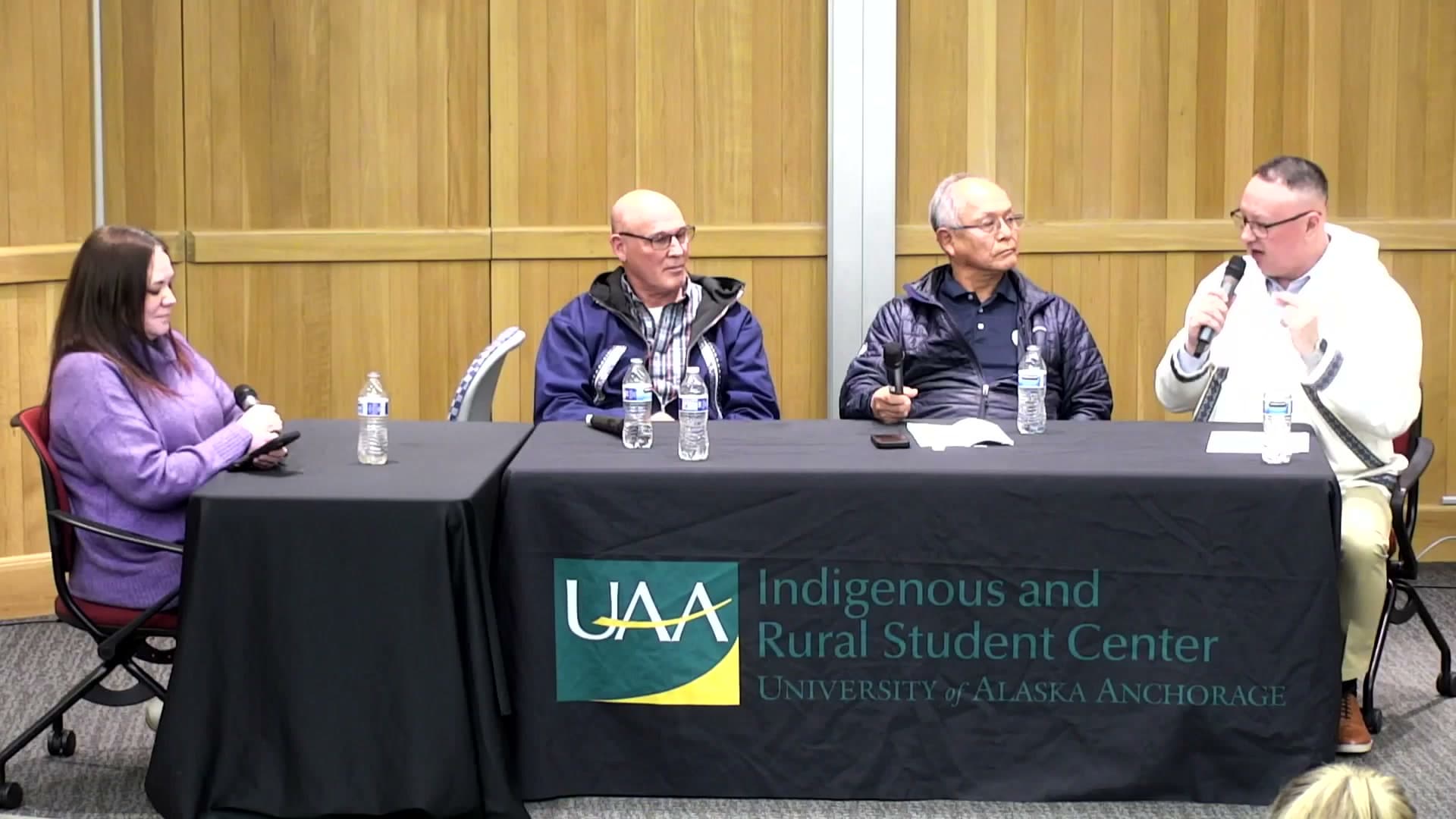
Again, Hallie Bissett. I'm Dena'ina Athabascan. I've served 12 years on the CIRI board of directors and have been involved in one way or another in Alaska Native issues for my entire 20-plus-year career. We won't say exactly how long. I'm the least interesting person up there, here, however, so I'm going to let— we'll start with Haven over here.
Please introduce yourself, and then we'll go Andrew and Richard.
Good evening, everybody. My name is Haven Harris, born and raised in Nome. I've been down here in Anchorage for about 18 years. My current role is Senior Vice President of Growth and Strategy at the Bering Straits Native Corporation. And I want to apologize in advance You should be listening to the much more intelligent and much more proficient oratory skills of Gail Shubert, but unfortunately she came down with the flu this week.
But I hope that I'll be able to add some context. I'm a former board member of the Sitnasak Native Corporation. So between Bering Straits and Sitnasak, I think I very much bring a perspective of groups that have been incredible beneficiaries of the 7 distributions over the years, and that's really where my perspective comes from.
And I'm Andrew Guy, the president and CEO of Telus Corporation. I've been in my position for about 16 years, but prior to that I was the general counsel for the company for about 15 years, and before that I was on the board of directors for about 6 years, and before that I was an employee of one of the subsidiaries and an intern. So I've been involved with Telus and its companies for a long time, and, uh, In those early years, I had the benefit of interacting with many of the original folks at TELUS who had information about how ANCSA developed and was implemented. So I was very fortunate in that respect. But I'm from Nabuskeak and I'm a Yup'ak from that area.
No audio detected at 23:00
Yup'ak. Next to Inukpiak. Hi, I'm Richard Glenn. My Inukpiak name is Savik.
I was most recently a schoolteacher in Anaktuvuk Pass, and I hope to return to it after this brief hiatus I'm going through right now. But for about 20 years, I was a director, I think 18 years a director at Arctic Slope Regional Corporation, an at-large board member, and for 20 years or so, I worked like Andrew just described, sometimes for the subsidiaries and sometimes for our main regional corporation. My focus was land. I studied geology. My elders taught me about Native land issues, Native land use, how to survive, how to not get frostbite, things like that.
No audio detected at 24:00
And I tried to put these two knowledge bodies of land and land issues together. So ASRC hired me in the lands department. I eventually became vice president of lands there, and then, well, somebody got hired and went to run the Bureau of Indian Affairs, and they said, you got— if she can go there, you better take her place. And that was my cousin Tara Sweeney. So I moved sideways from vice president of lands to this government affairs and external affairs for the corporation.
And it's because I love my cousin that much. But my heart has always been with land-related issues.
Well, as you know, we're here tonight to discuss the Alaska Native Claims Settlement Act and specifically one little piece, little but important, one sentence really, in the whole bill of the Alaska Native Claims Settlement Act that talked about revenue sharing. And I think, you know, in the beginning, nobody really got rich. This is how Roy Hundorf tells it. Nobody was getting rich but the lawyers trying to figure out how just that one sentence was going to work, where 70% of the revenue that you make from resource revenue production from your native lands would have to be shared with the other 11 regional corporations. And from that amount, about 50% of that is supposed to be distributed to the villages, and that's called 7J.
So just to get a background of what exactly it is we're here to talk about. But what's really important though, first, is to understand where did it come from? What was the thought process before we ever got to December 18th, 1971, and the bill was signed? And in fact, we were going to actually ask one of our audience members to come up and give us a little bit of history. If you'd be willing, Mr. Hensley, to join us up here.
The first question we have is, you know, how did it get there? How did it originate? What was the thought process when 7 was originally thought of when, you know, back in the late '60s after oil was discovered and we're really catapulting towards what became Angksa. He's just eating, he's ignoring me. Yeah, I want you to come up here.
And so I think it's really important that we understand, you know, really this man that's on his way up here, Willie Hensley, was one of the catalysts, one of a handful of people that really started the land claims process and started unionizing, uniting the Native people around this concept of land ownership. And we would be not where we are today without him. So thank you for joining us up here. The first question, you know, what was the thought process back in the late '60s when this became a thing? Well, things began really in '66, pretty much in earnest, you know.
No audio detected at 27:00
And I think, I think it's important to recognize how limited a time frame we're working in. I mean, it was pressure galore. I mean, most of us at the beginning of AFN, just about this time, you know, how many, 60-some years ago, We had absolutely no background of any consequence to get engaged in that massive battle that took place and the complications in it.
And the reality is that we had absolutely no idea that we were going to end up where we actually did. You know, insofar as this corporate setup is.
And of course, Alaska is huge, and so the different parts of Alaska had different rates of evolution insofar as contact with the Nalagamis or Kasaqs, you know, the white folks. I mean, most of northern and western Alaska and then probably interior Alaska were We were just, you know, hunting, fishing, and trapping and doing the best we could to earn a few dollars to pay off the trading post in those days.
And so the thought in those days really just revolved around the land and the uses that our people throughout Alaska had put that land to literally for millennia.
And so we weren't initially into the structure, you know, how this thing was going to end up. And we, in our minds, we just wanted to be able to continue using the land.
And needless to say, as a minority in this country and in particular in here in Alaska, we never controlled in any way the outcome because we were all— at the end of the day, the power structure was in the room and we were outside the room. And so what we had to do was the best we could to, to try to get a settlement, which all the cards were really stacked against us. I mean, historically speaking, because, you know, Native people had lost the continent basically, and we were about to be it. We were, you know, we were about to lose control at least over, well, really the whole ball of wax, 103 million acres. In the end, they were going to take everything.
And so that's really where we were in in the middle of the '60s as a consequence of the actions that began to be taken as a consequence of the Statehood Act. It really was the 11th hour. I mean, we were well on our way to having the state take the key lands in Alaska with really no real hope of getting get back, uh, once the state made its selections. Because once the state made a selection, as they did at Prudhoe, uh, that was a taking. And no way, if we ever— if we had the potential of getting it back in D.C., there was no way we were going to get it back because that was a taking.
And you'd— under the old system, you just get a few cents an acre. You know, under the Court of Claims or Indian Claims Commission. So, uh, that's a little bit of the background. Um, the, um, I, I found, uh, I, I called Emil this morning and I said, uh, what do you remember? Was that our idea?
Where the hell did that come from? And he hemmed and hawed a little bit. He said something about Chalista.
Area. Really, you know, we were all struggling. You know, we're all poverty-stricken out there. Back in those days, our annual incomes were minuscule, a couple thousand a year maybe, you know, selling a few skins and stuff. But I do have something I found I think it was mostly a product of the non-native system, and the way I'll kind of bring that out is by quoting something I found just the other day, really.
Let's see. Oh, I took a picture, that's what I did.
Okay, uh, here we are. There was a colloquy taking place in 1968 in a Senate hearing between the Secretary of Interior and one of the members, one of the senators, and, uh, and this is what it said.
Oh, not that one, this one here. Okay, here we go.
Could you hold that one second? Very large. Yeah, there we go. Goes sideways. Yeah, there we go.
Okay. Yeah, this is— they were hearing testimony on— and Senator Clinton Anderson from New Mexico was chairing the committee. That was before he turned the committee over to Scoop Jackson from Washington State. And they're actually hearing all the bills, 2906, Senate Bill 1964, 2690, 2020. There was a whole slug of, you know, different ideas being floated by different senators at different times, and sometimes as a consequence of work that we were doing in the Native community.
No audio detected at 33:40
It was July 12th, '68, Senator Hanson, I think he's from Wyoming or somewhere out there, Would the department propose any study, or would it include any provision— I've not read the bill— or give thought to an inclusion which might contemplate the presence of valuable minerals under some of the lands given to certain villages and not to others? So he was concerned that, you know, back in those days, uh, Tionik over here was wealthy, right? They had a lease sale on the Mokwaki Reservation, their reservation, and they ended up with, I think, something like $13 million. Well, in the late '50s, early '60s, $13 million was like $100 million. There was just no capital in Alaska, right?
No audio detected at 34:20
No financial capital. And so, I guess his question was, so there's one village with a ton of money and 20 miles over there, there's a village with nothing. And that was his concern. So Udall's answer was— no, no, I got it.
Pardon me. Udall's answer was, Senator, you raise a very good point. And this is the reason that we put in a provision that 50% of the minerals of these lands would go into this Statewide Economic Development Corporation. So there you have it. So I think this was sort of in response to the, you know, potential inequities that might result as a consequence of some villages or regions having tons and tons and others having none.
No audio detected at 35:20
Well, I asked Ima, I said, "Do you remember? Did we have any discussion at the board?" He couldn't remember. And it really It wasn't that much of an issue because this was, remember, this was prior to the passage of the bill, so none of us had anything. We didn't have any land, we didn't have anything. And you want 50% of what I got?
Hell yes, you can have it, I don't have nothing. So that was sort of the attitude, but in the end, you know, we had to make a lot of internal compromises to try to keep everybody together. Because we're, we're a bit like a flywheel, you know. I mean, we had so many different groups, so many different cultures, so many different experiences, different situations that, you know, we didn't want a one-size-fits-all solution. But as far as the Congress was concerned, it's one big problem, right?
No audio detected at 36:20
What did our area know about Chalista? Not much. What did What did Arik Slope know about Southeast? Not much. I mean, but you know, we were thrown together and we had lots of different situations.
I mean, you know, Southeast lands had already been taken, you know, 16, what, 16, 18 million acres is already gone, right, in the Forest Service. That's a taking. So all they got, all they got out of theirs was a measly $7.5 million and not a square inch of land. So when we saw that historical, you know, experience. So we knew that we needed to try to come up with something highly creative and unusual.
And trying to sell something like that to a skeptical Congress, that many of whom didn't think we were owed anything, you know, was a hell of a challenge, you know. And so, and so we did have one of the big issues, of course, was whether or not to let Southeast in. We let them in. We need to have unity. Another problem was we had some areas that had tons and tons of people, like, uh, uh, President Guy over here, and then you had other places, uh, that had a few people, like Arctic Slope, but their land use was immense because of the nature of the land.
You know, the further north you went, the more dispersed the resources were and the more dispersed the people were. So we had to make accommodations through the land loss provision so that Arctic Slope would get more land. And so my assumption is that, you know, if the distribution of land and money had been done under the original enrollments, you know, they would have got nothing hardly. I mean, small amounts, but my assumption was that Arctic Slope was probably more than happy to share. I don't know if you can say, you know, because they did get maybe, what, 1 million, 2 million more acres?
I don't know. But none of us, we're all— it was like, you know, we're in the dark, really, just doing the best we could. And in our region, we had absolutely no idea we had— we're going to have the world's richest deposit of lead and zinc. You know, and had I known then that, that we were going to develop the world's largest zinc mine, I might have had a different point of view on sharing 70% of it. But, but I have, I have never heard, I have never heard a word in our region negative to the notion I'm sure our people would be happy if we could keep more, but the truth of the matter is that, you know, according to the agreement that we made with all the regions, you know, we've lived up to it.
And so we're looking forward to, you know, your success too. Wena, thank you. Thank you. Thank you. Hona hepa'as'kwe'wili.
And just a moment to recognize NANA and ASRC who are here with us tonight, and even Seerie and Sealaska, if you're in the audience, those early payers of 7, 7. You know, at any one given time right now, the 7 payments from the Red Dog Mine alone make up anywhere from 50 to 90% of what everybody else is getting, and it's been that way for quite some time. So thank you to NANA. Thank you for everything you've done developing your resources and sharing it the way you have. I want to get back to what he was talking about, the mechanism and how we got here, um, you know, the land loss.
No audio detected at 40:20
Does anyone want to pick that one up and explain that a little bit more? No, I want to talk about something else though. I want to backtrack to kind of the start of where Willie was. When I think of ANCSA and what we ended up doing just to get the land, we really reversed almost 200 years of what was termed Manifest Destiny, the westward expansion, which became the northern expansion and out to Hawaii inevitably, that started with the acquisition of Louisiana Territory, right? And I love this movie, even though some of the characters in it are a little iffy.
And when you look back historically, but if you go to Mel Gibson's movie Maverick, He sits down with a tribe that he's befriended and he does this whole facade of, you know, being captured and stuff. And he's sitting there talking to one of the Native actors. I can't remember his name off the top of my head, unfortunately. And the guy goes, you know what? The next time we're really gonna find some god awful land so that you guys won't take it from us anymore.
And that feels like what we were experiencing in Alaska. You know, the, the leadership, uh, at the time, They were out there, like Willie said, starting in '66 after AFN, all the way up through the passage of it. We didn't have what we have today with a bunch of lobbyists, people who have spent considerable time walking the halls of Juneau, walking the halls of Congress and other state legislatures. But they fought for a mechanism that allowed us to retain as much of the land as we were able to get because we had a historical precedent going on with the discovery up on Prudhoe. And such an amazing leverage point that we had that was both probably terrifying in so many ways, but also incredibly fortuitous at that moment.
So I was just thinking as Willie was talking about how, you know, we were in that unique period of the no res period, as it's often described, where if we had been 15 years earlier, maybe 10 years later, we probably do have a much more advanced reservation system. We have more trust responsibility that would bring a completely different set of dynamics. But because of where we were, we ended up with these corporations that allowed, honestly, for the sharing mechanism that may not have been able to happen in any other time frame. That was kind of what I was thinking as Willie was speaking.
No audio detected at 42:40
I, I was just a little boy back when the Act was enacted, but I clearly remember the elders in the village talking about it, and they did not agree with it at all. They told all of us that Congress, angwiyakta we call it, and the state cannot tell us how to live and what to do. They basically told us to ignore the act in my village, and my village was one of the most traditional, I think, in the whole state. Many of our Elders did not even speak any English, so they did, they did not even know that the USA had claimed our lands, that they had purportedly sold it to the US. So in their thought process, and I came to realize it later, the white people that were coming in were like little kids to them.
No audio detected at 43:20
That was how they treated the white people, as little kids. And we have a rule that you cannot break a mind of a little kid. So that was the dynamic that went into that in my part of the country, at least.
But having said that, you know, the sharing mechanism that we ended up with fits totally with our culture. You know, we share everything because we know it's provided by our Creator, and that provision fit right into, you know, our way of being, our way of life. Did you have anything you want to say about the perimeters?
Radio check. Yeah, so the students of today will see the ANCSA and they'll say, "Oh, look what happened in ANCSA. Villages got so many hundreds of thousands of acres and regional corporations got so many millions of acres." The reality is ANCSA took, as Willie mentioned, ANCSA extinguished Aboriginal title and with the leftovers of the leftovers, the natives were able to select land. And that whole issue of taking and extinguishment is missed in most of the folks who are trying to learn about Angst today. When you extinguish something, you put it out, you erase it from effectiveness.
So when I started to become aware, there were people in our community still angry about the fact that we claimed the whole region where our footprints are, where our ancestors— they weren't even buried, their bodies and their bones are still visible to this day on top of the tundra. There's still the taking. In 1923, 23 million acres, President Warren Harding took it right out of the middle of the North Slope and called it the fourth petroleum reserve of the country. And in 1960, Eisenhower took I don't know, it must be around 8 million acres, which the seed of the Arctic National Wildlife Refuge was much smaller. It was called Arctic National Wildlife Range.
No audio detected at 46:00
No audio detected at 46:20
Nobody asked the people that lived in these areas, people who are now in Barrow, Utqasuq Wainwright, Nuuksuk, Kaktovik. They didn't ask them if they wanted to become wards of the Navy or shepherded by the Park Service or whoever it is that runs the wildlife refuges in those days. And so that's the beginning of the taking. And then here comes the state of Alaska, as Willie mentioned, a huge swath of middle lands, my grandparents' kind of traveling place right along the Beaufort Sea coast, took them away. That's off limits.
So if you look at what the villages in the region were allowed to, quote, select for their own native lands at the passage of Angksa, It's what Oliver Levitt used to call— this is the leftovers of an Eskimo picnic. It is a funny land use pattern. Wherever we have federal lands, they're off limits. So it's like, okay, we're all going to share a pie. Well, first of all, the biggest piece is mine.
Second, you can't have the real piece you want. And third, well, you're going to have among these poor substitutes, you're allowed to choose something. And Monica, is your daughter Cheyenne? Cheyenne Wheel?
Cheyenne, could you stand up? This little girl, great-grandfather was Etuk Edwardson. That's Monica Wheel, her mother. He was one of the fighters. He was one of the people protesting here before Anxous Passage about the great land theft because oil was discovered on lands that we claimed.
No audio detected at 48:00
Well, so we fight and fight and fight, and I just want to recognize that Etuk trained me when I first started at the regional corporation along with Joe Upiksaung. We had my corporation bosses, but these two warriors for the pre-Angksa fight, everything is worth going to the Supreme Court for, and it was always about the land. You can find film clips of Joe Upiksaung basically, uh, leading his region to be the only one to vote against Angsa, saying this is a real estate transaction. So long story short, we vote against the Settlement Act. The Settlement Act passes.
We say, man, we fought it. Well, we got to abide by its terms anyway, and in the meantime, do the best we can to reunite our people with the lands that we lost. And this is that land loss formula that William mentioned, since the amount of land we were, quote, losing was so vast that we deserve to be compensated a little bit extra, this land loss formula. And that, that's part of the whole recipe for how many millions of acres each region eventually were allowed to secure title to. So this is a recurring theme, fighting something but making the best of it, whatever the result.
And the second thing, so this, you come fast forward again to Anxas Passage, it has this Seven-Eye Clause in it. 70% Of your resource wealth needs to be shared with all the other regions, including timber in Southeast. And I remember, as Andy mentioned, Cook Inlet and Sealaska were the first sharers of resource revenue, and our corporation dividends got a little bit bigger because the folks were harvesting trees at Southeast. The folks in Cook Inlet were selling land or leasing land to— and developing it for Cook Inlet Oil and Gas. Way.
This is 40 years before Arctic Slope begins to its first contribution to start sharing its own resource development with the other regions. And so we kind of grow up here. We can't fight Seven Eyes, so the leadership of the regions got together and said, this is only one sentence. It's not very explicit. It doesn't say what is or what isn't off-limits.
No audio detected at 50:40
It doesn't say, for example, how are we going to treat gravel? Is gravel a natural resource? Do we share that? And so we got our leadership got together with each of the regions and they locked themselves in a room with a retired judge. I forget what they call him when he facilitates compromise between— huh?
Something like that. Yeah. Anyway, don't come out of the room until you guys agree on all these things. And all of the leadership put the flesh on the bones of Angsa 7i, which is, okay, what's eligible for sharing? What's not eligible?
We all agree to this? Yeah, everyone was kind of some on board, some not, but they all signed it and it became the working agreement for the regional corporations.
Now, if you, if you earned a dollar, let's say, in a part-time job at a restaurant, and you had to give 70 cents away for every dollar you earned to people who weren't working side by side with you, how would you feel, right? Well, whether or not sharing aligns with the values that we grew up, it was the law, and so we made the best of the law. And it makes no sense in endless, endless litigation to fight over, but just make the best with it as long as we all agree to what it really means. And that's a confidential, I guess you would call it, agreement, but we know that the end result is timber, oil, gas, minerals are shared when they're owned by subsurface of the regional corporation. And then Everything else is kind of, it's smaller potatoes than the skeleton, the main bones of the issue.
No audio detected at 52:00
No audio detected at 52:20
So on the land loss formula, you know, ANCSA was structured in a way that each region, each village got an entitlement of land and money. It was based on population. And that's where the land loss formula comes in too. You know, there were 7 regions that basically gave up land entitlement so that regions with known or better chances of having a resource to develop could develop that and then in turn share it with those regions that had voluntarily given up land entitlement. If I could add something, I think Richard said, you know, we were taking the scraps of the scraps of the scraps at times, right?
No audio detected at 53:00
I know in our region we've— we're now getting this era of rare earth minerals, right? And we've got a lot of that in our region. But for us as a Native corporation, who would— I would honestly love if we were sharing 70% because that'd mean we were developing something. This, a lot of those mineral resources were already spoken for before we ever got to make a selection. So we have some selections where there are rare earth minerals and great deposits, but they're really the tip of the iceberg on the bigger deposits.
No audio detected at 54:00
And I think that's one of the unfortunate things that we got stuck with because of the timeframe, because of what we were having to select. And how Richard so adequately described it is We didn't get the best piece. We didn't get to go in and our people knew where these things were for a long time. You know, elders speak of rare earth minerals and like the land is glowing for some reason. We knew it was different.
The water, the animals that came from it were different. And yet we didn't even have the chance to get those best pieces. So we've really had to make do. And for a corporation like Bering Straits, and I know for Chalista and Andrew's case where we haven't had yet the big opportunity to be providers of 797J. That, those payments, man, that kept us alive.
And I know we can tell the stories of the benefits of it for the regionals and village corps. And I hope we're going to get to that a little bit. But we, Bering Straits is now pretty successful, but we wouldn't have even survived without 797J. So, you know, that opportunity is what, you know, I look forward to some decade, hopefully for us. So, uh, you know, the regions we basically have the subsurface, it's the village corporations that have the surface, and the village corporations were the ones that selected most of the lands that we own the subsurface to.
No audio detected at 55:20
But the main purpose that, at least in my region, our village corporations chose The lands that they have was for subsistence because those were the areas where they went to fish and hunt and gather. That was the biggest purpose for selecting the surface areas of what they are all now. Now, I don't think that this system exists anywhere else in the world where you would have to share, excuse me, 70% of your profits with other companies, some regions of a continent or country. A lot of people don't like it, and let's be honest, you know, could change, could be different. I want to talk a little bit about what's uncomfortable about it, and specifically there's the thought that you spend all of your time and effort and money and resources investing into the process, and Willie, you can yell and correct me if I'm wrong, but I think it takes some 30, 40 years, and Andrew, you're going through this now with the Donlin Mine, to get to a point where you're actually producing something.
No audio detected at 56:00
And I want to ask, I mean, does it feel— nobody's telling Microsoft and Apple to share their revenues, for instance. Does it feel fair? I had an elder tell me one time, yes, you know, we share everything in the Native community, but we didn't share our money. So there's some different thoughts about it out there. It's not all glowy.
It's like 1971 is when the act passed and 1982 is when this agreement was finally signed, and I don't think it was all roses after that. So Richard, you want to. Say something? So I'm not going to argue about the goodness or badness of sharing, but I'll give you an example. So since inception, Arctic Slope Regional Corporation has shared $1.8 billion with all the other regions and villages in the state.
No audio detected at 57:20
So if the, if Seven Eyes says 70% of your wealth needs to be distributed to others, and that 70% equals $1.8 billion, then it doesn't take a rocket scientist to figure out it's about $2.25 billion worth of revenue has been generated from development of Native lands in the Arctic Slope. And of that, 70% given away, that equals $1.8 billion. Walter's here, he's a math wizard, he can correct me if I'm wrong. And then we're left with about almost $800 million of value to the corporation.
So let's forget about the fact that we're giving away 70% of something and think about what the value was to the corporation. Well, it's It's significant, $800 million over, especially between the, like, from 2005 to 2015 or something like that. So the bloom of resource development and benefits to the regions and to our whole state based on development of those specific Native lands at the time. So that's a value, and there's other values that development of Native lands get into, and I'm not going to I'm not going to get into a class on the corporate asset of developed Native lands, but what I want to say is what it did for us. What it did for us is at a time sometimes it was 30%, let's say, or sometimes it was a major part of our bottom line for income to the whole corporation to hire people, to make new to give jobs, to develop new enterprises.
And in the beginning, all of ASRC's efforts were resource development related—oilfield contracting, leasing of lands for exploration. And so everything was seemingly oil and gas focused. And then we took this bloom of resource development revenue and we used it to diversify the company. We used it to step outside of— not just step outside of the North Slope, but step outside of Alaska. And, and so whereas before 30% of our revenue was coming from resource development, today it's only 4%.
Think of the change. If you think of ASRC as kind of an oil and gas company, when only 4% of its resource of its revenue today comes from the resource development itself. That's a significant change. And in early— in inception and up to around the year 2000, it was like 75% of our work was in Alaska. Now today it's like almost 25% or 35% of our work is in Alaska.
You know, we're doing government contracting, we're doing industrial cleaning, We're refining oil and gas in North Pole and Valdez. But my story is we took the resource wealth and invested it, which is by nature not sustainable. It's a bloom of production and a decline, unless you find something else and develop again and stack all those together. We took the nature, the bloom of the resource development wealth, and invested it in something that is stable, that is durable, that is also not a victim to the spikiness, for example, of oil price. Price and volume, it's like in mining countries, tonnage and grade, right?
And so I think the leadership— and I don't work for them, I don't work for them today, but I'm going to tell you the leadership of today's regional corporation did a very wise thing to diversify. So the fact that 4% of the revenue is resource wealth, it doesn't mean that's a small number, it just shows how big the rest of the corporation got, which is really a great story. And it's our hope that others have grasped that kind of temporary bloom of resource wealth and use it in similar purpose.
So, uh, one of the uncomfortable things about ANCSA, it was a termination act basically at the beginning, and it was supposed to last 20 years, and then, you know, we'd be able to sell our shares and lose control of those corporations. But the 1991 amendments changed that, so it's no longer a termination, uh, a law, but many of the provisions in there are still termination related. So that's what we need to address, or the younger folks will need to address going forward. You know, in order for a corporation, any corporation, to be successful and hire its shareholders, you know, make a living off of these corporations, We need to have infrastructure in place. When you look at Western history, every major economic activity, business development activity that arises come after infrastructure has been placed by government.
No audio detected at 1:02:20
But in our case, we're expected to build infrastructure ourselves, being corporations. So that's a very difficult conversation that I think many in the, in the community, legislative folks don't want to hear about. But when you look at it, the state that has taken billions and billions off of the settlement, you know, of the lands that they've taken control of, same as the federal government. So they need to do their part in terms of getting infrastructure in place so that all these village and regional corporations can not go outside but develop in the regions, in the villages, so that our people don't have to leave.
So listening to Richard and Andrew gave me two real thoughts. The first is a little funny aside. Andrew, you talked about the billions of dollars that have been taken from our regions. Richard Foster, the representative, is Neil Foster's dad. I worked in Juneau with Senator Olson, and Richard was a good family friend, so I'd go sit down and talk to him all the time.
No audio detected at 1:04:20
And about every 5 or 6 years, he'd get mad at somebody down in Juneau and he'd introduce a bill, and he had it written in. It was ready to go at all times, and it was basically cutting the state of Alaska into two pieces. And he said he'd be glad to give the state of Alaska everything in Anchorage— sorry, Sere— pretty much everything in Fairbanks and a couple other assorted lands if we could make one state out of the rest of it. And his whole point to the state, and he'd bring it up to people, was if we took away all the Native lands and all of our resources that we gave up, there would be no state. There would be no resource development.
For the state of Alaska. And that was his threat. It wasn't a real bill in reality, but it was just that little subtle reminder that he liked to give to Juneau every 5 or 6 years. The other thing that I was really thinking of, and as I'm sitting next to Andrew, it's kind of funny how Chulustan and Bering Straits have such a similar history, being the ones up here who don't have the big development yet. Crossing our fingers for you, Andrew.
No audio detected at 1:05:20
But Richard, you made such a great point about the growth of ASRC, and I think it leads to the growth of a lot of our other corporations right now. I grew into Bering Straits doing government contracting. That's really my background. Spent a lot of time doing that. The 8 government contracting entries that we've all had have been incredibly successful for Alaska Native corporations.
It's lifted a lot of our regional corps up, a lot of our village corps, and it gives us a fundamental base to work with. But that really only works because of the 7 and 7 mechanisms. For Bering Straits, I can say it very plainly. Without the money that came from 7 and the ability to disperse it at any kind of given time in a flexible period, we were able to reinvest in Bering Straits to create business development opportunities, to fund these projects that now has us becoming one of the larger organizations in the state of Alaska. We're no ASRC, we're not that big, but, you know, we're trying to keep up with our cousins to the north.
And if you didn't have that mechanism, I don't think there's any chance that we would be existing in the way we do today. We wouldn't be giving out our largest dividend ever, our largest elders' dividend. So that's where I keep coming back to when I think about where we're at with 7 and 7. And for me, I, as a descendant shareholder, I really look at the world and I don't remember a time without this mechanism in place. Um, I look at it as something that is almost an inherent feature of us today.
And if Bering Straits is ever, you know, we ever have a development that's big enough to pay in, I'm going to be so pleased as punch because that means we're finally contributing back into the system that has perpetuated us. I love that. Before we get off the topic, though, I did want— I was hoping it would come up, what we lost. Let's compare numbers. Does anyone know in the audience what's the total amount that's been shared by ANCs since 1971?
It's $4.6 billion. $4.6 Billion has been shared since inception. The state of Alaska over that same period of time took $164 billion from oil and gas alone. The federal government very roughly took about $90 to $100 billion over that same period of time. And then keep in mind also that we're corporations, so we're actually taxed on this money as well.
That's another $1.2 billion that was taken from us from that $4.6 and paid back into the federal and state government via taxes. So we talk about, you know, all this great things that we got and look at all this money, but really it ends up being not that much. And the, the things that we've been able to do with that money is really quite incredible. I do want to get to the positive side of it, and you started hitting on it, Haven, when you talked about, you know, you wouldn't have been able to do any of the things you did. That same thing is true right now for the villages.
The village corporations right now, there's 177 of them still today. A lot of them emerged. There were over 200 when NAGSA passed. About two-thirds of those are 100% dependent today on resource revenue sharing. 7J revenue is the only thing that they've had.
And over the past 50 years, that amount, you know, if it's enough, has been taxed by the state and federal government as corporate revenues. I believe that should have never been taxed. I think we're owed about $1.2 billion back, but that's a story for another time. What are the— I mean, do you have any examples, the three of you, of how villages have grown in your region due to the 7J alone and how maybe they've diversified? Or do you have advice for village leaders that might be in the audience today?
Richard, you know, how can we be the next ASRC and, you know, look a little bit more like that? Smart Investing. What kind of advice would you give to those trying to diversify? I'm not much of a corporate expert. I know the land better than I know the corporate operations and all this, but I'm proud of our village corporation, for example, or my village corporation.
Corporation is a number 8 of these top 49ers that are awarded every year. So that corporation has taken the ball and ran with So advice for them is to, yeah, invest your 7J revenue in ways that can grow the company, as Haven was describing.
And keep in mind that it won't last forever. It won't last forever.
But that provision lasts forever. And so if something new is developed that we don't even know about today, then that kicks in too. So sometimes it rains and sometimes it doesn't rain. So yeah, I'm not a corporate advisor. Sorry.
Yeah, 7J has been really beneficial to the villages in my region. We have 4 to 5 village corporations. So 2/3 of them, which is about 30, rely on 7J to be profitable. Or even break even. And our villages provide a lot of basic services like operate a store, operate a fuel business, you know, everything that's needed by folks to supplement the hunting and fishing that we have out there.
So they've done a really good job in terms of using 7J to benefit the people out there, and not just shareholders but other people that are moving to the area. And, uh, that is what, uh, needs to be amplified, you know. But like I said, in order for development to occur, it has to be, uh, uh, at a level where it's not losing money, and that means having an infrastructure in place.
Um, I concur with what both Richard and Andrew have said. Bering Straits Region is very similar in that the preponderance of our villages, you know, maybe running a store, maybe running fuel, a couple rental facilities, things of that nature, right? And then the bulk of their revenue comes in from 7J. But I'm going to take us back to a little bit of a reality check with 7J right now. We're about to hit the 7J cliff.
2031, Probably final payment in 2032 from NANA, that first half payment. That is the end of the line when we're talking about the Red Dog payments in almost all realities. I haven't heard anything that's extending it out any longer recently. So if you're sitting in a village corp and you don't already have a business built, I can't say it strong enough. I hope you are starting to save money.
It's very difficult. We're in a very, very expensive period of time. We all know that. It's hard to envision a village court being able to say, no, we're not giving everything we can to our people, especially when they're living in our home communities. But there has to be some type of fiscal discipline and planning right now, which is not an easy thing to say.
And I'm not sitting here envious of those positions they're in by any stretch, nor am I one to want to preach to them, but I'm really afraid the position some of our village corps are going to be in in about 7 or 8 years when that 7J has really not come out for, you know, 3 or 4 years by that period, unless Donlin Creek or something magical pops up in a real immediacy. How are we looking on that magical Donlin Creek anyway? How many years do you think? The only thing coming to replace this revenue right now that's like anywhere close is the Donlin Mine in the Chalista region. There will be a giant fiscal cliff, as I mentioned, 50 to 90% right now of the money that's being shared is coming from one source, the Red Dog Mine.
No audio detected at 1:13:00
No audio detected at 1:13:20
The only thing coming to replace that is coming from Donlin. Well, we're hopeful. You know, it's been a 31-year process already, and even before that, uh, we knew that there was a gold resource there. But back then, the mining companies weren't very, very good in terms of being stewards of the land and waters. So our elders in the original board took their time in terms of getting the lease started at Donlin, and it started in 1995.
31 Years ago. But if the US had already had really good mining practices back then, we could have started earlier, you know, but we just didn't trust the industry back then. Now we do, and now we have the ability to influence how it's— how it can be built and operated for, you know, the life of its resource without doing harm to the environment and the fish and game that we rely on. So we're hoping that in the next few years our partners will make that decision to construct and then eventually operate.
I'll tell you a story that softens the blow of the turndown in Native-owned resource revenue, which is why a lot of the leadership, North Slope leadership, advocates for continued responsible development in our region regardless of whose land it's on. So let's take away the whole issue of land ownership just for a second and talk about development in your region. So we advocate for development because it Provides a tax base that builds the schools, the health clinics, the fire halls, the water sewer systems in our region. With the presence of industry in our region, we tax their property and the benefits of that taxation goes to our villages. Every community is dependent upon continued responsible exploration and development And the people of our region are sitting on the planning commissions and the village zoning commission, keeping their eyes on the development that goes on around them to make sure it's done right.
No audio detected at 1:15:20
So we got skin in the game, not in a land ownership sense, but instead in a civic sense. And this is why If it's on state land, if it's on federal land, you'll find our regional corporation leadership continuing to advocate for it because what else is going to keep the communities running? What else is going to keep the diesel fuel in the tank farm? How are we going to keep these water and sewer facilities, sanitation, basic sanitation ongoing? It takes continued development and taxation by the municipal government.
So that's the story of the borough in our region, and we advocate side by side with the borough for, for the right kind of development, because the borough knows until the economy changes, until the world changes, that's the only thing that's happening in our region that brings benefit to our city councils, to our city residents, and So that steps outside of the Aanxa lands, but it's all Native land. I don't know if— there's no fences in our region. When you ride a snow machine, you don't— the color of the tundra doesn't change when you go from Native land to NPRA to state land. And our people's roots are everywhere. You can find a testimony my grandfather gave His name was Walton Namawa.
See, before, it must have been like 1935 or something like that, they passed a law in 1935 that said mandatory education. And prior to those days, and my grandfather was born in the 19-teens, he said, if you could fly over the North Slope and look, it looked kind of like the Midwest looks. A lot of space in one house, then a lot of another space in another house. And not these 8 villages that we call today the North Slope communities. They were scattered like shotgun blasts across the whole landscape.
And only after this mid-'30s, they were told, "If you don't send your kid to school, you're going to jail." So boom, these things coalesced into Wainwright and Barrow and a few other locations. And then this social movement that became Angksut comes around. Atkasuk still had people this whole time, the Atkasuk area, but it became, quote, there was a headline in the Fairbanks paper, "What's a Nurksut? What's an Atkasuk?" Because the people came back to the place where they were just basically evicted from under this mandatory education. And that's true today even in the way we use our subsistence camp.
No audio detected at 1:18:40
No matter who owns the land, people are going to places where their grandparents were born or where so-and-so taught them how to hunt or, you know, we're stitched into the landscape like a fishnet and it covers the whole thing. So we're not just 8 dots on a map. We're this deep relationship to the land, and it transcends corporations and boroughs and everything. So thank you for letting me on my social box. I had one other thought.
Um, you know, I think Andrew was kind of alluding to it today because of the size of the corporations, some of the areas that have boroughs. Even the village corporations being far more successful. I think we do a better job of exuding our influence than perhaps we have in the past, even 20, 30 years ago. And I hope that we continue that path forward. You know, we now are able to put resources into areas that we weren't before when it comes to advocacy, when it comes to walking in halls.
I ran— last time I saw Andrew before this was actually in D.C. at a meeting where we were meeting with, you know, very high-level people. And it's great, but we still have so much more work to get in to do to get our voice there. Uh, I'll pick on my own corporation. We haven't necessarily done a good job of advocating for regional items. I was just at a board retreat last week where the A1 message I took out of that room was, all right, staff, you've done all this work, you've grown this company, that's great.
Now we've got to bring it back and help our people. And to me, that's kind of the core of the fight for the lands was also the fight for the people so that we can remain in our homes. Andrew, almost every time I hear Andrew speak, he talks about the infrastructure, the need for investment from both the federal and state government to invest in our communities. And I can't agree more. But, you know, we've been at varying levels of ability to push on that.
And I'm really grateful that we're finally getting more and more of our corporations, and mine included, so that we can go back and start speaking with a little bit more of a unified voice. ASRC is a great example. Example of it, and I pick on them when I talk to other of our friends saying, you know, they come in with the Voice of the Arctic. They come in with ASRC. They come in with the borough.
Their village corps come in and they speak in such a unified language and tone that it's— you can't break them apart. And that's where some of our biggest weaknesses is. And so that's something I think that we have to do more cohesively and collectively. But that again comes from the sharing mechanism. Bering Straits, I honest to God, I don't think we would exist without 7 and 7.
Andrew earlier spoke about the '91 amendments. If you had asked my mom in 1991 if she would have sold her shares for $1,000, I guarantee she would have signed that check, right? Because we had had nothing. The running joke in Nome used to be, hey, maybe we'll get enough money to buy a case of beer or or some toilet paper, right? That's where we were.
And so it's these mechanisms that, you know, whether they may have shown up as one line in one random saying by Department of Interior Secretary Udall, but it's the mechanism that's kept so many of us going to this point.
So as you guys are talking, I want to get to like the future of, or if you could change something, but as you've been talking, I haven't heard any of you to even address that it could be changed or be something that you'd want to change? This provision, ANCSA itself has been amended over 130 times or something like that, but not that provision. That provision's— is it untouchable? If we could touch it, what would you do with it? I mean, I would like to hear your thoughts.
No audio detected at 1:22:40
I have an opinion on that.
I wouldn't touch it. Because the example I have is totally unrelated, but the Marine Mammal Protection Act. People always want to say, "We should reopen the Marine Mammal Protection Act and try to change it so we can have better hunting opportunities in the ocean, or we could sell, or we could do X, Y, Z." And our advice has always been, once you open it, it can be changed by anyone. It'll change maybe in a way that you're not in favor of. It's like a can of worms.
So no, I, no, I'd rather deal with the devil that I know than the, than the one that I don't know. I, I think one thing that, uh, I would kind of look to change would be the Seven-Eye Agreement, so that, uh, you know, corporations are— we've become knowledgeable in running these major businesses, uh, but the Seven-Eleven agreement kind of discourages us from doing our own development using our own resources. So we partner up with other companies that, uh, want to do it. So in that respect, I think I would— that would be the only way, or the only thing that I would kind of tinker with, you know, but not change the, uh, 797J. I, I lean somewhere in the middle, more towards Richard, I would guess.
No audio detected at 1:24:00
I'm deathly afraid of opening these types of things. Um, I have a poli sci degree, and I just remember hearing about Christmas tree bills, right? You, you want to go fix something, and all of a sudden everybody's got to throw their a little piece into it. And I know one of the things that we haven't really talked about is the mechanics of how the costs can be extracted from these developments. Andrew's probably got 1,000 of these studies either in his computer or on his desk right now.
Richard, I'm sure, has extensive experience with it. You know, there's a lot of accounting features you can do, you know, before you even have to start paying into it, you get certain amounts of profit you can you take back and make sure you've recouped all your costs. So there are a lot of mechanisms to help you get to the economic feasibility of these big projects.
Um, that all being said, man, I would hate for us to have something that goes great and is this unique opportunity, whether it's Donlin or God bless us, something falls from the sky and lands that we could all be sharing in and we could keep our village corps going and we could provide the capital so that the regional corps can go from, you know, whatever size they are to double and triple. Because I just, I think so many of us would go in there with the best of intentions, but we would all have to look at what we're doing to better our own region. And we were in such unique periods coming out of the ANCSA agreement. And like you said, it took 9 years to go from '72 to '81. To get the original agreement signed.
Think of all the arguing that must have been going on during that period. I would hate for us to open it and spend another decade fighting over particulars because we are so much better at running corporations and we do know the arguments better. So it was amended one time. Oh. Well, maybe not one time, but when I was GC, it was amended to— for the scholarship Provision.
No audio detected at 1:26:20
That took about 10 years.
Talk about one of the benefits. So that's one of the deductibles, right? That— does someone want to explain how that works? You can subtract a certain amount of 7, um, and every region can do that even before they send out 7 for an education foundation. Is that kind of how it goes, right?
Um, and, and the result of that has been, you know, any of of you in this room that are getting a scholarship from a Native Foundation, you know, a lot of that money every year comes from revenue sharing and it wouldn't exist today without it. And so everybody that's been the beneficiary of those programs are beneficiary of 7. You look like you were going to say something. Yeah, I just wanted to add in, we were talking about taxes and things of that nature and we, you know, we could, we'd have to bring in some people who are really, really to come in. But I think, Andrew, that was part of your background at one time, if I remember right.
No audio detected at 1:27:20
But they're, you know, the trusts that we now have is a different component. ASRC is a little different because they have so many NOLs and tax credits from their resource extraction. But for the rest of us, you know, so much of the benefit is now coming through our trusts. And I've seen companies literally run their 7i or 7j straight through the trust to go out to shareholders. And it's a tremendous mechanism, but it's also another mechanism that really allows us for long-term shareholder benefit.
I hate that word shareholder. I'm just going to put that plug in there. That'd be the one thing I would fix in Engsa all the way around if I could. But it's been a true boon for our people that we're able to run so much of this money now through these trusts and they go out to our shareholders and they don't We don't have to pay taxes and we get better tax benefits, so it diminishes that $1.3 billion or whatever in the long run. But I just think there's so many new ways that we have to kind of slice the apple and look at the new developments so that hopefully they are more beneficial to our people in the long run.
That's really good advice. So for any village or corporate leaders that are in the audience or listening online, you can put your 7J or 7I money right into a settlement trust if you don't already have have one of those, you ought to be thinking about it. You pay about 10% tax on that if I'm remembering that right versus, you know, 38% or so of corporate tax. So you should pay otherwise 20— okay, they change. So it's 23% now.
That's pretty good though. All right. Well, I just want to remind folks, if you have questions, write it down on a piece of paper, bring it on up here. You can set it down here or just right up here on the table. We don't really have mics or someone going around audience.
Um, coming to kind of the end of my questions, were kind of smattered in everything that we said. Um, I do want to talk a little bit about what happens to the villages in 2031. Um, you know, if nothing else happens and Donlin's not a go by then, what's going to happen to the two-thirds of the villages that are depending on that revenue? Um, have you— surely you've had conversations at the executive level level about this cliff that's coming? What are you planning to do about the villages?
So I'm a dork, and, um, I've been talking about this with some friends for like a decade now. In all honesty, it's kind of scary how long I've been talking to people about it. First, uh, sitting as a regional corp executive, it ain't my place to tell the villages what to you first and foremost. And I think Andrew's nodding his head. I think Richard would wholeheartedly agree with that sentiment.
No audio detected at 1:30:00
But I think, um, as Hallie, as you said, you know, we've amended ANCSA like 100 times. It gets amended every year. Um, I think we will have to be prepared to be responsive to the needs of the villages. Um, if you just wanted me to spitball for a second, I think you'll see some version of the consolidation. You've got, you know, Kuskokwim Corporation, MTNT, groups like that, Ganiyu, that, you know, consolidated multiple village corps, right?
You've got two regions, the NANA and Ahtna regions, that have absorbed almost all of their villages. I think each corp— each corporation has one village corp that stayed out, K'ikiktguruk and Kotzebue, and then Not Cantwell, uh, uh, no, no, Cantwell went in. It's, uh, Klutukai. No, not Klutukai. Klutukai got absorbed.
Chitina. Thank you. I should know this. It's my wife's region. I'm sorry, I blanked.
Um, but I think, you know, we're going to have to be prepared for discussions like that. Um, do you do sub-regional groups because you're creating capacity? You know, when I think of the resource and abundancy of our corporations, I don't just think about it in terms of just the natural resources. I think you had a couple corporations, I'll pick on Doyon and Seri in particular, and maybe Sealaska, even though they had both, where they had probably the more educated, formal education-wise, just because they had sheer population and they were at the urban areas of our state. They had some benefits, so they were ready to go.
Then you had some of our groups that just didn't have that. So we didn't have something that should have drawn in our village corporations. I think you're just going to see we're going to have to be incredibly flexible. And hopefully our congressional delegation is willing to work with us on what that forward process looks like. Yeah, that's the tack that we're kind of looking at right now.
It's a real issue here, two-thirds being reliant on 7J to be break-even. And looking at the history that we already went through with villages joining up with the regions or joining up with other villages, that would be the best way to address what's coming. But we need to take it to not only Congress but to the state too, because we need to make changes to the law so that that it'll be an easier process. You know, it takes a lot of shareholders to approve a transaction like this, so we need to change those kind of thresholds in order to— if a village wanted to join up with another village or with the region, then that those would be the kind of changes we think need to make in the interim.
Richard, did you have anything you want to say? So I want to ask a little bit about local energy and how that plays into revenue sharing, because as I imagine, you know, there's a gold mine in Bering Straits region and you have to provide power somehow to that said mine, and let's say you find natural gas to provide power to that. Is that 7? I mean, how do you deal with that? Is that dealt with in the revenue sharing agreement now?
Are we restricted from developing our own lands for local use because of 7?
I got an easy excuse to wholeheartedly avoid this question. Thank you. Even though I helped develop village energy, I did it— we did it for Barrow. And Nur-Sitt has done local natural gas for local use. And I don't know the details of the source of the natural gas for the village of Nur-Sitt.
No audio detected at 1:34:00
It comes from the Alpine field, which in part is native-owned. So I don't know how the resource bookkeeping works, but it's so insignificant it pales in comparison to the value of production as a whole of oil. In Barrow, the So Andrew's example of the village selecting lands and the regional corporation gets to own the subsurface, and for the most part that didn't work in our region because I described earlier we were wallpapered with these federal enclaves. So in large part, the regional corporation didn't own the subsurface. In Barrow, they still don't own subsurface.
To most of the village lands. The government does. Remember, this was the Naval Petroleum Reserve. And only through these other tools, years later, we tried to reunite some of the subsurface back to Native ownership. We had to use land exchanges.
And land exchanges were our way to retain or to invest in ownership of the subsurface that we weren't even allowed to select in the first place. So we haven't run into this issue of will I be diluting or will I be distracted or dissuaded from developing these lands if they're for energy for local use. I imagine if it's native natural gas, for example, and it's going to a community, it's produced, it has a value, and the value to the— the benefit to the community is so great, a subsurface resource owner, I don't think especially if they're one rooted in that community, I don't think that they would— I don't think that they would walk away from that change in the quality of life just because they have to share resource revenue.
No audio detected at 1:35:40
You know, when NAGSA was beginning to be enacted in at least my village and the other villages, I saw village corporations, village corporations starting up utilities because there were no companies providing electricity, you know, back then. But these village corporations needed energy to run their offices and the stores that they were starting up. So That was one of the biggest benefits in terms of ANCSA and the 7J money being received by the villages. They were starting these very needed services, utility services.
And that needs to, or that kind of tells us Development can be beneficial in terms of not just the business, but for the whole community in terms of like water, sewer. My own village, we still don't have running water and sewer. We do have electricity, and that's many of the villages, that's what they face. So development it can be a major source of those services being begun and maintained.
I'm going to go back to the just the business part of it for a second, right?
In paying out 70% versus a 30% retention, if let's say Bering Straits had a mineral resource that we were able to extract and we stumbled upon natural gas nearby, that would all be part of the math equation. Right. And that goes back to the question that maybe Andrew was getting at about opening up 7i and looking at the incentives for investment. We would have to do the math of is this natural gas product cheaper and plentiful enough, commercially available, then instead of getting diesel shipped in or waiting for 2031 or '32 when micronuclear reactors start working. In theory, that's the horizon we're on, right?
No audio detected at 1:38:00
And so that would be the mechanism because what you would really have to be looking at is I am creating a commercial development for a commercial development. And do both of those cost-wise make sense for me to give out 7, 7 on natural gas? And then depending on the location of mineral extraction, that's the component that I think maybe Andrew was really getting at earlier. And that's what we would have to do just as a corporation. That's probably part of what separates us, um, in our long run from, say, tribes that have trust responsibilities in the Lower 48, for example.
Yeah, and I guess I can ask it a different way a little bit. For instance, should you have a mine, a military base, uh, data center? There's a question here about whether or not you see data centers as an opportunity, which we'll get to. Um, but, you know, there's going to be this big thing in your region, right? And you want to provide power to that thing, that thing that didn't exist before, that, you know, the village is just providing power for its own little store and the 50 houses or so that are there, 50 to 200 houses that are in that village, and that's it.
No audio detected at 1:39:20
And it's not a money-making equation at this point like it is in your region. But, you know, we have these things coming. We have mines coming. We have potentially data centers if you're into it. I don't know, you can give us your opinion in a minute.
But the state of Alaska has land, and you have land next to that thing. And who's going to provide power? And energy is like, you know, it is, it's very important for developing any of those things. So I think it, it seems to me that you are at a disadvantage in that scenario because of SevenEye.
I want to go back to what Richard said though. You know, ASRC has contributed, you know, $2.5-ish billion, uh, or $1.7 billion, $1.8 billion to SevenEye, and they've got $800 million. If this was a commercially viable opportunity, um, you know, you, you're talking 20, 30-year payments, um, for something like that. I, I can't imagine any of us wouldn't be able to find partners and pen that out math-wise. Um, it— the reality is, is if you have a big enough resource opportunity and a big enough viable distribution, whether it's a data center, a military base, a mine, whatever it is, these things can pan out for the most part unless they have a short run.
No audio detected at 1:40:40
If you have enough that's commercially viable for 25, 30, 50 years, it'll pan out. And for me personally, to be able— if Bering Straits had a scenario like that and we were able to contribute back to the rest of the corporations that have given so much to us, I would be ecstatic for it. Um, but again, this is the neat thing about our developing companies. We're now real deal viable corporations that are doing work in all three of our cases, I know for a fact, worldwide. And so we have people, we can go find people that can pen it out for us and go, yeah, hey, if that makes great sense, go get it.
Or no, you know, if you guys want to do it as a community benefit of some sort, that's a different discussion, but just commercially it doesn't make sense. We can have those discussions at a good high level, and our our staff, our boards, they're all equipped today to have that discussion.
So, uh, this is why I'm uncomfortable with the hypothetical, because let's say, let's say this is the paradigm. Let's try to adopt it for a second. The first— so the exploration game carries risk. So to— let's say we try to put a well under a village. An exploration well.
It's basically going to be a wildcat well. That's tens of millions of dollars, maybe $50 million to sink into an unknown. You might be there, might not be. Even in this oil and gas province like Cook Inlet or the North Slope, there's risk. There's dry holes drilled all the time.
So who has the stomach big enough to swallow the risk of wildcat exploration?
It's hard to talk even the largest of our regional corporations into that kind of risk.
Richard, isn't it like, you know, wildcatting? They're basically hoping for 2 out of 20 wells to hit, somewhere in that ratio, right? You know, you're— Doyon's had a lot of experience with it, Haughton has had a lot of experience with it. That's— yeah, CERES had a lot of experience. I mean, that's a lot of money you're you're talking hoping for 2 out of 20 to hit.
Yeah, and I just would, you know, add to that, as I was on the CIRI board when we invested in the Doyon Region, and as part of— somebody asked me as we were leading up to the Seven-Eye discussion here, why isn't there more Native corporations working together to develop a resource? And I said, well, there are. I mean, there are examples of that, and one of them is the Doyon-CIRI partnership in the Minto Flats, I think it was, or Yukon Flats, one of those, you know, two maybe, maybe more than 2. I want to just remember that it was 2 dry wells, you know, tens of millions of dollars that have now just gone. And you got to answer to shareholders about that.
You know, why are you giving money to this other region to go explore these things? And, you know, had we hit the money, right, it would have been working interest ownership. It's a different level, right? You hit on that. We're kind of forced into these relationships with other entities because we're not able to go out and do it on our own.
Do you guys foresee any scenarios in the future where— and I think I heard you say no— but where Native corporations work together more? Maybe you want to give another example than the one I've given where it's actually happening or has happened in the past.
You know, it's possible. Couldn't rule it out. Because aside from the 7i7j portion of a project, there's so much other support needed by any major project, and that's where the corporation can benefit. You know, the SRC has been really good at doing that. You know, the non-7i7j portion of the oil and gas business.
Look at NANA. They were able to support the project outside of the 797 portion. And we're looking at the same at the Darlington if it does go into construction operation.
I think there's always an opportunity, right? Like Um, people may not see it every day, but there's a lot of avenues where corporate leadership sit in the same room, spend time together. Uh, you know, Andrew's on the ARA board, the CFOs for ARA, the legal GCs. There's a lot of us that sit in various trade associations together. So to say that it won't ever happen, I think, would be a logical fallacy.
Um, but I think also we're we look pretty inward a lot of the time, and especially at the size a lot of our corporations are getting at, you know, um, if we had a major development in the Bering Straits region, I know for a fact my board would be like, go talk to the village corps around it, let's start getting them the maximum amount of benefit, even if they couldn't be large financial investors. Uh, you know, Andrew brought up it, we would automatically want to run our own mine or our own military base or whatever where it is because we're trying to create capacity for our people. So we're always, I think, a little selfish in a good way about wanting to create capacity for our own people, our own cousins, you know, that are in our regions. But, uh, I don't think you could ever say no to the possibility that, you know, Chilista and Bering Straits and ASRC are going to be joint ventured someday on some project. We sit in the room together a lot.
It'd be just such logical fallacy to say it'll never happen. So it is happening. I mean, if you go up north, oil and gas development on the North Slope, regardless of whether it's on Native lands or state or federal lands, our regional corporation and their subsidiaries from throughout the state are there. So you got like Nana Worley Parsons. Chulista used to be the gas field operators for my home village.
No audio detected at 1:47:00
I remember seeing their reports. And anyway, so all of the guys, the corporate players, the village corporations and regional corporations that want to have an operating company that's involved in oil and gas exploration, production, development, ice road building, pipeline construction, engineering, catering contracts, transportation contracts, they're all there. There's lots of them there, dozens of them there. So it, it does happen, but it happens in a way that it doesn't start off with, let's all get together and, you know, the 12 boards meet together and see how we can— it happens because they've grown mature contracting vehicles and they jump at the opportunity. They compete with each other, they could— everybody competes and sharpen each other's pens and pencils.
I was going to say knives. So you, anyway, you learn and you become an efficient, disciplined contractor, credible, get the work done, do the right job on, you know, all that stuff that we depend on in performance. And there they are, they become an enduring presence in, let's quote, our backyard. So it, yeah, it can happen. It's just not an orchestrated hypothetical.
That sounds kind of obvious. Forget about it. So I'm going to ask this question. I'm going to ask Haven to answer it, and/or Richard, but not you. Under the 1982 settlement agreement, how are emerging revenue streams like forest carbon credits, renewable energy leases, or critical mineral exploration treated under the 7 rules?
This is kind of gets to that. In 1981-82, were we thinking about things like that? And, and how are they being dealt with if we're not amending it, if we're not changing it? How is it, how is it happening? How is it being treated under the old agreement?
Quite frankly, in the courts. And we tried not to talk about the courts, but I guess we're here. Um, let's be honest, uh, I always say, I always give this analogy. In 1971, my grandma was in Nome. My mom was a young girl, hadn't even graduated high school yet.
They didn't have checking accounts. They didn't have bank accounts, right? It was non-Natives who had those things, even in Nome, which was, you know, predominantly a pretty mixed town, but thought of as a white town in rural Alaska.
So, we, in 9 years' time, had to come up with a sharing mechanism because of one semi-passed-over line in an incredible provision. And then, we realized 9 years later that, holy crap, we better save ourselves from ourselves so that our shares aren't sold and we could go from being perpetuity companies to terminated. I mean, reality, how many— there'd probably be like, what, 3 or 4 corporations right now if we hadn't passed the '91 Amendment. So I think unfortunately a lot of those provisions, as bright as our people were and as much foresight and forethought as they could put into it, there was no way they could have envisioned a carbon credit market in California. You know, who the hell would have thought of that?
We weren't even worried about that. We were there, you know, the only carbon concerns we had were that was the fog in LA at the time, smog in LA. So, you know, unfortunately we are dealing with these through the courts, but maybe that's the best way we can do it because in my opinion, it stops us from opening up Pandora's box and that 7 provision fully like we talked about earlier. And that's just our reality today, I think. Yeah.
And so we can go on to another question. What advice or insight— I guess I kind of asked this already, but I'll ask it again. What advice or insights can you offer to ANCSA village corporations who may not be as financially solvent or organized as ANCSA envisioned? And what resources or tools can be— can you advise for shareholders to consider in establishing best practices for future success beyond 7, 7 distributions and instruments? And I think you talked to this a little bit, but maybe we can go a little further.
And, you know, for instance, how much money do you need to bankroll an 8?
And if you have any other advice, jump on in. So, uh, we've got a couple village corp leaders in the room. Looking at one in particular right now. I almost want to drag Gary up here. Um, I gave a presentation to a bunch of the villages in the Bering Straits region about 15 years ago, and I said at the time that you needed a minimum of $2 million sitting in the bank if really wanted to try to start a good BD group to go into 7 or 8 contracting.
I think today I would probably double that sum for someone that even wanted to start off. And as Andrew said, as Richard's talked about, as I've talked about, we have so many of our village corporations that respectfully, $4 million sitting in their bank account is, It might as well be a wives' tale almost.
If I was sitting in a village court, village corp seat today, I think the number one thing I would do is reach out to my shareholders and figure out what they want.
You know, again, we as regional corps cannot tell the village corps what to do, nor should we even try to. But I think if my village corporation reached out to me and said, what do you think we should do about 7? 7J, I would say do a survey and figure out, do our people need X, Y, and Z today, or do they want to create something to try and look for 10 years, 15 years down the line? Because we have so many needs in our communities, and I would hate to try to preach to a village corporation when, you know, they might be paying honestly for heating fuel this winter that keeps the village lights turned on and keeps our people safe warm. Well, and Andrew, you have a great example, and we've, we've touched on it, but maybe you can and maybe you can't talk about TKC, how they all came together.
It's 10 villages, right, in the, in the Kuskokwim Corporation, and that mechanism of joining together, and you've touched on it a little bit. Do you want to talk about how that works with the villages that did merge and what kind of, you know, extra oomph it gives them to work together? Well, I don't really have the history I just know that they're smaller villages historically, so their leadership had the foresight to merge. You know, all of them were a lot smaller than many of the communities in the Jalisco region, so I think it made sense for them to pool their resources.
I don't really have the history though. Well, no, I mean, it's one of the— did you want to say something? I don't have the history, but I just want to touch on— Andrew just said they were the smaller villages and they merged. I think and feel— I worked at a very small village corp about, uh, for about 3 and a half years, and one of the issues is just our capacity. It's hard when you're a small village corp to even gain either the shareholder capacity or the financial capacity to be able to do more and more investment.
No audio detected at 1:54:40
And that's been one of the things about 7i and 7j is for those combined Village Corps, they now have a financial capacity, even though they have more shareholders, they're now hitting something where maybe they're getting $500,000 or $750,000 in 7i and 7j in the good years. And that, you know, if they decide to distribute it to their people, great, that's their decision. But for some of them, they put that away like a squirrel saving acorns for the winter. And it's allowed a handful of our village corporations to really rise up and become economic powers in their own right. The cool thing about a village corporation that's successful, you get a smaller village corporation, if they get $50, $75 million a year, for example, in government contracting, they're putting out oftentimes much larger dividends than even our biggest regional corporation is.
And that is such an amazing benefit to those people. So that's where, you know, the coolest benefit is watching village corporations do well. And we do have a handful of them. But the biggest fear is those village corporations that haven't caught up because they just don't have that capacity built in yet. You know, actually, as you're saying that, I remember, I recall a village in the Southeast that actually put all of their money, like, from timber in the beginning and just into the market.
They don't have a board, they don't have operating entities, they've literally just put everything in the market. I think they have to renew that every 10 years. Yeah, and, and, uh, and they pay some of the highest dividends per shareholder in that village, and it's just an interesting, uh, mechanism. Some— I worry about the villages though that invested in utilities and that also have a cliff coming. Do you, as regional corporations, I mean, maybe you have a village that you're thinking of, oh God, yeah, that village owns such and such utility and probably some of that depends on SEF and CHE.
Do you feel responsible at all to, one of the questions is, do you feel like regional corporations have responsibility to the villages when this cliff is coming? And if you do, what kinds of things are you, and you kind of touched on it a little bit, But, you know, what is the region's role in that, if any? Maybe there isn't one. Well, village corporation shareholders are regional corporation shareholders too.
No audio detected at 1:57:00
So we're serving the same people. And when they're having a hard time, we do help the village corporations through our advocacy efforts.
And the Tsalista board a long time ago passed a kind of a policy to help with the energy issues in our villages as long as it broke even. The last one was a long time ago though, and we haven't gotten into any new arrangements with any other village corporations. Besides those original 3 or 4. But like it was mentioned, capacity, the ability to care for the project successfully, that's the biggest kind of block we run into in terms of when we look to work with a village corp. Yeah.
So your previous question about What's a good recipe for village corporations as this cliff approaches? If I look back in our own village corporation and our regional corporation's history, a lot of their business ventures start with partnerships and joint ventures. So there's a whole bunch of 5941 joint ventures built into our kind of corporate DNA. And if it succeeds, if If it succeeds, both partners succeed. And so you find the need, you form the joint venture, whether it's anything from flood response to medical services to— take your pick, right?
The whole spectrum is open. And a lot of the currently 100% owned subsidiaries of both the village and regional corporations started out as joint ventures with a successful, credible joint venture partner. And I came here to talk about 7 and 7, so I'm not going to talk about corporate calisthenics.
So there's a question here about, can you explain why ANCs don't develop their own resource? And I guess as I was reading that question over and over, I kind of thought of Bristol Bay, and we don't have anyone from Bristol Bay up here, but do any of you want to speak to What would cause an ANC to not want to develop a certain resource?
I've got an idea. I want to go back to the land selection discussion. Um, it was brought up earlier, so many of the sites and the lands we picked, um, we knew where a lot of resources were, and in a lot of cases they weren't available to us. And so most of the time, the lands that were picked were sacred sites or hunting lands. They were places that had particular importance to our people.
We did a land exchange so we could get land surrounding Salmon Lake, a beautiful lake right outside of Nome. And, you know, I'm a pretty pro-development guy, but if someone said, "Hey, Haven, there's a bunch of rare earth minerals at the bottom of Salmon Lake or right next to it," I don't think I'd be real enthusiastic about that. Because that's an important place for us. And so I think we as the responsible stewards of our land, we are companies that are perpetuity companies. But I think in almost every one of our mission statements or vision statements, we have a mention about how important the land is to us and how it perpetuates us as a people.
And so I just think we have this real definitive feeling, gut feeling of these are the areas we're willing to do development in. And these are the areas we're not. And even in the areas where some of us are like, yeah, let's go, we get a lot of pushback on that for a variety of reasons. And that's a healthy debate. And that's part of why, why and who we are, I think, as Native people.
And Andrew, you already talked about it, but can you elaborate? You've waited specifically for certain things to be in place before you said, yep, we can now develop this responsibly. Is that right? Right, yeah. So what kind of things were you waiting for as you were analyzing the development?
Well, the biggest one was the application of NEPA, the National Environmental Policy Act, which was enacted I think a year before ANCSA was. But that act applied to mining activities basically and was about being responsible development, you know, not harming the environment, the waters, the air, you know, all of those factors that go into healthy living in terms of our subsistence lifestyle. So that was the biggest part in Calista's case, at least, when we finally got the trust in the application implementation of the law and the usage by the companies operating under that law.
No audio detected at 2:01:40
No audio detected at 2:02:00
So I have a story again. This talks about Smith Bay, which is 75 miles east of Barrow. And there's about a dozen or so of our families have subsistence cabins and go there every year. You're basically almost halfway between Nooksut and Barrow. And oil was discovered in Smith Bay, if you remember, shallow, shallow bay.
Some places your boat's gonna hit bottom before you make it to the apron of the river delta. And there were 3 of us, a cousin of mine who's passed away, and there was Oliver Levitt and I were sitting and talking and said, there's been a discovery here, how do you guys feel about it? And my cousin, his grandparents set their cabin out there generations ago, and he was an advocate— I mean, he was strongly opposed to any development near his grandparents' place. Then here's Oliver Levitt, whose own mother was born right about where his cabin is.
They didn't build a cabin there, they had a sod house there. And then his father was born at Cape Halkett, was just on the west end of Harrison Bay. So about 50 or 75 miles separated these guys, and they knew how to walk toward each other. This is how well they knew the geography of the places where they're born and raised. In fact, Oliver Tobey, his mom could walk all the way from where she was born She knows a route that her feet will basically hardly even get wet by the time she gets to Barrow, 75 miles as the bird flies.
And that's how connected Oliver was to that land. So, Oliver, how do you feel if development's going to happen here? He said, guess we'll have to move and start going somewhere else. That kind of dispassionate attitude, which is that Sure, our lands are sacred, but all of them are sacred. Even underneath our village footprint where the sewage treatment lagoons are, or the power plants, that was sacred land.
The whole of it is sacred, but the need for improving, for bettering the quality of life of our people is also sacred. And one gift of our region is, regardless of who owns it, is there's a lot of room. And Oliver was ready. He said, "I'll go somewhere else." So there's the two end members of this theory of sacred places. It happened right there in that one conversation.
No audio detected at 2:05:00
What I heard both of you, all three of you say is, you know, sometimes one resource is not the only resource in that place, and there can be some pretty wide varying opinions on that. And somehow you kind of navigate all of that and find a way for forward. And I heard Haven pick up on, you know, for— we're kind of going out and asking the villages what they want, what do the shareholders want. We're taking that information in as we go. We have about 10 minutes left.
If anyone else wanted to ask a question, you can bring it up. But I have one here. I don't know if he'll be able to answer it because I've been sitting on it for a while and I don't know if I could do it. It says, if you had one word to describe the Alaska Native Claims Settlement an act, what would it be?
Evolving. I got another E word— extinguishment. Don't forget,. That's true. You got one?
Determination, probably. I like it. Self-determination. Yeah, well, that's two words, darn it. Determination with a hyphen.
It's got a hyphen. You're right. You're right. Is there any kind of final thoughts? This kind of lightning round as we're closing this out on 7).
You can talk about, you know, what you hope to see in the future as it pertains to revenue sharing, what you hope doesn't happen, anything that you want to share with the audience here about 7), what they ought to know that we maybe didn't talk about today yet.
I think we should, uh, fully implement the purpose of Angsa. You know, it has two purposes. One, obviously, operate businesses and make money. The other part is the important one: improve the socioeconomic conditions of our villages and shareholders. So we need to work to fully implement both marching orders basically, because ultimately our shareholders and our communities are benefited.
And we're getting to that point where we can do it. You know, at the beginning we were hunting fishing people, totally unknowledgeable about business practices and stuff like that. You know, a lot of us came near bankruptcy in the first 20 years, but we've learned our lessons and we've started applying our own values into our own businesses. You know, we were successful for millennia in this Arctic conditions, and those values apply to the businesses that we operate. So that way we can fully implement ANCSA including the 797J portions of it.
I've got a story to steal Richard's phrase.
So Bering Straits, like Chalista, we were one of the ones that went bankrupt in the '80s and then came out of it late '80s, early '90s. I think '91 actually, we came out of bankruptcy finally. And Gail Schubert told me a story years ago. All the way until about 2015, she had bankruptcy paperwork filled out sitting in her desk for Bering Straits. And the reason for that was we had been in such bad shape that we were still oftentimes moving money from account to account to pay for these contracts and government contracting that we were doing.
And thank God it always worked out. We started being able to give dividends. But it's that recently, it's only 11 years ago that Bering Straits, which is now number 7 on the 49ers list, was really— we're behind both of these guys, so we can't give too much applause. But we were that close to bankruptcy still. And the other aspect of that is, earlier I mentioned, you know, we used to— Bering Straits shareholders used to joke about, hey, can I get enough money to buy a case of beer?
No audio detected at 2:09:20
Or some toilet paper. It wasn't until 2 years ago that an original shareholder at Bering Straits had gotten $10,000 of cumulative dividends.
We went over $10,000 in 2025, and this year we gave out another record. We were able to give out a special dividend, so we've jumped over $13,000. Um, what Andrew said resonates so much with me because of that statement. We are just now getting to the point where we can hopefully start really improving, not just the— not giving a dividend. And, you know, scholarships are great, all those things are great, but actually beginning to advocate, begin to carry some of the water for our communities and our people.
We actually have almost 60% of our shareholders out of our region, but we spend probably 80% of our time in our board meetings talking about our region. And I think that's a fine ratio because it's— we're all still connected to those communities. And without those communities, we lose so much of our soul. So I'm just genuinely appreciative of the foresight that it may have taken 9 years from '72 to '81 to get this sharing mechanism sorted out, because if they hadn't had that foresight, if they hadn't fought those fights, Bering Straits wouldn't be able to have ever given that $10,000 dividend. We would not be able to be in the position now where we can start advocating and helping carry the water for our communities.
That's my thought. Richard isn't picking up his microphone, so I'll leave you with some thoughts of my own. You know, the numbers I said earlier, $4.6 billion shared amongst the regional and village corporations so far, $1.2 billion back to the state and federal coffers in taxes, rough estimate. You know, if we're not We don't want to touch the 7i, 70%. That's like, it sounds sacred to me.
But hey, what about, why was it ever taxable? And you know, that's a question I want to ask because it's supposed to be part of a settlement, right? Why were we taxed on that? And, and shouldn't we probably get that back? And you know, these villages are about to go off a cliff.
And so there's a good, there's a story there to be told. I think. There's discussions with the Treasury Department. Love it. Good, good.
That's good. Anything you want to add? No. Well, you know, we've got 5 minutes to go, but I think, you know, I'll give you your time back if nobody else has any other questions. I could talk all day, but I don't want to stand up here and rehash things we've already covered.
Thank you one more time to NANA, to ASRC, Sirius-E Alaska, all of the ones that have paid so far into the 7 revenue sharing. You've heard from Haven, just one of the regional corps corporations, how much that money has meant to them. They wouldn't be here today. I think both Chalista and Bering Straits said that. And kudos to all of you for building something that's not dependent on those resources.
I think that's a big thing that came out of today for me, was listening to you all talk about, you know, building something else that isn't dependent on that revenue stream. And then that's something to learn for everybody working together. Is what I heard you say. You know, the villages, whether they're merging together, that's still always us taking care of each other. So it's really beautiful what I heard today, and I want to just thank each and every one of you so much for participating.
I know you're very busy people, um, Haven especially, for jumping in at the last possible second. We really appreciate you being here. You're an expert on all kinds of things, so added all kinds of value. Richard, thank you, thank you, thank you for everything that you've done today to be part of this panel. With that, I will just go ahead and let's give everybody, panelists up here and Nana and Siri and Sealaska, a round of applause.
Thank you.
No audio detected at 2:13:40
No audio detected at 2:14:00
No audio detected at 2:14:20
No audio detected at 2:14:40
No audio detected at 2:15:00
No audio detected at 2:15:20
I wanted to thank our online viewers. There's about 80 or or more of you online. Thank you for attending and, and look forward to sharing the future ANCSA panel discussions with you online. And we'll try to add a question option for online participants next time.