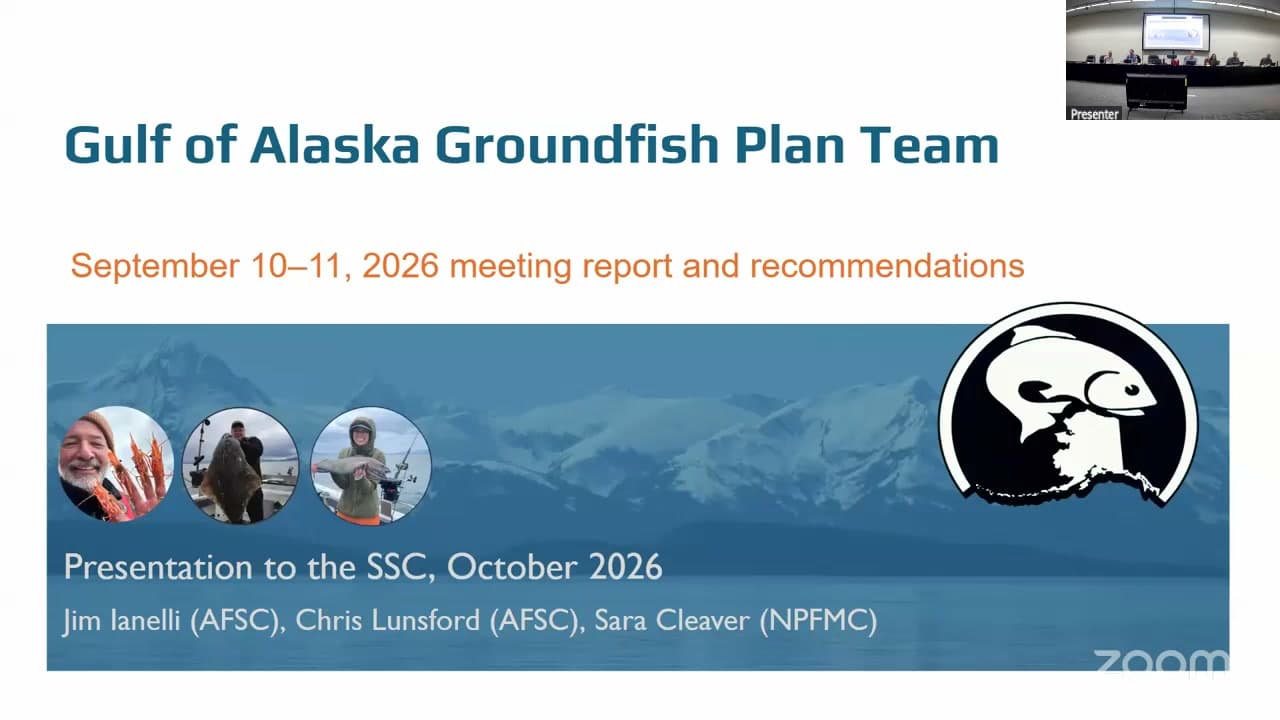
Frame from "NPFMC SSC October 7, 2026 - Day 3" · Source
Western Gulf fishermen ask council scientists to back moving Bering Sea cod quota
Two Western Gulf of Alaska fishermen asked the North Pacific Fishery Management Council's Scientific and Statistical Committee on Wednesday to back moving Bering Sea Pacific cod quota into the Western Gulf's winter A-season. Both pointed to recent presentations by the cod stock assessment authors showing that some cod move between the two areas, which are managed under separate plans.
Ben Ley of the Peninsula Fishermen's Coalition asked for an interim, A-season-only reallocation of 3%, which he called "intentionally conservative." He said the figure assumes about 30% migration, "even though the actual movement may be closer to 50%." A formal model and any resulting management change may be at least a year away, he said.
Kiley Thompson of Sand Point, who operates the F/V Decision, said her boat has been the lead vessel in the cod tagging project since it began in 2021. She described a stock that "spawns primarily in the Western Gulf of Alaska in the winter and migrates to the Bering Sea in the summer" and said the status quo is unacceptable. She asked the committee to recommend an ad hoc TAC, or total allowable catch, moved "from the Bering Sea to the Western Gulf, somewhere between 3 to 7%."
Committee member Martin Dorn of the University of Washington asked whether the tagging was still going on, saying the models under development depend on good information. Thompson said it is not. Funding for satellite tagging ran out in 2025, she said, and she and other trained fishermen want to continue conventional tagging on a voluntary basis.
A report from the council's joint groundfish plan team meeting in September says genetic and tagging data indicate substantial connectivity between Western Gulf and eastern Bering Sea cod, with much of the movement from January through March. The teams' timeline calls for spatial model results in September 2027 and potential apportionment alternatives in fall 2028. The report says any change involving seasonal allocation or both management plans would require careful development and sufficient time for the council process.
Ian Stewart of the International Pacific Halibut Commission, one of the committee's three co-chairs, said the testimony would be noted under the committee's general plan team report rather than the harvest projections, since no cod harvest projection was before the committee.
This article is based on a public meeting of NPFMC - Council & SSC Meetings — NPFMC SSC October 7, 2026 - Day 3 ().
Made by our human newsroom with AI. Reviewed by Cale Green. How humans and AI work here · Grow with our newsroom Transcript byWalter AlaskaNews
Stay informed. Support what matters.
Free, permanent access to local news you can verify. Subscribe to support Bill AlaskaNews and go ad-free.
Related Coverage
New models could cut Alaska's 2026 sablefish catch advice by nearly a third
Alaska News · 1d ago
Council scientists back new Gulf of Alaska pollock model as survey mismatch persists
Alaska News · 3h ago
Council advisers debate studying more charter leasing of commercial halibut quota
Alaska News · 5h ago
North Pacific council's SSC keeps snow crab buffer at 40%, not 50%
Alaska News · 1d ago
The panels that shape Alaska's pollock and cod catch limits meet next month
Alaska News · 1mo ago
Comments
Sign in to leave a comment.
No comments yet. Be the first to share your thoughts.