Veterans sentencing bill advances despite concerns over court authority
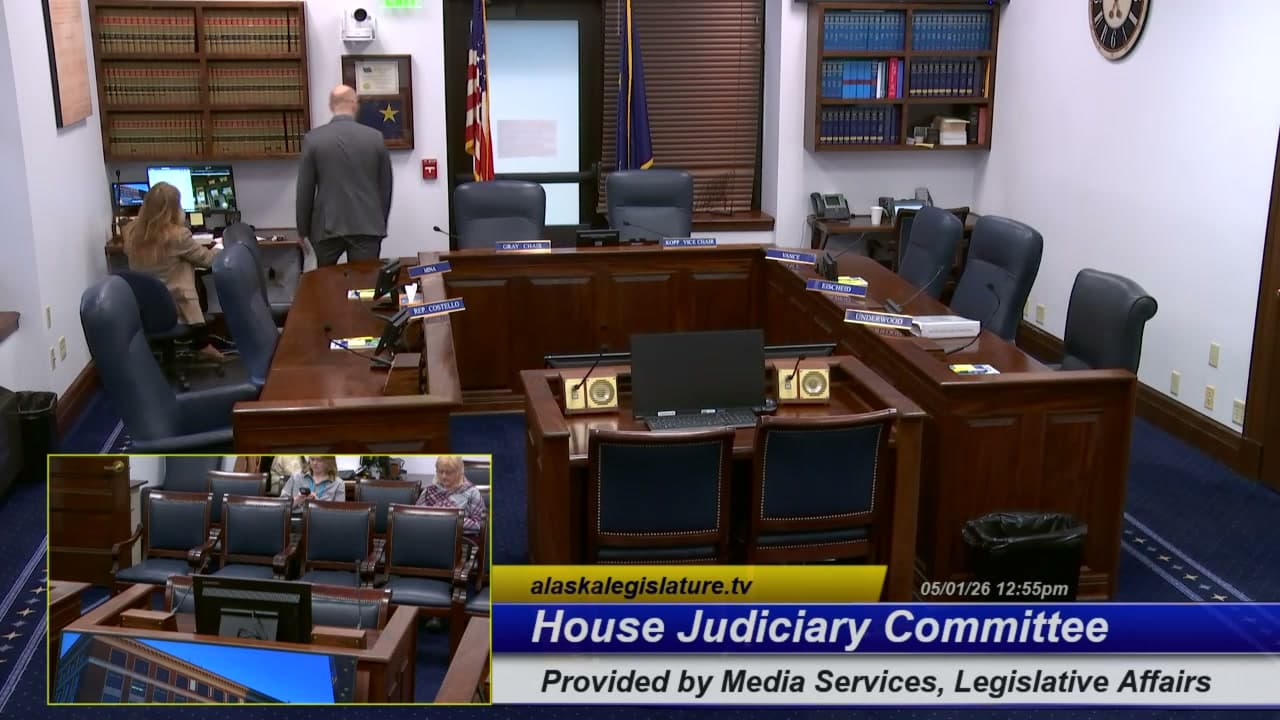
The Alaska House Judiciary Committee heard testimony Friday on legislation that would expand veterans' access to therapeutic courts, despite warnings from state prosecutors and court officials that the bill could trigger significant litigation over separation of powers.
House Bill 299 would allow veterans convicted of probation-eligible misdemeanors to enter treatment programs even if prosecutors object. That is a departure from the current system in which prosecutors hold veto power over who enters veterans courts. The bill would codify eligibility standards and give judges authority to determine whether a veteran qualifies for the program. The measure, which has been referred to both the House Judiciary Committee and the House Department of Military and Veterans Affairs Committee, would amend Alaska Rules of Criminal Procedure 35 and 43 by creating the veteran sentencing program and alternate procedures for dismissing charges.
Brock Hunter, co-founder of the Veterans Defense Project, said the legislation builds on a model that passed unanimously in Minnesota in 2021. He said Minnesota's fiscal analysis projected cost savings of around $1 million per year through reduced jail and prison beds and fewer trials.
"This past year, the Minnesota Sentencing Guidelines found that the act had been used in 115 veteran cases, and of those, 91 had successfully completed their program and earned the dismissal of their charges," Hunter said.
Hunter said key prosecutors in Minnesota participated in drafting that state's legislation and that the County Attorneys Association supported its passage. He said he is not aware of any significant litigation around the issue in Minnesota, a contrast with the concerns raised by Alaska prosecutors.
The bill would require veterans to prove eligibility by showing they have mental or physical symptoms of a condition stemming from military service. Hunter said the burden of proof rests with the veteran, who must provide medical records or other documentation to the court and prosecutor.
"What this basically does is it provides a due process process for a veteran to pursue if they believe that they should be eligible under the statute," Hunter said. "The judge is the decision maker. The prosecutor has the opportunity to object. The veteran has the burden of proof to show by, in Minnesota, clear and convincing evidence that they meet the criteria under the statute."
But Angie Kemp, deputy attorney general with the Department of Law's Criminal Division, said the current draft lacks the clear and convincing evidence standard that Minnesota included. She said the absence of that language would likely generate litigation over who bears the burden of proof.
Kemp also raised concerns about separation of powers. The bill would allow courts to dismiss or amend charges, functions that traditionally belong to prosecutors. She cited Alaska case law in which courts rejected a judge's attempt to dictate how charges should be amended, calling it a violation of separation of powers.
"Those are both historically prosecution functions," Kemp said. "So that would be another area where I would describe that there would be significant litigation surrounding this particular bill."
Nancy Mead, general counsel for the Alaska Court System, said the bill does not align with how Alaska's existing veterans courts operate. Those courts serve felons in Anchorage, which has 32 participants, and Fairbanks, which has six. All treatment is provided by the Department of Veterans Affairs.
Mead said current veterans courts require no proof of service-related conditions. A Veterans Justice Outreach coordinator from the VA compares every arraignment to a master list of veterans and identifies candidates for the program. Eligibility depends on clinical factors, the nature of the charges, and criminal history.
"For someone to get into a veterans court now, they just need to be a veteran who got into trouble with the law," Mead said. "There is no requirement that they say anything about service-related injuries or conditions."
Mead said the bill's focus on misdemeanors would exclude more than half of current veterans court participants, who are felons. She also questioned whether the bill envisions the intensive 18-month supervision model used in therapeutic courts or a less structured alternative.
"I need to get clarity on exactly what is contemplated," Mead said.
Representative Andrew Gray, the committee chair, asked whether adding a clear and convincing evidence standard would reduce litigation. Kemp said yes, noting that clarity on burden of proof always reduces motion practice.
Gray also asked about the bill's language allowing veterans who are "found guilty of, or plead guilty to" an offense to enter the program. Kemp said that structure removes the incentive to plead guilty before trial, potentially increasing the number of cases that go to trial and forcing victims to testify.
"A veteran could insist that their case goes to trial, put the victim through that trial, and then also request the benefit of the program," Kemp said.
Bernard Aoto, staff to the bill sponsor, said the sponsor is willing to work with stakeholders on amendments. He said the bill aims to address barriers to entry that some veterans face, including prosecutorial discretion and limited availability of therapeutic court services outside Anchorage and Fairbanks.
Hunter said the bill is designed to provide a less intensive alternative for lower-level offenses in jurisdictions that already have veterans courts, and to give judges in rural areas tools to set up individualized treatment plans scaled to a veteran's needs.
"The goal of this bill in Minnesota and the model bill upon which 299 is based is to, in jurisdictions that have an existing Veterans Treatment Court, provide a less intensive alternative for offenders that are not as high risk, is not as high need," Hunter said.
Gray asked whether the sponsor would be open to expanding the bill to include felonies, as Minnesota's law does. Aoto said yes, noting that a companion bill in the Senate already includes Class C felonies.
The committee took no action on the bill Friday. Gray said the committee would bring it back at a later date.
This article is based on a public meeting — Alaska Legislature: House Judiciary - May 1, 2026 1:00pm ().
AI-assisted. How we use AI Transcript byLucas Brown
Stay informed. Support what matters.
Free, permanent access to local news you can verify. Subscribe to support Alaska News and go ad-free.
Related Coverage
House panel advances domestic violence protective order extensions
Alaska News · 4mo ago
House Military Committee Advances Joint Armed Services Overhaul
Alaska News · 5mo ago
Senate panel advances property tax assessment cap bill
Alaska News · 5mo ago
Senate panel advances property tax cap bill despite state warnings
Alaska News · 5mo ago
House Judiciary advances bill extending confidentiality to tribal advocates
Alaska News · 5mo ago
Comments
Sign in to leave a comment.
No comments yet. Be the first to share your thoughts.