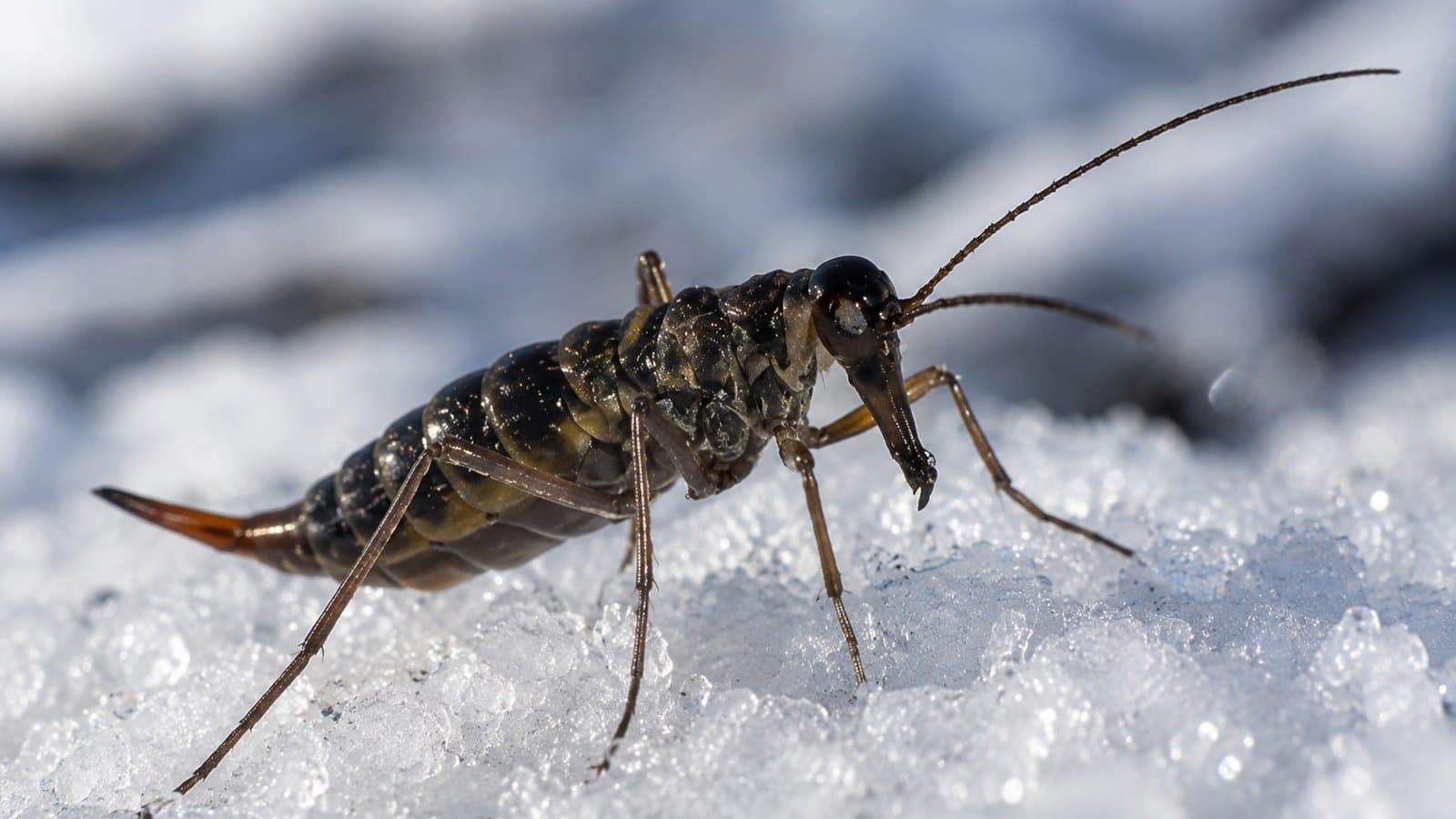
Photo by Cale Green
The strange snow bug Alaska is spending $750K to understand
There's a strange little insect that lives on Alaska's snow, walks on it in the dead of winter, can't fly, and is so rarely seen that scientists still don't know how many kinds exist. Now a Fairbanks researcher has nearly $750,000 to find out.
The National Science Foundation grant will fund a three-year effort to sequence the genomes of nearly every known species of snow scorpionfly — a cold-loving, wingless bug that, despite its name, is neither a scorpion nor a fly. They turn up across the northern hemisphere but are so seldom encountered that basic questions about them go unanswered: how many species there are, how they're related, where one kind ends and another begins. Derek Sikes, the insect curator at the University of Alaska Museum of the North, will lead the work, combining fieldwork, museum specimens, and genetics to build the group's first real family tree.
One of the last big unsolved puzzles in insect evolution is how scorpionflies relate to fleas — and snow scorpionflies may be fleas' closest cousins. The genomes from this project could finally settle it. The grant also puts Alaska undergraduates and a postdoc to work on cutting-edge genetics, and funds summer bug camps for kids, with the findings shared freely online.
Source: National Science Foundation, National Science Foundation: NSF Award [Evo Patterns & Processes] → University of Alaska Fairbanks Campus: PurSUiT: Using phylogenomics to uncover the diversity and evolutionary history of the family Boreidae (Insecta: Mecoptera).
Made by our human newsroom with AI. How humans and AI work here · Grow with our newsroom
Stay informed. Support what matters.
Free, permanent access to local news you can verify. Subscribe to support Melinda Communities.News and go ad-free.
Related Coverage
New $605k research asks why some Denali spruce survive the beetles
Alaska News · 2mo ago
A UAF mathematician builds software to untangle interbreeding species' family trees
Alaska News · 1mo ago
UAF scientist gets $300K to unlock permafrost's carbon time bomb
Alaska News · 4mo ago
Alaska won up to $160M to hunt critical minerals with AI and microbes
Alaska News · 3mo ago
Can a bacterium pull rare earths out of coal waste? Alaska researchers just got $4.7M to find out
Alaska News · 2mo ago
Comments
Sign in to leave a comment.
No comments yet. Be the first to share your thoughts.