AI image
Supreme Court declines to review Alaska's challenge to rural subsistence priority
The U.S. Supreme Court has declined to hear the State of Alaska's challenge in United States v. Alaska, and with that quiet, one-line refusal it closed out one of the longest and most consequential legal fights in the state's history: the question of who decides when rural Alaskans get first call on the fish and game they live on. The answer, settled for now, is that on federal lands and the waters running through them, that authority belongs to the federal government, not the state.
For the Yup'ik, Cup'ik and other families along the Kuskokwim River, and for rural communities across Alaska, the ruling protects a priority that has been fought over in court for forty years. For the state, it's another end of the road on an argument three levels of federal courts rejected.
To understand why a refusal to hear a case counts as a landmark, it helps to know what the state was trying to undo.
When Congress passed the Alaska National Interest Lands Conservation Act in 1980, it wrote into Title VIII a rural subsistence priority: when fish or game run short on federal public lands, the people who depend on them to fill a freezer and feed a family come first, ahead of sport and commercial users. The idea was to protect a way of life that predates the state itself.
But there was a catch that shaped everything after. In 1990, the Alaska Supreme Court ruled in McDowell v. State that a rural preference violated the Alaska Constitution, which guarantees all residents equal access to the state's resources. That decision meant Alaska legally could not run a subsistence program that favored rural users, even though ANILCA required exactly that. The result was a split system that persists today: the state manages fish and game on state land, and the federal government manages the subsistence priority on federal land, because the state is constitutionally barred from doing it.
The name attached to the fight belongs to Katie John, an Ahtna Athabascan elder. In the 1980s she and another elder asked the state to reopen subsistence fishing at Batzulnetas, her family's ancestral fishing ground. The state said no, while downstream users were allowed to take hundreds of thousands of salmon for sport and commercial harvest. The lawsuit that followed became a trilogy of federal decisions, the "Katie John cases," that established a crucial point: the "public lands" where the federal priority applies include the navigable waters flowing through federal refuges and parks, not just the dry ground. Rivers, in other words, count. Katie John died in 2013, but the precedent kept her name.
That river question is the whole ballgame in a place like the Kuskokwim, where the fish are in the water, not on the land.
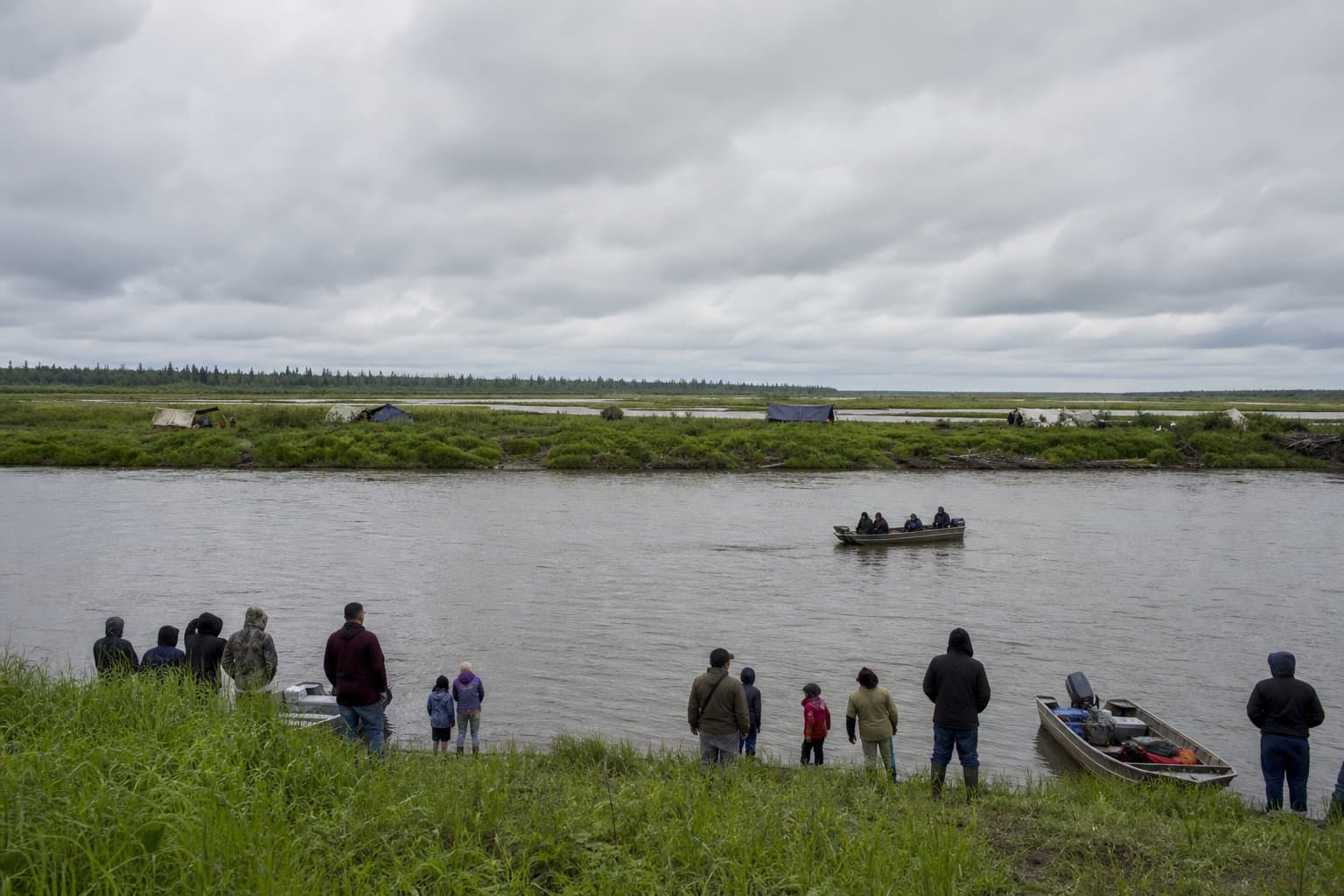
The current case grew directly out of the Kuskokwim salmon collapse. As Chinook and chum runs cratered, federal managers closed stretches of the river within the Yukon Delta National Wildlife Refuge to everyone except rural subsistence users. Beginning in 2021 and 2022, the state pushed back, issuing its own orders opening the same water to all Alaskans, in direct conflict with the federal closures. The federal government sued.
The state's legal theory was ambitious. It argued that a 2019 U.S. Supreme Court decision, Sturgeon v. Frost, had effectively knocked out the Katie John precedents by holding that "public lands" in a different, unrelated section of ANILCA did not include navigable waters. If the state was right, the Katie John trilogy was dead, the federal subsistence priority on rivers would collapse, and the state would regain control of subsistence fishing across Alaska. Native organizations, including the Association of Village Council Presidents representing 56 tribes in western Alaska, intervened against the state.
The state lost at every level. A federal district judge rejected the argument in 2024 and issued a permanent injunction barring the state from undercutting the federal priority. The Ninth Circuit Court of Appeals affirmed in August 2025, finding that Sturgeon and Katie John could be squared because they interpreted different parts of the law for different purposes, and noting that Congress had repeatedly signaled its approval of the Katie John reading. The state petitioned the Supreme Court, which declined to take it up. That refusal leaves the Ninth Circuit's ruling standing as the final word.
The state has not conceded the principle. The Department of Law has framed the case as a question of "who has the authority to manage fish and wildlife resources in Alaska, for the benefit of all Alaskans: the State or the federal government," and has argued that the dual-management system is unworkable, that fish don't recognize the boundary between state and federal water, and that a single manager would serve conservation better. Attorney General Treg Taylor argued the Ninth Circuit ducked the hard work of reconciling its own precedent with the Supreme Court's. The state also maintains that even under its own management, subsistence would remain the highest-priority use, just without the rural limitation federal law requires.
That last point is the crux of the disagreement. The state says it would protect subsistence for everyone; ANILCA and the Katie John cases hold that in times of shortage, the priority has to go to rural residents specifically, the people with the fewest alternatives when the salmon don't come. For the tribes and rural fishers who intervened, that distinction is the difference between a protected right and a promise, and keeping it out of the state's hands, given the McDowell ruling that bars the state from honoring it, was the point.
The Alaska Federation of Natives called the outcome "a victory for Alaska Native communities and all who value their traditional way of life." The tribal organizations that fought the case are now seeking more than $1.1 million in combined attorneys' fees from the state.
What the decision does not do is fix the Kuskokwim. The salmon are still in crisis, the runs still a fraction of what they were, and the management questions that come with scarcity, how many fish, for whom, and when, will keep landing on the same river families every summer. What changed is that the answer to who holds the final authority over that priority, on federal waters, is no longer an open question. After forty years, the law that carries Katie John's name stands.
Assembled from public records the newsroom collected ().
Drafted with AI. Edited by Cale Green (1 revision). No full editor review is on record. Who is accountable.
Stay informed. Support what matters.
Free, permanent access to local news you can verify. Subscribe to support Walter AlaskaNews and go ad-free.
Related Coverage
Supreme Court leaves federal subsistence authority intact
Alaska News · 3mo ago
Federal Subsistence Board adopts 52 wildlife proposals for Alaska
Alaska News · 5mo ago
AFN gathers Dillingham voices on the future of subsistence
Alaska News · 1mo ago
Federal subsistence permits and harvest reports move online in new Alaska portal
Alaska News · 1d ago
Federal migratory bird subsistence rules take effect across Alaska
Alaska News · 3mo ago
Comments
Sign in to leave a comment.
No comments yet. Be the first to share your thoughts.