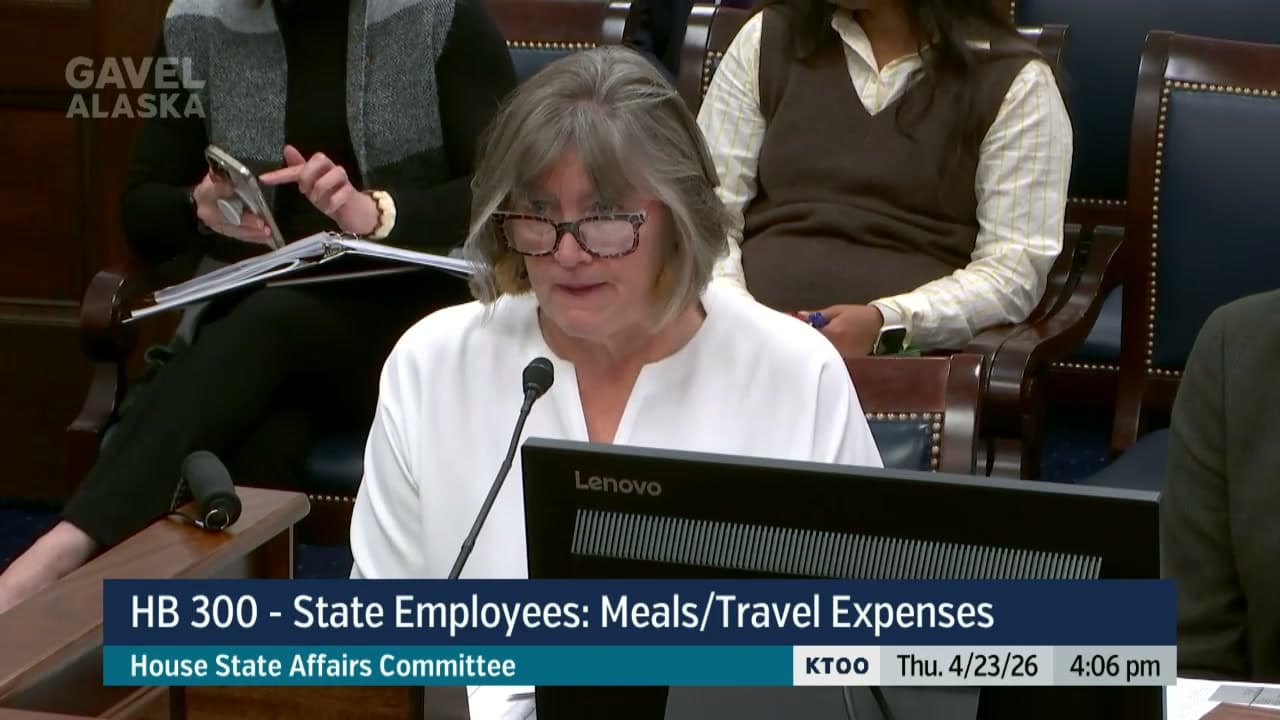
State employee per diem frozen since 2010 despite 40% inflation
The House State Affairs Committee heard testimony Thursday on legislation to raise state employee per diem rates that have not changed since 2010 while Alaska's cost of living climbed 40 percent.
House Bill 300 would raise the short-term in-state travel rate from $60 per day to $82 and the long-term rate from $33 to $45, with automatic adjustments every three years tied to the Alaska Urban Consumer Price Index beginning in 2029.
Representative Sara Hannan, who introduced the bill, said state employees have been covering additional costs out of pocket as meal prices have outpaced reimbursement.
"The current meals and incidental per diem rates for state employees for traveling in-state for work has not changed since 2010," Hannan said. "Over time, inflation has caused a large gap between what those rates cover and what the actual costs to workers are, and workers largely make up the difference out of their own pockets, essentially subsidizing state operations."
The bill addresses in-state travel only. State employees traveling out of state already receive federal per diem rates up to $92 per day, which adjust regularly based on current costs.
Scott Lay, a 29-year Department of Transportation employee who has worked in remote villages across western Alaska for the past decade, told the committee the current $33 long-term per diem rate falls far short of actual costs in rural communities.
"It's virtually impossible when a sandwich in a cooler at the tribal store costs $12," Lay said. "I can buy boxed milk in most of my villages for around $17 a gallon. I can get cheese for, a few pounds of cheese for $10 to $20 a pound."
Flynn Casey, a state employee with the Department of Fish and Game and Department of Environmental Conservation, told the committee the current rate breaks down to $12 for breakfast, $16 for lunch, and $32 for dinner, with nothing left for incidentals. Casey noted that Alaska state legislators receive a higher per diem rate than executive branch employees.
"This rate has been in effect since 2010. It has not changed in 16 years," Casey said. "Since that time, the Consumer Price Index for urban Alaskan consumers has risen 40 percent. The specific figure for food items has risen 46 percent."
Committee members suggested aligning Alaska's rates with federal Department of Defense per diem schedules, which adjust quarterly and vary by location. Representative Kevin McCabe noted that Juneau's federal rate is $114 per day, Anchorage is $145, and Bethel is $101.
"I'm curious, Representative Hannan, why we didn't just use the MIE rate from the IRS or from, I think it's IRS for lower 48 and it's the DOD for Alaska," McCabe said. "Why don't we just go to that instead of having to inflation adjust it?"
Hannan said she would be open to increasing the rates to match federal levels.
"I would have no objection to increasing it," Hannan said. "I was trying not to be overly too far out of my skis. You know, I wanted to make sure that we articulated the concern for our employees that they've been frozen in time. But instead of unfreezing them, keeping up with the competition of other workers that they may be working side by side on a project, I think is a very good thing."
During committee discussion, Hannan's staff acknowledged that the proposed $82 rate falls about $8 short of a full inflation adjustment from 2010 levels, with the actual figure closer to $90.
Representative Andi Story said adequate per diem could help the state retain employees and reduce the high cost of recruiting and training replacements.
"I see so much when I look at the cost of keeping state employees, and we have had high vacancy rates, some departments higher than others," Story said. "I see this as an opportunity to keep more employees here, but more importantly, it's a lot, it's a high cost to retrain employees. To recruit them, and this can be a tool, giving adequate compensation for when they're traveling in our vast state."
Jesse Sloan, president of the supervisory unit representing about 2,500 state supervisors, said the bill addresses a structural problem that has left employees absorbing inflation for 15 years. Sloan noted that when state employees travel to Seattle or Washington, D.C., Alaska already reimburses them at federal rates up to $92 per day.
"HB 300 does three things that our members need," Sloan said. "It raises the short-term rate from 60 to 82. It puts the rate into statute so it's accountable to the legislature and the people, and it builds a CPI adjustment starting in 2029 so we don't have frozen rates in the future."
The committee did not take action on the bill Thursday. Chair Julie Carrick said the committee would likely set an amendment deadline Tuesday and take action on the bill Thursday.
This article is based on a public meeting — Alaska Legislature: House State Affairs, 4/23/26, 3:15pm ().
AI-assisted. How we use AI Transcript byLucas Brown
Stay informed. Support what matters.
Free, permanent access to local news you can verify. Subscribe to support Alaska News and go ad-free.
Related Coverage
Alaska House panel considers doubling bulk fuel loan cap amid price crisis
Alaska News · 4mo ago
Senate Finance reviews bill to double bulk fuel loan cap to $1.5M
Alaska News · 4mo ago
Alaska residential schools seek doubled stipends to cover rising costs
Alaska News · 4mo ago
House Panel Considers Bills to Ease Alaska's Liquor Liability Insurance Crisis
Alaska News · 6mo ago
House Education Committee Advances Bill to Boost Residential School Funding
Alaska News · 6mo ago
Comments
Sign in to leave a comment.
No comments yet. Be the first to share your thoughts.