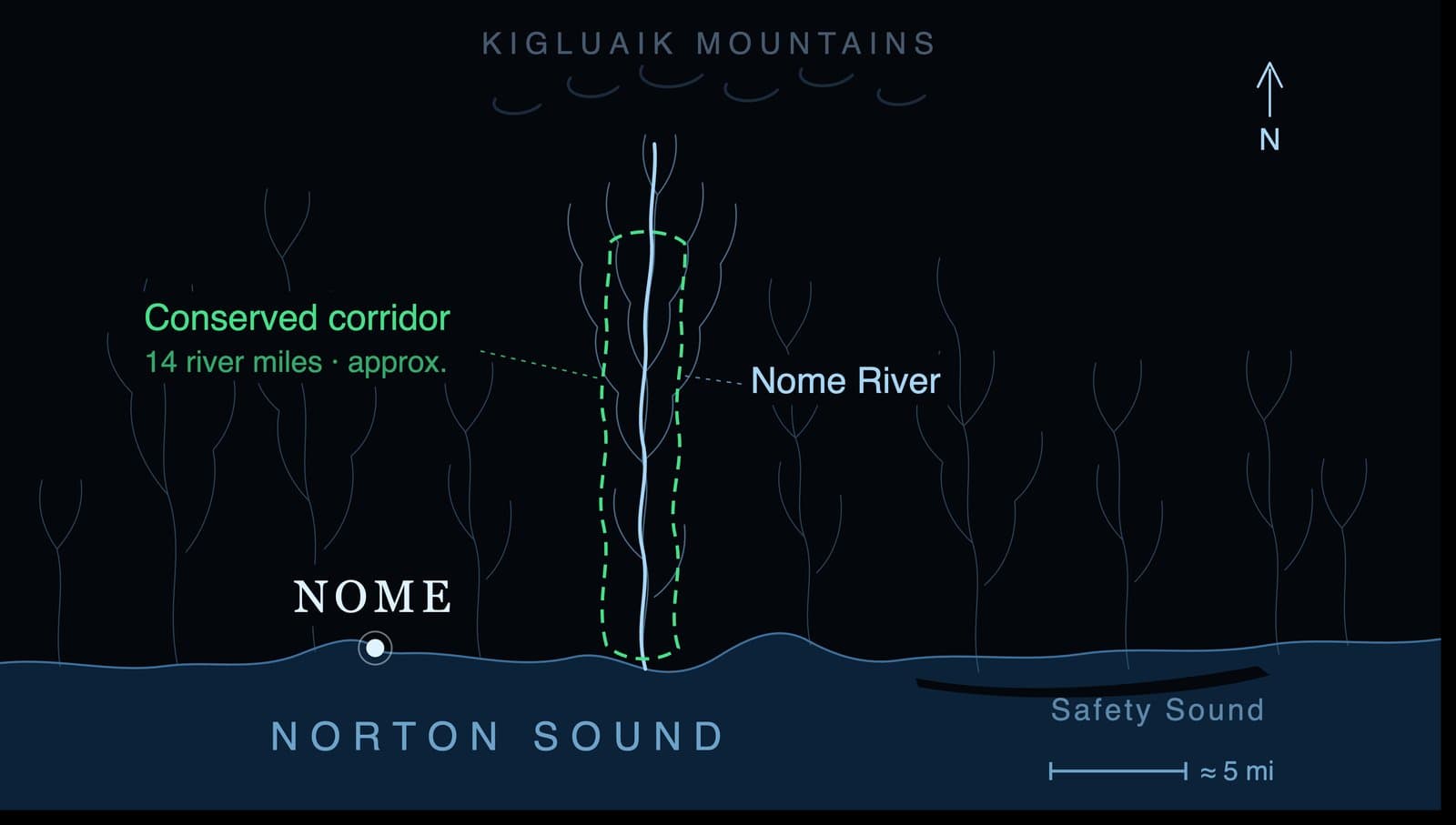
AI generated image and map · Photo source
Sitnasuak Buys the River the Gold Rush Left Behind
Fourteen miles of the Nome River — staked, claimed, and held privately as gold-mining land since the rush days — now belongs to Sitnasuak Native Corporation, with a permanent conservation easement attached that guarantees it will not be developed.
The 1,700-acre acquisition from The Conservation Fund, announced June 2, is a quiet reversal of a century-old story: ground locked up under historic mining claims passing into Alaska Native corporate stewardship, with the easement — held by Interior Alaska Land Trust — protecting fish and wildlife habitat, shareholder subsistence access, and recreation along the river.
The trade is straightforward. By accepting permanent development restrictions, Sitnasuak gives up the commercial options that come with unrestricted ownership.
The deal also lands adjacent to one of the livelier unresolved questions in Alaska Native corporate law: whether money earned by conserving ANCSA resources counts as resource revenue that must be shared.
Section 7(i) of ANCSA requires that 70 percent of all revenues each regional corporation receives from its timber resources and subsurface estate be divided annually among the regional corporations — a two-sentence provision that has generated disputes for five decades.
The live version of the fight is over carbon credits: Sealaska traded its timber-harvest rights for California carbon credits, and Bering Straits Native Corporation is among the corporations challenging Sealaska's position that those revenues are not shareable under 7(i). An arbitration panel sided with the conserving corporations, reasoning that committing to leave timber standing transfers no legal or possessory interest in the resource itself; that ruling is now under court challenge.
Sitnasuak's situation is distinguishable — it is a village corporation buying already-encumbered surface land, not a regional corporation selling conservation value off its own timber or subsurface estate. But the underlying question the easement model raises is the same one the carbon case will answer: in the ANCSA system, who shares when a corporation gets paid for leaving land alone? Few corporations seem eager to litigate it broadly — perhaps because most expect, someday, to be on the conserving end themselves.
For a corporation whose shareholders fish and gather along the Nome River, the announcement frames the deal as exactly what it looks like: access for future generations, written into the deed.
Source: Sitnasuak Native Corp receives riverfront parcels via conservation easement transfer.
Made by our human newsroom with AI. How humans and AI work here · Grow with our newsroom
Stay informed. Support what matters.
Free, permanent access to local news you can verify. Subscribe to support Maggie AlaskaNews and go ad-free.
Related Coverage
The navigability question that's been simmering since Alaska statehood just got four more answers
Alaska News · 4mo ago
The fight to keep Red Dog alive past 2031
Alaska News · 3mo ago
Interior transfers 1.4 million acres in Dalton corridor to Alaska
Alaska News · 5mo ago
NovaGold moves to consolidate the Donlin gold project, a potential next Red Dog for Alaska Native corporations
Alaska News · 3mo ago
Kawerak hauls 4,000 pounds of e-waste out of Nome
Alaska News · 4mo ago
Comments
Sign in to leave a comment.
No comments yet. Be the first to share your thoughts.