Senate panel hears workforce plan for Alaska LNG pipeline
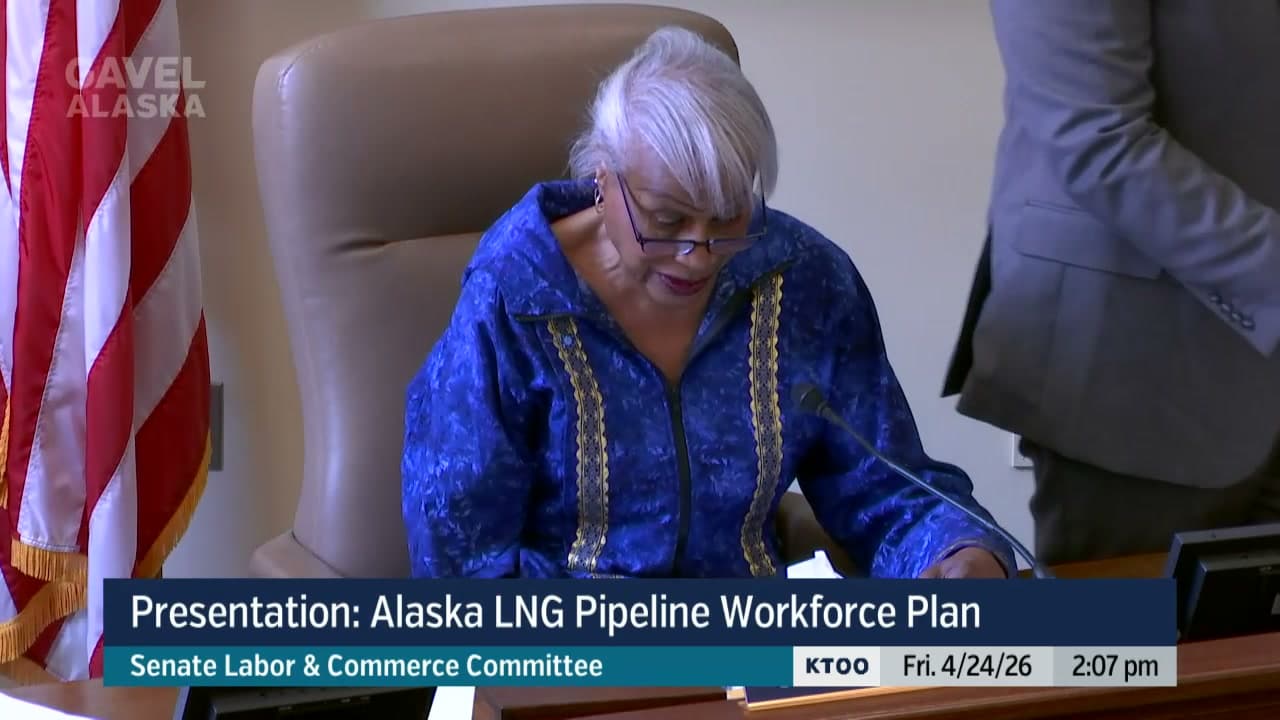
The Senate Labor and Commerce Committee heard a presentation Friday on workforce needs for the Alaska LNG pipeline project, with consultants warning the state must act immediately to prepare workers for construction that could begin as soon as 2027.
Joey Crump, president of Northern Industrial Training, told the committee the project will require roughly 6,600 workers at peak construction. That is a floor estimate that could climb higher. The 800-mile pipeline from the North Slope to a Nikiski export terminal, with a projected cost of $40 billion to $44 billion, would need workers across dozens of occupations. Those include 1,900 engineers, 1,600 pipefitters and welders, 450 ironworkers, 400 electricians, and 3,500 logistics workers. When combined with other major projects on the horizon, including Donlin Gold and the Port of Nome expansion, peak demand could reach 8,700 workers at once.
"Alaska is a small state, and we cannot independently supply the workforce required for multiple concurrent projects, or frankly, a big one like AKLNG," Crump said. "That provides us with an opportunity to strategically invest and strengthen in our workforce ecosystem and the Alaska residents, but the urgency is that we have to do it now."
The presentation updated a 2018 workforce plan commissioned by the Alaska Workforce Investment Board. Dirk Kraft, the board's executive director, said the state needed a fresh analysis because the project timeline has shifted, ownership has changed, and multiple large projects now compete for the same workers.
Alaska faces a shrinking labor pool. The working-age population has dropped by roughly 30,000 over the past decade. The workforce is aging, with up to half of workers in key trades now 45 or older. Non-residents already account for about 23 percent of Alaska's total workforce, the highest share in three decades. Construction saw a 24 percent jump in non-resident workers from 2022 to 2023.
The state's training system operates at only 60 to 80 percent capacity, according to survey responses from dozens of training providers. Crump said the system could produce more workers if barriers are removed. Those barriers include instructor shortages, outdated equipment, and funding that covers tuition but not living costs while students train.
"The problem with that kind of thinking is that it forgets that the cost of training is very rarely the barrier," Crump said. "It is the cost of not working while you are training that is the barrier."
The report identifies four immediate priorities. Expand short-cycle vocational programs that feed other training pathways. Grow registered apprenticeships. Invest in instructor capacity and facilities at high-performing providers. Redesign funding to cover student support costs like child care and housing.
Short-cycle programs take one to three months. They are the easiest to scale and feed longer apprenticeships and technical programs. Registered apprenticeships produce journey-level workers but take two to five years and face federal constraints. Alaska electricians and plumbers are limited to one apprentice per journeyman, a ratio Crump said prevents the state from reversing workforce decline.
Senator Jesse Bjorkman asked whether graduates of short-cycle programs could work immediately on the pipeline or would need to enter apprenticeships first. Crump said some could start right away in entry-level positions, and short-cycle training makes workers more attractive to apprenticeship programs. But he warned that federal apprenticeship requirements on a project labor agreement would drive massive increases in non-resident hire.
"We simply do not have the people in the state of Alaska, so they will be coming from out of state," Crump said.
The report recommends the state consider petitioning the federal Department of Labor to allow a two-to-one apprentice ratio, or establish a state apprenticeship agency that could set its own ratios. It also calls for multi-year funding cycles instead of one-year grants, which effectively reduce performance time to 10 months after administrative work on both ends.
Senator Elvi Gray-Jackson asked whether funding sources are guaranteed. Crump said he struggled to use the word guarantee but noted that the State Training and Employment Program and federal Workforce Innovation and Opportunity Act funds have been consistent for years.
The report analyzed 61 occupations across the project's two construction phases. The first phase, pipeline development from 2026 to 2029, overlaps with the second phase, LNG facility and infrastructure construction from 2027 to 2032. Sustained operations are projected to begin in 2032, creating 900 to 1,000 permanent jobs.
Crump said the window for workforce preparation is closing. Construction is expected to peak between 2027 and 2029, meaning training must start before final investment decision if possible.
"Every quarter we delay makes it harder to prepare workers before the major construction push hits," Crump said.
The report has not yet been finalized or approved by the Alaska Workforce Investment Board. Kraft said the executive committee and full board will review it before distribution to the legislature. The board includes four organized labor seats, all currently filled.
Committee chair Forrest Dunbar asked whether the legislature should take direct action this year. Crump said exploring a state apprenticeship agency would require legislative action and is worth pursuing. He also recommended against legislation that would require a quota of Alaskans working on projects.
Dunbar pressed Crump on whether the report recommends increasing education funding, particularly for career and technical education in secondary schools. Crump said the report does not advocate for increasing or decreasing spending, only for prioritizing existing funding to achieve results.
"What we are talking about is using existing levers and prioritizing the funding so that we can get to the desired actions," Crump said.
When Dunbar asked what should be cut to make room for workforce priorities, Crump declined to answer. He said the report does not cover that question.
The committee adjourned at 2:23 p.m. The panel will meet again Monday to consider the governor's appointees, Senate Bill 259 on property tax assessment increases, and House Bill 126 on reinstatement of Native corporations and religious corporations.
This article is based on a public meeting — Alaska Legislature: Senate Labor & Commerce, 4/24/26, 1:30pm ().
AI-assisted. How we use AI Transcript byLucas Brown
Stay informed. Support what matters.
Free, permanent access to local news you can verify. Subscribe to support Alaska News and go ad-free.
Related Coverage
Alaska lacks the skilled workers for the LNG project, a report says
Alaska News · 1mo ago
Alaska Building Trades, LNG subsidiary sign worker hiring pact
Alaska News · 3mo ago
A union-labor fight is breaking out over who builds Alaska's gas line
Alaska News · 3mo ago
Consultant warns Senate Finance that Alaska LNG faces megaproject risks
Alaska News · 3mo ago
Senate panel examines LNG project economics, megaproject risks
Alaska News · 5mo ago
Comments
Sign in to leave a comment.
No comments yet. Be the first to share your thoughts.