Alaska expands background checks to all medical professionals
The Alaska Senate Health Committee voted Thursday to require criminal background checks for all medical professionals licensed by the State Medical Board, expanding a requirement that originally applied only to doctors seeking licenses through interstate compacts.
The change affects physicians, osteopathic physicians, podiatrists, and physician assistants. While Alaska's Department of Health already requires fingerprint-based background checks for healthcare workers in licensed facilities, current law does not mandate them for all State Medical Board licensees.
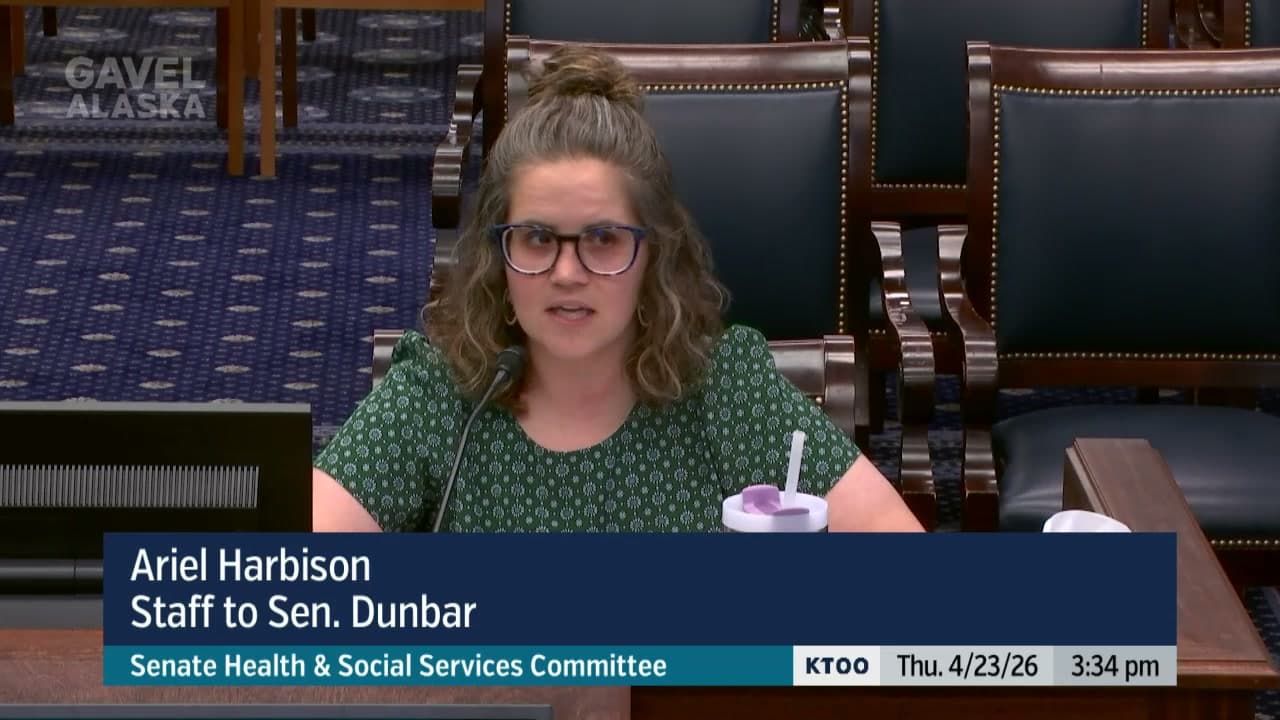
"This is essential for the health and safety of Alaskans, most of whom assume background checks are already a licensure requirement," committee aide Ariel Harbison said.
The expanded background check requirement came as part of a committee substitute for Senate Bill 281, which primarily establishes Alaska's participation in four interstate medical licensure compacts. The Department of Public Safety requested the changes to comply with federal law governing criminal justice information sharing.
"Our office received a few requests regarding background checks and fingerprinting for licensure under these compacts. Without clarifying statutory language, the Department of Public Safety would be unable to process background checks required under these healthcare compacts," Harbison said. The compact language alone is insufficient to authorize national criminal history record checks.
Federal law, requires that criminal justice information shared for non-criminal justice purposes, such as licensing, can only be disclosed to government entities and must be used solely for the authorized purpose. The committee substitute adds language explicitly limiting the use and dissemination of criminal justice information collected through background checks to what federal law authorizes.
Lisa Parenton, director of statewide services for the Department of Public Safety, explained that the department must comply with Public Law 92-544 to access national criminal history records maintained by the FBI. State records can be released under state law, but national checks require federal compliance.
"We are required to comply with the requirements of that in order to request national criminal history records," Parenton said.
The background check process currently relies on manual fingerprint cards submitted on paper, a system Senator Forrest Dunbar called "ponderously slow" and possibly unique to Alaska. Parenton said the department converted from a 40-year-old mainframe system to a modern platform in late January and is exploring electronic fingerprint submission with licensing agencies.
About 95 percent of criminal arrest fingerprints are already submitted electronically, mostly from Department of Corrections facilities. But 90 percent of non-criminal justice applicant cards for employment and licensing remain manual processes.
The new system will eventually allow electronic submission, replacing the current process where applicants submit physical fingerprint cards that the department converts to digital format before mailing results back to the requesting agency.
One limitation of the federal law is that background check information obtained for licensing cannot be shared with private employers. A nurse who gets fingerprinted for state licensure must be fingerprinted again when applying to work at a hospital, because the licensing information cannot be shared with Providence Hospital or other private facilities.
"The employer and the licensing body are two different purposes, two authorizing, two different authorizing statutes to get that information," Parenton said. "This will not change that."
The committee adopted the substitute version of SB 281 without objection. Committee Chair Forrest Dunbar set an amendment deadline of 5 p.m. Wednesday, April 29, for members considering changes before the bill's next hearing.
The committee substitute removed language that would have expanded the scope of practice for physician assistants. "We know there's another PA scope of practice bill that is going through the body. And we spoke with the sponsor and felt that this maybe wasn't the best vehicle for this bill. So, that is the justification there," Dunbar said.
The bill also establishes Alaska's participation in interstate compacts for physicians, physician assistants, psychologists, and emergency medical services personnel, and codifies the Rural Health Transformation Program Advisory Council.
The committee will take up the bill again at its next meeting.
This article is based on a public meeting — Alaska Legislature: Senate Health & Social Services, 4/23/26, 3:30pm ().
AI-assisted. How we use AI Transcript byLucas Brown
Stay informed. Support what matters.
Free, permanent access to local news you can verify. Subscribe to support Alaska News and go ad-free.
Related Coverage
Senate panel adopts changes to health care compact bill
Alaska News · 5mo ago
Senate panel advances health care compacts bill despite sovereignty concerns
Alaska News · 5mo ago
Senate Committee Advances Healthcare Licensing Compact Bill
Alaska News · 4mo ago
Alaska is adding a fingerprint background check to EMS licensing, starting in 2027
Alaska News · 2w ago
Alaska House passes five healthcare licensure compacts in single bill
Alaska News · 4mo ago
Comments
Sign in to leave a comment.
No comments yet. Be the first to share your thoughts.