AI image
Senate Finance weighs Alaska LNG tax worth $124M a year — and whether it's enough for host communities
The alternative volumetric tax at the center of Senate Bill 2001 would generate roughly $124 million a year once the full Alaska LNG project reaches operational capacity, the Legislative Finance Division told the Alaska Senate Finance Committee on Wednesday — the latest step in the Senate's months-long effort to make the project financeable without leaving host boroughs short.
The bill would replace Alaska's existing roughly 20-mill property tax on large oil and gas facilities with a lower, throughput-based structure. (Existing statute already exempts Alaska LNG property from property tax during construction.) At full operation, the revenue would be weighted by where each jurisdiction's capital sits: the Kenai Peninsula Borough would receive about $55 million, the North Slope Borough $40 million, Mat-Su $8 to $10 million, and Denali $4 to $5 million, with the state collecting $15 million on behalf of the unorganized borough, said Legislative Finance Director Alexi Painter.
The structure phases in slowly. The bill grants a temporary abatement — no tax until the earlier of an initial throughput threshold or five years after commercial operations begin — after which the rate grows with inflation, capped between 1 and 2 percent a year, and is paid monthly rather than annually. Blended, the rates run about 8 cents per thousand cubic feet for in-state gas and 10 cents for export gas, equivalent to roughly 1.97 mills at the project's high-end $54.5 billion cost estimate. Revenue would begin in fiscal year 2031 with only the in-state phase running and reach the full $124 million once exports are online, around fiscal year 2034, Painter said.
The tax breaks come with strings. The abatement is conditional on the project sponsor paying $40 million for community impact grants, negotiating a project labor agreement, and building a spur line to Fairbanks. The bill also creates an Alaska Liquefied Natural Gas Project Mitigation Fund, letting the Legislature appropriate up to $90 million of state revenue from the project, and exempts the taxed property from the required local contribution for K-12 schools.
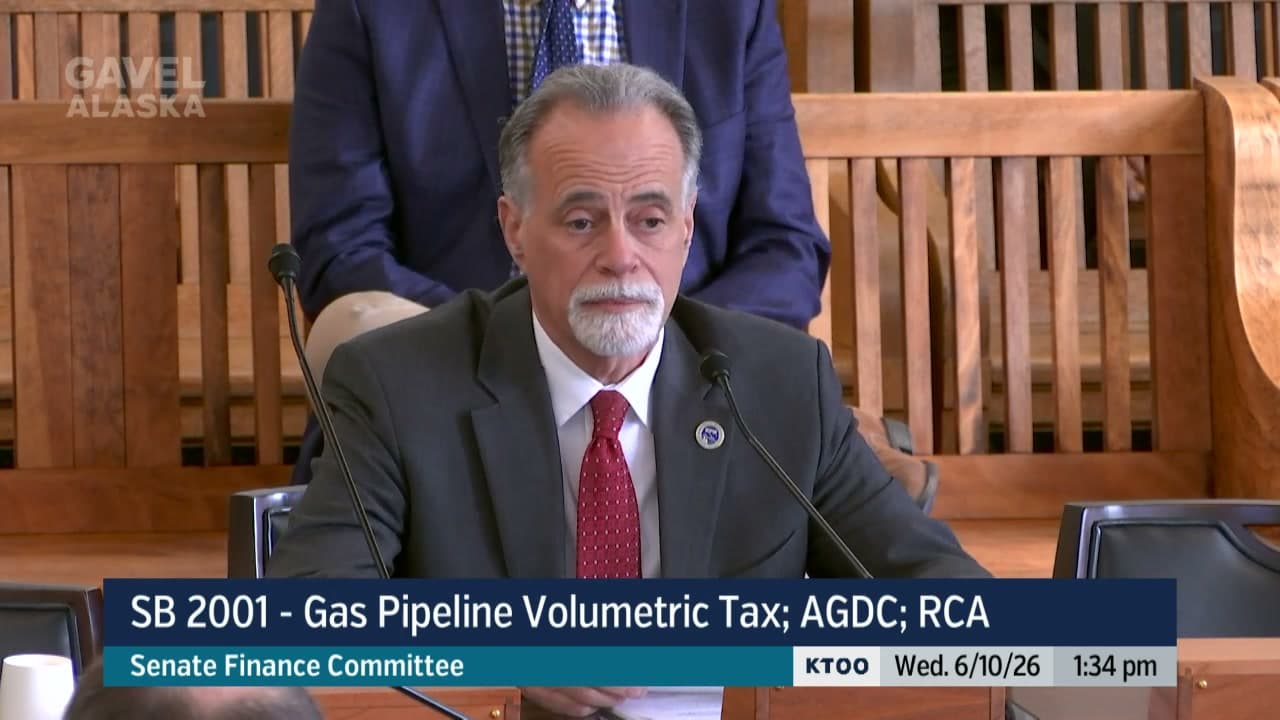
Whether all of that adds up to "enough" was the question Kenai Peninsula Borough Mayor Peter Micciche brought to the committee. The Kenai will host 42.7 percent of the project's value — 900 acres in Nikiski with three liquefaction trains, two storage tanks and two Cook Inlet berths moving up to 2.5 billion cubic feet a day — a build that will nearly double Nikiski's population for four years and dwarf anything the community has absorbed before. At a standard 9-mill rate, Micciche said, the facility would pay $212 to $215 million a year; the House's 12-cent version works out to roughly a 70 percent discount.
"That's okay," he said. "90 percent was too much. 70 is in the ballpark." The borough estimates about $30 million a year in project impacts — solid waste, roads, fire, EMS, hospitals, schools and federal-permit compliance — and Micciche said the reduced tax could still cover them. His warning to lawmakers was narrower: he holds a statutory right under Title 29 to negotiate the borough's own deal, and if they take it away, "please make sure you protect our community from harm."
"I'm here to fight for enough," he said. "Not for a lot, but for enough."
This article is based on a public meeting of Alaska State Legislature — Alaska Legislature: Senate Finance - June 10, 2026 1:30pm ().
Made by our human newsroom with AI. How humans and AI work here · Grow with our newsroom Transcript byLucas Brown
Watch key moments from the source meeting. Click to expand.
Stay informed. Support what matters.
Free, permanent access to local news you can verify. Subscribe to support Walter AlaskaNews and go ad-free.
Related Coverage
Senate Finance hears $18 billion revenue trade-off for Alaska LNG tax break
Alaska News · 4mo ago
Alaska LNG tax bill ties $26.5B in revenue to volume, not value
Alaska News · 4mo ago
House panel hears gas line tax bill with 15-cent volumetric fee
Alaska News · 5mo ago
House Resources gas line bill would cost municipalities $13B under governor's plan
Alaska News · 5mo ago
House panel hears tax proposal for Alaska LNG project
Alaska News · 5mo ago
Comments
Sign in to leave a comment.
No comments yet. Be the first to share your thoughts.