Senate Finance hears bill expanding civil rights protections to nonprofits
The Senate Finance Committee heard testimony Monday on legislation that would extend workplace discrimination protections to roughly 44,000 Alaskans employed by nonprofit organizations.
House Bill 23 would close what sponsors call a significant gap in state civil rights law. Currently, employees of nonprofit organizations outside Anchorage and Juneau have no state recourse if they face workplace discrimination at small nonprofits with fewer than 15 employees. The bill would bring those workers under the jurisdiction of the Alaska State Commission on Human Rights, which already covers for-profit employers.
Representative Andy Josephson, an Anchorage Democrat who sponsored the measure, told the committee the bill passed the House 39-0 and has met with broad support. He said the change would ensure fairness across all Alaska workplaces.
"If you do not live within the Municipality of Anchorage where we do have a formal Anchorage Equal Rights Commission, so you live in say Palmer and you have a complaint based on civil rights category, you would only be able to contact the HRC if your complaint relates to a for-profit business," Josephson said. "But if your complaint relates to a nonprofit business, you would be relegated to contacting the Equal Employment Opportunity Commission, which is very busy in Seattle."
Municipal human rights commissions in Anchorage and Juneau already cover nonprofit employees in their respective communities, but the state commission has no jurisdiction over nonprofits elsewhere in Alaska.
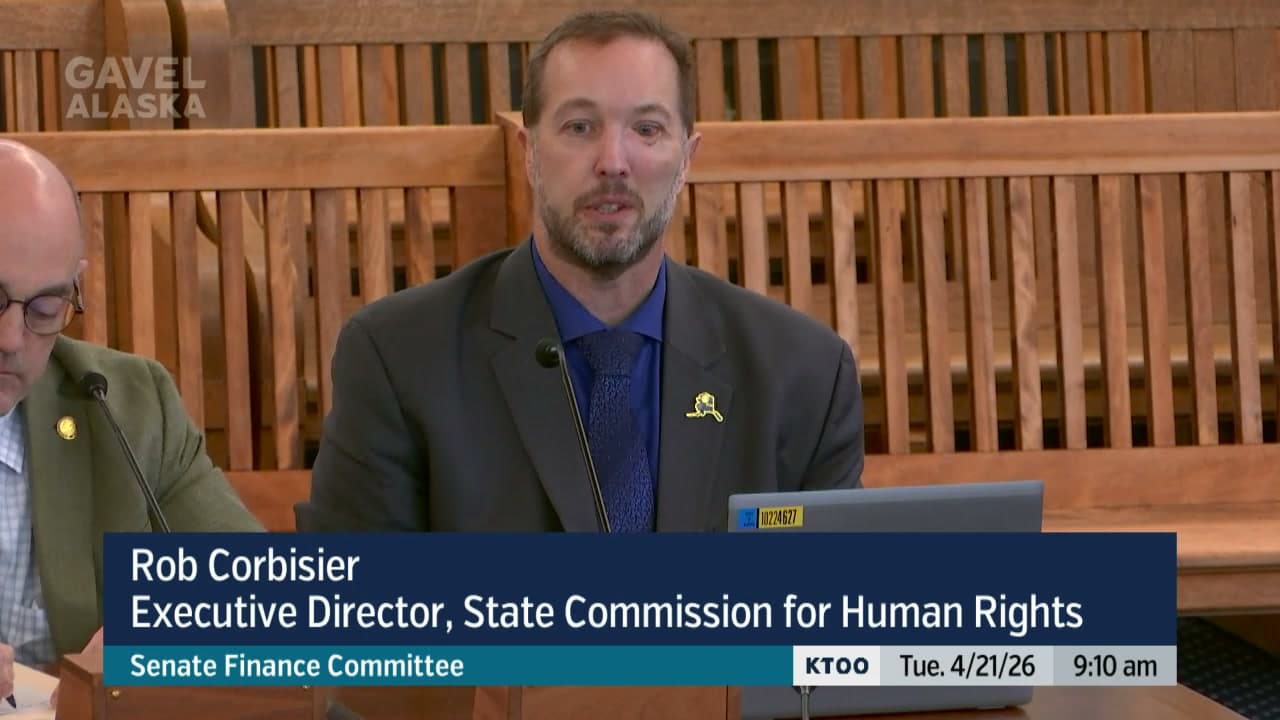
Rob Corbisier, executive director of the commission, said employees at small nonprofits currently have limited options when facing discrimination. The federal Equal Employment Opportunity Commission only handles cases involving employers with 15 or more workers, leaving employees at smaller organizations with no recourse except filing their own lawsuits.
"If you are working for a small nonprofit outside of Anchorage, and you are being sexually harassed, small nonprofit, less than 15 employees, you have no recourse other than to file your own private lawsuit," Corbisier said. "And how much is it going to cost for a retainer for private counsel. You are going to be looking at $3,000 to $5,000 just to walk in the door."
Corbisier said the commission routinely handles cases with damages under $10,000 to $15,000 that private attorneys would not take because the potential recovery does not justify the cost.
The bill would retain exceptions for religious organizations on ecclesiastical matters and for fraternal organizations. Ken Alper, staff to Representative Josephson, said the change applies narrowly to discrimination law and does not alter the definition of employer elsewhere in state labor statutes.
According to data from the Foraker Group presented to the committee, Alaska nonprofits employ approximately 35,000 to 44,000 people statewide. About half work in healthcare, with others in social assistance, public services, and finance.
The legislation also makes three other changes to the commission. It would rename the Alaska State Commission on Human Rights to the Alaska State Commission on Civil Rights, a change Corbisier said would reduce confusion about the agency's jurisdiction. He said the commission regularly receives calls about environmental issues and prisoner rights that fall outside its authority.
"We do get calls from people who want us to get involved in, like, environmental causes. Because they feel like, you know, I should have a human right to breathe clean air," Corbisier said. "And it is like, well, maybe you do, but that is well outside of ASHER's jurisdiction."
The bill would allow commissioners to be removed only for cause, rather than at will. Josephson said the change would provide continuity for the quasi-judicial body, similar to protections for members of the Alaska Oil and Gas Conservation Commission. Corbisier said the provision arose after a commissioner disappeared for a year with no clear process for removal.
The measure would also move the commission's annual report deadline from early January to November 15 and shift to electronic distribution rather than printed copies. Corbisier said the current timeline gives him roughly five to seven business days to compile data, write the report, and deliver 40 printed copies to the legislature.
"I cannot get our, I mean, I cannot even begin synthesizing our data until January 1st," Corbisier said. "And the way the statute is currently written, it gives me roughly 5 to 7 business days every single year to synthesize the data, write the vignettes, get it to a publisher, have the layout done, printed, and then delivered here. And that task is just impossible."
The bill carries a positive fiscal note of $32,000 in federal receipts. The commission receives $850 from the federal Equal Employment Opportunity Commission for each case it handles under a workshare agreement. Alper said the commission expects to absorb the additional caseload without requiring new staff.
The committee took no action on the bill Monday. The Senate Finance Committee is scheduled to meet again at 1:30 p.m. to hear HB 280.
This article is based on a public meeting — Alaska Legislature: Senate Finance, 4/21/26, 9am ().
AI-assisted. How we use AI Transcript byLucas Brown
Stay informed. Support what matters.
Free, permanent access to local news you can verify. Subscribe to support Alaska News and go ad-free.
Related Coverage
Senate panel advances civil rights commission bill with new settlement tool
Alaska News · 4mo ago
House committee advances LGBTQ anti-discrimination bill on 4-3 vote
Alaska News · 4mo ago
Alaska House panel hears bill to hold contractors liable for unpaid wages
Alaska News · 4mo ago
House Finance weighs bill to standardize state payment timelines
Alaska News · 6mo ago
Alaska bill would penalize state for late payments to contractors
Alaska News · 4mo ago
Comments
Sign in to leave a comment.
No comments yet. Be the first to share your thoughts.