Senate Finance adopts operating budget with $150 energy payment, school grants
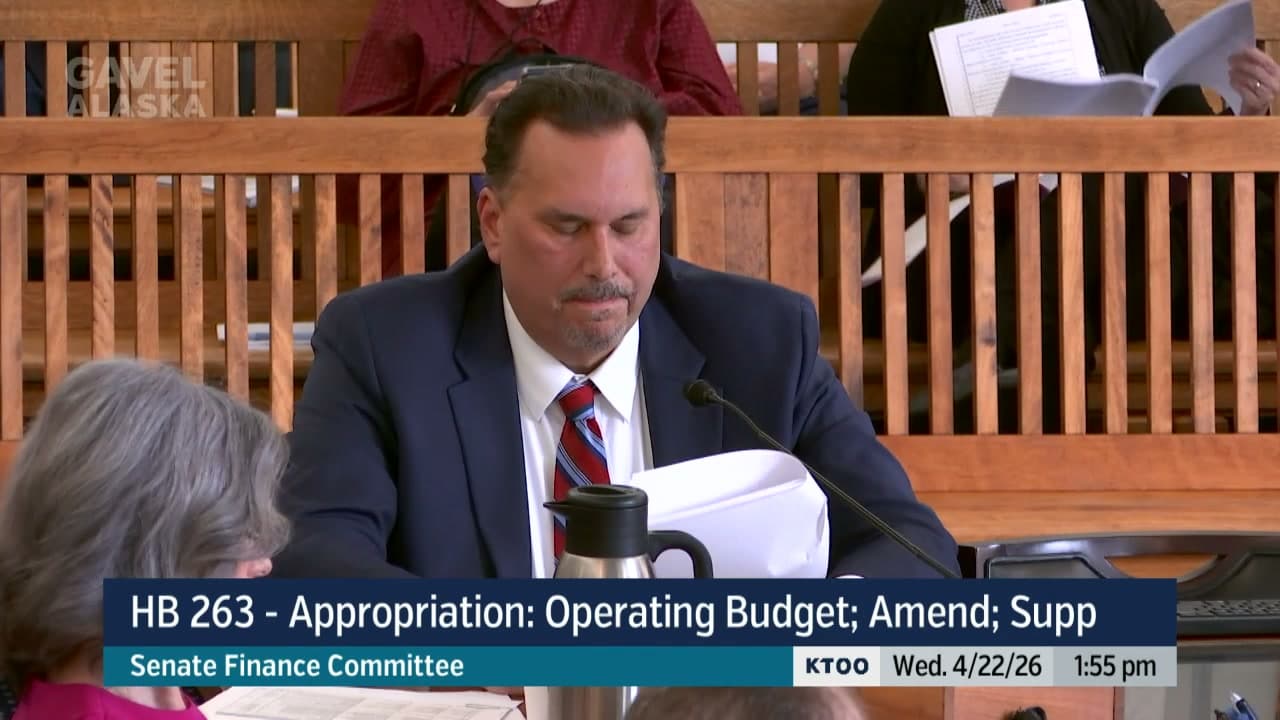
The Alaska Senate Finance Committee adopted a $13.83 billion operating budget Thursday that includes a $150 per person energy relief payment and up to $100 million in one-time grants to school districts.
The committee substitute for House Bill 263 appropriates $6.21 billion in unrestricted general funds, $1.04 billion in designated general funds, $2.06 billion in other funds, and $4.52 billion in federal funds. The budget targets spending at $73 per barrel of oil while reserving $50 million for supplementals next year.
Pete Eklund, staff to Senate Finance Committee Chair Bert Stedman, walked the committee through the changes. The budget includes $96 million in general funds for a $150 per person energy relief payment that will be added to the October Permanent Fund dividend. After that payment, up to $100 million in general funds will go to school districts as grants distributed using the adjusted average daily membership formula.
"So they will be granted out just like the money was run through the BSA, or the base student allocation, but outside the formula as a one-time grant or as a one-time item," Eklund said.
The actual amount school districts receive depends on final revenue numbers. Alexi Painter, director of the Legislative Finance Division, told the committee that if oil prices remain at forecast levels for the rest of the fiscal year, about $59.3 million would be available for school grants. If prices average $95 per barrel through June, the full $100 million would be funded.
The budget also includes $29.1 million in energy relief grants to school districts, calculated by taking the highest energy costs each district reported over the past three years and multiplying by 30 percent.
For communities, the budget adds $10 million from the general fund to the community assistance fund, increasing the fiscal year 2027 payout to $30 million. A separate $20 million appropriation will make an additional base payment to help communities with high fuel and shipping costs. The budget also increases the disaster relief fund from $24 million to $48 million to address costs from the Ahlong storm and other recent disasters.
The Alaska Marine Highway System receives $3.5 million in general funds for maintenance of effort and salary adjustments, plus $49.5 million in backstop funding if no federal operating dollars arrive in fiscal year 2027. Eklund said the Federal Transit Administration issued a notice of funding opportunity in recent weeks, and federal money is expected at some point during the fiscal year.
The budget splits the Office of the Governor into two parts, with approximately half effective July 1, 2026 through December 31, and the remainder effective January 1, 2027. A new appropriation was created for the lieutenant governor.
For retirement systems, the budget increases the on-behalf payment for the Public Employees Retirement System unfunded liability from $75.3 million to $106.3 million in general funds to meet the actuarially determined contribution rate. The Teachers Retirement System on-behalf payment increases from $157.2 million to $164.1 million.
The budget includes a $650,000 cost driver study for the Department of Corrections, with the Legislative Budget and Audit Committee issuing a request for proposals for an independent third-party analysis. The study aims to identify and evaluate primary cost drivers within the department.
"We have had various hearings over the previous few years and this year, all trying to get a handle on the Department of Corrections budget," Eklund said.
The committee also reversed the administration's plan to decentralize payroll and shared services across state agencies.
Painter warned the committee about uncertainty in the state's fiscal position. The Annual Comprehensive Financial Report for fiscal year 2025 showed a $160 million surplus instead of the projected $190 million deficit, meaning the $129.6 million appropriated from the Higher Education Investment Fund may not have been needed.
"This has been a persistent issue over the past, you know, at least the past six or seven years that I have been tracking it, where our projected deficit and the actual accounting deficit often are off by a couple hundred million dollars," Painter said.
The discrepancy stems from factors including post-audit revenue adjustments, timing of federal reimbursements, and agencies releasing encumbrances. Painter encouraged the legislature to maintain fiscal buffers rather than spending every projected dollar.
The committee also adopted a committee substitute for House Bill 265, the mental health budget, with changes limited to salary and benefit adjustments for several union contracts.
Amendments to the operating budget are due to Eklund's office by 4 p.m. Friday. The committee's next meeting is scheduled for Friday morning at 9 a.m.
This article is based on a public meeting — Alaska Legislature: Senate Finance, 4/22/26, 1:30pm ().
AI-assisted. How we use AI Transcript byLucas Brown
Stay informed. Support what matters.
Free, permanent access to local news you can verify. Subscribe to support Alaska News and go ad-free.
Related Coverage
Senate Finance adopts $13.8B budget with $150 energy payments, school grants
Alaska News · 5mo ago
Alaska Senate Passes Operating Budget With Energy Relief
Alaska News · 4mo ago
Senate Passes Budget Balanced at $73 Oil, Rejects House's $320M Deficit Plan
Alaska News · 4mo ago
Alaska Senate passes $13.9B operating budget with $200 energy relief
Alaska News · 4mo ago
Senate Finance advances $2.8B operating budget to Rules Committee
Alaska News · 5mo ago
Comments
Sign in to leave a comment.
No comments yet. Be the first to share your thoughts.