Alaska Senate Passes Operating Budget With Energy Relief
The Alaska Senate passed its operating budget Friday that balances at $70 per barrel oil and includes $150 energy relief payments for Alaskans. The vote sets up conference committee negotiations with the House over spending priorities and use of state reserves.
The budget passed 17-3 after the Senate rejected four amendments and adopted four others and adopted four others.
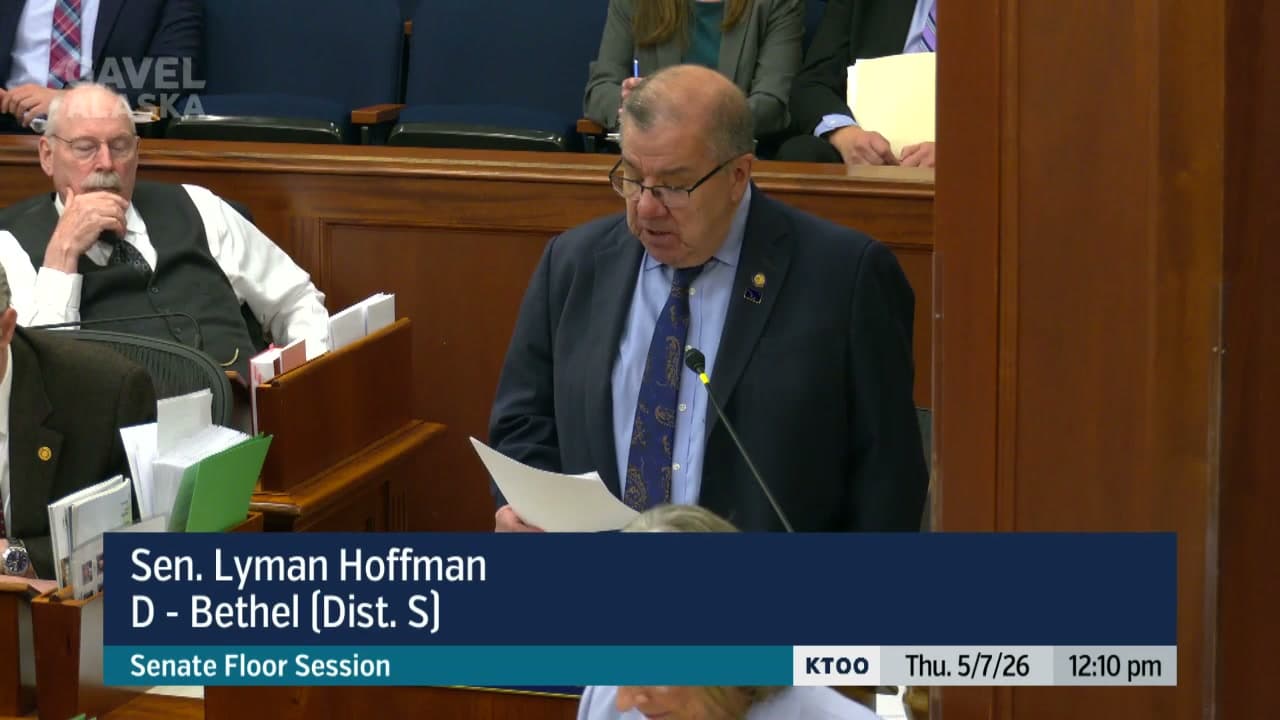
Senate Finance Co-Chair Lyman Hoffman said the Senate budget balances at $70 per barrel oil with $46 million left over for supplementals next year when combined with capital budget spending agreements. The House budget, by comparison, runs close to $320 million in deficits at $75 per barrel oil.
The Senate version avoids tapping the Constitutional Budget Reserve, which held $3.5 billion at the start of fiscal year 2026. The House budget requires a CBR draw of more than $300 million.
The Senate budget includes a $1,000 permanent fund dividend base plus a $150 energy relief payment. Hoffman said the relief responds to fuel price spikes caused by war in Iran. School districts facing high fuel costs would receive $29.1 million in grants, calculated by taking each district's highest energy costs over the past three years and adding 30 percent.
The budget also doubles the base payment for community assistance to $20 million and fills the community assistance fund with $90 million to ensure a full $30 million payout in fiscal year 2028.
The Senate funded two major studies: $650,000 for an independent analysis of cost drivers in the Department of Corrections and $400,000 for a Base Student Allocation study.
Hoffman said the budget fully funds Alaska Retirement Management Board recommendations for PERS and TRS at $38 million, funds wildfire response at a five-year average of $60.6 million, and invests more than the five-year average for disaster relief at $48 million.
For the first time, the budget includes reverse sweep language to streamline year-end accounting. Hoffman said the provision would speed up the comprehensive financial report while sweeping less than $8 million into the CBR, reducing the days and weeks of accounting work to close out subfunds.
The Senate rejected four amendments from Republican members. An amendment by Senator Rauscher to direct $2 million in Arctic National Wildlife Refuge lease revenue to a state trooper post in Talkeetna failed 6-14. A second Rauscher amendment restricting community assistance funding from being used against resource development projects also failed 6-14, as did his amendment to fund a park ranger position in Valdez.
The most contentious vote came on an amendment by Senator Myers to pay a full statutory permanent fund dividend, which would have required drawing down the Constitutional Budget Reserve. The amendment failed 3-17 after extended debate.
The Senate adopted four amendments before final passage. Senator Stedman explained one amendment that backfills funding for crime victims as permanent fund dividends have declined.
The Senate also adopted amendments adding $28,300 for personal services and $563,700 in grants for domestic violence assistance, $650,000 for election security equipment and prepaid ballot envelopes, $1 million for special session expenses, and a technical correction reducing teachers' retirement system unfunded liability payments by $180,000 to match Alaska Retirement Management Board recommendations.
The budget now heads to a conference committee to resolve differences with the House version. Hoffman said the House used $147.6 million in fiscal year 2027 funds for a one-time BSA grant and $10.7 million for pupil transportation, totaling $158.5 million. The Senate used $111 million in fiscal year 2026 funds for a one-time BSA grant plus the $29.1 million in school fuel grants, totaling $140.1 million.
Senate President Gary Stevens announced the Constitutional Budget Reserve section also passed 17-3, meeting the three-quarters threshold required for CBR appropriations.
The Senate also passed the mental health budget 20-0, which adds $5.15 million to the Homeless Assistance Program to match Mental Health Trust recommendations and includes language to increase rates for private duty nurse services.
The conference committee will need to reconcile the two chambers' approaches to energy relief, education funding, and whether to tap the Constitutional Budget Reserve before the legislature adjourns in two weeks.
This article is based on a public meeting — SFLR-20260507-1030 ().
AI-assisted. How we use AI Transcript byLucas Brown
Stay informed. Support what matters.
Free, permanent access to local news you can verify. Subscribe to support Alaska News and go ad-free.
Related Coverage
Senate Passes Budget Balanced at $73 Oil, Rejects House's $320M Deficit Plan
Alaska News · 4mo ago
Alaska Senate passes $13.9B operating budget with $200 energy relief
Alaska News · 4mo ago
Senate Finance adopts $13.8B budget with $150 energy payments, school grants
Alaska News · 5mo ago
Senate Finance adopts operating budget with $150 energy payment, school grants
Alaska News · 5mo ago
House rejects Senate's $1,000 PFD budget, sets up conference talks
Alaska News · 4mo ago
Comments
Sign in to leave a comment.
No comments yet. Be the first to share your thoughts.