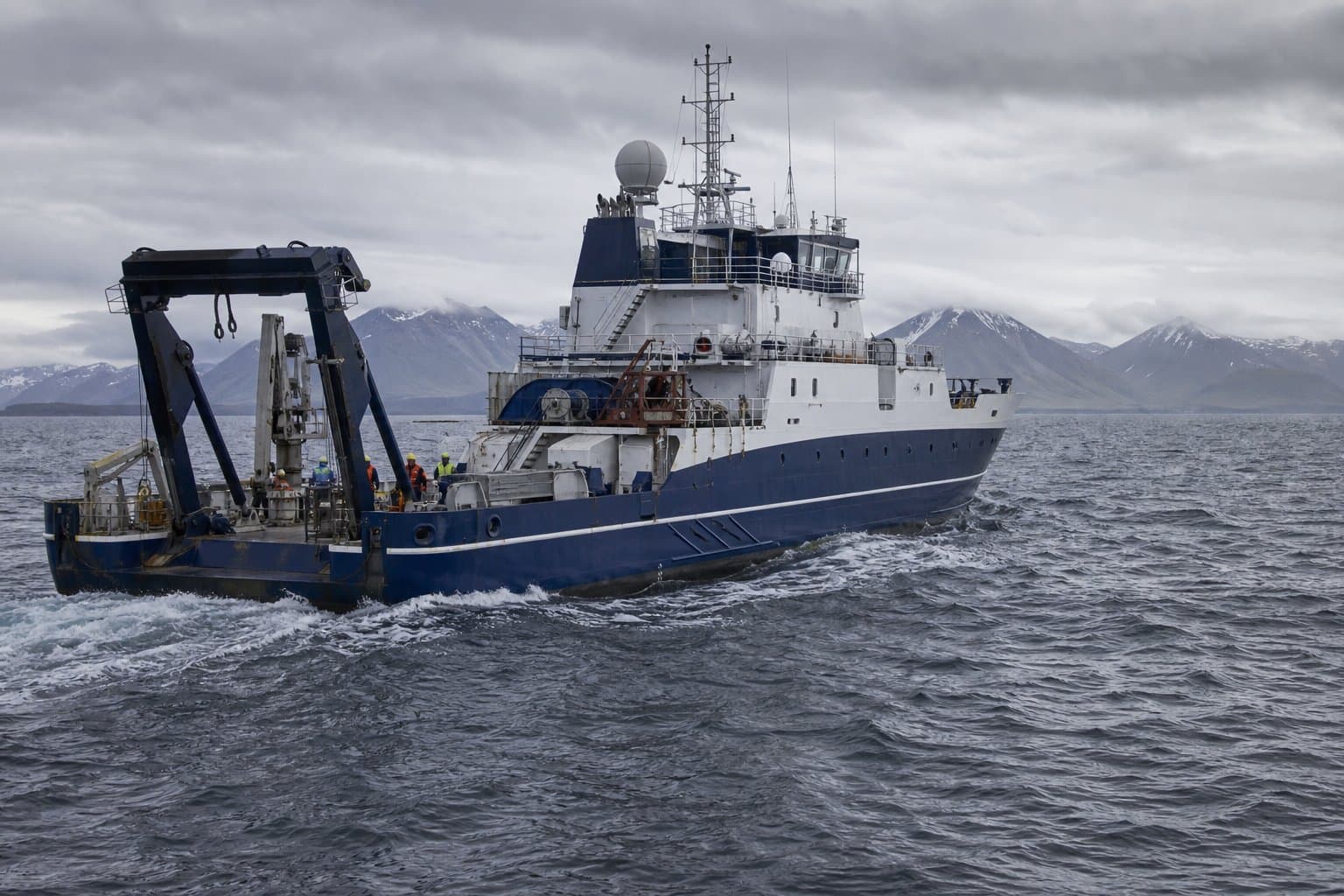
NSF awards $400,926 to UAF for R/V Sikuliaq instrumentation upgrades
Acoustic data used to assess fish stocks and map seafloor habitat in the Bering Sea and Gulf of Alaska can be affected by a phenomenon called bubble sweep, and a new federal grant will fund an engineering evaluation of the problem aboard a research vessel that collects that data in those waters.
The National Science Foundation awarded $400,926 to the University of Alaska Fairbanks on July 13 to upgrade instrumentation on the R/V Sikuliaq, the 261-foot ice-capable vessel owned by NSF and operated by UAF's College of Fisheries and Ocean Sciences. The award covers a broad range of improvements: sound velocity sensing equipment, acoustic support system components, fluorometric sensing instrumentation, software modernization, restoration of acoustic observational capabilities, and a limited unmanned aerial system capability for use in ice-covered environments. Bubble sweep is the mechanism by which wave action forces air under a ship's hull, where entrained bubbles scatter the acoustic beams used for depth sounding, seafloor mapping, and fish-school detection. The award includes an engineering evaluation of bubble sweep effects on the Sikuliaq's scientific acoustic systems.
What the Evaluation Will and Will Not Do
The evaluation is diagnostic in scope. It will characterize the extent and conditions of bubble sweep effects aboard the Sikuliaq. Gabriel Matthias, instrument engineer for the Sikuliaq at UAF's College of Fisheries and Ocean Sciences, is the principal investigator. The award runs through June 30, 2027.
The broader data-quality concern is one industry voices have raised in other contexts. At a June 2025 U.S. House subcommittee hearing on seafood competitiveness, commercial fishing representative Dustin Delano said, "we can always do better, and we need to do better before it's too late."
AI-assisted, reviewed by editors. Spot an error?
Comments
Sign in to leave a comment.
No comments yet. Be the first to share your thoughts.