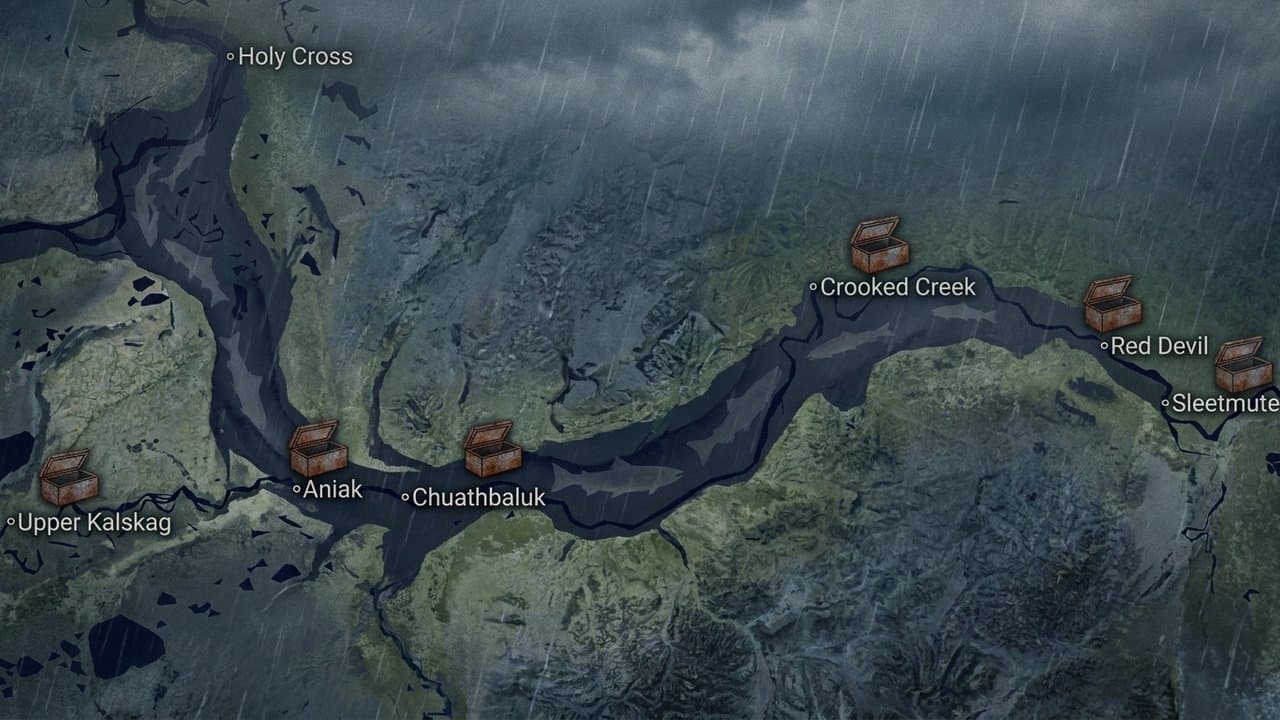
Editorial map (Gemini + Google Maps)
Kuskokwim subsistence households face empty freezers as salmon closures hold
Federal public waters of the Kuskokwim River have been closed to all salmon harvest since June 1. The Federal Subsistence Board's proposed Temporary Special Action covering Chinook and Chum salmon in the mainstem and select tributaries runs through July 31, leaving subsistence households with only narrow set-net openings on specific dates between Eek and Tuluksak to put up fish for winter. The restrictions are part of a broader Arctic-Yukon-Kuskokwim salmon crisis in which federal managers cite escapement shortfalls as the conservation rationale for the closures.
For households that depend on the river, the consequence is fewer fish in the freezer heading into winter. The Alaska Department of Fish and Game offered partial relief effective June 28, raising non-Chinook bag limits to six per day and 12 in possession downstream of the Yukon Delta National Wildlife Refuge boundary near Aniak, but Chinook closures and federal water restrictions remain fully in force. Subsistence openings between Eek and Tuluksak included set-net dates on June 2, 5, 9, and 28, plus drift and set-net dates on June 12, 16, and 22 with specified hours.
The Kuskokwim River Inter-Tribal Fish Commission, formed in 2014 to represent tribal governments and co-manage salmon fisheries with state and federal agencies, supports the conservation closures but continues to press for structured openings that meet community food needs. The Federal Subsistence Board has stated that the closures and gear restrictions are necessary to conserve severely depressed Chinook and Chum stocks and allow enough salmon to reach spawning grounds to meet escapement goals. State managers, meanwhile, have shown that management is not uniformly restrictive: the department determined it was "warranted to increase the bag and possession limits for salmon, other than king, pink, and coho salmon" in downstream reaches where runs could sustain additional harvest.
U.S. Rep. Mary Peltola, running for U.S. Senate, frames the restrictions as political failure: "Rather than reel in the corporations causing the scarcity in our salmon runs, Alaskans who rely on fishing to feed their families aren't allowed or aren't able to fill their freezers to make it through winter." In her campaign message, she says households are being forced to buy more groceries as prices rise and warns that "restrictions and scarcity are becoming the norm for our fisheries, not the exception." Peltola attributes the decline to out-of-state corporate factory trawlers, noting that the salmon return rate has fallen from six fish per spawning salmon to less than one. Her claim that trawler bycatch drives the collapse is a campaign assertion; federal managers cite escapement shortfalls. As of July 2, Bering Sea groundfish fisheries had reported Chinook bycatch of 12,657 fish and chum bycatch of 5,891 fish for the season, figures that Peltola and others point to as evidence of the problem, though federal managers have not publicly attributed the closures to bycatch alone.
Source: Salmon, Scarcity, and a U.S. Senate race.
AI-assisted. How we use AI
Stay informed. Support what matters.
Free, permanent access to local news you can verify. Subscribe to support Bill AlaskaNews and go ad-free.
Related Coverage
The state closes Kuskokwim subsistence coho fishing as the run lags
Alaska News · 1mo ago
Alaska closes Yukon subsistence salmon fishing through early June
Alaska News · 3mo ago
Federal managers close Yukon, Innoko gillnets to protect Chinook and chum
Alaska News · 3mo ago
Kuskokwim subsistence fishing reopens as salmon run strong
Alaska News · 2mo ago
Kuskokwim mainstem reopens early as six spawning tributaries stay closed to Chinook and chum
Alaska News · 2mo ago
Comments
Sign in to leave a comment.
No comments yet. Be the first to share your thoughts.