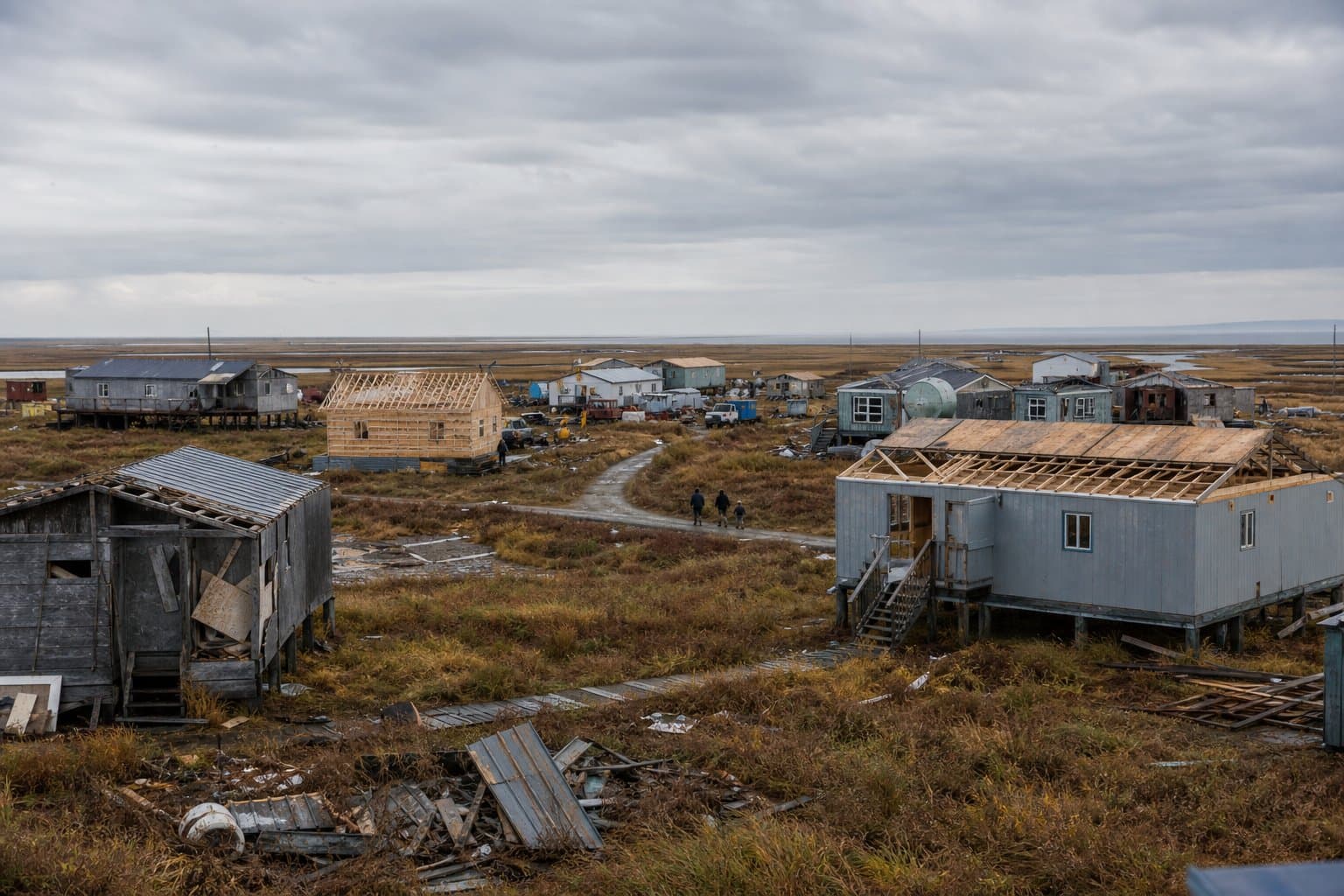
AI image
Kipnuk households paid $18 million; no village infrastructure project
Federal disaster records show Kipnuk households have received $18,048,479 after the remnants of Typhoon Halong destroyed 153 homes there in October 2025. Kipnuk does not appear on the public assistance applicant list for disaster 4893, and no project is recorded there. Kwigillingok, the second-hardest-hit village, is also absent from that list. A separate major disaster declaration issued to the Native Village of Kipnuk on May 29, 2026, for the same storm, requested by the tribe itself, shows zero funded projects and zero applicants more than three months later. FEMA's funded-projects dataset does not capture projects still in pre-obligation processing, so the absence of a recorded project does not by itself mean no work is underway or planned.
One federal award record sits outside those datasets. USAspending lists $430,684.98 obligated to the Native Village of Kipnuk under FEMA's Public Assistance Program (CFDA 97.036), a project grant for disaster assistance running from Sept. 15, 2025, through Sept. 30, 2026. The record is coded to disaster 4853 rather than either Halong declaration. Its performance period begins before the October storm, and it states neither a project scope nor a disbursed amount.
The split matters in the Kuskokwim Delta. Household payments cover repairs, replacement and rent for individual families. Public assistance rebuilds roads, water systems, utilities and public buildings. In this disaster, almost none of that money has reached the villages that lost the most.
The storm destroyed 245 homes across western Alaska. Kipnuk accounted for 153 and Kwigillingok for 55, together holding 208 of the 245 destroyed homes. In Kipnuk, 285 households registered and 237 were found eligible, an average of $76,154 per eligible household, the highest in the disaster. That included $5,958,400 in replacement assistance, $556,771 in repair assistance and $2,432,077 in rental assistance. Kwigillingok's 129 registrations produced 111 eligible households and $8,085,645. Together the two villages account for $26.1 million of the $62.4 million paid across 46 communities, or 41.9 percent. Across the entire disaster, 2,511 households registered and 2,125 were found eligible.
Public assistance runs on a separate track. Obligations for disaster 4893 stand at $5,712,194 across 17 funded projects. Four belong to the State of Alaska and account for $4,937,558, or 86.4 percent, including non-congregate sheltering at $2,971,062 and a state emergency operations center protective measures project at $1,094,625. Everything obligated to every other applicant combined comes to $774,636. Ten applicants exist for the entire disaster: the State of Alaska, the cities of Bethel and Napakiak, several tribal entities, two school districts and the Alaska Village Electric Cooperative. Local projects are small. Napakiak's two debris removal projects total $460,983 in a village where 12 homes were destroyed. Other applicants received amounts ranging from about $4,575 for a school roof repair to $123,037 for fuel delivery and generator repair.
Ten of the 17 projects are emergency protective measures and two are debris removal. No project falls under roads and bridges, water control facilities, public utilities, or parks and recreational facilities. The disaster's entire permanent work category totals $81,625 and contains no construction, only four equipment claims. Mitigation funding recorded across all 17 projects is zero.
The obligations recorded so far are not stalled by age. They run from Oct. 31, 2025, nine days after the declaration, through Sept. 3, 2026, and all 17 projects are marked eligible, with none denied. Under the state's public assistance process, an applicant must file a Request for Public Assistance within 30 days after its area is designated eligible. Federal disasters split funding 75 percent federal and 25 percent state.
This account draws on the funded projects and applicants lists for disaster 4893, the individuals and households program registrations for the same disaster, the funded projects dataset for disaster 4912, and the USAspending award record. The datasets carry no statements from named officials, and no explanation for the applicant-list absence appears in them.
The records do not show whether Kipnuk applied and was refused, applied and is pending, or never applied. They do not show what has been physically rebuilt in either village, or where the 237 eligible Kipnuk households are living now. Those answers rest with the tribal and city governments in the Delta, the state division that administers public assistance to subrecipients, and the federal recovery office.
Source: Kipnuk lost 153 homes to Typhoon Halong and its households have been paid $18 million. Federal money obligated for the village's own infrastructure: none ().
AI-assisted. No editor review is on record for this article. Who is accountable.
Stay informed. Support what matters.
Free, permanent access to local news you can verify. Subscribe to support Walter AlaskaNews and go ad-free.
Related Coverage
Alaska villages can rebuild after Halong. They can't use the money to move.
Alaska News · 11mo ago
Kipnuk is being pieced back together, one boardwalk at a time
Alaska News · 2mo ago
Nearly four years on, Alaska has been paid 15 percent of Merbok's $90.9 million
Alaska News · 1mo ago
Household disaster aid accounted for eight of every 10 federal dollars sent to Alaska this week
Alaska News · 2w ago
Wind, high surf and rain batter four Y-K Delta villages into a second day
Alaska News · 1mo ago
Comments
Sign in to leave a comment.
No comments yet. Be the first to share your thoughts.