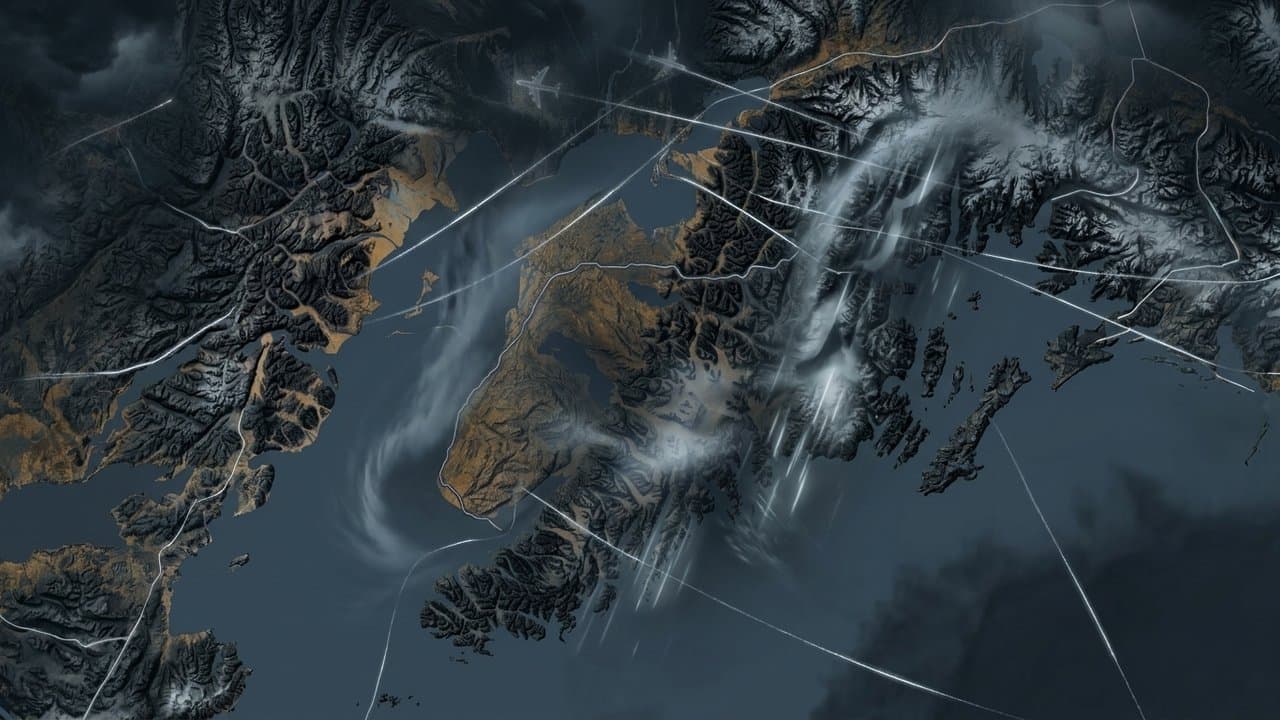
Editorial map (Gemini + Google Maps)
Kenai Assembly asks state to ban cloud seeding, on consent agenda
The Kenai Peninsula Borough Assembly asked the Alaska State Legislature and Governor on Tuesday to ban weather modification statewide, three weeks after a commercial cloud-seeding operation flew drones over the borough without telling borough officials in advance.
The request passed 7-0. Assembly Vice President Kelly Cooper and Assembly Member Dale Eicher were absent.
The Assembly approved it inside the consent agenda, a single block of items the borough's own standing agenda note describes as "routine and non-controversial by the Assembly." The note allows any member to pull an item for separate discussion. No member pulled either of the two weather modification measures. Assembly Member Lenora Niesen moved the block.
The resolution asks the state to prohibit weather modification and geoengineering in Alaska, or, failing a ban, to require permits backed by civil or criminal penalties. It also asks Alaska's congressional delegation to strengthen federal law. It took effect immediately. It is Resolution 2026-046.
What Happened on Aug. 23
A borough Legal Department memorandum written Sept. 3 by Borough Attorney Sean Kelley and Land Management Officer Aaron Hughes states that Rainmaker Technology Corporation, a cloud-seeding company based in El Segundo, California, conducted commercial cloud seeding inside the borough that day. The memo states that "Rainmaker's press release was the first notice KPB received that drones carrying payloads for weather modification purposes were operating within KPB." The memo describes ten drone flights.
Four days before the vote, the state told the borough it had found nothing to enforce. Randy Bates, commissioner of the Alaska Department of Environmental Conservation, wrote to Mayor Peter Micciche on Sept. 11 that "DEC has not identified a violation or an adverse impact requiring action under its existing authorities. No DEC permit is currently required solely for conducting cloud-seeding activities, and Alaska does not have a regulatory framework specific to weather modification."
Bates wrote that the department cannot close that gap on its own. "DEC cannot create a permitting requirement that does not exist in statute or regulation," the letter states. He offered the department's technical and regulatory expertise to lawmakers if they decide oversight is warranted. The letter was attached to both borough measures.
The six-page letter carries the figures, all drawn from material the company provided. Rainmaker's technical report states that 19 flares dispersed roughly 374 grams of silver iodide. The company put the claimed effect three ways: a mean of about 57 acre-feet of additional precipitation, about 19 million gallons, and about 0.01 inches across the area analyzed. Bates cautioned against reading the gallons figure as a measurement. It "represents the estimated total volume of additional precipitation distributed across the area analyzed, not 19 million gallons falling on a single location," he wrote, and such estimates "are modeled estimates and are not the same as a direct measurement of water collected at the ground."
Rainmaker contacted the Alaska Department of Natural Resources before conducting its Alaska activities and received a letter of no objection, Bates wrote. The company also indicated it engaged with local landowners and Native organizations regarding land access. Bates noted the natural resources letter "addressed Rainmaker's proposed activities on land under DNR's jurisdiction and was not a DEC environmental permit or authorization." The state's letter says that letter is attached. It is not in the copy laid before the Assembly.
Bates wrote that Rainmaker "acknowledged to DEC that communication with state officials and legislators prior to its operations would have been appropriate and we agree."
The Borough's Narrower Rule
The borough says it cannot regulate the activity itself. "As a second-class borough, KPB does not have authority to fully regulate weather modification activities or airspace rights," the legal memorandum states. The classification sets which powers a borough holds. The resolution concedes that the power to ban the practice, or to build a uniform permitting framework, "is a state function."
That is why the borough's own companion measure is narrower. Also introduced on consent, Ordinance 2026-35 would add a new section to borough code, KPB 17.10.165, requiring ten categories of disclosure from anyone applying for a commercial lease or commercial land use permit for temporary use of borough land. The list includes chemical type and quantity, the quantity, type, manufacturer, serial number and total weight of flares, total pyrotechnic material, safety data sheets, flight duration and altitude, and release coordinates including predicted impacted areas. It bans the activity outright in one setting: "Geoengineering or weather modification activities are prohibited on borough lands open for casual use." Failing to file a closeout confirmation after an approved activity would draw $1,000 a day and a five-year bar on applying for a borough lease or permit.
Nothing in the borough or state records establishes whether Rainmaker used borough land on Aug. 23. The state's letter points to land under Department of Natural Resources jurisdiction, plus private and Native landowners. If no borough land was involved, the ordinance would not have reached the operation that prompted it.
Federal law does require advance notice, but not to boroughs. Under the weather modification reporting rules, anyone intending to conduct weather modification in the United States must file a report with the National Oceanic and Atmospheric Administration at least ten days before the activity begins, naming the sponsor and operator and mapping the target and control areas. Seeding clouds to produce ice crystals is expressly reportable. When a project may significantly depart from practices used to avoid danger to persons, property or the environment, the administrator notifies the operator and state officials. The rules date from 1976. The maximum penalty for a knowing and willful violation is $10,000. The Assembly's findings state that such filings are not shared with affected municipalities before operations begin.
The resolution cites Tennessee, which banned the practice in 2024, and Florida, which did so in 2025.
One-Sided Record, Open Hearing Ahead
Rainmaker does not speak in any of the records the borough published. The company's position appears only at second hand, in the state's letter, and every technical claim about silver iodide quantities and downwind effects is attributed to material the company supplied. No resident, landowner, tribal representative or independent scientist appears in the file. The Sept. 15 minutes remain in draft, so the record does not establish whether anyone testified, even though the agenda note states that public testimony is taken on consent items.
The borough ordinance is the one piece still open. The public hearing on Ordinance 2026-35 is set for Oct. 20, and that is the remaining point at which residents can be heard on the borough's own rule before the Assembly votes. The statewide ban the Assembly asked for now rests with the Legislature and the Governor, and nothing in the record shows a response.
Source: The Kenai borough asked the state to ban cloud seeding. The request passed on the consent agenda, in a block its own rules call routine and non-controversial. ().
AI-assisted. No editor review is on record for this article. Who is accountable.
Stay informed. Support what matters.
Free, permanent access to local news you can verify. Subscribe to support Walter AlaskaNews and go ad-free.
Related Coverage
Kenai Peninsula mayor's ordinance would regulate weather modification
Alaska News · 1w ago
Kenai could put school board term limits to voters under a new state law
Alaska News · 3w ago
The Kenai Borough Assembly president wants three votes to carry the assembly
Alaska News · 4d ago
Kenai Peninsula assembly president proposes rewrite of rules for filling assembly vacancies
Alaska News · 1w ago
Kenai assembly weighs putting school board term limits to voters
Alaska News · 1mo ago
Comments
Sign in to leave a comment.
No comments yet. Be the first to share your thoughts.