AI image
Federal charter keeps water sampling going on the Unuk, downstream of three British Columbia mines
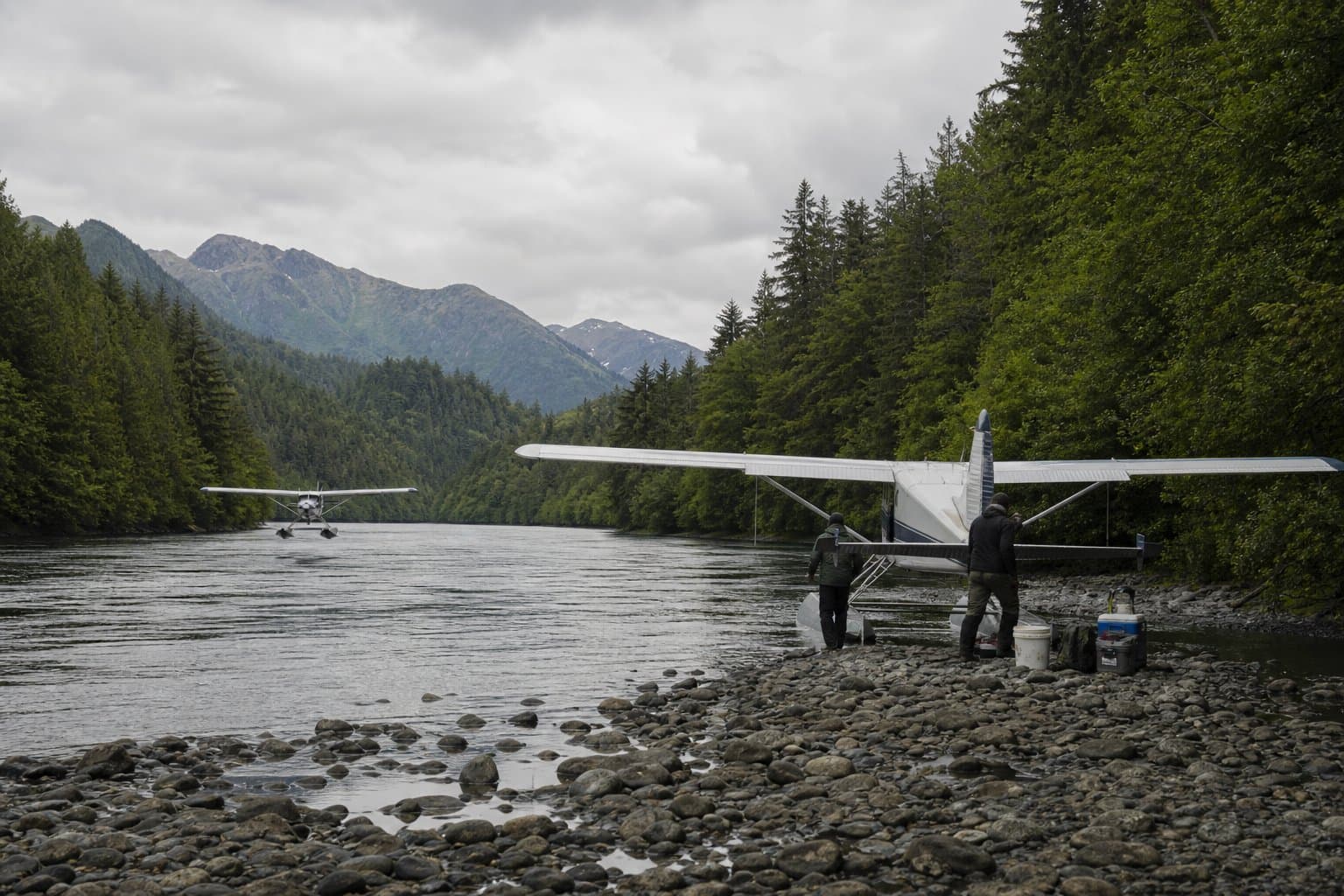
Federal scientists will keep flying into one of Southeast Alaska's most remote river valleys this fall, sampling water on a river with three large British Columbia mines in development upstream.
The Department of the Interior awarded Misty Fjords Air and Outfitting Inc. $15,510 on Aug. 11 for on-call fixed-wing flights supporting U.S. Geological Survey salmon research on the Unuk River through Dec. 1. USGS collects water-quality samples every six to eight weeks, weather and aircraft permitting.
The Unuk begins in British Columbia and flows into Misty Fjords National Monument, a wilderness area inside the Tongass National Forest. USGS describes it as a very remote watershed that receives few visitors in a year. It is mostly braided, with two lava canyons on the main stem where water pours out of lava tubes. The agency's station there is a super gage, a streamflow gage carrying continuous water-quality monitors.
It is the second smallest watershed in the USGS transboundary study and the one with the most mining above it. Three large projects sit in development in the Canadian headwaters: Kerr-Sulphurets-Mitchell, Brucejack and Eskay Creek.
Congress directed USGS in 2018 to partner with local tribes and other federal agencies on a water-quality strategy for transboundary rivers affected by mining. Unuk collection began that year. The agency also gauges the Alsek, Taku, Stikine and Salmon rivers. Salmon fisheries in those watersheds contribute an estimated $1 billion a year to the regional economy, according to USGS.
A Central Council of the Tlingit & Haida Indian Tribes of Alaska resolution backs "an immediate temporary pause in permitting, exploration, development, and expansion of BC mines" until a binding international watershed agreement exists. No response to the resolution appears in the federal record.
Source: Department of the Interior.
AI-assisted. How we use AI
Stay informed. Support what matters.
Free, permanent access to local news you can verify. Subscribe to support Maggie AlaskaNews and go ad-free.
Related Coverage
State Defends Transboundary Mining Oversight as Stakeholders Demand Stronger Protections
Alaska News · 4mo ago
Tok's 40-Mile Air gets $45,000 contract for helicopter flights to track Yukon-Charley wolves
Alaska News · 5d ago
Alaska's largest fisheries lab swaps ozone for ultraviolet to treat its water
Alaska News · 1mo ago
A federal minerals program is funding science on the seafloor mining wants to dig
Alaska News · 2mo ago
A $3.19 million contract will fix roads and fish passage near Ketchikan
Alaska News · 1mo ago
Comments
Sign in to leave a comment.
No comments yet. Be the first to share your thoughts.