Fairbanks father's testimony drives push for faster body cam release
A Fairbanks father whose two sons were shot by Alaska State Troopers during a mental health crisis call told state lawmakers Tuesday his family waited months for body camera footage while learning details from news media instead.
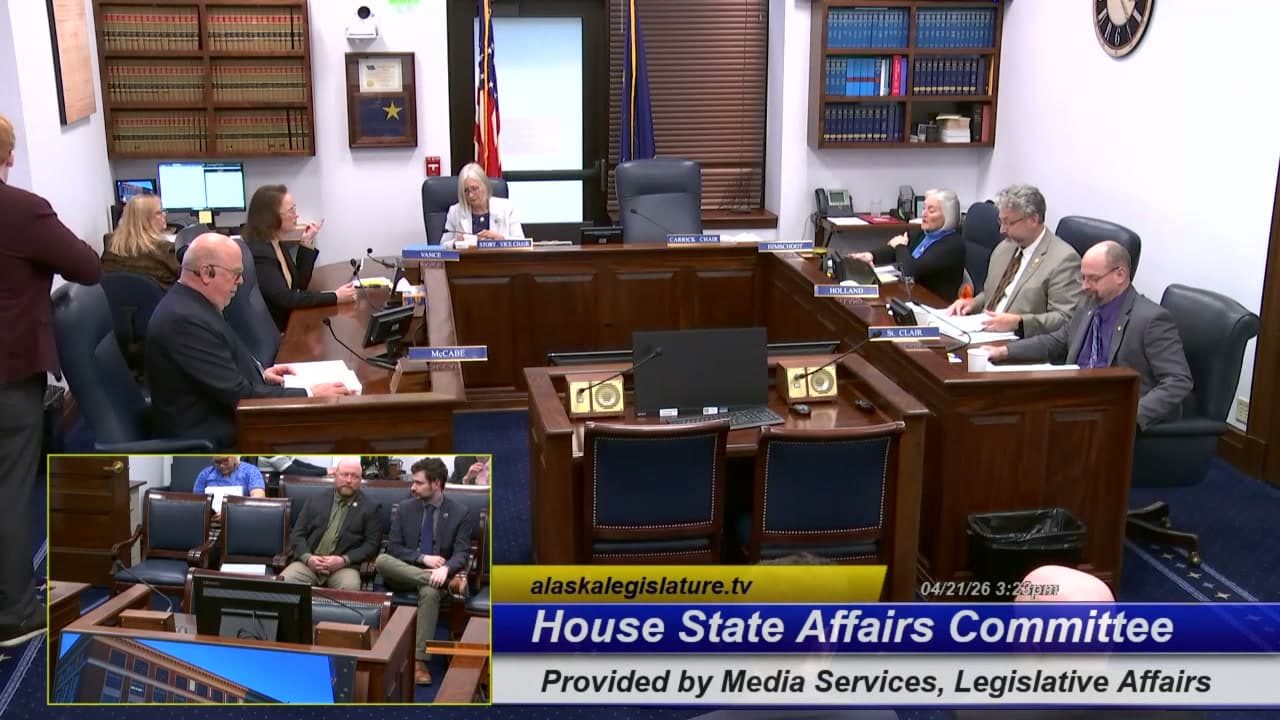
Gerald Rexford testified before the House State Affairs Committee in support of House Bill 377, which would require police agencies to release body camera footage within 30 days of use-of-force incidents resulting in death or serious injury. The committee adopted a committee substitute incorporating that requirement.
Rexford called troopers on January 1 after his wife asked him to get help for their 24-year-old son, who was in a mental health crisis. He told the dispatcher his son needed to return to the hospital. While Rexford stood outside, gunshots were fired inside his home. Both of his sons were shot.
"I watched as a covered body was carried out of my home, and no one would tell me what had happened," Rexford said. "In the months that followed, our family was in Seattle while my oldest son fought for his life."
Rexford said officers involved viewed the body camera footage on January 7, but his family has not received the full unedited footage. The footage released publicly was edited and did not fully answer the family's questions, he said. Alaska News Source received the footage while the family was finishing the burial.
"We had been requesting this since January, were denied, and were given a statute to appeal. So we did," Rexford said.
The committee substitute for HB 377 would require agencies to release body camera footage within 30 days of use-of-force incidents resulting in death or serious injury. Agencies could extend the deadline by 30 days if the agency head determines release would substantially interfere with an active criminal investigation. Courts could extend the timeline further.
Representative Sarah Vance said she wanted to ensure the timeline and exemptions are correct to avoid interfering with investigations.
"I want to make sure that we have this timeline correct around the exemption regarding an active criminal investigation and how much the courts can extend that because investigation timelines vary, and that is the ultimate justice," Vance said.
Vance maintained an objection to adopting the committee substitute, citing concerns about investigation timelines. She later removed the objection after discussion.
Austin McDaniel, communications director for the Department of Public Safety, said current practice requires agencies to release body camera footage within 10 days after the Office of Special Prosecutions determines an officer's use of force was lawful and justified. Most larger agencies release footage within hours of that determination, he said.
McDaniel said he could not provide an average timeline for completing investigations, which involve multiple agencies including the Alaska Bureau of Investigation, the state crime lab, and the State Medical Examiner's Office. He said most investigations take more than 30 days but less than 90 days.
Chair Ashley Carrick said the committee substitute represents a compromise from advocacy requests for a 21-day release requirement with no exemptions.
"There's been a tremendous amount of advocacy even just very recently about doing a 21-day rather than a 30-day period and not having any exemptions for, say, the extension to be offered or the courts to lift that ceiling," Carrick said.
Carrick said the 30-day timeline with a possible 30-day extension aligns with what appears to be reasonably accomplishable based on prior testimony. The requirement applies only to body camera footage from use-of-force incidents resulting in death or serious injury, not all public records requests or all police body camera requests.
Cynthia Gachupit, executive director of Empowerment Advocacy Alaska, said her organization is the only nonprofit providing direct victim services specifically to victims and surviving family members of officer-involved shootings. She supported the 30-day release provision but raised concerns about cost barriers.
"By allowing the municipalities and the Department of Public Safety to charge for every minute of search and redaction time and requiring that payment in advance, HB 377 was creating a pay-to-play justice system," Gachupit said.
Gachupit urged the committee to consider fee waivers for victims and surviving family members of officer-involved shootings, who are not currently considered victims under state law. She also asked the committee to maintain the five-hour free search time for individuals requesting records related to their own victimization.
Antonia Comack, a missing and murdered Indigenous people advocate from Wasilla, said removing the five-hour rule from statute will enable law enforcement agencies to charge more money for public records.
"Making public records more expensive is going to make transparency less accessible," Comack said. She said she supports the portion of the bill surrounding body camera footage for officer-involved shootings but believes families should have full access to unedited footage as soon as possible with no option for a 30-day extension.
Rexford urged Alaska to move toward a faster timeline similar to Minnesota, where families receive access within days of an incident involving death or serious injury. He said establishing a clear 30-day timeline in statute is an important step forward.
"I'm asking you to support this bill so that what happened to our family does not happen to another family," Rexford said. "Even if it does not apply to our situation, it will help future families so they are not left waiting for answers."
The committee adopted the committee substitute without a roll call vote after Vance removed her objection. The committee did not take final action on the bill Tuesday. Carrick said the committee will continue work on the bill at a future hearing.
The committee substitute also adds text messages to the definition of public records under Alaska's Public Records Act. The bill originally came to the committee as a request from the City of Fairbanks and passed through the House Community and Regional Affairs Committee before reaching State Affairs.
This article is based on a public meeting — Alaska Legislature: House State Affairs, 4/21/26, 3:15pm ().
AI-assisted. How we use AI Transcript byLucas Brown
Stay informed. Support what matters.
Free, permanent access to local news you can verify. Subscribe to support Alaska News and go ad-free.
Related Coverage
House Finance weighs bill to standardize state payment timelines
Alaska News · 6mo ago
Anchorage Assembly postpones public safety commission to July
Alaska News · 3mo ago
Alaska House committee reviews $759K in agency requests to fix payment delays
Alaska News · 5mo ago
Alaska Senate panel hears bill requiring 7-day review for foster youth in psychiatric hospitals
Alaska News · 4mo ago
House panel fast-tracks insurance coverage for PANDAS treatment
Alaska News · 5mo ago
Comments
Sign in to leave a comment.
No comments yet. Be the first to share your thoughts.