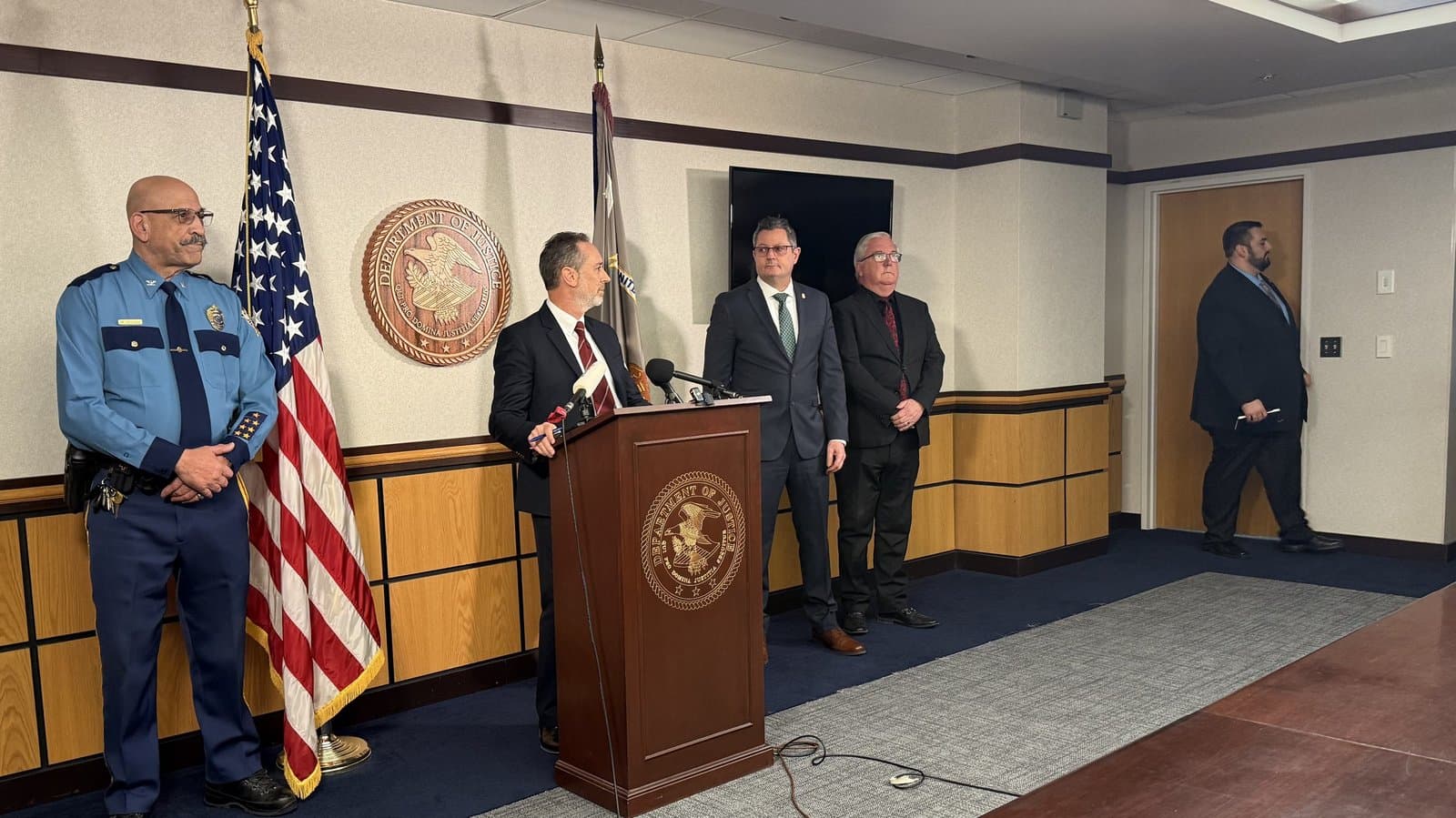
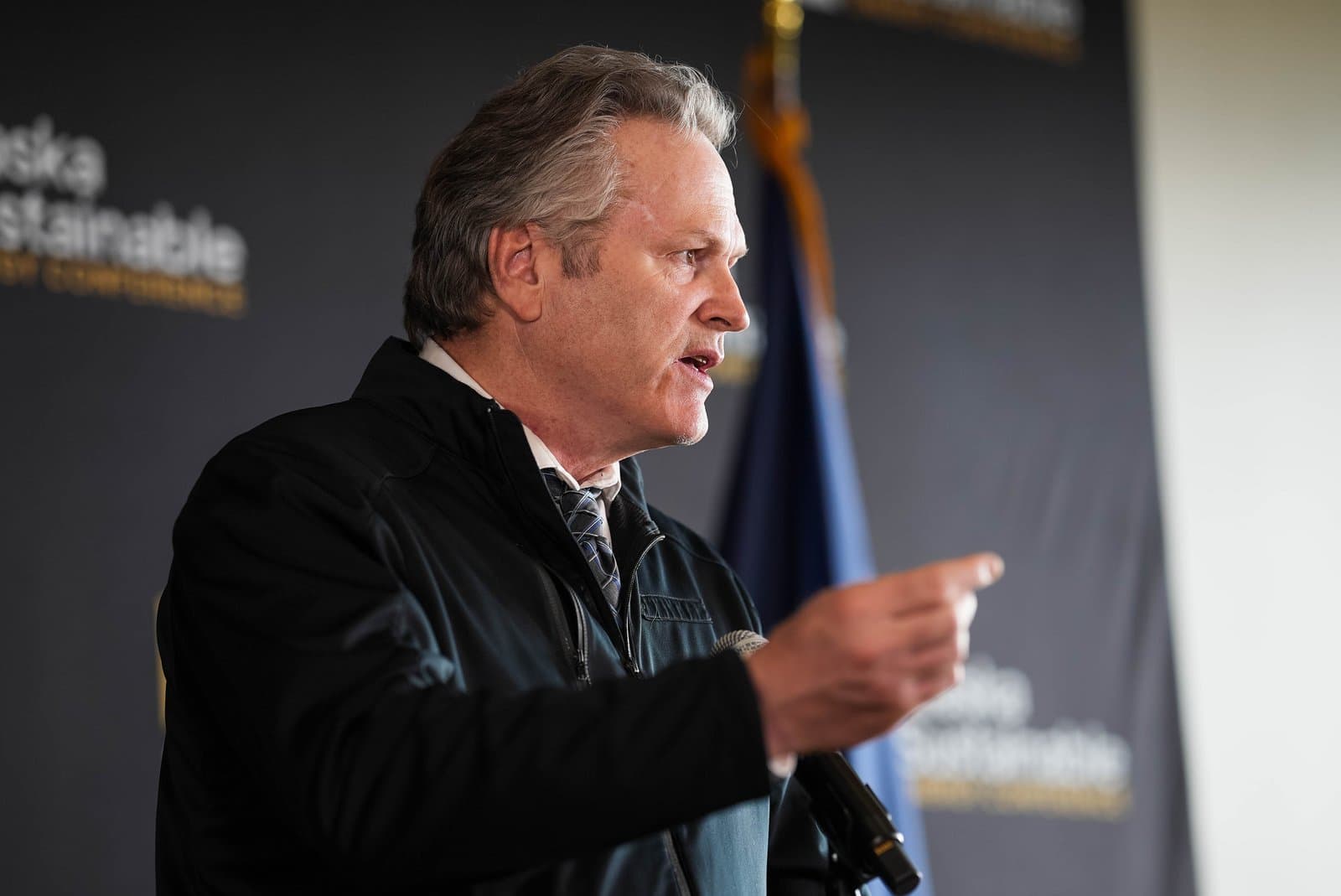
U.S. Attorney Michael Heyman speaks at a press conference in Anchorage on Friday, with an Alaska State Trooper and federal officials beside him. (Jeff Landfield / The Alaska Landmine)
DOJ confirms criminal probe tied to Daniel J. Sullivan’s candidacy days before election
Four days before Alaska's U.S. Senate election, the state's top federal prosecutor said Friday that law enforcement around the country is taking "investigative steps" in a criminal investigation tied to Daniel J. Sullivan's candidacy.
An hour after the press conference, the Justice Department asked a federal judge in a separate civil case to fast-track sworn answers and depositions from Mary Peltola's campaign and the Democratic Senatorial Campaign Committee, and to order the state, if the result may have been affected, to preserve and keep separate the ballots that rank Daniel J. Sullivan.
U.S. Attorney Michael Heyman wouldn't say who is under investigation or which laws are at issue, and no charges have been announced. "You're assuming that there is a crime being committed," he told a reporter at a press conference in Anchorage. "I'm not making any assumptions on whether a crime has been committed or not."
He said the investigation has been underway for several months, and that a New York Times report Wednesday brought "a significant surge of law enforcement assets to Alaska."
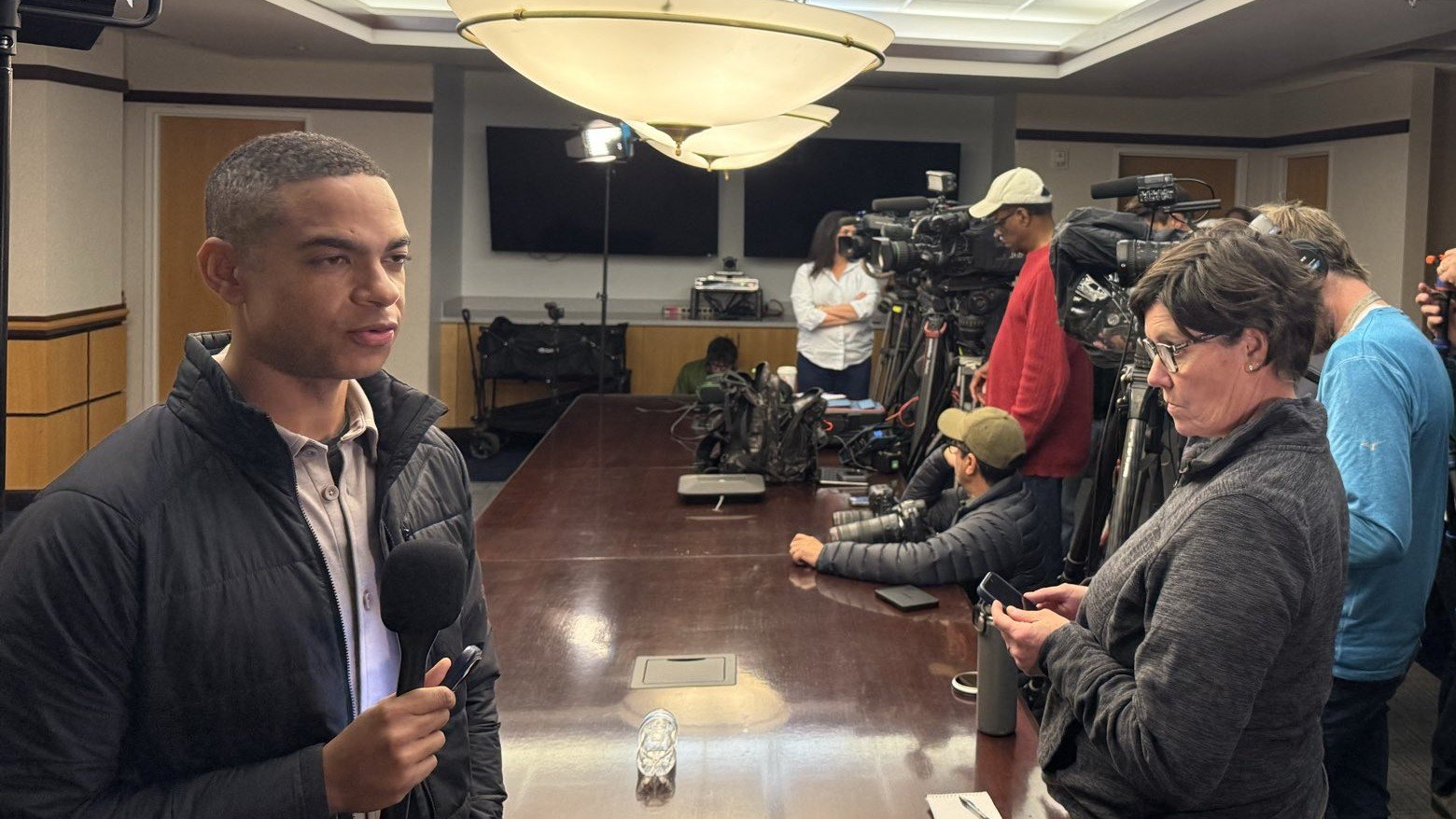
The Times reported that Peltola aides worked with people trying to recruit Daniel J. Sullivan, a retired Petersburg teacher who shares the senator's name, as part of a broader effort with DSCC officials, internally called the "ballot composition project," to draw spoiler candidates into the race.
Much of its account came from Peltola's former campaign manager, Elisa Rios, who asked last week to retract her interviews; the Times said her account was consistent with its other reporting.
Heyman described the report as alleging "a sprawling conspiracy to recruit and prop up Daniel J. Sullivan as a sham candidate."
Alaskans for Mary, the campaign committee Peltola designated in January, has said it "did not recruit any candidates into the race." The Times said the effort began in summer 2025.
Peltola said at an event in Juneau this week that she "knew nothing about any other candidates on the ballot except for me and the incumbent." The DSCC has denied involvement, and Daniel J. Sullivan had said he entered the race on his own.
Daniel J. Sullivan drew about 2.5% of the vote in the August primary. The Justice Department argues that if voters mistake him for Sen. Dan Sullivan, that could be enough to change the result.
Asked why hold the press conference four days before the election rather than after it, Heyman said, "We're not escalating anything except to the extent that a new article came out." When allegations "go to the heart of" election integrity, he said, "we are going to take it seriously even if it is a few days before the election."
Pressed on what types of crimes investigators might be looking at, he said, "It's been widely spoken about, conspiracy theories and election integrity, but I'm not going to go into the specifics."
Heyman said he had been on the case “for all of about 24 hours,” since his recusal over a possible judgeship was lifted, and hadn’t talked with the White House about the complaints.
The department's civil suit asks U.S. District Judge Sharon Gleason to block certification if Sen. Sullivan loses but would have won with Daniel J. Sullivan's votes, pending an investigation into whether those votes were meant for the senator. The state's lawyers have called the suit's legal theory "meritless," and Sen. Lisa Murkowski, a Republican who endorsed Sen. Sullivan, said last week that the department "should never have filed this lawsuit."
Besides the Times report, the suit cites the state Division of Elections' June finding that Daniel J. Sullivan filed "with the purpose of confusing or misleading the electorate." State courts put him back on the ballot because the division used a "good faith" test found nowhere in Alaska law, without ruling on his motives.
Friday's motion seeks a narrower first step: an order that the state "preserve and segregate" ballots that rank Daniel J. Sullivan, which the department says would apply only if the result may have been affected. In a sworn declaration, a department lawyer said the purpose is to investigate whether those rankings were "the product of voter confusion, should such an investigation become necessary," and that the step would be "impossible after Election Day."
"That lawsuit seeks to protect ballots. Nothing more for the moment," Heyman said. The department, he said, "is not asking the court to declare a winner or loser or change the votes in any way."
Alaska opposed the request Friday, arguing ballots are already preserved for 22 months and that segregating them during voting would violate ballot secrecy.
The DOJ also asked to take discovery early from Alaskans for Mary and the DSCC: written answers under oath, documents and depositions of representatives from each group. Its proposed requests reach past Daniel J. Sullivan.
They ask about Gerald Heikes, a Republican also on the Senate ballot whom the Times reported was recruited, and David Leslie, a Democrat who dropped out after the primary. They ask about consultant Jim Lottsfeldt, who the Times reported agreed to lead outside spending for long-shot candidates; any money paid to Daniel J. Sullivan; why Rios's job with the campaign ended; and why the campaign didn't answer the Times' questions.
Gleason hasn't ruled. In a separate motion Friday, the department asked her to decide by Monday, the day before Election Day. The proposed written requests would give the campaign and DSCC 30 days unless Gleason orders a shorter period or the parties agree, and the deposition notices leave the date and place blank. The filings carry Heyman's name along with that of Associate Attorney General Stanley Woodward Jr. in Washington.
Heyman said the civil and criminal investigations are "parallel proceedings," and that secrecy rules keep criminal investigators from sharing what they find with lawyers on the civil side.
The department argues that the National Voter Registration Act, which lists protecting "the integrity of the electoral process" among its purposes, gives it authority to bring the case.
The state, Peltola's campaign and the DSCC, and a group of voters and voting-rights organizations have all asked Gleason to throw out the suit. The state argues that the law is "a voter registration law" and that the case "has nothing to do with voter registration."
The campaign and DSCC argue that the investigation DOJ wants couldn't be done reliably because Alaska ballots are secret and are separated from voters' identifying information before they're counted. Replies to the department's response are due by noon Saturday.
The FBI's Anchorage office asked anyone with information to contact it at tips.fbi.gov. Gov. Mike Dunleavy ordered a separate state investigation Wednesday.
"If you're an Alaskan voter, cast your ballot for the individual that you intend to support," Heyman said. "Anyone who tries to illegally deceive voters and interfere with the election will answer for it," he added.
Stay informed. Support what matters.
Free local news you can verify. Support Alaska News and go ad-free.



Comments
Sign in to leave a comment.
No comments yet. Be the first to share your thoughts.