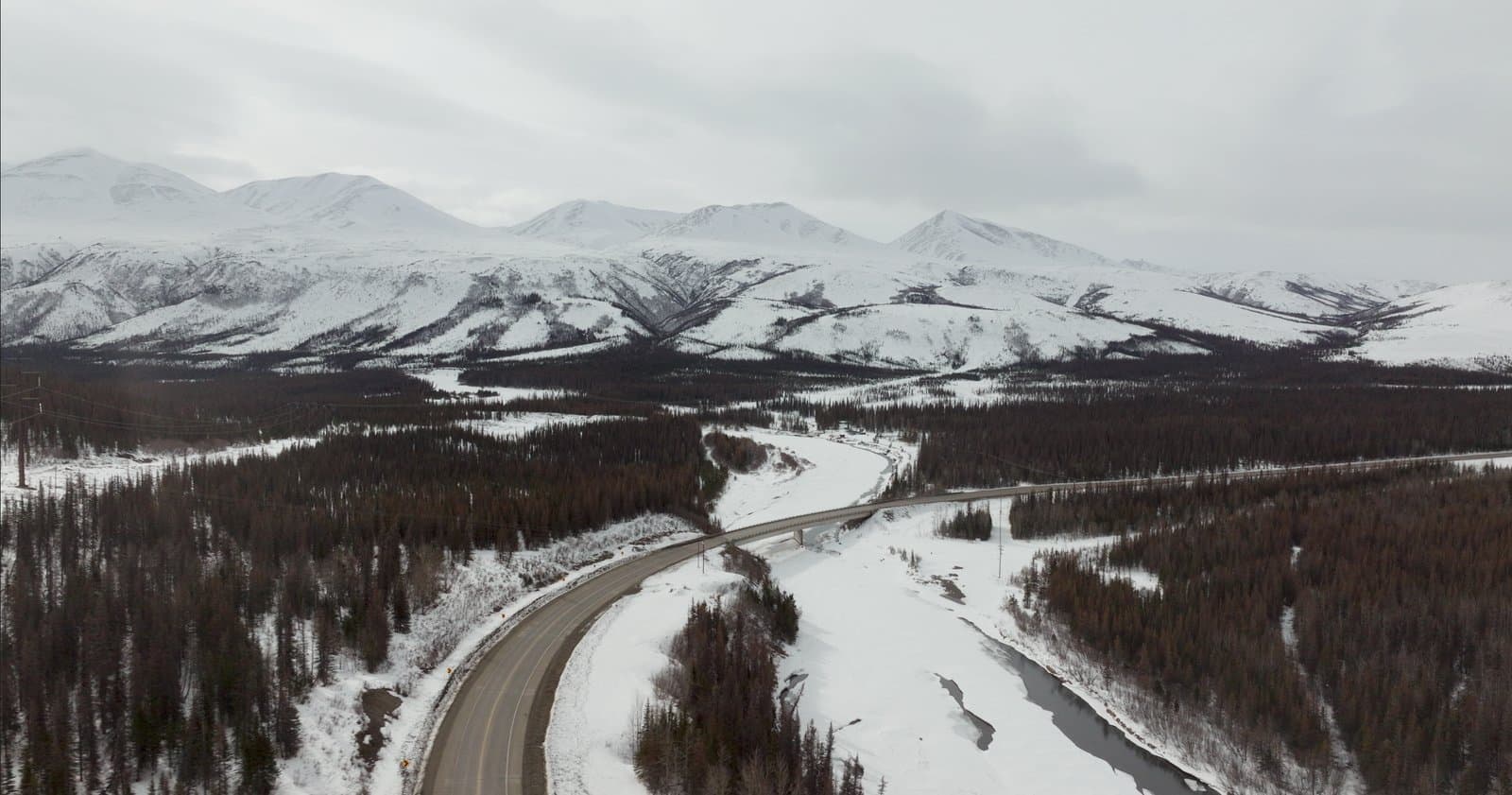
The Dalton Highway in the southern Brooks Range. The proposed Ambler road would branch west from the Dalton at milepost 161. Photo by Cale Green
Conservation groups appeal state's Ambler road easement in Anchorage Superior Court
Seven conservation groups asked Anchorage Superior Court on Wednesday to overturn the Alaska Department of Natural Resources' approval of an easement across state land for the Ambler road, according to their notice of appeal, which their lawyers at Trustees for Alaska released Thursday. The case is an administrative agency appeal, in which the court reviews the department's final decision and administrative record.
The appeal names Natural Resources Commissioner John Crowther in his official capacity, the department and the Alaska Industrial Development and Export Authority. The appellants are the Northern Alaska Environmental Center, Alaska Community Action on Toxics, Alaska Wilderness League, Center for Biological Diversity, National Parks Conservation Association, Sierra Club and Winter Wildlands Alliance.
The easement is the state-land piece of a road AIDEA calls the Ambler Access Project. DNR's April 2, 2025 decision approved a construction corridor about 125 miles long and 450 feet wide, about 6,818 acres of state land, from milepost 161 of the Dalton Highway toward the Ambler Mining District. Once construction is complete, the final recorded private exclusive easement would be 250 feet wide. The decision describes the road's purpose as access to state mineral resources and, potentially, mine development and the transport of ore. DNR took public comment on the easement for 60 days in early 2022 and held two listening sessions.
The road as proposed runs 211 miles. The 2020 federal environmental impact statement put 26 of them inside Gates of the Arctic National Preserve and 25 on Bureau of Land Management land, with the rest on state, borough and Native corporation land. That review led to federal approval of the road, and a 2024 supplemental review led the Interior Department to deny it. President Trump decided AIDEA's appeal under the Alaska National Interest Lands Conservation Act on Oct. 6, 2025, supplanting that denial, and the BLM and the National Park Service issued right-of-way permits to AIDEA on Oct. 23, 2025, according to DNR's decision.
Some of the federal land along the route has since changed hands. In May, after revoking a 1970s withdrawal along the Dalton Highway, Interior conveyed about 1.4 million acres of the highway corridor to the state, a corridor the department said includes proposed routes for the Ambler road. DNR's September decision says the revocation does not change its conclusions.
Trustees for Alaska and 13 organizations, including the seven appellants, asked DNR to reconsider the easement shortly after it was granted. DNR denied the request Nov. 12, 2025. Two days later the Alaska Supreme Court decided Orutsararmiut Native Council v. Boyle, the Donlin Gold case, and DNR withdrew its denial to take briefing on what the ruling meant. On Sept. 2 the department granted reconsideration in part, modified its April decision to recognize its obligations under the Alaska Constitution to address cumulative impacts and affirmed the easement. That decision replaced the November denial, and together with the amended April approval it is the final agency action under appeal.
Both sides cite the Donlin ruling, which drew its line by whose resources are being developed. When the state's own resources are developed, the court said, Article VIII of the Alaska Constitution requires the state to consider the cumulative impacts of the whole project, and that duty applies whether approvals are phased over time or split across different permits. But the Donlin mine would extract privately owned minerals on private land, so the unanimous court held that DNR did not have to weigh the mine's cumulative impacts when it granted state water permits and a pipeline right-of-way across state land to serve it. The required analysis, the court wrote, "is focused on the costs and benefits of developing state resources." It illustrated the point with a hypothetical private mine less than five miles from existing highways, reached by a road across state land with relatively limited impacts. In that example, the state's public-interest review would cover the road, and the mine would be governed by other laws, such as mine reclamation and pollution rules. The court also noted that REDOIL, its earlier cumulative-impacts decision, had not resolved how the project under review must be defined.
The two sides disagree on that question. DNR says the project is the easement on state land, with later stages reviewed as they are proposed, which it says is the kind of phased review the Supreme Court allowed in REDOIL. The constitution, its September decision says, "does not require DNR to speculate about possible future impacts." The conservation groups say the project is the whole road, together with the gravel mines, other infrastructure and the hardrock mines it would serve, and that reviewing the easement alone splits the project into parts. "Any decision must fully look at the entire project and all the impacts," Krystal Lapp, interim executive director of the Northern Alaska Environmental Center, one of the appellants, said in a statement.
The appeal makes four claims:
DNR did not make a best interest finding or an equivalent public-interest analysis before granting the easement, and if the easement statute, AS 38.05.850, limits the department to considering economic benefits, the statute is unconstitutional as applied.
DNR did not consider the cumulative impacts of the whole project.
DNR did not give the prior public notice and safeguards Article VIII requires, including an impacts assessment released in time for meaningful comment.
DNR did not take a hard look or adopt adequate measures to protect public trust resources.
DNR's September decision answers that easements under AS 38.05.850 are exempt from the statutory requirement for a written best interest finding and that it met its separate duties under Article VIII. The statute's economic preference, it says, applies to competing easement applications and does not displace that constitutional analysis. The department also says it is not obliged to wait for federal agencies or private landowners to decide about adjoining land.
The decision says AIDEA could use the corridor only after securing every other approval, and that DNR would still have to approve several plans, each with public notice and comment, before construction and before the road opens. DNR says it will evaluate additional impacts through those later approvals, including decisions on gravel sites.
Source: records.courts.alaska.gov, Seven conservation groups take the Natural Resources commissioner and AIDEA to superior court; the decision they are appealing is not yet in the public record.
AI-assisted. Reviewed by Cale Green. How we use AI
Stay informed. Support what matters.
Free, permanent access to local news you can verify. Subscribe to support Walter AlaskaNews and go ad-free.
Related Coverage
Dalton corridor suit is not over: groups appeal, and 700,000 acres remain in dispute
Alaska News · 1mo ago
AIDEA will discuss the Ambler road in Kotzebue, with the public out
Alaska News · 2w ago
Ninth Circuit lets King Cove road work continue while appeal runs into November
Alaska News · 1w ago
Judge asked to rule by Aug. 31 on whether King Cove road work can begin
Alaska News · 1mo ago
Ambler advances, but the U.S. stake in its developer hasn't closed
Alaska News · 1mo ago
Comments
Sign in to leave a comment.
No comments yet. Be the first to share your thoughts.