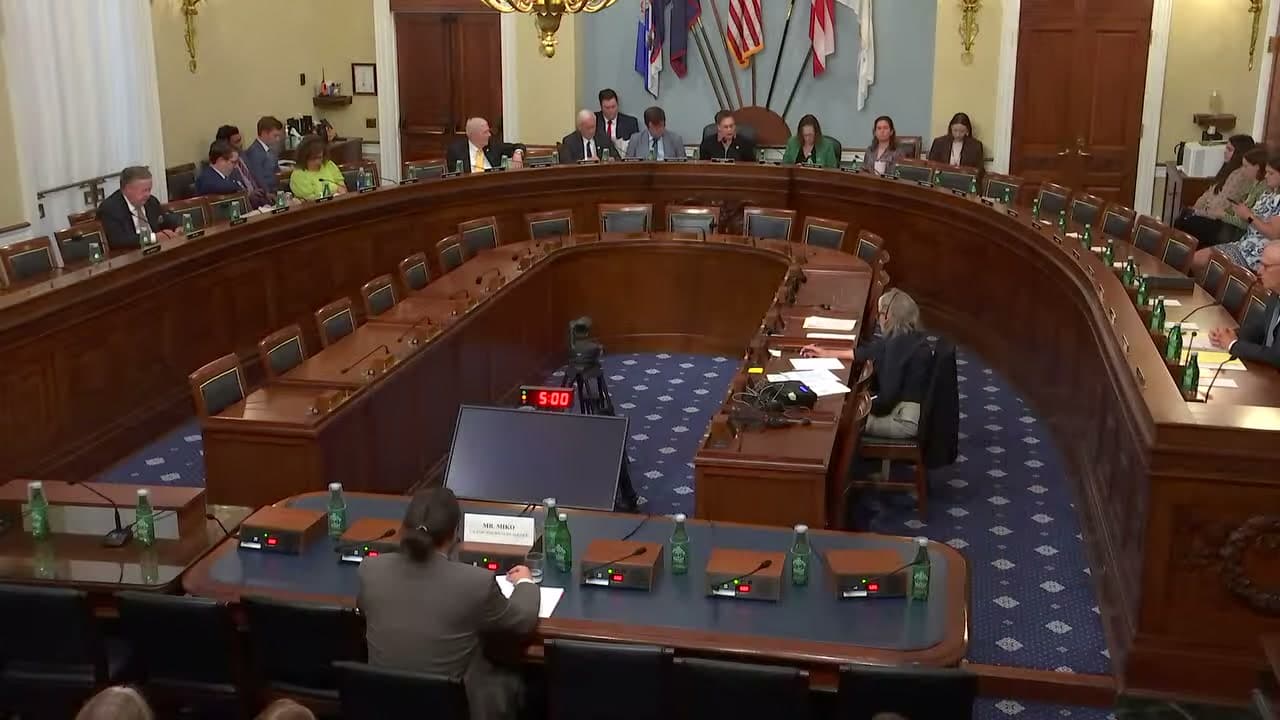
Frame from "House Natural Resources Subcommittee on Water, Wildlife and Fisheries: Legislative Hearing" · Source
Congress weighs $500 million in tribal water money Alaska can't reach
Congress is considering a water-rights settlement that would send a base $500 million in federal money to one California tribe. It is a mechanism that most Alaska tribes, in a state where thousands of rural homes still lack running water, are poorly positioned to use.
A House subcommittee heard testimony Wednesday on the Agua Caliente Band of Cahuilla Indians settlement, which would recognize a federal tribal groundwater right of up to 20,000 acre-feet a year and establish a $500 million trust fund, most of it for water development and infrastructure. The same hearing took up amendments to existing settlements for four pueblos in New Mexico and the Pechanga Band in California. The panel took no vote, and no Alaska tribe was on the agenda.
That absence reflects a deeper legal difference. These settlements typically resolve federally reserved or treaty-based water claims, and the classic reserved right grows out of land the federal government set aside as a reservation. Alaska's history never built that footing. When Congress settled Alaska Native land claims in 1971, it did so through corporations rather than tribes, extinguished aboriginal claims including claims to water, and revoked the state's Native reservations except the Annette Island Reserve at Metlakatla. Alaska's villages were not even formally recognized as tribes by the federal government until 1993, and in 1998 the Supreme Court held that corporation land is not Indian country. The result is more than 200 recognized tribes and almost no reservation land. The Native American Rights Fund has described reservation-based water claims for most Alaska tribes as likely unavailable.
The contrast is stark in a state where the water problem is not a legal abstraction. More than 3,300 rural Alaska homes, concentrated in 32 unserved communities, still lack running water and flush toilets, according to the state Department of Environmental Conservation.
Those communities do get federal water help, through sanitation and infrastructure programs run by the Indian Health Service, the EPA, USDA and the state's Village Safe Water program. What they generally cannot use is the settlement mechanism itself, the one that converts a recognized federal water right into a congressionally funded package that lasts for decades.
The settlement before the subcommittee shows what that mechanism can deliver. Agua Caliente Chairman Jeff Grubbe said it would direct $300 million to tribal water-development projects, another $100 million to groundwater augmentation, and $100 million split between water management and long-term operations and maintenance. The $500 million is a base figure subject to cost adjustments. Grubbe said settling would avoid a basin-wide court adjudication that could otherwise take decades. Rep. Ken Calvert noted the bill relies on mandatory spending, and the Interior Department raised concerns in writing about the size of the federal contribution.
The other two measures would modify settlements already on the books. The pueblos' bill would extend completion deadlines without changing rights or adding federal cost, according to testimony. The Pechanga measure would make technical changes to its settlement and, tribal representatives said, needs no new appropriation.
Alaska has no settlement to adjust.
This article is based on a public meeting of House Natural Resources Subcommittee on Water, Wildlife and Fisheries — House Natural Resources Subcommittee on Water, Wildlife and Fisheries: Legislative Hearing ().
Drafted with AI. Edited by Cale Green (1 revision). Reviewed by Cale Green. Who is accountable. Transcript byLucas Brown
Watch key moments from the source meeting. Click to expand.
Stay informed. Support what matters.
Free, permanent access to local news you can verify. Subscribe to support Maggie AlaskaNews and go ad-free.
Related Coverage
The water rights Alaska Natives can't claim
Alaska News · 1mo ago
Alaska water systems face July deadlines to claim PFAS settlement funds or lose right to sue
Alaska News · 4mo ago
Senate committee advances bill to give land to five landless SE Alaska Native communities
Alaska News · 2mo ago
House panel hears bill to move tribal regulatory authority to Interior
Alaska News · 3mo ago
A new federal water-testing rule could check rural Alaska for 'forever chemicals' — if it reaches us
Alaska News · 2mo ago
Comments
Sign in to leave a comment.
No comments yet. Be the first to share your thoughts.