AI image
A new federal water-testing rule could check rural Alaska for 'forever chemicals' — if it reaches us
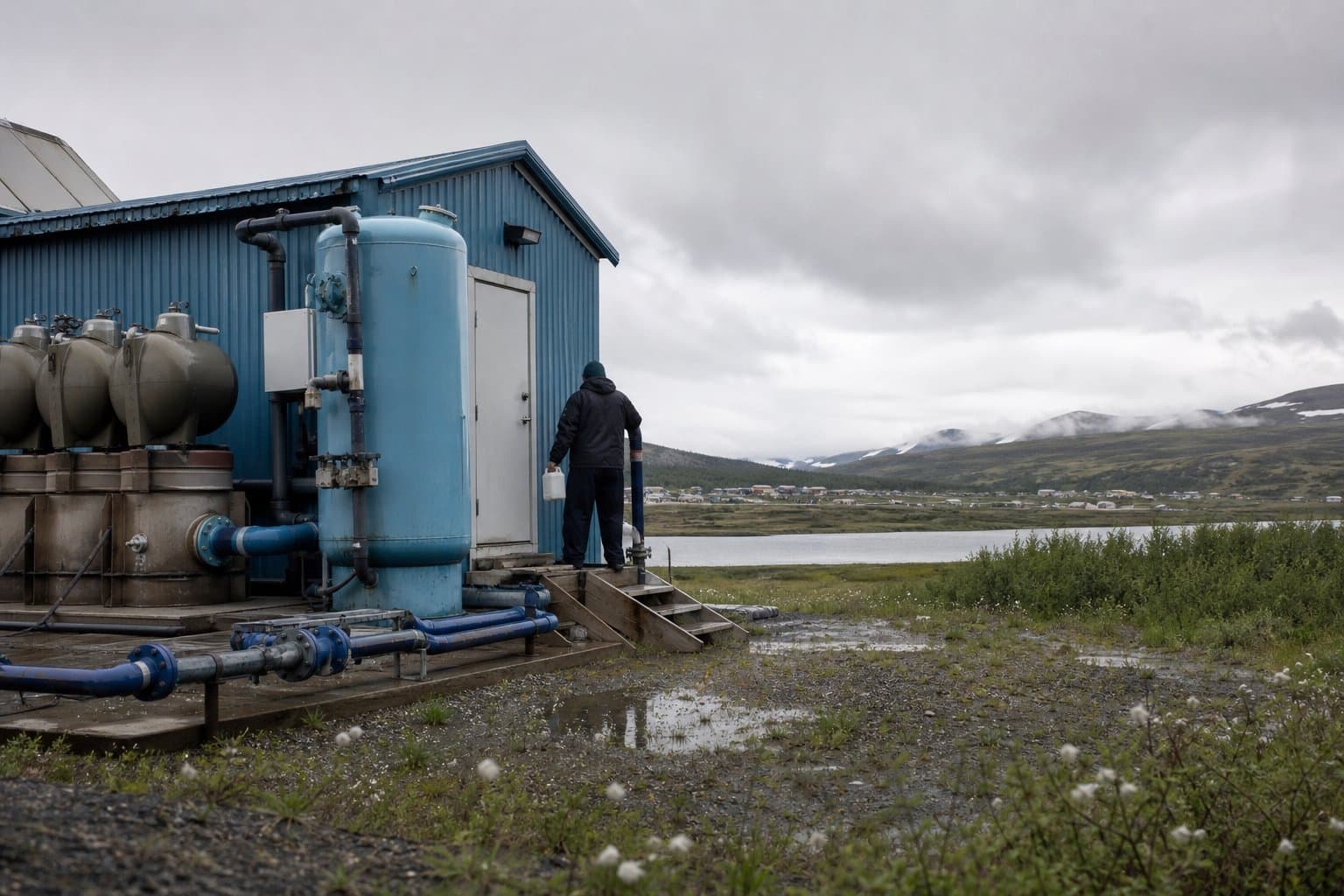
A drinking-water rule the U.S. Environmental Protection Agency proposed this week is written for the whole country, but it lands differently here — where the water it would test is drawn by hundreds of small village and borough systems, and where the contaminants it's hunting for are ones Alaska is already chasing. For Alaskans, the rule is a chance and a burden at once.
The proposal is the sixth round of the Unregulated Contaminant Monitoring Rule, the testing cycle the Safe Drinking Water Act requires every five years. Between 2028 and 2030 it would have public water systems check for 30 contaminants that aren't yet federally regulated — among them several PFAS, the "forever chemicals" that don't break down and are linked to serious health effects. Every system serving more than 3,300 people has to take part. But most of Alaska's systems are far smaller than that, so the state's participation rides largely on a separate national sample of just 800 small systems — and even that is contingent on Congress funding it and on labs having the capacity to run the tests.
This is not an abstract exercise in Alaska. The state is already managing PFAS contamination in drinking water in communities from Fairbanks and North Pole to Gustavus, Dillingham, King Salmon and Yakutat, nearly all of it traced to the firefighting foam long used at airports and military sites; in several places the state has had to supply residents clean water while it maps the plumes. Plenty of smaller systems have never been thoroughly tested for these compounds at all. For them, the logic of a rule like this is blunt: you can't fix what you've never measured.
The trouble is what testing costs out here. EPA would cover the lab fees for systems serving 10,000 or fewer people — nearly all of Alaska's — but not the rest of it. In much of the state, collecting a sample on the required schedule and getting it to a certified lab means a flight or a long drive to a drop point, on a clock, in a climate where winter can freeze the standard equipment; the operator's time is unpaid. And even a clean set of results comes with a caveat: this rule only gathers data, it doesn't regulate. The first federal limits on PFAS in drinking water, set in 2024, are now under federal reconsideration, and Alaska has no enforceable limit of its own — it recommends action at 70 parts per trillion, and the Legislature has weighed, but not passed, stricter standards.
A test can tell a community what's in its water. Whether anyone must act on it is, for now, a separate question.
Source: U.S. Environmental Protection Agency, U.S. Environmental Protection Agency: Revisions To Establish the Sixth Unregulated Contaminant Monitoring Rule (UCMR 6) for Public Water Systems.
AI-assisted. How we use AI
Stay informed. Support what matters.
Free, permanent access to local news you can verify. Subscribe to support Alaska News and go ad-free.
Related Coverage
Alaska water systems face July deadlines to claim PFAS settlement funds or lose right to sue
Alaska News · 4mo ago
PFAS found in three Anchorage Bowl wells, one pulled from service
Alaska News · 1mo ago
A remote Kodiak village tries tp fix its water
Alaska News · 3mo ago
A new Mat-Su road would cross the ground its drinking water comes from
Alaska News · 3mo ago
Ninety-two Alaska water systems are listed as serious violators
Alaska News · 3w ago
Comments
Sign in to leave a comment.
No comments yet. Be the first to share your thoughts.