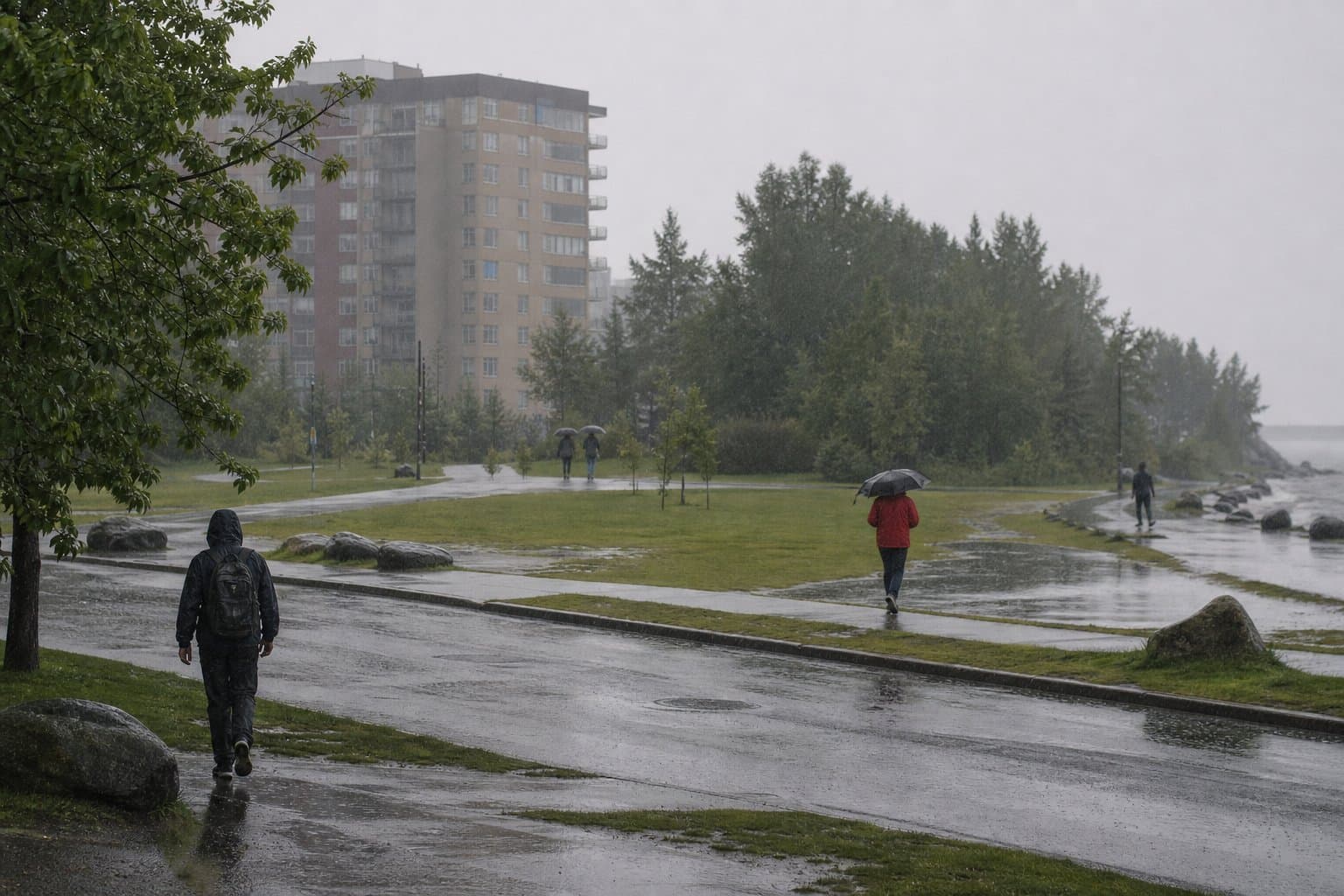
Anchorage ties its record for wettest July
Anchorage Airport recorded 4.49 inches of rain last month, tying the 2001 mark for the wettest July since observations at the station began in 1952, and Talkeetna measured 10.59 inches, its highest July total since 1922. Much of Southcentral took in two to three times normal rainfall, according to the monthly Alaska climate summary published by Alaska climate specialist Rick Thoman.
"At Anchorage Airport, 4.49 inches (114mm) tied with 2001 for highest July precipitation on record (observations since 1952)," Thoman wrote in the summary. "Talkeetna's 10.59 inches (269mm) was the highest July precipitation since the cold and rainy July of 1922."
The rain fell in a month that was cool almost everywhere in the state. Temperatures ran below normal nearly statewide, with Anchorage recording its coolest July since 2008, Fairbanks its coolest since 2001 and McGrath its coolest since 1981.
What distinguished the month was persistence rather than any single storm. Anchorage logged measurable rain, defined as 0.01 inches or more, on 12 consecutive days, the longest such summer streak since 1981. Talkeetna reported more than 0.10 inches on 12 straight days, the second-longest streak in its record. The wettest stretch fell in mid-July, following a dry June.
Two storms between July 20 and 23 capped the rain in the lower Susitna Valley and produced localized flooding. The Amber Lake cooperative station southwest of Talkeetna reported a two-day total of 3.43 inches, and Talkeetna Airport measured 2.91 inches in the 24 hours ending at 10 a.m. AKDT July 23. The US Geological Survey gauge on the Talkeetna River above town crested just above flood stage, the highest crest since September 2012. The rain also triggered a landslide north of Talkeetna that forced cancellation of Alaska Railroad service between Denali National Park and Talkeetna until crews cleared the debris.
Alaska News has covered the same pattern as it unfolded, including an earlier article on the cool, wet trough that parked over the state in July and a later article on the flood watch that the National Weather Service in Anchorage extended across Anchorage, Eagle River and both sides of the Kenai Peninsula as an atmospheric river moved in. An earlier Alaska News article on the state's cold first half of 2026 noted that every month from December 2025 through June 2026 ran below the 1991-2020 baseline statewide.
Recent data suggest the month belongs to a cluster of unusually wet Julys, though the available sources do not settle its cause. The Alaska weather and climate blog ak-wx.blogspot.com argues that four of the eight Anchorage Julys with more than four inches of rain have occurred since 2022, against a long-term median of roughly 1.7 inches. Anchorage meteorologist Aaron Morrison, writing on Facebook, counted 23 days with measurable rain and a fifth consecutive July above normal precipitation. The wet pattern was not statewide: Southeast Alaska ran below normal under the same setup, and neither the summary nor the blog attributes the month to any specific driver.
AI-assisted, reviewed by editors. Spot an error?
Related Coverage
Landslide north of Talkeetna cut Alaska Railroad service to Denali in July
Alaska News · 1h ago · 84% match
Anchorage trades summer warmth for a cool, wet stretch
Alaska News · 3w ago · 82% match
Heavy rain now expected in the Mat-Su, with rivers set to crest Wednesday
Alaska News · 4d ago · 79% match
Seven straight months below normal: what drove Alaska's chilly first half of 2026
Alaska News · 2w ago · 78% match
Rain forecast for Yentna and Skwentna gravel bars through Monday night
Alaska News · 2w ago · 77% match
Comments
Sign in to leave a comment.
No comments yet. Be the first to share your thoughts.