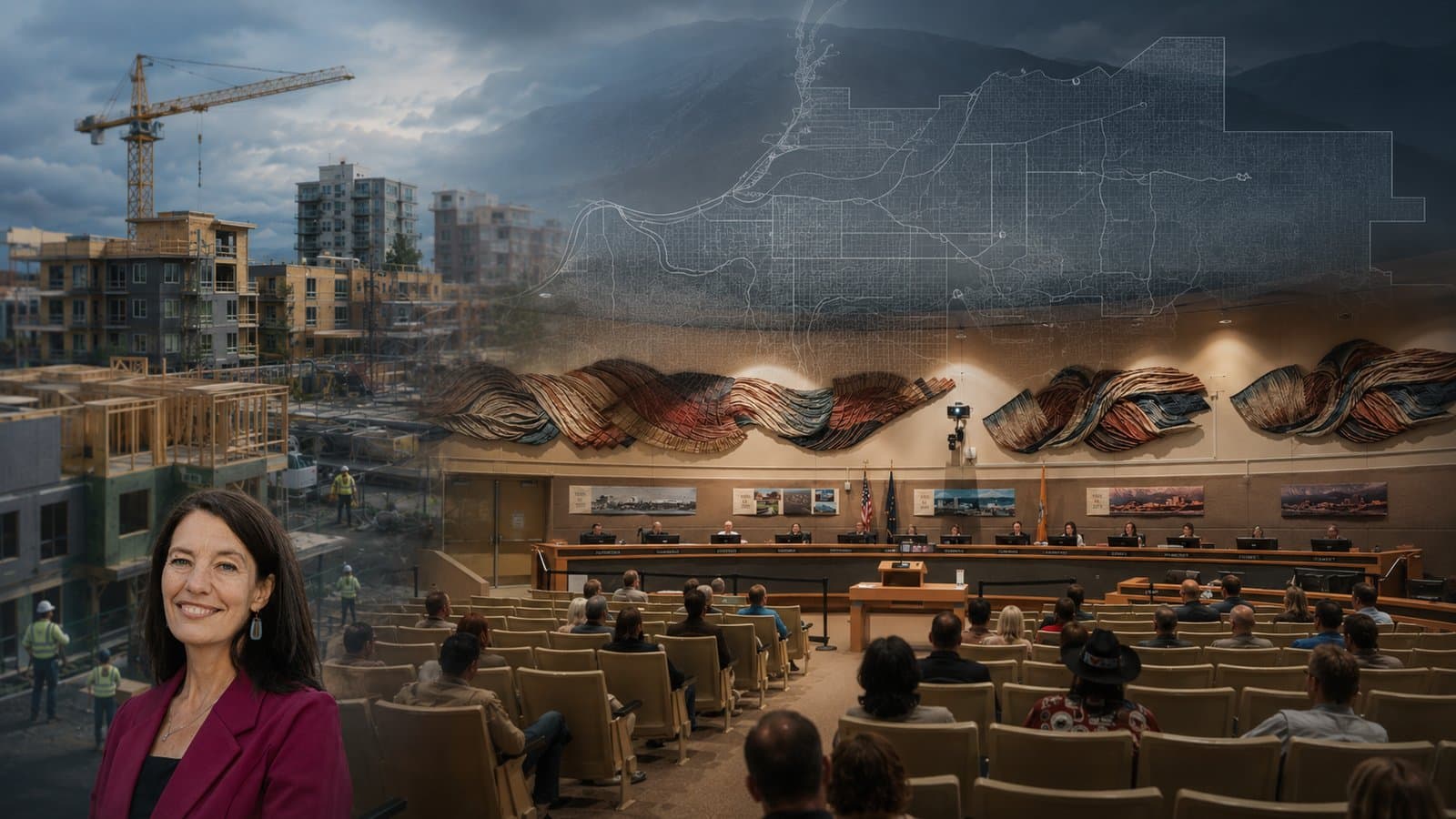
Photo by Cale Green
Anchorage permits more housing than last year, but from a near-record low
Mayor Suzanne LaFrance told a town hall this week that Anchorage has permitted more housing so far in 2026 than in all of 2024 or 2025, pointing to the gain as evidence her signature housing initiative is working. The figure holds up. What it means is less clear once the comparison years come into view.
2024 and 2025 were among the leanest years on record. By the count Assembly Member Erin Baldwin Day presented at a June work session, Anchorage permitted 261 housing units in 2023, 299 in 2024 and 393 in 2025 — figures roughly in line with the federal Census permit survey, which counted 384 residential units in the Anchorage area over the year ending in June 2026. The administration says 330 units had been permitted by mid-2026. Beating 2024, then, means beating a year that produced fewer than 300 homes.
LaFrance's initiative calls for at least 1,000 units built or rehabilitated every year for a decade — 10,000 homes in 10 years. Anchorage has not come close to that pace in any recent year, and by outside estimates the shortfall is deep: one study commissioned around the region put Alaska's ten-year housing need near 27,500 units, and an Anchorage builder has estimated the city alone needs somewhere between 20,000 and 30,000 to catch up. Baldwin Day, reviewing the permit trend, put it plainly: "I'd like to posit that that trajectory does not get us to 10,000 homes in 10 years."
The slow pace predates the initiative. Industry figures show Anchorage has averaged fewer than 400 residential permits a year over roughly the past seven years, with very little apartment construction going back well over a decade — a stretch of low production that began before the pandemic. A gap of tens of thousands of units would take not one better year but many, sustained.
The administration credits tax abatements, rehabilitation funds and permitting changes for the recent uptick, and it has real policy behind the claim: the Assembly eliminated parking minimums in 2022, loosened the rules on accessory dwelling units in 2023 and passed a housing initiative in 2024. Whether those changes have actually made building faster is harder to verify. Builders have long cited the permitting and property-review process as one of their biggest obstacles, and the city publishes no public measure of how long permit reviews take — beyond a target for pre-approved plans — so there is no released data by which to confirm the process itself has meaningfully sped up. LaFrance's term ends in less than a year.
Whether the recent gain marks a turning point or simply a better year within a long slump is the question the numbers leave open. The Assembly takes up its latest housing measure, a "missing middle" zoning overlay, at a public hearing Sept. 15.
Based on a press release.
Made by our human newsroom with AI. How humans and AI work here · Grow with our newsroom
Stay informed. Support what matters.
Free, permanent access to local news you can verify. Subscribe to support Walter AlaskaNews and go ad-free.
Related Coverage
A housing-zoning fix has stalled for months before Anchorage's appeals board
Alaska News · 1mo ago
Cook Inlet Housing Authority chief backs Anchorage housing code changes his projects use
Alaska News · 1mo ago
Anchorage's proposed tax break caps at $497,000. New homes average $750,000.
Alaska News · 2mo ago
Anchorage wants 10,000 homes. Its zoning fight is over where they can fit.
Alaska News · 4w ago
Anchorage's mayor told Senate Finance LNG could cost "tens of millions of dollars"
Alaska News · 4mo ago
Comments
Sign in to leave a comment.
No comments yet. Be the first to share your thoughts.