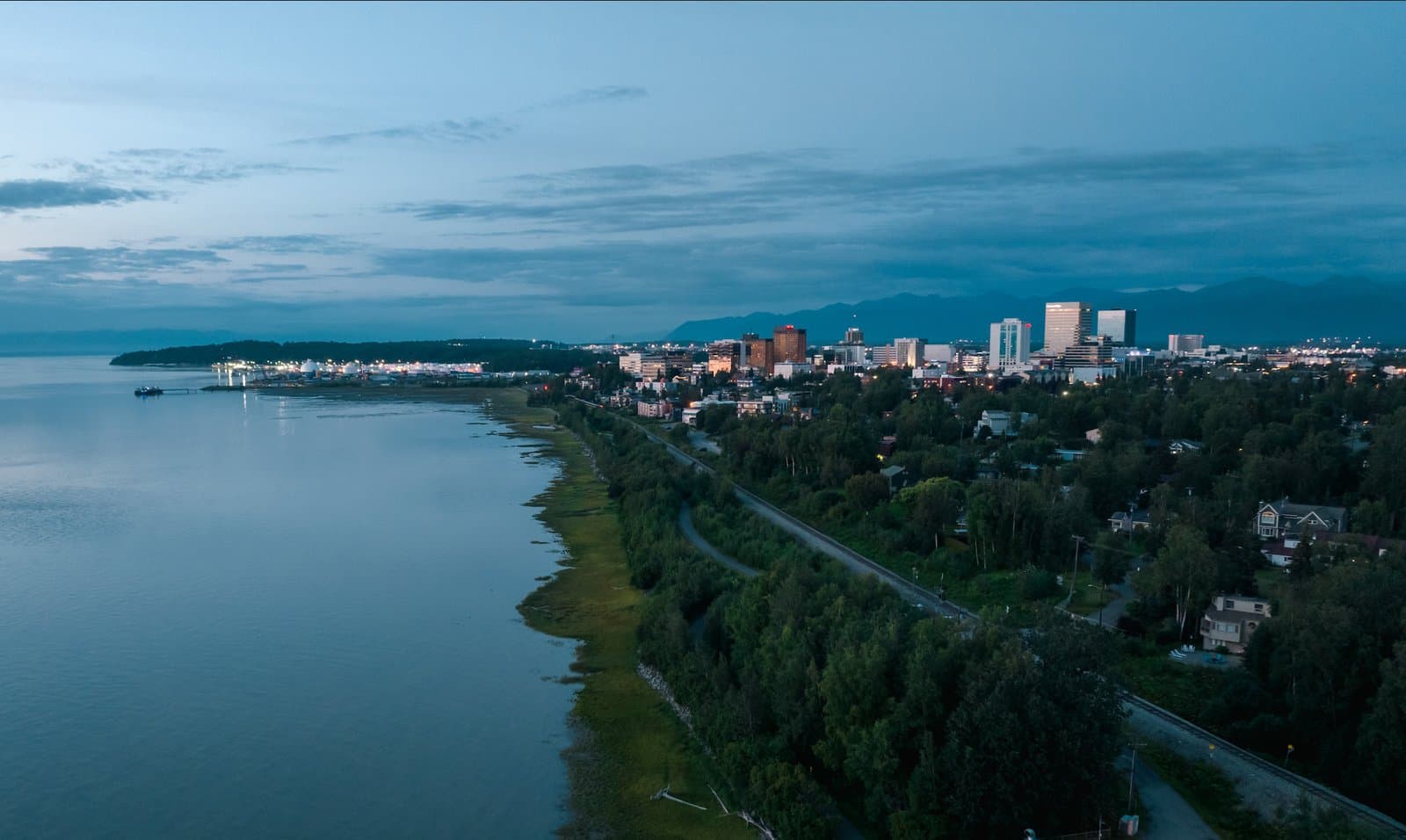
Photo of an Anchorage Summer along the Coastal Trail by Cale Green
Anchorage's mayor told Senate Finance LNG could cost "tens of millions of dollars"
Four Alaska borough mayors told the Senate Finance Committee on June 10 that Alaska LNG construction will hit local services before tax revenue arrives. They asked lawmakers to add mitigation funding to SB 2001 — the bill that would give the project a tax break to help finance it.
Anchorage Mayor Suzanne LaFrance told the committee that "new service costs would exceed revenues by tens of millions of dollars" over the nine-year construction period. She cited a report by Halcyon Consulting and economist Jonathan King, commissioned by the Anchorage Community Development Authority.
That report tells a more specific story than LaFrance's testimony did. King's analysis puts the construction-period cost to Anchorage somewhere between $23 million — if new housing keeps pace with the worker influx — and $173 million if it doesn't. The $173 million figure has been widely cited in public discussion of the report.
The gap between the two figures is housing. If workers move to Anchorage and new homes get built, those homes pay property taxes that cover most of the city's added service costs. If workers come but housing doesn't, Anchorage absorbs the costs without a growing tax base.
LaFrance's administration had previously published a plan for exactly that. In April 2025, she launched "10,000 Homes in Ten Years" — a signature initiative targeting 1,000 new homes a year, with regulatory reform, faster permitting, financial incentives, and tougher blight rules. The Assembly passed the HOME Initiative in 2024 to ease residential zoning, and updated commercial rules took effect in January 2025.
The initiative is moving in the right direction but is running well below its target pace. Permits are up year over year, with about 500 projected in 2026 — meaningful growth, but roughly half the 1,000-a-year mark the plan needs to hit. Whether housing supply accelerates fast enough to absorb the LNG worker influx is the open question for which cost scenario plays out.
LaFrance did not mention her housing plan, or how it factored into that potential revenue shortfall, in her Senate Finance testimony.
The other three mayors had their own asks. Fairbanks Mayor Grier Hopkins wants a Fairbanks gas spur line with the cost spread across all Railbelt gas users, including Anchorage. Mat-Su Mayor Edna DeVries wants LNG tax revenue to stay in pipeline-route boroughs. Denali Mayor Chris Knoll wants tax payments to go directly to municipalities without state appropriation.
SB 2001 itself is a tax break designed to make the project financeable. Glenfarne, the developer, says it needs the lower rate to compete with global LNG projects. Every mayoral ask would either eat into that competitiveness, shift cost onto Railbelt gas customers, or require the state to chip in more.
This article is based on a public meeting of Alaska State Legislature — Alaska Legislature: Senate Finance - June 10, 2026 9:00am ().
Made by our human newsroom with AI. How humans and AI work here · Grow with our newsroom Transcript byLucas Brown
Watch key moments from the source meeting. Click to expand.
Stay informed. Support what matters.
Free, permanent access to local news you can verify. Subscribe to support Walter AlaskaNews and go ad-free.
Related Coverage
Anchorage permits more housing than last year, but from a near-record low
Alaska News · 1mo ago
Two Anchorage housing votes on June 23: a tax break and new fees on the same new homes
Alaska News · 4mo ago
Anchorage's proposed tax break caps at $497,000. New homes average $750,000.
Alaska News · 3mo ago
Senate Finance hears $18 billion revenue trade-off for Alaska LNG tax break
Alaska News · 4mo ago
Micciche sets break-even floor on Kenai Peninsula tax break for Alaska LNG
Alaska News · 4mo ago
Comments
Sign in to leave a comment.
No comments yet. Be the first to share your thoughts.