Anchorage budget crisis mirrors national school funding squeeze
The Anchorage School District faces a $90 million structural deficit for fiscal year 2027, with projected shortfalls of $42 million and $30 million in the years after. Superintendent Jharrett Bryantt told the board February 17 that the district operates with purchasing power equal to $1,400 less per student when adjusted for inflation since 2011. The crisis forces consideration of school closures, regional nursing models, and specialist reductions. These decisions place Anchorage alongside districts statewide grappling with similar pressures.
Alaska's base student allocation has stayed flat for a decade while operational costs have climbed. Bryantt noted that last year's BSA increase, though historic, merely matched one-time funding from the previous year. The district has not seen structural revenue changes to match inflation. This pattern mirrors statewide trends where education funding has failed to keep pace with rising costs for healthcare, transportation, and specialized services.
The proposed solutions reflect cost-cutting strategies employed by districts from Juneau to Fairbanks. The district wants to close Fire Lake, Lake Otis, and Campbell STEM elementary schools. It plans to implement a regional nursing model and consolidate elementary specialists from five areas to three. Board testimony revealed that both Juneau and Fairbanks adopted regional nursing models during their own budget crises. The specialist consolidation would cut 25.4 full-time positions. The nursing shift would affect staffing ratios across more than 90 schools. The district estimates each school closure saves roughly $900,000 annually.
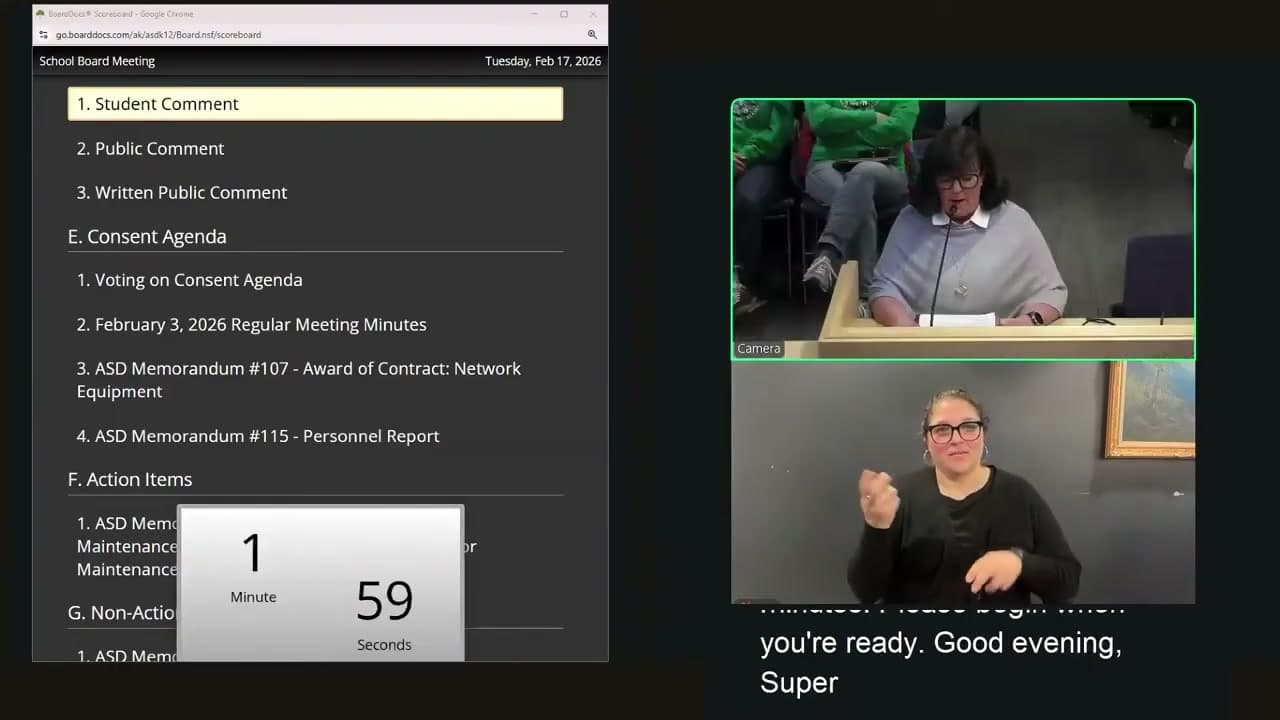
The three schools targeted for closure carry recent history. Fire Lake and Lake Otis had been spared in a November 2025 board vote. They returned to the closure list when the administration proposed shuttering them on February 13, 2026. At the February 17 public testimony, parent Cara Freeborn challenged the board directly. "How am I supposed to trust you?" she asked. "As an employee and a mom of the kids at Fire Lake, how could you possibly do this twice in one year, three times in two years, all to kick us out of our neighborhood school full of neighborhood children, low-income families, and three special needs classes to put a charter school in. How could we not think that you're not prioritizing charter school children?"
Kate Hammer raised concerns about the French immersion program. She noted that more than 50 percent of immersion elementary students are zoned for O'Malley neighborhood and have bus access. "Many of our families rely on busing, and it's likely if we lose bus access, some parents will be forced to pull their children out of the French program," Hammer said.
Student voices also emerged in testimony. One speaker observed, "I've also noticed that across the district I've seen many different student-led petitions for keeping swim and tennis sports as well as keeping individual nurses at schools." The petitions reflected concerns about both athletics and the shift away from dedicated school nurses.
Anchorage's situation differs from some peer districts in one critical way: the funding formula itself. Bryantt pointed out that the Matanuska-Susitna Borough School District receives approximately $1,000 more per non-intensive student than Anchorage. That amounts to a 10 percent premium based on regional cost differentials established decades ago. He questioned whether those findings remain relevant today and suggested the disparity warrants legislative review.
The district's enrollment decline compounds the funding challenge. Enrollment has dropped while fixed costs for facilities, utilities, and maintenance have not. Deputy Chief of Operations explained that the district operates more facilities than enrollment and funding levels can sustainably support. This creates pressure on class sizes, staffing flexibility, and program offerings across buildings. The proposed school closures would generate $2.6 million in savings for fiscal years 2027 and 2028. That figure drops to approximately $150,000 by year five as the state's hold-harmless provision for school size adjustment phases out.
The timeline for decision-making has drawn criticism. The board directed administration February 9 to identify consolidation options through Resolution 25-26-01(S.1), approved 5-2. The closure proposal emerged February 13. That gave families four days' notice before the February 17 meeting. Board Member Dave Donley raised concerns about whether community councils received adequate notice under municipal code. The compressed schedule reflects the urgency Bryantt described, though it leaves little time for stakeholder input on decisions affecting hundreds of families. The board faced a March 2, 2026 deadline to submit a balanced FY27 budget to the Anchorage Assembly.
On February 24, 2026, the board approved the $867 million FY27 budget in a 5-2 vote. The three school closures passed 4-3. The budget cuts more than 500 staff positions while preserving some sports programs.
The implications extend beyond immediate budget relief. School closures in under-enrolled buildings may improve operational efficiency, but they disrupt established programs and community relationships. The regional nursing model may address staffing shortages and create more equitable workloads, yet it removes the consistent presence nurses provide for both medical emergencies and mental health support. The specialist consolidation may reduce scheduling complexity, but it eliminates dedicated instruction in areas like health education and forces teachers to cover content outside their training.
Anchorage's choices will test whether structural budget changes can be achieved without sacrificing educational quality. It is a question facing districts statewide as the gap between revenue and costs continues to widen.
This article is based on a public meeting — 2/17/2026 ASD School Board Meeting ().
AI-assisted. How we use AI Transcript byLucas Brown
Stay informed. Support what matters.
Free, permanent access to local news you can verify. Subscribe to support Alaska News and go ad-free.
Related Coverage
ASD projects $40M FY28 deficit — two months after voters rejected school bond and tax levy
Alaska News · 3mo ago
Anchorage schools model a $9 million budget gap for fiscal 2028
Alaska News · 1w ago
Anchorage's school board says closures won't fix the budget; residents aren't so sure
Alaska News · 1mo ago
Alaska districts must submit fiscal 2027 plans by May 15. Many don't yet know what the state will give them.
Alaska News · 4mo ago
Anchorage budget trade-off: schools OR general government, not both, may be coming
Alaska News · 3mo ago
Comments
Sign in to leave a comment.
No comments yet. Be the first to share your thoughts.