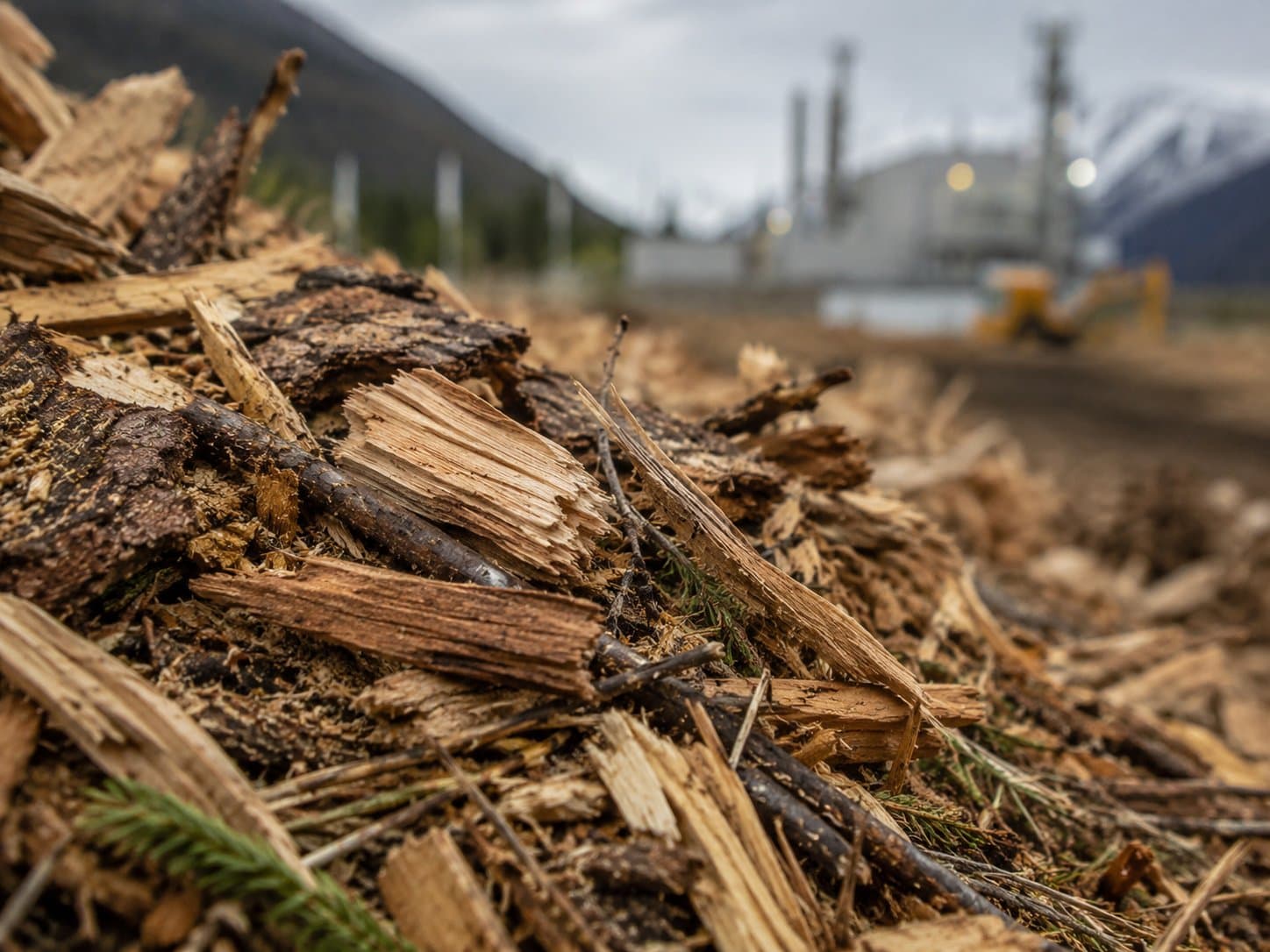
Photo by Cale Green
Alaska Proposes $4.4 Billion Synthetic Aviation Fuel Refinery Using Beetle-Killed Trees
Alaska officials want to build a $4.4 billion refinery that would turn beetle-killed timber and forest waste into 150 million gallons of aviation fuel per year.
The state's pitch: Alaska imports most of its jet fuel despite sitting at the geographic center of global air cargo routes, and woody biomass offers a cheaper feedstock than the cooking oil and animal fats most other synthetic fuel projects use.
The proposal targets Fischer-Tropsch gasification, a decades-old technology that converts wood into synthetic paraffinic kerosene. Most U.S. projects under construction use a different pathway that processes lipids. Deputy Commissioner Katherine Keith said the state evaluated 23 million acres in the Mat-Su Valley and Kenai Peninsula and estimates Fischer-Tropsch production at $4.85 per gallon versus over $7.50 for lipid-based fuel.
Commissioner Ryan Anderson said Alaska produces only 30% to 40% of the aviation fuel it needs. The state handles more than 700 wide-body freighter flights through Anchorage every week and supplies over 900 million gallons of fuel per year to air carriers.
The capital cost estimate includes $3 billion in direct construction costs plus preconstruction and contingency reserves. Keith said the state modeled a 250-megawatt power plant fueled by natural gas and recycled process gases to achieve a carbon intensity score of 20.7 grams CO2 per megajoule. The refinery would also produce renewable diesel and naphtha, she said.
Keith said the feasibility study is available online and the state is seeking feedback from industry and researchers on the assumptions and calculations. Officials want experts to evaluate whether the project can compete with refineries using other pathways already moving toward commercial production, she said.
Michael Darcy, chairman and CEO of DG Fuels, said his company's Fischer-Tropsch process achieves 97% carbon conversion efficiency and a 200-million-gallon facility uses about 1 million dry tons of timber waste. DG Fuels' operating cost is $1.72 per gallon, competitive with oil at $40 per barrel, Darcy said. The company is pursuing two Alaska projects planned side by side.
The Alaska projects would export 443 megawatts of carbon-neutral power during normal operations and 1.4 gigawatts during shutdowns, Darcy said. The facility can produce military fuels including JP-5, which is critical for aircraft carriers because of its high flash point. The Department of Defense has described projects like his as national security priorities, Darcy said.
Atlas Air Vice President of Sustainability Katherine Preston said her company uplifts over 100 million gallons of jet fuel annually at Anchorage and accounts for nearly 30% of cargo traffic through the state. Atlas customers in the EU and Asia are demanding synthetic aviation fuel to meet corporate climate goals, but cost remains the primary barrier to adoption, Preston said. Typical premiums run two to three times conventional jet fuel prices, making lower operating cost projections attractive if they prove achievable at scale, she said.
Tom Hucker, senior advisor for the U.S. Department of Energy's Office of Energy Dominance Finance, said the office has $289 billion in total lending authority and can finance both innovative technologies and ordinary energy infrastructure. The office has moved toward a collaborative loan structure that can close in as little as six months for investment-grade borrowers, Hucker said. The current administration prioritizes projects that make energy more affordable, reliable, and secure, he said.
Keith said the feasibility study walks through the mass and energy balance, utility requirements, and carbon dioxide management needed to achieve certification under ICAO standards, which would allow air carriers to claim carbon credits. The Port MacKenzie site offers space, a deepwater port, rail access, and convergence with other industrial activity, though other candidate locations exist around the state, she said.
The state is accepting peer review comments on the feasibility study through an online portal. Anderson said the report is intended to test assumptions and invite industry feedback on whether the project can attract private investment and federal financing.
This article is based on a public meeting — Strategic Demand for Synthetic Aviation Fuel - Alaska's Opportunity ().
Made by our human newsroom with AI. How humans and AI work here · Grow with our newsroom Transcript byLucas Brown
Stay informed. Support what matters.
Free, permanent access to local news you can verify. Subscribe to support Bill AlaskaNews and go ad-free.
Related Coverage
Alaska eyes $3B carbon revenue from 600,000 burned acres
Alaska News · 4mo ago
Alyeschem breaks ground on North Slope methanol plant
Alaska News · 4mo ago
Alaska gas pipeline tax bill sets $40M milestone test for boroughs, schools, and rural heating fund
Alaska News · 3mo ago
Alaska Sustainable Energy Conference explores future of statewide energy systems
Alaska News · 4mo ago
Senate Finance hears $18 billion revenue trade-off for Alaska LNG tax break
Alaska News · 4mo ago
Comments
Sign in to leave a comment.
No comments yet. Be the first to share your thoughts.