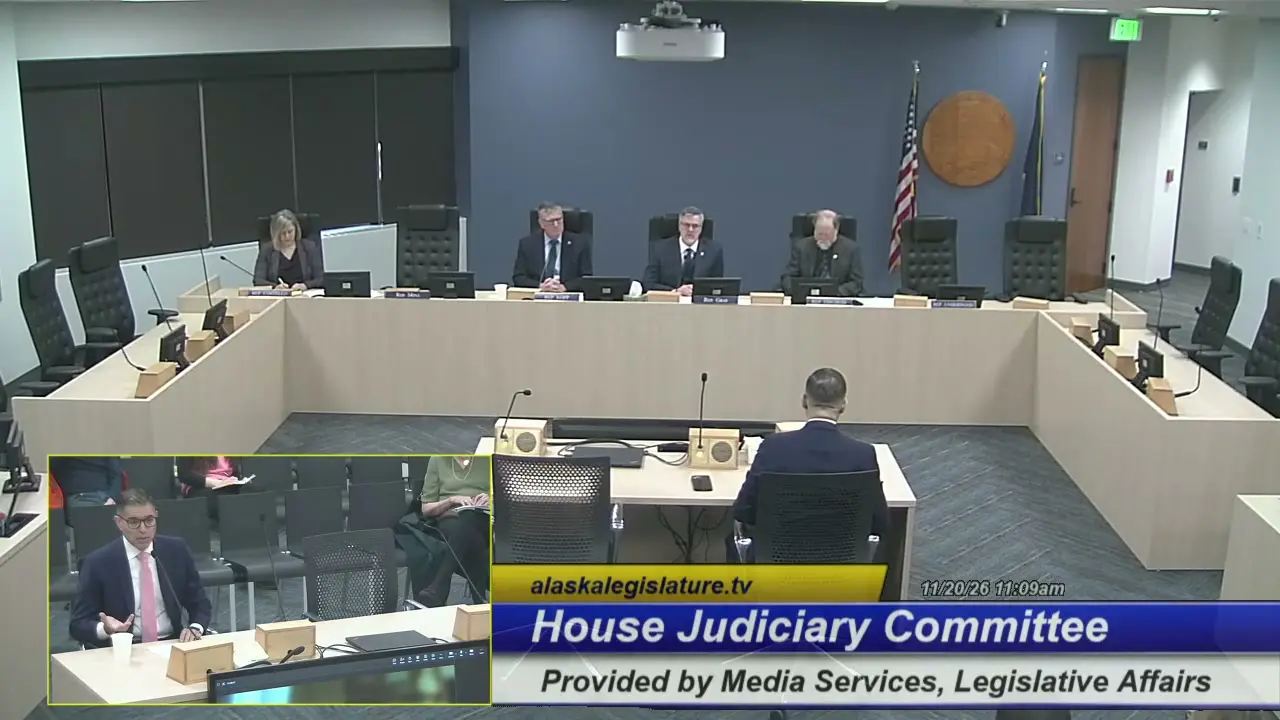
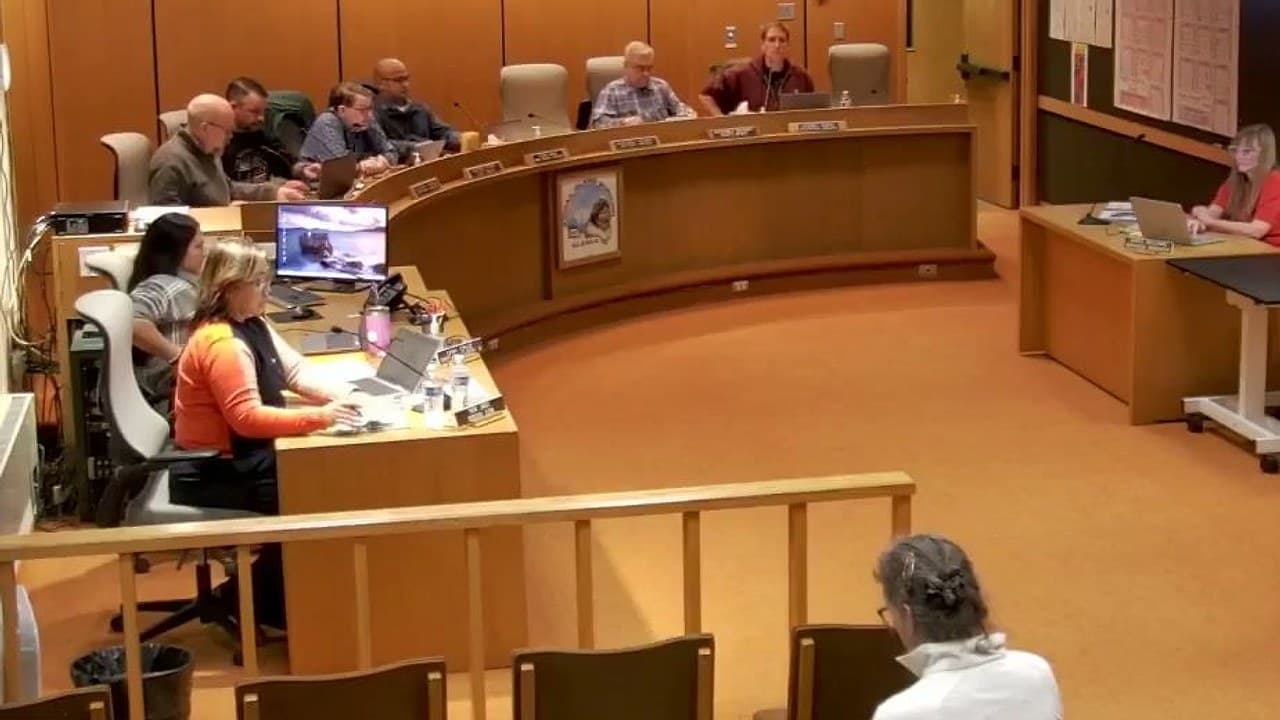
Frame from "Alaska Legislature: House Judiciary - November 20, 2026 10:00am" · Photo source
Alaska lawmakers seek answers on ICE detention as jail holds rise to 130 this year
Alaska's state jails held 130 people for federal immigration authorities this year, up from 99 last year and 13 in 2024.
The numbers, from state corrections records through Oct. 19, came up Friday at an Alaska House Judiciary Committee hearing in Anchorage.
The Department of Corrections, which runs the jails, didn't testify. It agreed to answer the committee's questions in writing.
Rep. Andrew Gray, who chairs the committee, said Corrections Commissioner Jen Winkelman told the committee by email Friday that the state had no ICE detainees in custody that day. Testimony was by invitation only, and no one from U.S. Immigration and Customs Enforcement spoke.
The committee heard from Honorio Latyr Pereira Barreto, a certified nursing assistant from Senegal who has worked in hospice care. He said he spent 117 days in administrative segregation at the Anchorage Correctional Complex after ICE detained him in June.
"I was alone in my cell approximately 23 hours a day," he said.
Under a federal agreement, people arrested by ICE in Alaska are held in state jails until they're released or moved, most often to an ICE center in Tacoma, Washington.
ICE pays the state $243.24 per detainee per day, according to a May federal order. Immigration detention is civil, meaning people are held in connection with their immigration cases, not to serve a criminal sentence.
Gray said the committee "cannot rewrite federal immigration law," but added: "The Anchorage Correctional Complex is ours. The contract is ours."
ICE detained Barreto on June 11 as he left a hearing in Anchorage's Wellness Court. He said that on June 21, after staff refused to bring a supervisor, he knocked on his cell door to get one's attention and received a disciplinary write-up. The next day, he was moved to segregation.
He said he was later found guilty of that infraction. In August, while still in segregation, he served a 10-day punitive sanction that cut off calls and visits with friends and family. "I'm not asking the committee to assume why staff made those decisions," he said. "I'm asking you to examine whether those decisions were appropriate."
He also described about a dozen strip searches after visits with his attorney, in a room where he said passing staff and detainees could see him. For about five days before segregation, he said, he shared a two-bunk cell with two other detainees and slept on the floor beside the toilet.
His attorney, Christine Quint, said no one explained the segregation to her office. Her understanding, she said, was that the jail was trying to meet civil detention standards by keeping him apart from criminal inmates.
Quint said strip searches after contact visits with attorneys are standard for everyone at the jail. She believes they're avoidable when a lawyer is reviewing legal papers with a client.
Rep. Genevieve Mina cited federal standards for jails that hold ICE detainees under contract. They describe administrative segregation as non-punitive, and she said the state isn't complying with them.
Barreto entered the country legally and became a conditional permanent resident in 2020. Immigration officials ended that status in October 2024 after deeming his petition to make it permanent abandoned, according to court records. Removal proceedings began in June, the same month he filed a new petition.
An immigration judge denied Barreto bond, finding him a danger to the community. A federal judge ordered his release in October, ruling the immigration judge used the wrong legal standard.
His immigration case is ongoing. Because the corrections department didn't testify, no one at the hearing disputed his account.
Rep. Mia Costello called much of what the committee heard "very shocking."
House Majority Leader Chuck Kopp said, "We want a healthy relationship that protects due process between our law enforcement and ICE, not no relationship." He wants the corrections department to explain who signs off before Alaska accepts detainees from other states and who can decline or defer a transfer if staffing, space or medical care falls short.
The yearly counts come from department records the ACLU of Alaska obtained through public records requests and laid out in a memo to Gray. The 2025 count doesn't include 41 men flown in from Tacoma that June.
Most holds this year were short; the most common was three days. One in five people stayed a week or more, and the longest stay was 128 days.
Forty of this year's 130, or 31%, were kept in custody under a 2020 agreement that lets trained corrections staff serve ICE administrative arrest warrants on people about to be released on state charges, the ACLU estimated. It counted anyone whose ICE hold immediately followed release on state charges.
David Bier of the Cato Institute, a libertarian think tank in Washington, testified that ICE data obtained through public records requests shows 68% of people booked into ICE detention in Alaska this year had no criminal conviction.
Fourteen percent had a violent conviction, compared with 6% nationally, and 18% were in ICE's highest threat category, compared with 10% nationally, he said.
The committee held a hearing in June 2025, after the 41 men were flown in. Gray said lawmakers heard then about lockdowns, strip searches, missing medication and lawyers unable to reach clients, and the corrections commissioner acknowledged "bumps in the road."
Now, Gray said, "it appears that little has changed."
Nicholas Olano, an Anchorage immigration attorney, said bond hearings for people held in Alaska moved from Portland to Tacoma around June 2025. In August, he said, two judges there stopped letting lawyers who weren't in Tacoma appear by video.
Wrapping up, Gray listed ideas he heard from the invited witnesses:
independent oversight of jail conditions
minimum protections in state law for civil detainees
a ban on accepting immigration detainees from other states
bond hearings in Alaska
a review of whether to keep the 2020 warrant agreement
a possible ban on ICE arrests near courthouses and schools
No bill was on the agenda. The department's written answers will be posted on the Legislature's website.
What did you make of this story? (no account needed)
Made by our human newsroom with AI. Reviewed by Cale Green. How humans and AI work here · Grow with our newsroom · Transcript byLucas Brown
Keep Alaska News free for everyone.
No paywall, ever. Members pay so everyone can read the meetings and records Alaska News covers.
Get Alaska News in your inbox
Create your free account and get the day’s top stories around 6 each morning, in a few minutes’ read.
Top stories, around 6 each morning.
Stories on what you follow, on Sundays.
This article is based on a public meeting of Alaska State Legislature — Alaska Legislature: House Judiciary - November 20, 2026 10:00am ().
Watch key moments from the source meeting. Click to expand.












Comments
Sign in to leave a comment.
No comments yet. Be the first to share your thoughts.