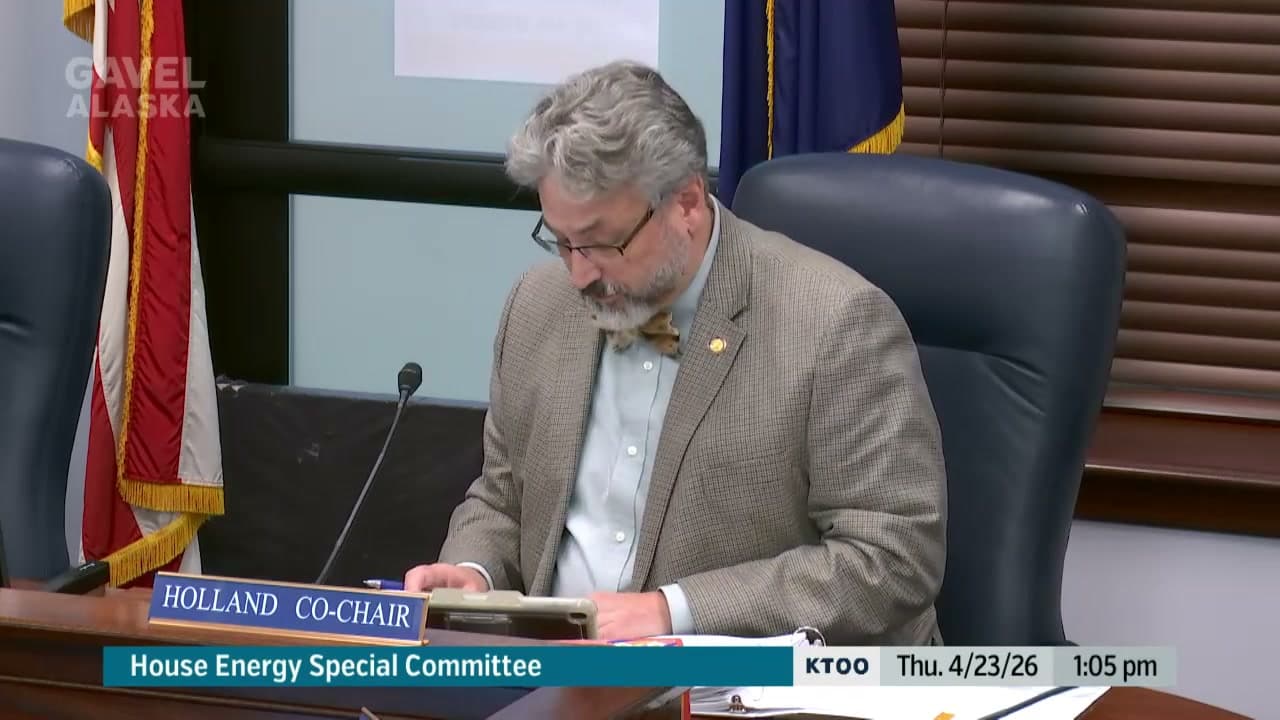
Alaska lawmakers hear warnings of rural fuel crisis, weigh loan program expansion
Alaska lawmakers heard stark warnings Wednesday about fuel supply challenges facing rural communities, with officials describing potential shortages and price increases that could reach catastrophic levels.
The House Energy Special Committee convened fuel suppliers, utility operators, and state officials to assess the crisis. Testimony painted a picture of communities already paying up to $17 per gallon for diesel fuel, with prices expected to climb 30 to 50 percent higher this year.
The fuel crisis stems from the U.S.-Iran conflict that began in late February, which has driven gasoline prices nationwide sharply higher. Voluntary export controls in Japan and South Korea have introduced significant uncertainty into fuel availability for Western Alaska, cutting off traditional supply sources from South Korean refineries.
Nils Andreassen, executive director of the Alaska Municipal League, told lawmakers the state faces both a price problem and an availability problem. The difference matters because higher costs strain budgets while fuel shortages threaten basic services.
"The larger issue is whether fuel will be available at all," Andreassen said.
Mike Poston, director of sales at Vitus Energy, explained that traditional fuel sources from South Korean refineries have been cut off due to Middle East supply disruptions. Those countries are implementing rations or prohibiting or limiting exports, making the most economical supply of product no longer available. His company now must source fuel from farther away, increasing both transportation costs and delivery times.
Vitus typically begins taking village fuel orders in January and contracts with refineries by February. This year, the company has bid unsuccessfully on some fuel supplies. Poston said the company believes it will have to continue bidding higher until successful. The heavy supply push will come probably sometime in June or late June or early July. That compressed timeline leaves little margin for weather delays or other disruptions.
Poston warned that communities without funds available when fuel arrives may not receive deliveries. At current fuel values, Vitus cannot extend credit.
"We can't be the bank," he said.
If more than a couple of villages need fuel flown in, Poston said, the infrastructure to do that does not exist in Alaska. He noted that Noatak, not far from Kotzebue but with a river that is not navigable, must fly in fuel at a current price of $17 per gallon.
Dr. Gwen Holdmann, chief scientist at the Alaska Center for Energy and Power, presented analysis showing rural Alaska consumes roughly 90 to 100 million gallons of liquid fuel annually. A five-dollar-per-gallon increase would add $450 million in costs across the state. Even a one-dollar increase translates to $100 million.
Holdmann noted that only about 25 to 30 percent of electricity sales in rural Alaska qualify for Power Cost Equalization subsidies. The remaining two-thirds of users will absorb fuel price increases without state assistance.
Tom Atkinson, chief executive of Kotzebue Electric Association, said his utility paid $3.10 per gallon for diesel last year. Current quotes stand at $4.76 per gallon, a 53 percent increase. That would push the utility's annual fuel cost from $4 million to $6 million.
"It's really hard to look at a 53 percent increase and go ahead and purchase fuel at that price," Atkinson said. "It puts all of us in a very hard position."
Kotzebue generates 30 percent of its electricity from renewable sources but remains dependent on diesel.
Sandra Moller, director of the Division of Community and Regional Affairs, outlined the state's Bulk Fuel Revolving Loan Fund as a primary tool to help communities purchase fuel. The program has $20 to $22 million available and maintains a near-100 percent repayment rate.
The fund serves communities under 2,000 population and caps individual loans at $750,000. Moller said the average loan is $360,000, though five borrowers took the maximum amount last year. The division had 76 loans to 51 communities in 2025.
Moller presented scenarios showing the fund may need double its current capitalization if fuel prices increase by three dollars per gallon and more communities seek loans. Raising the loan cap or expanding eligibility would require additional funding. For one community the division reached out to in preparing for the presentation, Moller said, they will have to find $1.2 million more than they had last year. They are already accessing the bulk fuel fund at the cap.
"My biggest concern is the individual in any community being able to pay for that additional cost," Moller said. The loan program helps communities purchase fuel, but repayment depends on collecting fees from residents who may struggle to pay higher energy bills.
Representative Bryce Edgmon said the legislature has funded programs including Power Cost Equalization and the Alaska Heating Assistance Program, which received $17.5 million this session. But he warned state action alone cannot prevent the worst outcomes.
"No matter how much we can do, the levers we could pull, the programs we can fund, we're not going to be able to meet this thing head-on if the worst outcome materializes," Edgmon said.
Andreassen recommended several state actions, including extending a Jones Act waiver set to expire in May, increasing the bulk fuel loan cap to $1.5 million, and designating a state coordinator to help communities navigate the crisis. He urged communities to order fuel early rather than wait for better prices.
Poston said a Jones Act extension through November is critical. Without it, fuel purchased on foreign-flagged vessels under the current waiver would have to be exported if it arrives after the waiver expires.
The committee did not take action Wednesday. Co-chair Chuck Kopp said lawmakers have roughly 30 days remaining in the session to address the crisis.
The hearing included discussion of longer-term solutions, including regional fuel purchasing cooperatives and increased Alaska refinery capacity. Representative Donna Mears noted that Marathon's Kenai refinery operates near capacity producing jet fuel, leaving limited production for other fuel types.
Moller said any changes to the bulk fuel loan program would require legislative action. Raising the loan cap or expanding eligibility are both set in statute. Additional capitalization would likely come through capital budget appropriations.
The division also administers fuel price surveys twice yearly and provides training through the Rural Alaska Fuel Administration program. The most recent survey, completed in January, showed average prices of $6.63 per gallon for gasoline and $6.32 for heating fuel across 100 communities.
Those prices reflect a three-dollar increase from the previous year and do not account for expected increases from this summer's fuel deliveries.
This article is based on a public meeting — Alaska Legislature: House Energy, 4/23/26, 1pm ().
AI-assisted. How we use AI Transcript byLucas Brown
Stay informed. Support what matters.
Free, permanent access to local news you can verify. Subscribe to support Alaska News and go ad-free.
Related Coverage
Alaska House panel considers doubling bulk fuel loan cap amid price crisis
Alaska News · 4mo ago
Rural Alaska faces fuel crisis as prices surge, shortages loom
Alaska News · 4mo ago
Rural Alaska fuel prices could hit $25/gallon, lawmaker warns
Alaska News · 4mo ago
Alaska House doubles bulk fuel loan cap to $1.5 million
Alaska News · 4mo ago
Senate Finance reviews bill to double bulk fuel loan cap to $1.5M
Alaska News · 4mo ago
Comments
Sign in to leave a comment.
No comments yet. Be the first to share your thoughts.